















USA Virtual Reality Games Market Outlook to 2030
Region:North America
Author(s):Yogita Sahu
Product Code:KROD4580
October 2024
97
About the Report
USA Virtual Reality Games Market Overview
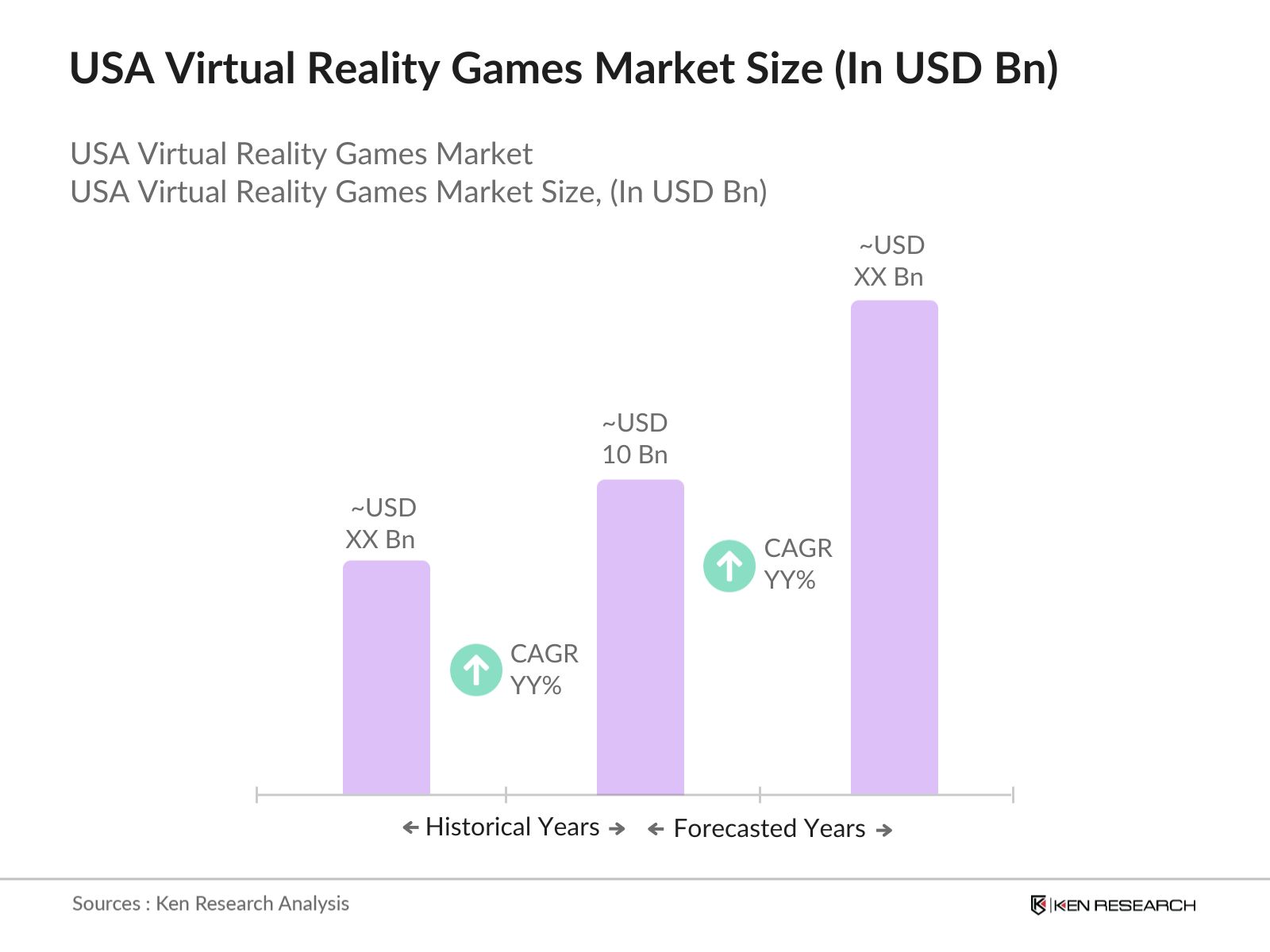
- The USA Virtual Reality (VR) Games market is valued at USD 10 billion, based on a five-year historical analysis. This market size is driven by a combination of factors, including advancements in VR hardware, especially headsets like Meta's Oculus and Sony's PlayStation VR, and the growing consumer demand for immersive entertainment experiences. The popularity of VR content among gaming enthusiasts and the integration of high-speed internet infrastructure have further fueled the markets growth, allowing seamless and interactive gaming experiences.
- The USA is a leading region in the market due to the concentration of global tech hubs and game development studios. Cities like San Francisco and Seattle dominate this market because of their rich ecosystem of VR developers, gaming companies, and proximity to technology giants. Furthermore, Silicon Valley's heavy investment in innovation and high consumer demand in urban areas, with better access to VR hardware and infrastructure, plays a key role in cementing the dominance of these regions.
- In 2024, the U.S. Department of Education launched a $1 billion initiative to integrate VR technology into education and training programs. This initiative has paved the way for VR gaming applications to be utilized in serious games aimed at training students in science, technology, engineering, and mathematics (STEM) disciplines. As a result, the VR gaming market has benefited from additional government support and cross-industry applications of the technology.
USA Virtual Reality Games Market Segmentation
By Platform: The market is segmented by platform into PC VR, Console VR, and Mobile VR. PC VR holds a dominant market share due to its capability of delivering high-end graphics, seamless gameplay, and compatibility with advanced VR hardware like the Valve Index and Oculus Rift. PC gaming enthusiasts tend to invest in more powerful gaming setups, which naturally extends to VR adoption. Additionally, the widespread use of Steam VR further cements PC VR's leading position in the market.

By Game Type: The market is also segmented by game type into Action, Simulation, Role-Playing, Adventure, and Puzzle/Strategy. Action games lead the market, driven by the immersive nature of VR, which enhances the experience of fast-paced gameplay and interactive environments. Popular VR action games such as Half-Life: Alyx and Beat Saber attract a large user base due to their high level of interactivity and detailed virtual environments that take advantage of VR technologys immersive capabilities.

USA Virtual Reality Games Market Competitive Landscape
The market is dominated by a mix of large tech corporations and innovative game development companies. Major players include global tech giants with extensive resources for R&D, as well as smaller companies that focus on niche VR game development. Metas Oculus and Sonys PlayStation VR are key contributors due to their hardware ecosystems and content platforms.
|
Company |
Established |
Headquarters |
Platform Focus |
Revenue (USD bn) |
No. of VR Titles |
Hardware Ecosystem |
Partnerships |
VR Game Engine |
Investment in R&D |
|
Meta Platforms (Oculus) |
2004 |
Menlo Park, CA |
|||||||
|
Sony Interactive (PS VR) |
1946 |
Tokyo, Japan |
|||||||
|
Valve Corporation (Index) |
1996 |
Bellevue, WA |
|||||||
|
HTC Corporation (Vive) |
1997 |
Taoyuan City, Taiwan |
|||||||
|
Survios, Inc. |
2013 |
Los Angeles, CA |
USA Virtual Reality Games Market Analysis
Market Growth Drivers
- Increase in Internet Infrastructure: The expansion of high-speed internet in the U.S. is fueled by a $1.2 trillion federal investment, leading to a record 9 million fiber-to-the-home connections in 2023. By 2024, projections indicate an additional 12 million homes will gain fiber access, enhancing broadband penetration and supporting economic growth through increased online business activities and job creation.
- Surge in Investments from the Gaming Industry: U.S. tech and gaming companies are heavily investing in virtual reality technology. In 2024, over $1 billion was invested in VR game development, primarily by industry leaders like Microsoft, Meta, and smaller startups. These investments have led to improvements in VR game graphics, hardware, and interactivity, making it more appealing to both developers and consumers. This investment trend is expected to continue as companies race to dominate the VR gaming space.
- Growth of eSports Integration: The rise of competitive gaming and eSports has also positively impacted the market. In 2024, there are over 250 eSports tournaments that incorporate VR titles, attracting thousands of players and millions of viewers. This integration is increasing the visibility of VR games, making them a central part of competitive gaming culture. The growth of VR in eSports is bringing new revenue streams to developers and increasing market demand for advanced VR gaming technologies.
Market Challenges
- Content Fragmentation Across Platforms: The VR gaming market suffers from content fragmentation, where specific games are exclusive to certain VR platforms. In 2024, over 60% of VR games are exclusive to one platform (such as PlayStation VR or Meta Quest), which frustrates consumers who are unwilling to buy multiple hardware systems to access their desired content. This lack of cross-platform compatibility is a barrier to mass adoption, as it limits the consumer base for each game.
- Shortage of Skilled VR Developers: The U.S. VR gaming industry is currently experiencing a shortage of skilled developers proficient in creating VR content. In 2024, there are fewer than 10,000 qualified VR developers working in the gaming industry, while demand for VR content creation far exceeds this number. This shortage is delaying the development of new titles and features, impacting the industrys capacity to expand its content library and innovate rapidly.
USA Virtual Reality Games Market Future Outlook
Over the next five years, the USA VR Games industry is expected to show growth, driven by advancements in VR hardware technology, increasing consumer demand for immersive experiences, and the expansion of high-speed internet connectivity. Furthermore, as VR gaming becomes more accessible with affordable hardware options and an expanding library of games, more casual gamers are likely to adopt the platform.
Future Market Opportunities
- Increased Use of Haptic Feedback in VR Games: Over the next five years, VR games in the U.S. will incorporate more sophisticated haptic feedback technology. Companies are expected to develop wearables that simulate touch, pressure, and temperature changes during gameplay. By 2029, these advancements will create more immersive gaming experiences, attracting a broader audience and significantly enhancing user engagement. Haptic technology will be a key differentiator for VR games in the coming years.
- Cloud-Based VR Gaming Platforms: Over the next five years, cloud-based VR gaming is expected to revolutionize the market by removing hardware barriers. Cloud gaming services will allow players to stream VR games directly to their devices without requiring high-end computers or consoles. By 2029, cloud-based VR gaming services are expected to be available to over 100 million users in the U.S., lowering the cost of entry into the VR gaming space.
Scope of the Report
|
By Game Type |
Action Simulation Role-Playing Adventure Puzzle/Strategy |
|
By Platform |
PC VR Console VR Mobile VR |
|
By Distribution Channel |
Online Offline |
|
By End-User |
Casual Gamers Hardcore Gamers Enterprise Users (Training, Simulation) |
|
By Region |
North East West South |
Products
Key Target Audience Organizations and Entities Who Can Benefit by Subscribing This Report:
VR Hardware Manufacturers
Entertainment & Media Companies
Investment and Venture Capital Firms
Government and Regulatory Bodies (e.g., Federal Communications Commission)
Cloud and Streaming Services Providers
Banks and Financial Institutions
Private Equity Firms
Companies
Players Mentioned in the Report:
Meta Platforms (Oculus)
Sony Interactive Entertainment (PlayStation VR)
HTC Corporation (Vive)
Valve Corporation (Index)
Survios, Inc.
Google LLC (Daydream)
Samsung Electronics (Gear VR)
Microsoft Corporation (Mixed Reality)
Epic Games (Unreal Engine)
Unity Technologies (Unity Engine)
NVIDIA Corporation (Graphics Processing)
Magic Leap, Inc.
ILMxLAB
Superhot Team
Qualcomm Technologies (Snapdragon VR)
Table of Contents
1. USA Virtual Reality Games Market Overview
1.1. Definition and Scope
1.2. Market Taxonomy
1.3. Market Growth Rate
1.4. Market Segmentation Overview
2. USA Virtual Reality Games Market Size (In USD Bn)
2.1. Historical Market Size
2.2. Year-on-Year Growth Analysis
2.3. Key Market Developments and Milestones
3. USA Virtual Reality Games Market Analysis
3.1. Growth Drivers
3.1.1. Increasing Consumer Demand for Immersive Experiences
3.1.2. Rising Adoption of VR Hardware (Head-Mounted Displays, Motion Controllers)
3.1.3. Expansion of High-Speed Internet Infrastructure
3.1.4. Technological Advancements in VR Content Development
3.2. Market Challenges
3.2.1. High Development Costs for AAA VR Games
3.2.2. Limited Adoption Due to Motion Sickness and Health Concerns
3.2.3. Fragmentation of VR Platforms (PC, Console, Mobile)
3.3. Opportunities
3.3.1. Growth in VR Arcades and Location-Based Entertainment
3.3.2. Expansion into Educational and Training Simulations
3.3.3. Collaboration with Movie Studios and Streaming Platforms
3.4. Trends
3.4.1. Integration with Social Gaming Networks
3.4.2. Advancements in Haptic Feedback and Sensory Input Devices
3.4.3. Growth in Multiplayer and Esports VR Games
3.5. Government Regulation
3.5.1. Data Privacy Regulations (GDPR, CCPA Compliance)
3.5.2. Health and Safety Standards for VR Devices
3.5.3. Content Rating Systems for VR Games
3.6. SWOT Analysis
3.7. Stakeholder Ecosystem (Developers, Publishers, Hardware Manufacturers, Service Providers)
3.8. Porters Five Forces
3.9. Competition Ecosystem
4. USA Virtual Reality Games Market Segmentation
4.1. By Game Type (In Value %)
4.1.1. Action
4.1.2. Simulation
4.1.3. Role-Playing
4.1.4. Adventure
4.1.5. Puzzle/Strategy
4.2. By Platform (In Value %)
4.2.1. PC VR
4.2.2. Console VR
4.2.3. Mobile VR
4.3. By Distribution Channel (In Value %)
4.3.1. Online (Digital Platforms, Subscription Services)
4.3.2. Offline (Retail Stores, VR Arcades)
4.4. By End-User (In Value %)
4.4.1. Casual Gamers
4.4.2. Hardcore Gamers
4.4.3. Enterprise Users (Training, Simulation)
4.5. By Region (In Value %)
4.5.1. North
4.5.2. West
4.5.3. East
4.5.4. South
5. USA Virtual Reality Games Market Competitive Analysis
5.1. Detailed Profiles of Major Companies
5.1.1. Meta Platforms (Oculus)
5.1.2. Sony Interactive Entertainment (PlayStation VR)
5.1.3. HTC Corporation (Vive)
5.1.4. Microsoft Corporation (Mixed Reality)
5.1.5. Valve Corporation (Index)
5.1.6. Samsung Electronics (Gear VR)
5.1.7. Google LLC (Daydream)
5.1.8. Unity Technologies (Game Engine)
5.1.9. Epic Games (Unreal Engine)
5.1.10. Qualcomm Technologies (Snapdragon VR)
5.1.11. NVIDIA Corporation (Graphics Processing)
5.1.12. Magic Leap, Inc.
5.1.13. Survios, Inc.
5.1.14. ILMxLAB
5.1.15. Superhot Team
5.2. Cross Comparison Parameters (No. of Employees, Headquarters, Revenue, Game Titles, Platform Reach, In-House VR Technology, Distribution Partnerships, Investment in R&D)
5.3. Market Share Analysis
5.4. Strategic Initiatives (Partnerships, Product Launches, New Market Entries)
5.5. Mergers and Acquisitions
5.6. Investment Analysis
5.7. Venture Capital Funding
5.8. Government Grants
5.9. Private Equity Investments
6. USA Virtual Reality Games Market Regulatory Framework
6.1. Data Privacy and Security Standards
6.2. Content Regulations (Violence, Accessibility)
6.3. Health and Safety Compliance
7. USA Virtual Reality Games Future Market Size (In USD Bn)
7.1. Future Market Size Projections
7.2. Key Factors Driving Future Market Growth
8. USA Virtual Reality Games Future Market Segmentation
8.1. By Game Type (In Value %)
8.2. By Platform (In Value %)
8.3. By Distribution Channel (In Value %)
8.4. By End-User (In Value %)
8.5. By Region (In Value %)
9. USA Virtual Reality Games Market Analysts' Recommendations
9.1. TAM/SAM/SOM Analysis
9.2. Customer Persona and Cohort Analysis
9.3. Go-to-Market Strategies
9.4. White Space Opportunity Analysis
Research Methodology
Step 1: Identification of Key Variables
The initial phase of the research involves constructing a comprehensive ecosystem map for the USA Virtual Reality Games Market. This step is carried out through extensive desk research, utilizing a blend of secondary databases and proprietary market data. The main objective is to identify critical variables like market drivers, growth inhibitors, and key segments that define the market's competitive dynamics.
Step 2: Market Analysis and Construction
In this stage, we compile and analyze historical data related to market penetration, platform adoption rates, and revenue generation from both digital and physical VR games. Additionally, service quality statistics such as consumer satisfaction and retention rates are examined to ensure accurate market estimations.
Step 3: Hypothesis Validation and Expert Consultation
Market hypotheses are formed and then validated through computer-assisted interviews with industry experts from top VR game development companies and hardware manufacturers. These insights are instrumental in refining market projections and understanding the evolving market landscape.
Step 4: Research Synthesis and Final Output
The final phase includes interactions with key VR game publishers to gain detailed insights into their product portfolios, distribution channels, and consumer trends. This bottom-up research approach ensures the final report provides a robust, well-validated analysis of the USA VR Games market.
Frequently Asked Questions
01 How big is the USA Virtual Reality Games Market?
The USA VR Games market was valued at USD 10 billion in 2023, driven by advancements in VR hardware, increasing consumer demand, and the expansion of digital gaming platforms.
02 What are the challenges in the USA VR Games Market?
Challenges in the USA VR Games market include high development costs for VR games, platform fragmentation, and the limited adoption of VR due to issues like motion sickness and health concerns related to extended use.
03 Who are the major players in the USA Virtual Reality Games Market?
Key players in the USA VR Games market include Meta Platforms (Oculus), Sony Interactive Entertainment (PlayStation VR), HTC Corporation (Vive), Valve Corporation (Index), and Survios, Inc., which dominate through strong platform ecosystems and game development capabilities.
04 What are the growth drivers of the USA VR Games Market?
Growth drivers in the USA VR Games market include technological advancements in VR hardware, increased internet speeds, and rising consumer demand for immersive gaming experiences. The growing investment in esports and social VR platforms also contributes to market expansion.
05 Which segment dominates the USA VR Games Market?
The PC VR segment dominates the USA VR Games market due to its superior graphics, processing power, and compatibility with high-end VR headsets.
Why Buy From Us?

What makes us stand out is that our consultants follows Robust, Refine and Result (RRR) methodology. i.e. Robust for clear definitions, approaches and sanity checking, Refine for differentiating respondents facts and opinions and Result for presenting data with story

We have set a benchmark in the industry by offering our clients with syndicated and customized market research reports featuring coverage of entire market as well as meticulous research and analyst insights.

While we don't replace traditional research, we flip the method upside down. Our dual approach of Top Bottom & Bottom Top ensures quality deliverable by not just verifying company fundamentals but also looking at the sector and macroeconomic factors.

With one step in the future, our research team constantly tries to show you the bigger picture. We help with some of the tough questions you may encounter along the way: How is the industry positioned? Best marketing channel? KPI's of competitors? By aligning every element, we help maximize success.

Our report gives you instant access to the answers and sources that other companies might choose to hide. We elaborate each steps of research methodology we have used and showcase you the sample size to earn your trust.

If you need any support, we are here! We pride ourselves on universe strength, data quality, and quick, friendly, and professional service.