















USA Voice And Speech Recognition Market Outlook to 2030
Region:North America
Author(s):Yogita Sahu
Product Code:KROD6549
November 2024
81
About the Report
USA Voice and Speech Recognition Market Overview
- The USA Voice and Speech Recognition market is valued at USD 13.6 billion, driven by increasing demand for voice-activated solutions across industries such as healthcare, automotive, and consumer electronics. The rise of artificial intelligence (AI) and machine learning (ML) technologies, coupled with the growing reliance on contactless operations due to the pandemic, has significantly boosted the adoption of voice and speech recognition systems.

- Major cities such as San Francisco, New York, and Seattle dominate the market. These cities have become hubs for tech innovation, with a high concentration of companies developing and implementing advanced voice recognition technologies. The strong presence of global technology leaders, along with robust infrastructure for AI research and development, allows these cities to maintain their market leadership.
- The U.S. governments 2023 National AI Strategy includes direct provisions aimed at fostering innovation in voice and speech recognition technologies. A notable $1 billion in federal funding has been allocated toward AI-driven speech recognition systems development. This funding supports research in areas such as healthcare, education, and defense, where speech recognition can offer substantial improvements in efficiency and security.
USA Voice and Speech Recognition Market Segmentation
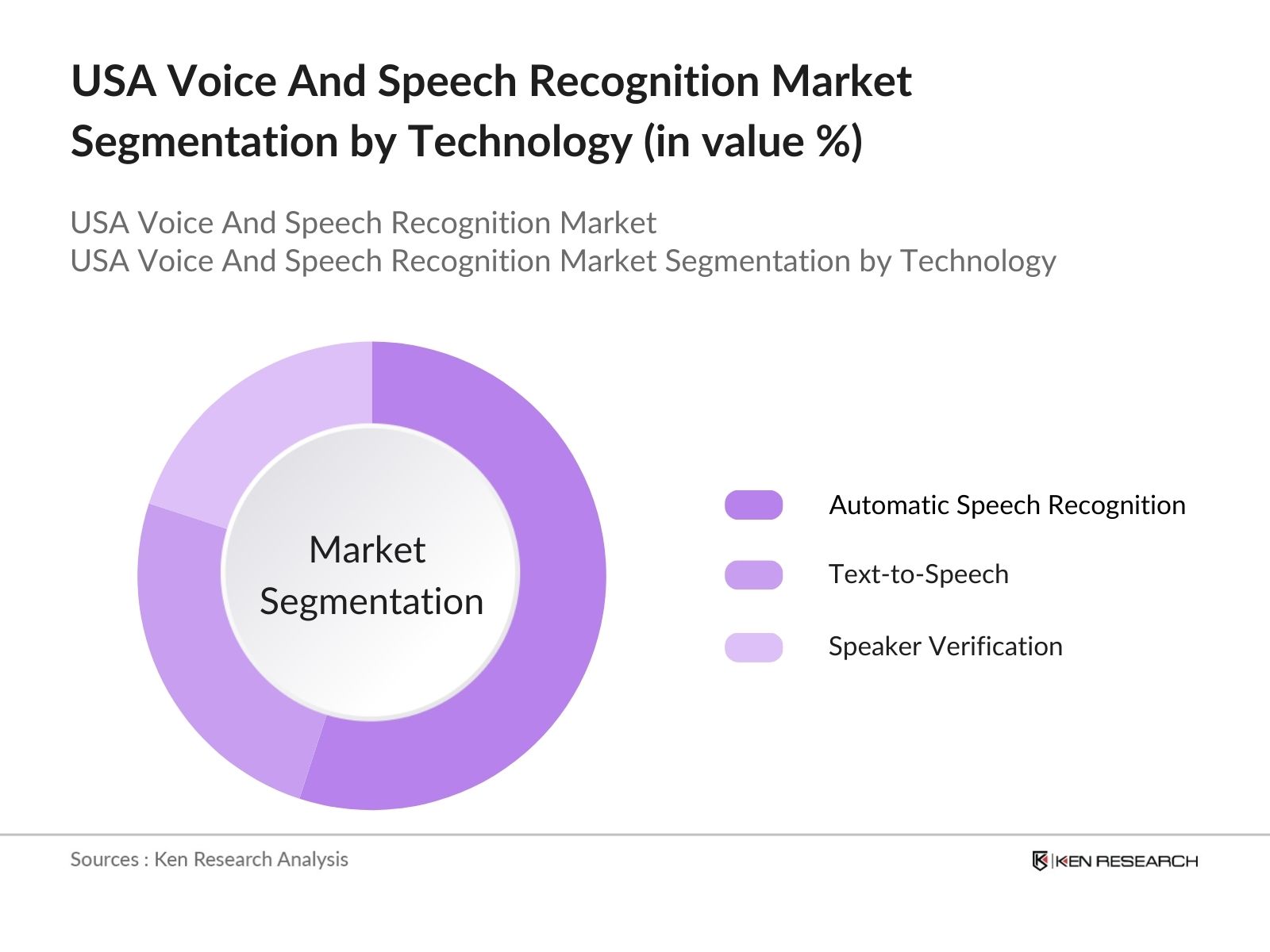
By Technology: The market is segmented by technology into Automatic Speech Recognition (ASR), Text-to-Speech (TTS), and Speaker Verification and Identification. Among these, Automatic Speech Recognition has a dominant market share due to its wide application across industries. ASR technology is extensively used in smart devices, virtual assistants, and customer service platforms, enabling users to interact with technology using natural speech.
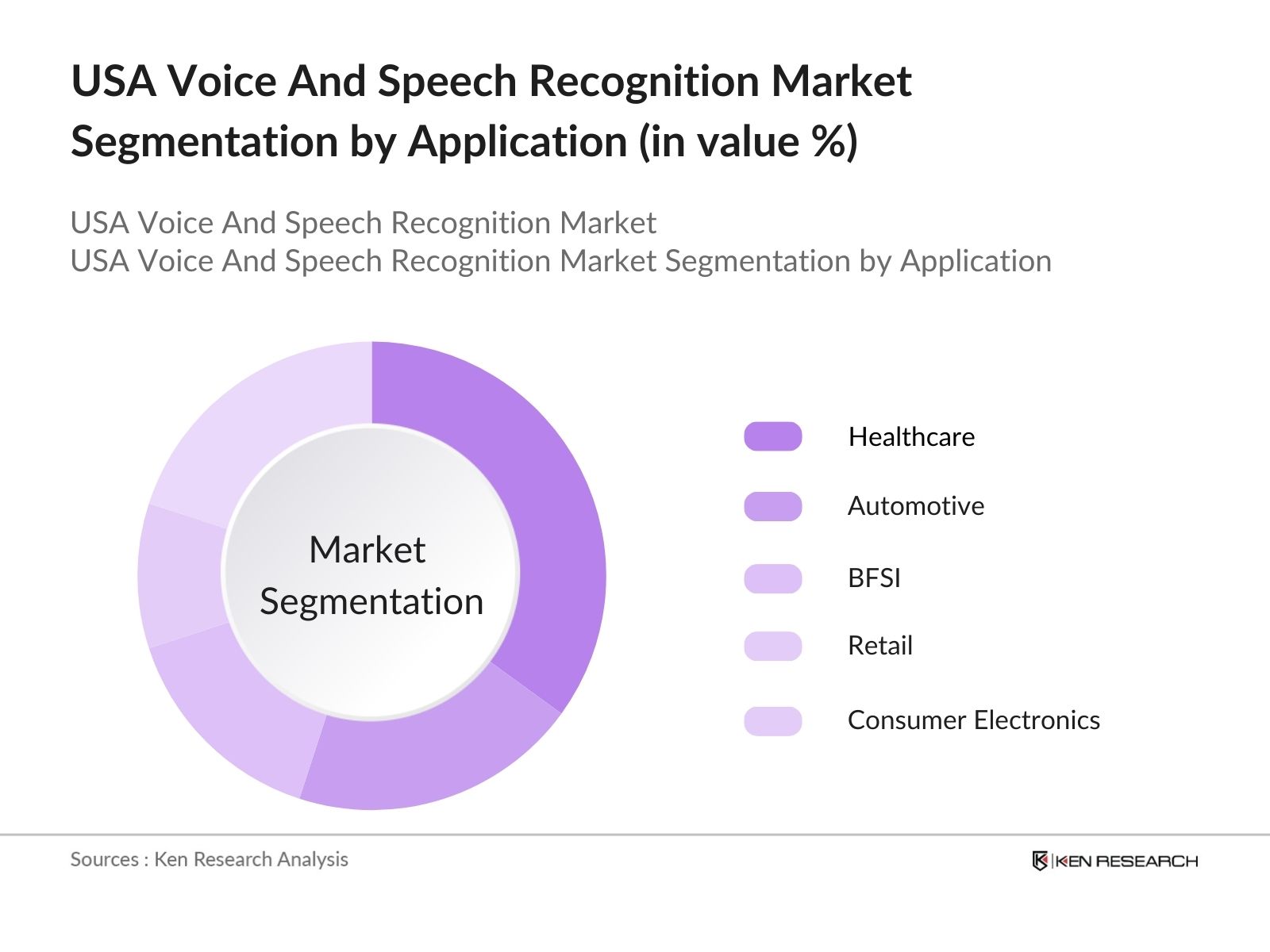
By Application: The market is segmented by application into Healthcare, Automotive, BFSI, Retail, and Consumer Electronics. The Healthcare sector holds the largest market share within this segmentation. The increasing demand for voice recognition technology in medical transcription, virtual assistants for elderly care, and telemedicine solutions has made healthcare the leading application area. Speech recognition technology in healthcare enhances the accuracy and efficiency of patient documentation, reduces administrative burdens, and improves patient care, which drives its widespread adoption.
USA Voice and Speech Recognition Market Competitive Landscape
The market is dominated by several key players, both domestic and global. These companies focus on expanding their AI capabilities, improving product accuracy, and scaling cloud-based solutions. The competitive landscape is characterized by high research and development investments, a strong focus on patent portfolios, and increasing strategic partnerships for enhancing technological reach.
|
Company Name |
Establishment Year |
Headquarters |
R&D Expenditure |
Patent Portfolio |
AI Infrastructure |
Product Innovation Rate |
Cloud Integration |
Global Market Share |
Customer Base Size |
|
Google LLC |
1998 |
Mountain View, CA |
|||||||
|
Apple Inc. |
1976 |
Cupertino, CA |
|||||||
|
Microsoft Corporation |
1975 |
Redmond, WA |
|||||||
|
Nuance Communications |
1992 |
Burlington, MA |
|||||||
|
Verint Systems |
1994 |
Melville, NY |
USA Voice and Speech Recognition Market Analysis
Market Growth Drivers
- Rising Adoption of Voice Biometrics in Financial Institutions: Voice biometrics has become a crucial component for identity verification in financial institutions, particularly in sectors like banking, insurance, and fintech. In 2024, over 1.2 billion voice authentication transactions were completed in the U.S. financial industry, according to a report by major industry players. Financial institutions are increasingly implementing these solutions to enhance security, reduce fraud, and ensure compliance with stringent regulations.
- Surge in Smart Home Devices with Voice Integration: The smart home device market in the USA continues to grow exponentially, with over 150 million devices such as smart speakers, thermostats, and lighting systems utilizing voice assistants by mid-2024. Consumers are turning towards voice-controlled devices for convenience and better user experiences. This shift drives the demand for improved voice recognition technologies capable of understanding various accents, dialects, and user-specific nuances, with notable investments coming from tech giants developing AI-based speech recognition modules.
- Increased Application in Healthcare for Transcription Services: The U.S. healthcare industry increasingly relies on voice and speech recognition technology for transcription services and administrative tasks. More than 3 million healthcare professionals across hospitals and clinics have adopted AI-driven voice recognition platforms for faster and more accurate patient documentation. This adoption is driven by the need to reduce human errors in patient data entry and streamline administrative workflows, reducing the time physicians spend on clerical tasks, thus allowing them more time for patient care.
Market Challenges
- Privacy Concerns and Data Security Issues: Voice and speech recognition technologies raise substantial privacy and data security concerns. In 2024, it was reported that over 50 million smart home users expressed concerns about their conversations being recorded and misused. High-profile data breaches in the tech industry have only heightened these worries.
- Technical Limitations in Noisy Environments: Another challenge impacting the market is the decreased accuracy of voice recognition systems in noisy or multi-speaker environments. Reports from testing facilities have shown that in environments with noise levels exceeding 75 dB, the error rate for speech recognition systems increased, with one major vendor reporting a 15% drop in recognition accuracy.
USA Voice and Speech Recognition Market Future Outlook
Over the next five years, the USA Voice and Speech Recognition industry is expected to witness growth driven by advancements in AI and NLP (Natural Language Processing) technologies, the increasing adoption of voice assistants, and a growing emphasis on automation in industries such as healthcare and BFSI.
Future Market Opportunities
- Growth in Voice-Controlled Automotive Interfaces: The automotive industry will continue to advance voice recognition technology for in-car control. By 2029, around 65 million vehicles in the U.S. are forecasted to have advanced voice-controlled systems that manage not only entertainment and navigation but also autonomous driving features, enhancing overall driving safety and experience.
- Enhanced Voice Security Protocols in Financial Services: The financial industry will see growth in the use of voice-based biometric authentication systems. By 2029, nearly 20 million banking customers are expected to rely on voice authentication for secure transactions, as the technology continues to improve and meet stringent regulatory requirements for fraud prevention and customer data protection.
Scope of the Report
|
By Technology |
Automatic Speech Recognition Text-to-Speech Speaker Verification and Identification |
|
By Deployment Mode |
Cloud-Based On-Premise |
|
By Application |
Healthcare Automotive BFSI Retail Consumer Electronics |
|
By End-User |
Enterprises Individual Consumers |
|
By Region |
Nort East South West |
Products
Key Target Audience Organizations and Entities Who Can Benefit by Subscribing This Report:
AI Technology Providers
Voice Recognition Hardware Manufacturers
Banks and Financial Institution
Automotive Manufacturers
Consumer Electronics Manufacturers
Investor and Venture Capitalist Firms
Government and Regulatory Bodies (FCC, National Institute of Standards and Technology)
Private Equity Firms
Companies
Players Mentioned in the Report:
Apple Inc.
Google LLC
Microsoft Corporation
Nuance Communications
Verint Systems
Amazon.com, Inc.
IBM Corporation
Baidu, Inc.
Sensory, Inc.
SoundHound Inc.
Table of Contents
1. USA Voice and Speech Recognition Market Overview
1.1. Definition and Scope
1.2. Market Taxonomy
1.3. Market Growth Rate
1.4. Market Segmentation Overview
2. USA Voice and Speech Recognition Market Size (In USD Bn)
2.1. Historical Market Size
2.2. Year-On-Year Growth Analysis
2.3. Key Market Developments and Milestones
3. USA Voice and Speech Recognition Market Analysis
3.1. Growth Drivers
3.1.1. Rising Adoption of AI and Machine Learning (Technology Penetration)
3.1.2. Increasing Use in Healthcare and Automotive Sectors (Application Penetration)
3.1.3. Government Initiatives for Digital Transformation (Policy Impact)
3.1.4. Growing Voice Commerce (Industry Trend)
3.2. Market Challenges
3.2.1. Data Privacy and Security Concerns (Regulatory Risk)
3.2.2. Speech Recognition Accuracy in Accented Speech (Technology Limitation)
3.2.3. High Integration Costs (Cost Sensitivity)
3.3. Opportunities
3.3.1. Expansion into New Use Cases (Market Expansion)
3.3.2. Innovations in Natural Language Processing (NLP Integration)
3.3.3. Increasing Demand for Contactless Solutions (Post-COVID Shift)
3.4. Trends
3.4.1. Voice Biometrics Adoption (Security Feature Penetration)
3.4.2. Voice-Activated Consumer Devices Growth (Smart Device Penetration)
3.4.3. Integration with Virtual Assistants (AI Integration)
3.5. Government Regulation
3.5.1. U.S. Data Protection Laws (HIPAA, CCPA)
3.5.2. Voice Data Privacy Regulations (GDPR Influence)
3.5.3. Accessibility Regulations (Section 508 Compliance)
3.6. SWOT Analysis
3.6.1. Strengths
3.6.2. Weaknesses
3.6.3. Opportunities
3.6.4. Threats
3.7. Stakeholder Ecosystem
3.7.1. End-Users (Healthcare, Automotive, Consumer Electronics)
3.7.2. Technology Providers (AI, NLP)
3.7.3. Regulatory Bodies (Federal Agencies)
3.8. Porters Five Forces
3.8.1. Threat of New Entrants
3.8.2. Bargaining Power of Suppliers
3.8.3. Bargaining Power of Buyers
3.8.4. Threat of Substitutes
3.8.5. Industry Rivalry
3.9. Competition Ecosystem
4. USA Voice and Speech Recognition Market Segmentation
4.1. By Technology (In Value %)
4.1.1. Automatic Speech Recognition (ASR)
4.1.2. Text-to-Speech (TTS)
4.1.3. Speaker Verification and Identification
4.2. By Deployment Mode (In Value %)
4.2.1. Cloud-Based
4.2.2. On-Premise
4.3. By Application (In Value %)
4.3.1. Healthcare
4.3.2. Automotive
4.3.3. BFSI
4.3.4. Retail
4.3.5. Consumer Electronics
4.4. By End-User (In Value %)
4.4.1. Enterprises
4.4.2. Individual Consumers
4.5. By Region (In Value %)
4.5.1. North
4.5.2. East
4.5.3. South
4.5.4. West
5. USA Voice and Speech Recognition Market Competitive Analysis
5.1. Detailed Profiles of Major Companies
5.1.1. Apple Inc.
5.1.2. Google LLC
5.1.3. Amazon.com, Inc.
5.1.4. Microsoft Corporation
5.1.5. IBM Corporation
5.1.6. Nuance Communications
5.1.7. Baidu, Inc.
5.1.8. Sensory, Inc.
5.1.9. Verint Systems
5.1.10. iFLYTEK Co., Ltd.
5.1.11. SoundHound Inc.
5.1.12. VoiceVault Inc.
5.1.13. LumenVox
5.1.14. Cantab Research Ltd. (Speechmatics)
5.1.15. OpenAI
5.2. Cross Comparison Parameters (R&D Expenditure, Patent Portfolio, AI Infrastructure, Product Innovation Rate, Global Market Share, Cloud Infrastructure, Integration Capability, AI Model Efficiency)
5.3. Market Share Analysis
5.4. Strategic Initiatives
5.5. Mergers And Acquisitions
5.6. Investment Analysis
5.7. Venture Capital Funding
5.8. Government Grants
5.9. Private Equity Investments
6. USA Voice and Speech Recognition Market Regulatory Framework
6.1. Data Privacy Standards (HIPAA, CCPA)
6.2. Compliance Requirements for Healthcare and BFSI
6.3. Certification Processes for Speech Recognition Systems
7. USA Voice and Speech Recognition Future Market Size (In USD Bn)
7.1. Future Market Size Projections
7.2. Key Factors Driving Future Market Growth
8. USA Voice and Speech Recognition Future Market Segmentation
8.1. By Technology (In Value %)
8.2. By Deployment Mode (In Value %)
8.3. By Application (In Value %)
8.4. By End-User (In Value %)
8.5. By Region (In Value %)
9. USA Voice and Speech Recognition Market Analysts Recommendations
9.1. TAM/SAM/SOM Analysis
9.2. Customer Cohort Analysis
9.3. Marketing Initiatives
9.4. White Space Opportunity Analysis
Research Methodology
Step 1: Identification of Key Variables
The initial phase involved mapping the entire USA Voice and Speech Recognition ecosystem, covering all key stakeholders such as hardware manufacturers, AI technology providers, and end-users. The primary goal was to identify critical variables that influence market dynamics, using a mix of secondary research and proprietary databases.
Step 2: Market Analysis and Construction
In this step, we compiled and analyzed data on historical market penetration and industry growth, assessing how technology and AI innovations contributed to revenue generation. This included analyzing the interplay between voice recognition technologies and their use across various industries.
Step 3: Hypothesis Validation and Expert Consultation
To validate market estimates, we conducted interviews with industry experts across leading companies. This step helped refine the research by providing direct insights into the operational and financial performance of major industry players.
Step 4: Research Synthesis and Final Output
The final step involved consolidating data from interviews and statistical models to develop a comprehensive analysis of the USA Voice and Speech Recognition market. This bottom-up approach ensured accurate insights into market trends, segment performances, and future projections.
Frequently Asked Questions
01. How big is the USA Voice and Speech Recognition Market?
The USA Voice and Speech Recognition market is valued at USD 13.6 billion, with growth driven by the increasing use of AI-powered voice assistants, contactless technologies, and widespread adoption across industries such as healthcare and consumer electronics.
02. What are the key challenges in the USA Voice and Speech Recognition Market?
Challenges in the USA Voice and Speech Recognition market include concerns over data privacy, the accuracy of speech recognition systems in handling diverse accents, and the high costs associated with integrating these technologies into enterprise systems.
03. Who are the major players in the USA Voice and Speech Recognition Market?
Major players in the USA Voice and Speech Recognition market include tech giants like Google, Apple, and Microsoft, along with specialized companies like Nuance Communications and Verint Systems. These companies dominate the market due to their strong AI capabilities and widespread adoption of their voice-activated solutions.
04. What are the growth drivers of the USA Voice and Speech Recognition Market?
Growth drivers in the USA Voice and Speech Recognition market include the increasing demand for contactless solutions post-COVID, advancements in AI and NLP technologies, and the growing integration of voice recognition in consumer electronics, healthcare, and automotive industries.
05. Which segment is dominant in the USA Voice and Speech Recognition Market?
The Automatic Speech Recognition (ASR) segment holds a dominant position, driven by its widespread use in voice-activated consumer devices and virtual assistants. ASRs ability to process natural speech and its integration across multiple industries contribute to its leadership.
Why Buy From Us?

What makes us stand out is that our consultants follows Robust, Refine and Result (RRR) methodology. i.e. Robust for clear definitions, approaches and sanity checking, Refine for differentiating respondents facts and opinions and Result for presenting data with story

We have set a benchmark in the industry by offering our clients with syndicated and customized market research reports featuring coverage of entire market as well as meticulous research and analyst insights.

While we don't replace traditional research, we flip the method upside down. Our dual approach of Top Bottom & Bottom Top ensures quality deliverable by not just verifying company fundamentals but also looking at the sector and macroeconomic factors.

With one step in the future, our research team constantly tries to show you the bigger picture. We help with some of the tough questions you may encounter along the way: How is the industry positioned? Best marketing channel? KPI's of competitors? By aligning every element, we help maximize success.

Our report gives you instant access to the answers and sources that other companies might choose to hide. We elaborate each steps of research methodology we have used and showcase you the sample size to earn your trust.

If you need any support, we are here! We pride ourselves on universe strength, data quality, and quick, friendly, and professional service.