















USA Voice Recognition Market Outlook to 2030
Region:North America
Author(s):Yogita Sahu
Product Code:KROD6491
December 2024
86
About the Report
USA Voice Recognition Market Overview
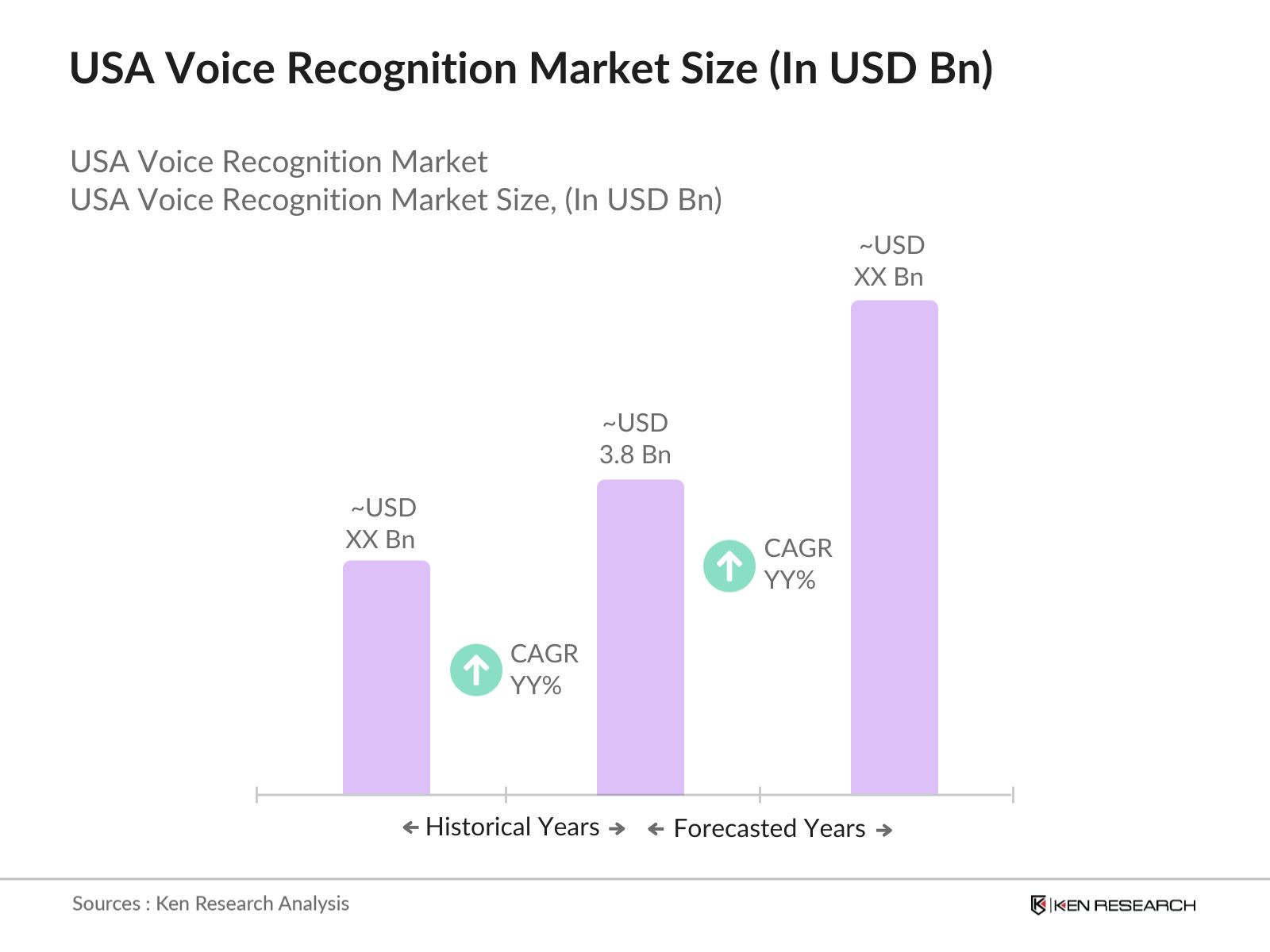
- The USA voice recognition market is valued at USD 3.8 billion, driven by the increasing adoption of AI-powered voice assistants and the integration of voice technology across industries such as automotive, healthcare, and consumer electronics. The rising demand for connected devices in smart homes, where voice commands are used to control lights, temperature, and other appliances, is further driving market growth. Additionally, voice recognition systems are gaining traction in healthcare, where they are utilized for clinical documentation and hands-free operations.
- In the USA, the cities driving this market include New York, San Francisco, and Seattle. These urban centers are home to leading technology companies, fostering innovation and partnerships within the voice recognition space. Additionally, these cities have a higher penetration of smart devices and a consumer base with higher disposable incomes, which accelerates the adoption of voice-enabled technologies.
- The US government is promoting the use of voice recognition technology in law enforcement agencies for criminal investigations and public safety initiatives. By 2024, federal and state-level agencies were using voice biometrics for identifying suspects in over 120,000 criminal cases. This initiative has streamlined case management and accelerated suspect identification in complex investigations, further encouraging the adoption of voice recognition technology in governmental functions.
USA Voice Recognition Market Segmentation
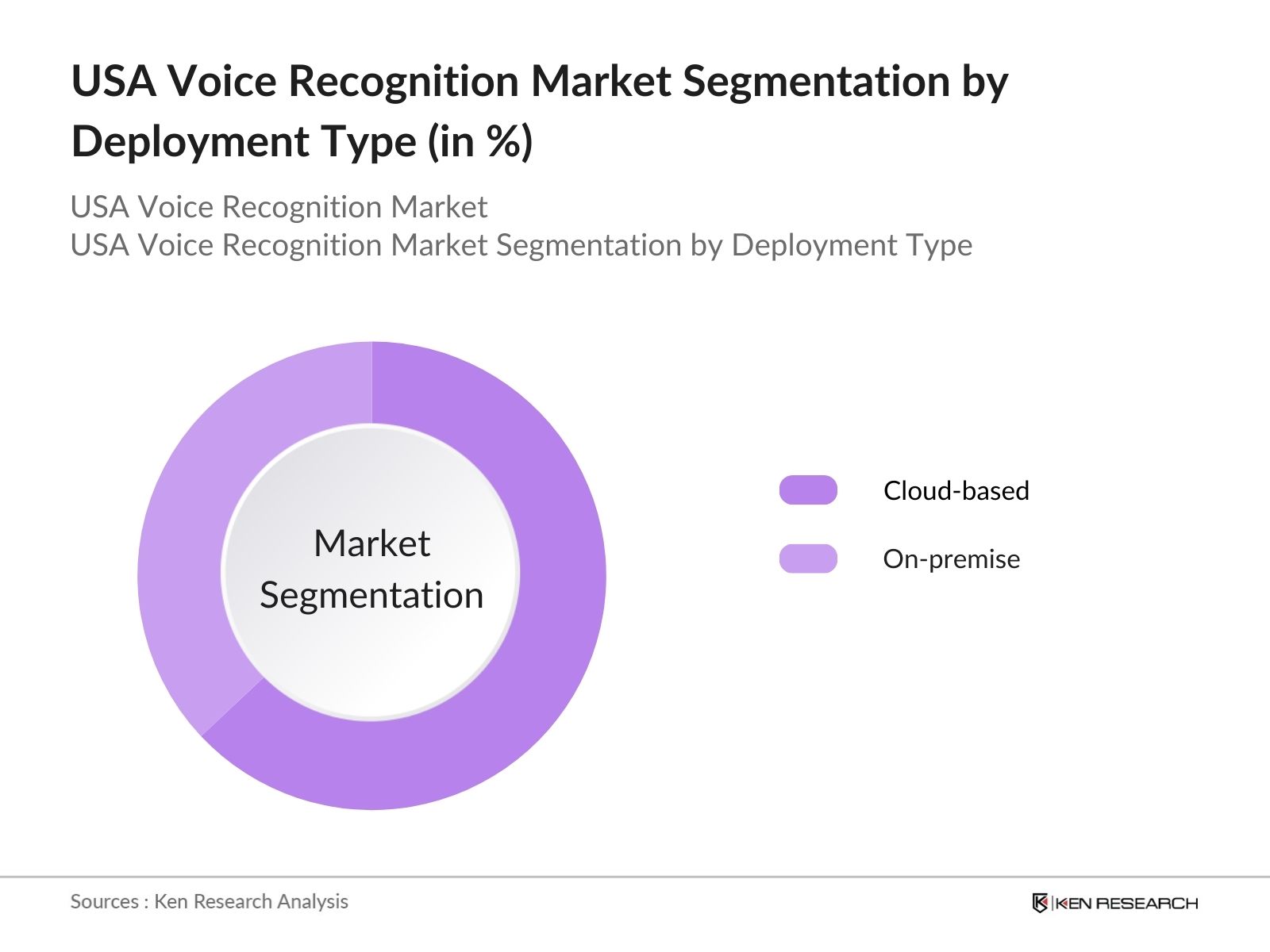
By Deployment Type: The market is segmented by deployment type into cloud-based and on-premise systems. Cloud-based systems hold a dominant share due to the ease of scalability and integration with AI-driven applications like virtual assistants and smart home systems. The rise in cloud adoption across industries for remote work and automation has propelled cloud-based voice recognition to the forefront. On-premise systems are preferred in sectors with stringent data security requirements, such as healthcare and government.
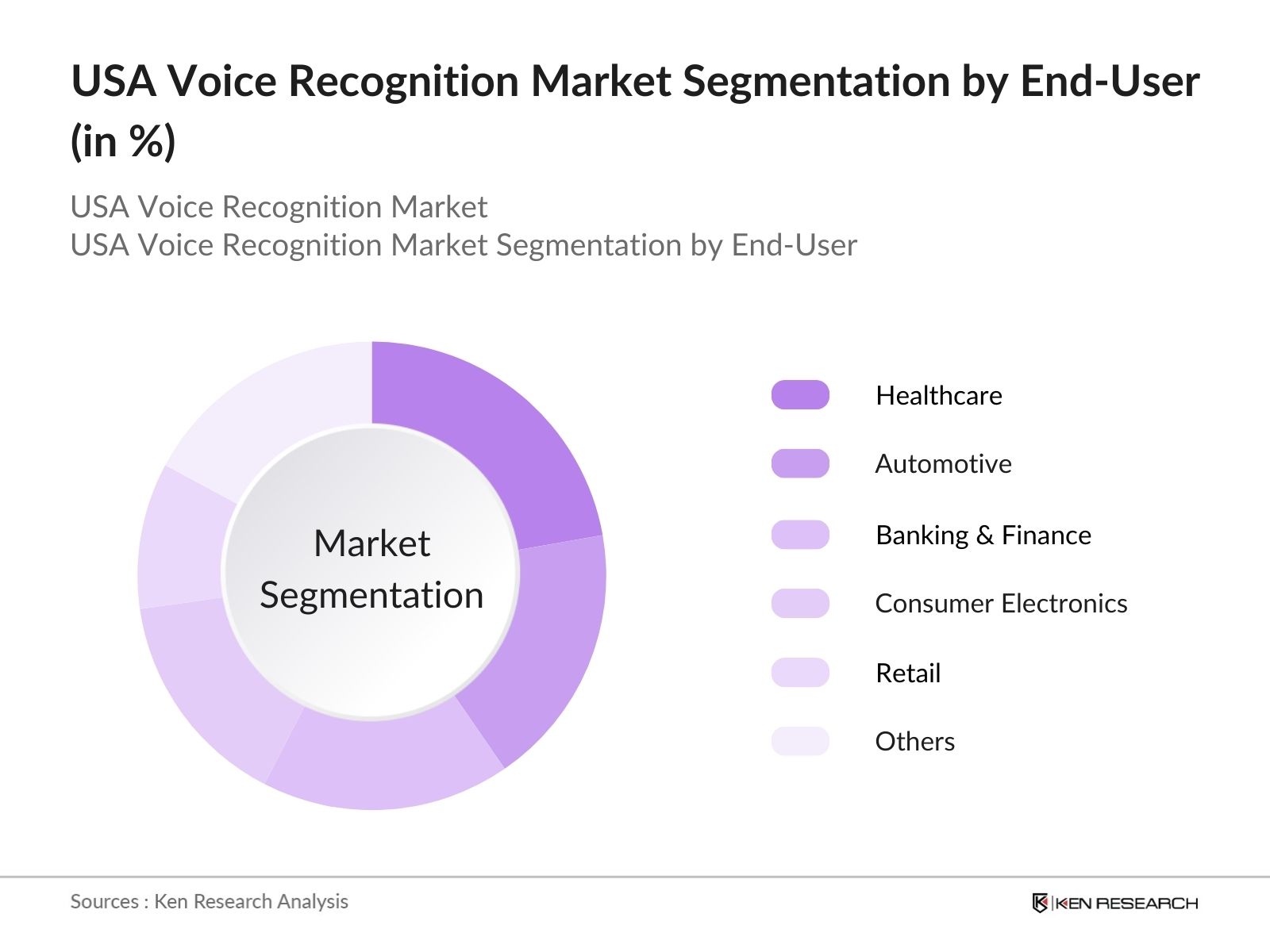
By End-User Industry: Voice recognition systems are extensively used across various industries such as automotive, healthcare, and consumer electronics. The automotive sector leads due to the increasing adoption of voice-controlled in-car systems like navigation, infotainment, and vehicle settings adjustment. Companies like Apple CarPlay and Amazon Echo Auto offer seamless voice integration, enhancing driver convenience and safety.
USA voice Recognition Market Competitive Landscape
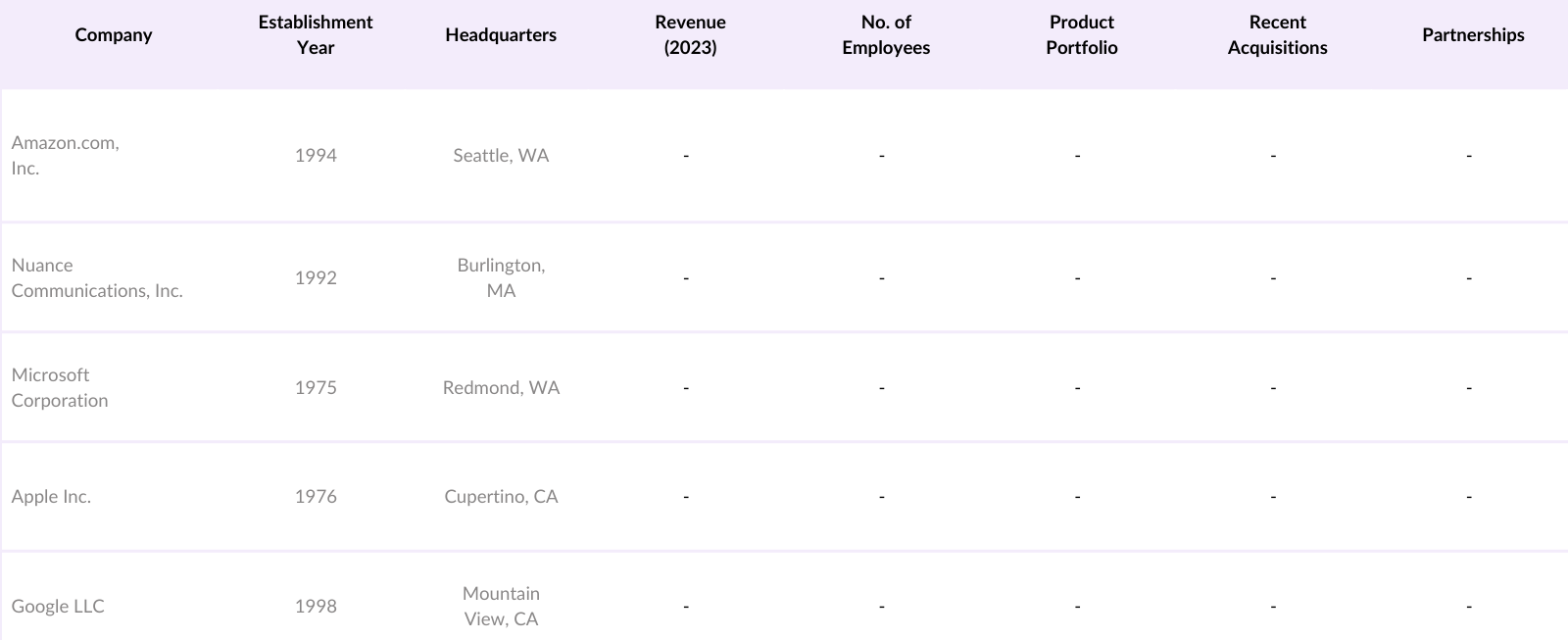
The market is dominated by global technology giants and specialized voice recognition firms. These players engage in continuous innovation to maintain their competitive advantage. Key companies include Amazon, which has pioneered smart home voice systems with Alexa, and Apple, whose Siri system is widely used across mobile devices and smart systems.
USA Voice Recognition Market Analysis
Market Growth Drivers
- Increased Adoption of Smart Devices: The integration of voice recognition technology into smart devices has been a key driver in the market. According to data from 2024, over 122 million smart speaker units have been deployed in the USA, creating a high demand for voice recognition capabilities. The penetration of these devices across households has fueled the demand for more accurate and advanced voice recognition systems that cater to everyday tasks, such as controlling home appliances, ordering goods, and managing schedules.
- Rising Usage of Voice Recognition in Healthcare: Voice recognition technology is increasingly being implemented in healthcare settings to improve patient data management and clinical workflow efficiency. In 2024, it was reported that around 72,000 healthcare providers in the USA had integrated voice-enabled Electronic Health Records (EHR) systems to enhance documentation accuracy. These systems allow physicians to dictate notes and navigate complex EHR systems using voice commands, reducing the time spent on manual data entry.
- Expansion in Automotive Industry Adoption: In the automotive industry, voice recognition is being adopted for hands-free controls and enhanced in-car experiences. As of 2024, over 38 million vehicles in the USA are equipped with voice recognition systems, enabling drivers to make calls, control navigation, and access entertainment without using their hands. This safety feature is becoming increasingly mandatory due to stringent government regulations focused on reducing road accidents caused by driver distractions.
Market Challenges
- Privacy and Data Security Concerns: One of the biggest challenges to the widespread adoption of voice recognition technology is the concern surrounding privacy and data security. In 2024, around 40 million Americans expressed reluctance to use voice-enabled devices due to fears of unauthorized access to personal information and the potential misuse of recorded data.
- Accuracy and Language Barriers: While voice recognition technology has improved, achieving high accuracy in recognizing diverse accents, dialects, and speech patterns remains a challenge. In 2024, reports indicated that nearly 15% of voice recognition system users in the USA experienced issues with the technology not accurately interpreting commands due to language variances and accents.
USA Voice Recognition Market Future Outlook
Over the next five years, the USA voice recognition industry is expected to experience robust growth, fueled by advancements in AI, machine learning, and natural language processing (NLP). The increasing integration of voice assistants in consumer electronics, automotive systems, and healthcare devices is anticipated to drive demand.
Future Market Opportunities
- Increased Use in Healthcare for Diagnostic Tools: The healthcare sector is expected to see an increase in voice recognition applications, with over 500,000 healthcare professionals utilizing voice-activated diagnostic tools by 2029. This trend will be driven by the need to streamline administrative processes, reduce errors, and improve patient outcomes.
- Enhanced AI Capabilities in Voice Recognition: AI-driven advancements in voice recognition are expected to significantly improve the accuracy and functionality of the technology. By 2029, it is estimated that over 70% of voice recognition systems in the USA will be powered by AI, offering personalized experiences and real-time language translation.
Scope of the Report
|
By Deployment Type |
Cloud On-premise |
|
By End-User Industry |
Automotive Healthcare Retail Government Consumer Applications |
|
By Technology Type |
ASR NLP Speaker Identification Verification |
|
By Application |
Voice-enabled Devices Automotive Smart Home Automation |
|
By Region |
North-East USA Mid-West USA Southern USA Western USA |
Products
Key Target Audience Organizations and Entities Who Can Benefit by Subscribing This Report:
Automotive manufacturers
Healthcare Companies
Smart home technology providers
Voice-enabled device manufacturers
Telecommunication companies
Financial institutions and banks
Government and regulatory bodies (e.g., FCC, FDA)
Investors and venture capitalists
Companies
Players Mentioned in the Report:
Nuance Communications Inc.
Microsoft Corporation
Apple Inc.
Google LLC (Alphabet Inc.)
Amazon.com Inc.
Lumenvox LLC
M2SYS Technology
Vocalzoom
Harman International
Inago
Table of Contents
USA Voice Recognition Market Overview
1.1 Definition and Scope
1.2 Market Taxonomy
1.3 Market Growth Rate (AI Integration, NLP adoption, Voice-driven IoT)
1.4 Market Segmentation Overview
USA Voice Recognition Market Size (In USD Bn)
2.1 Historical Market Size
2.2 Year-On-Year Growth Analysis
2.3 Key Market Developments and Milestones (Voice-enabled virtual assistants, Healthcare Integration)
USA Voice Recognition Market Analysis
3.1 Growth Drivers
3.1.1 Demand for Connected Devices (Smart Home Automation)
3.1.2 Adoption in Healthcare (EHR Integration, Speech-to-Text)
3.1.3 Increasing Voice-activated Security Solutions (Biometrics)
3.1.4 Rising Demand in Automotive Systems
3.2 Market Challenges
3.2.1 High Accuracy-related Issues (Noisy Environments)
3.2.2 Privacy and Security Concerns (Data Protection)
3.2.3 Regulatory Compliance Requirements
3.3 Opportunities
3.3.1 AI-Driven Innovation (Personalization, Automation)
3.3.2 Integration in Emerging Markets (Telecom, Retail)
3.3.3 Expansion in Smart Home and Automotive Sectors
3.4 Trends
3.4.1 AI-powered Personal Assistants (Alexa, Siri, Cortana)
3.4.2 Voice Biometrics for Authentication
3.4.3 Contextual Understanding (NLP and AI)
3.5 Government Regulations (Healthcare, Data Privacy)
3.5.1 HIPAA Compliance for Voice Data
3.5.2 Data Protection Acts (California Consumer Privacy Act)
3.6 SWOT Analysis
3.7 Porters Five Forces
3.8 Competition Ecosystem
USA Voice Recognition Market Segmentation
4.1 By Deployment Type (In Value %)
4.1.1 Cloud-based Systems
4.1.2 On-premise Systems
4.2 By End-User Industry (In Value %)
4.2.1 Automotive
4.2.2 Healthcare
4.2.3 Retail
4.2.4 Government
4.2.5 Consumer Applications (Smart Homes, IoT Devices)
4.3 By Technology Type (In Value %)
4.3.1 Automatic Speech Recognition (ASR)
4.3.2 Natural Language Processing (NLP)
4.3.3 Speaker Identification and Verification
4.4 By Application (In Value %)
4.4.1 Voice-enabled Devices
4.4.2 Customer Service (AI Chatbots)
4.4.3 Automotive Voice Control
4.4.4 Smart Home Automation
4.5 By Region (In Value %)
4.5.1 North-East USA
4.5.2 Mid-West USA
4.5.3 Southern USA
4.5.4 Western USA
USA Voice Recognition Market Competitive Analysis
5.1 Detailed Profiles of Major Companies
5.1.1 Nuance Communications Inc.
5.1.2 Microsoft Corporation
5.1.3 Apple Inc.
5.1.4 Alphabet Inc. (Google)
5.1.5 Amazon.com Inc.
5.1.6 IBM Corporation
5.1.7 Baidu Inc.
5.1.8 Lumenvox LLC
5.1.9 M2SYS Technology
5.1.10 Vocalzoom
5.1.11 Harman International
5.1.12 Sensory Inc.
5.1.13 Inago
5.1.14 Voicebox Technologies
5.1.15 Advanced Voice Recognition Systems, Inc.
5.2 Cross Comparison Parameters (No. of Employees, Headquarters, Revenue, Product Portfolio, AI Innovations)
5.3 Market Share Analysis
5.4 Strategic Initiatives (Mergers, Acquisitions, AI Integration)
5.5 Venture Capital Investments
5.6 Government Funding and Grants (Healthcare, Smart City Initiatives)
USA Voice Recognition Market Regulatory Framework
6.1 Industry Standards for Voice Data Handling
6.2 Compliance and Certification Processes
USA Voice Recognition Future Market Size (In USD Bn)
7.1 Future Market Size Projections
7.2 Key Factors Driving Future Market Growth (AI Innovation, Voice Biometrics, Smart Devices)
USA Voice Recognition Future Market Segmentation
8.1 By Deployment Type (In Value %)
8.2 By End-User Industry (In Value %)
8.3 By Technology Type (In Value %)
8.4 By Application (In Value %)
8.5 By Region (In Value %)
USA Voice Recognition Market Analysts Recommendations
9.1 TAM/SAM/SOM Analysis
9.2 Customer Segment Prioritization
9.3 Innovation-driven Marketing Strategies
9.4 White Space Opportunity Analysis
Disclaimer Contact UsResearch Methodology
Step 1: Identification of Key Variables
In the initial phase, we mapped the ecosystem of stakeholders within the USA Voice Recognition Market. This included a detailed review of existing reports, technology providers, and secondary sources to identify critical variables affecting market dynamics. This formed the foundation of our study.
Step 2: Market Analysis and Construction
Historical data was collected on market penetration, adoption rates, and revenue generation trends. We evaluated voice recognition system deployments in key sectors such as automotive, healthcare, and government, analyzing their growth trajectories.
Step 3: Hypothesis Validation and Expert Consultation
We conducted interviews with industry experts to validate our initial findings. This feedback was crucial for understanding real-world applications and challenges in voice recognition technologies, especially in the rapidly evolving AI landscape.
Step 4: Research Synthesis and Final Output
Finally, we synthesized all data into comprehensive insights. This included verifying data on company performance, product segments, and revenue estimates through industry sources and market leaders.
Frequently Asked Questions
How big is the USA Voice Recognition Market?
The USA Voice Recognition Market is valued at USD 3.8 billion, driven by the adoption of AI-based systems in smart homes, healthcare, and the automotive industry.
What are the key challenges in the USA Voice Recognition Market?
Key challenges in the USA Voice Recognition Market include accuracy issues in noisy environments, concerns over data privacy, and the high cost of implementing sophisticated voice recognition systems.
Who are the major players in the USA Voice Recognition Market?
Major players in the USA Voice Recognition Market include global technology giants such as Amazon, Apple, Microsoft, Google, and Nuance Communications, all of which dominate the market with their advanced voice assistant technologies.
What is driving the growth of the USA Voice Recognition Market?
Growth in the USA Voice Recognition Market is being driven by the integration of AI and NLP into voice recognition systems, which enhances the performance of virtual assistants, smart home devices, and automotive control systems.
Which industry dominates the USA Voice Recognition Market?
The automotive industry dominates the USA Voice Recognition Market, driven by the need for hands-free voice control in navigation, infotainment, and vehicle settings. Healthcare is also a significant sector, leveraging voice recognition for medical documentation.
Why Buy From Us?

What makes us stand out is that our consultants follows Robust, Refine and Result (RRR) methodology. i.e. Robust for clear definitions, approaches and sanity checking, Refine for differentiating respondents facts and opinions and Result for presenting data with story

We have set a benchmark in the industry by offering our clients with syndicated and customized market research reports featuring coverage of entire market as well as meticulous research and analyst insights.

While we don't replace traditional research, we flip the method upside down. Our dual approach of Top Bottom & Bottom Top ensures quality deliverable by not just verifying company fundamentals but also looking at the sector and macroeconomic factors.

With one step in the future, our research team constantly tries to show you the bigger picture. We help with some of the tough questions you may encounter along the way: How is the industry positioned? Best marketing channel? KPI's of competitors? By aligning every element, we help maximize success.

Our report gives you instant access to the answers and sources that other companies might choose to hide. We elaborate each steps of research methodology we have used and showcase you the sample size to earn your trust.

If you need any support, we are here! We pride ourselves on universe strength, data quality, and quick, friendly, and professional service.