















USA VSAT Market Outlook to 2030
Region:North America
Author(s):Samanyu
Product Code:KROD423
November 2024
88
About the Report
USA VSAT Market Overview
- The USA VSAT market has experienced notable growth, this is reflected by global VSAT market reaching a valuation of USD 8 Bn in 2023. This growth is fueled by increasing demand for reliable and high-speed communication in remote and rural areas, advancements in satellite technology, and the expanding need for secure communication networks in military and government sectors.
- The key players in the USA VSAT market include Hughes Network Systems, Viasat Inc., Gilat Satellite Networks, Inmarsat, and Iridium Communications. These companies dominate the market due to their extensive satellite infrastructure, robust product offerings, and strategic partnerships with government and commercial entities.
- In March 2023, Gilat announced its plan to acquire DataPath, a U.S.-based systems integrator specializing in satellite communications solutions for the defense sector. This acquisition aims to bolster Gilat's presence in the U.S. defense market and is expected to add around USD 50 million to its annual revenues. DataPath has existing contracts with the U.S. Army and Navy, which will further integrate Gilat into key defense operations.
- California is a dominant region in the USA VSAT market due to its extensive use of satellite communication in the technology and entertainment sectors. The state accounted for majority of the market share in 2023, driven by the presence of key players and high demand for reliable communication services in remote areas.

USA VSAT Market Segmentation
The USA VSAT market can be segmented based on several factors:
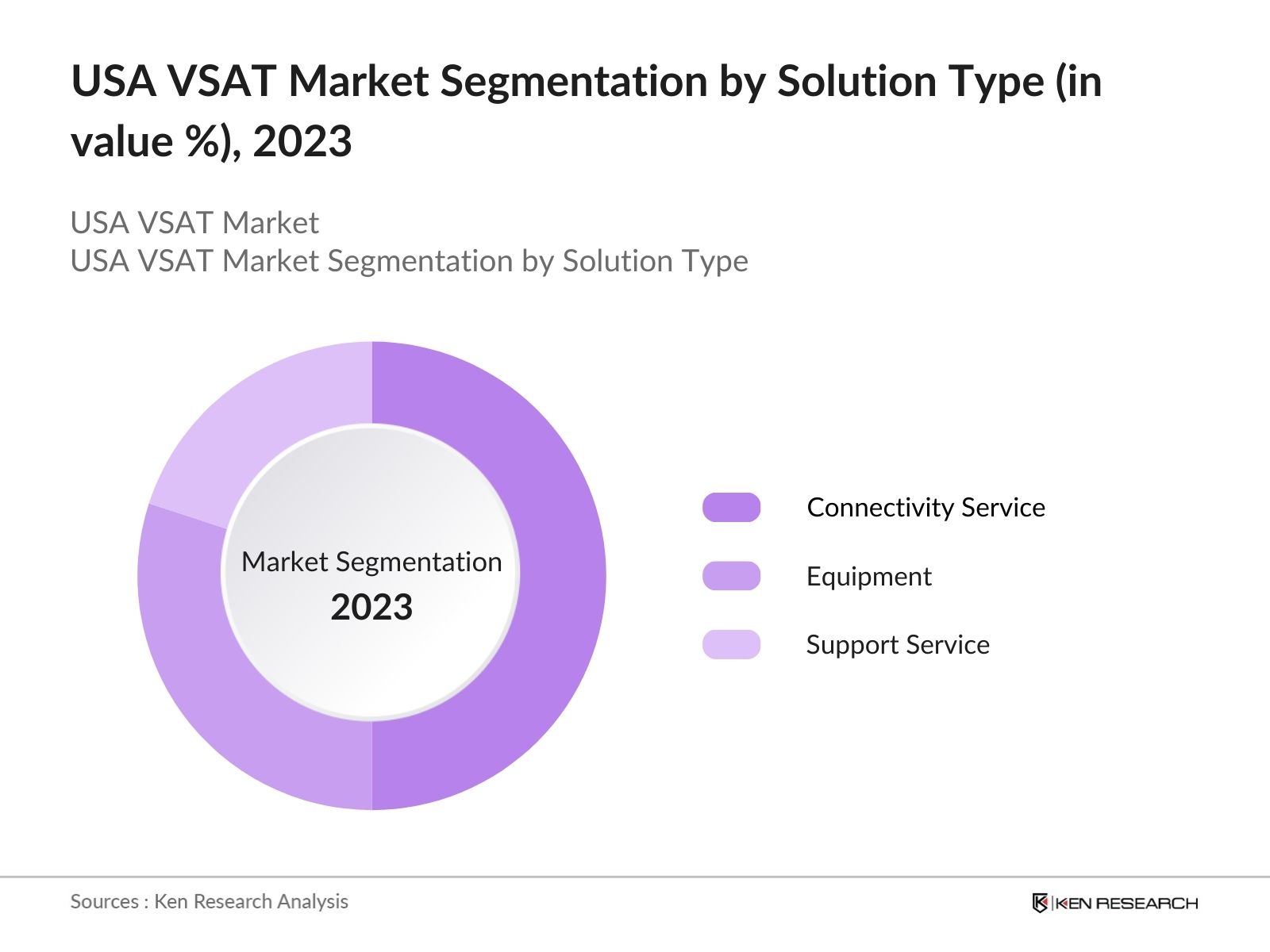
By Solution Type: USA VSAT market segmentation by solution type is divided into connectivity service, equipment and support service. In 2023, the Connectivity Service segment led the USA VSAT market, this segment's prominence is due to the continuous need for reliable and high-speed internet, which provides ongoing revenue through subscription models. The increasing reliance on remote communication and data services, along with the expansion of broadband in underserved regions, has heightened demand for strong connectivity solutions.
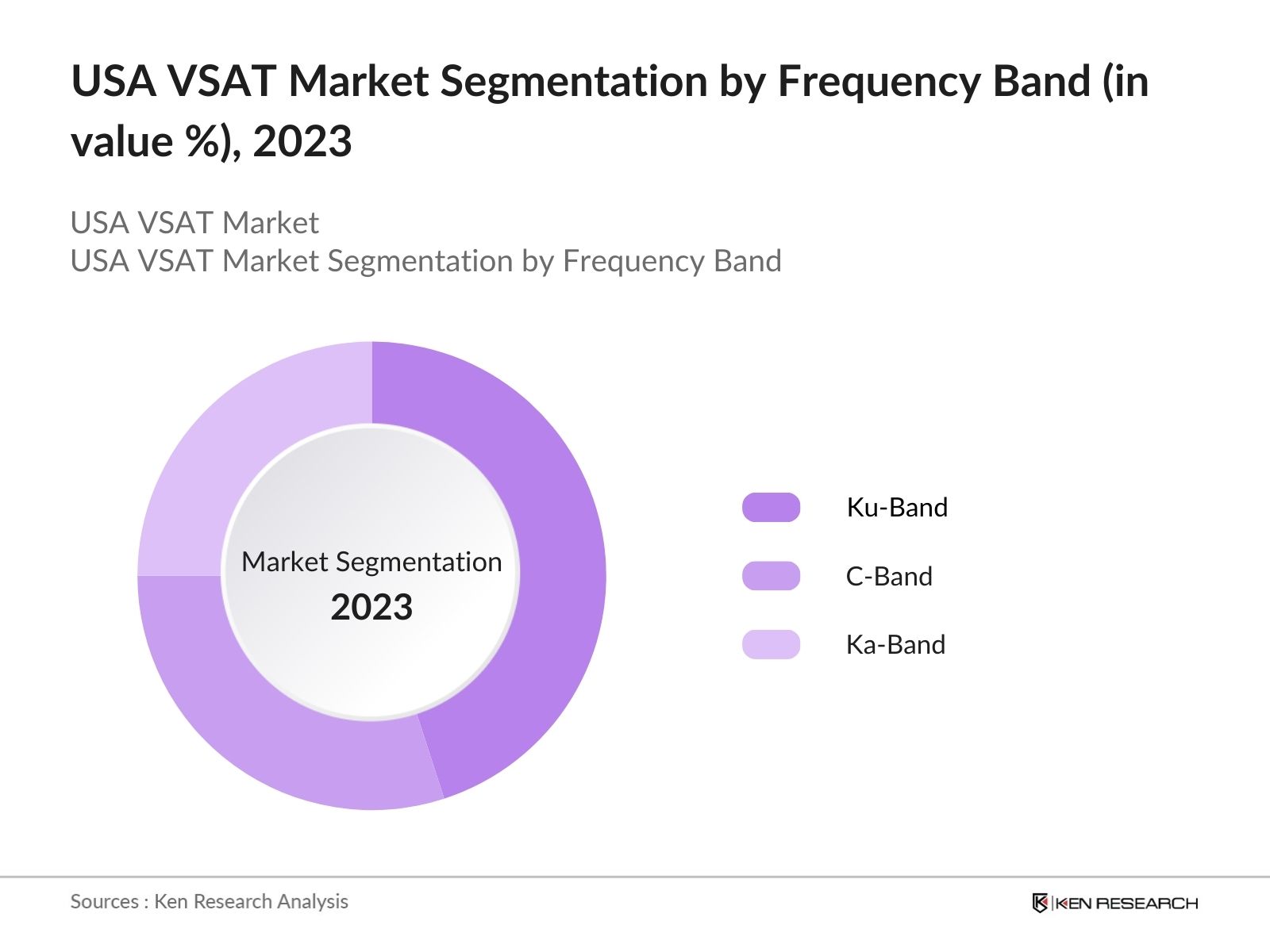
By Frequency Band: USA VSAT market segmentation by frequency band is divided into ku-band, c-band and ka-band. In 2023, the Ku-band segment accounted for majority of the market share, attributed to its widespread use in both commercial and government applications. Ku-band's ability to provide high data rates and its suitability for various applications make it the preferred choice for many users.
By Region: USA VSAT market segmentation by region is divided into north, south, east and west. In 2023, the Western region dominated the market. The region's dominance is due to the high concentration of technology companies and the extensive use of satellite communication in both commercial and governmental applications.
USA VSAT Market Competitive Landscape
|
Company |
Establishment Year |
Headquarters |
|
Hughes Network Systems |
1971 |
Germantown, MD |
|
Viasat Inc. |
1986 |
Carlsbad, CA |
|
Gilat Satellite Networks |
1987 |
Petah Tikva, Israel |
|
Inmarsat |
1979 |
London, UK |
|
Iridium Communications |
2001 |
McLean, VA |
- Hughes Network Systems: Expansion of Service Coverage: In 2023, Hughes Network Systems expanded its service coverage by launching a new high-capacity satellite, JUPITER 3. This satellite provides enhanced broadband services across North America, increasing Hughes' market share and service reliability. The launch of JUPITER 3 is a significant development, as it enables Hughes to offer faster and more reliable internet services to a broader customer base.
- Viasat Inc. Partnership with Delta Air Lines: Viasat Inc. announced a partnership with Delta Air Lines in 2024 to provide in-flight Wi-Fi services on over 1,000 aircraft. This partnership enhances Viasat's presence in the aviation sector and underscores its commitment to providing high-speed connectivity solutions. The collaboration is expected to generate significant revenue for Viasat and improve passenger experience on Delta flights.
USA VSAT Industry Analysis
USA VSAT Market Growth Drivers:
- Expansion of Remote Work and Telecommuting: In 2024, the USA experienced a significant increase in remote work, with 22 million people, 14% of the U.S. workforce, are working from home at least part-time. This shift has driven the demand for reliable and high-speed internet services, especially in rural and remote areas. The VSAT market is benefitting from this trend as businesses and individuals seek dependable communication solutions to support telecommuting needs.
- Advancements in Satellite Technology: Technological advancements in satellite communications have significantly enhanced the capabilities and efficiency of VSAT systems. In 2024, the launch of new high-throughput satellites (HTS) increased the capacity and speed of VSAT services, making them more attractive to a wider range of users. The National Aeronautics and Space Administration (NASA) reported that the new satellites launched in 2024 could handle data transmission rates of up to 1 Gbps, enabling faster and more reliable communication for various applications.
- Rising Need for Disaster Recovery and Emergency Communication: As of early September 2024, the U.S. has experienced 19 major weather or climate events that resulted in damages exceeding USD 1 billion each. This includes a combination of severe storms, a tropical cyclone, a wildfire, and winter storm events. This has underscored the importance of robust disaster recovery and emergency communication systems. VSAT networks are crucial in providing reliable communication in affected areas where terrestrial networks are often disrupted. The Federal Emergency Management Agency (FEMA) reported that in 2024, VSAT systems were deployed in over 30 disaster recovery operations, ensuring continuous communication for emergency services and affected communities.
USA VSAT Market Challenges:
- Regulatory and Licensing Issues: Regulatory and licensing issues can pose challenges for the deployment and operation of VSAT systems. In 2024, several VSAT providers faced delays in obtaining the necessary licenses from the Federal Communications Commission (FCC), impacting their ability to launch new services. The complex regulatory environment can lead to increased costs and operational delays, affecting market growth. The FCC reported that in 2024, it took an average of 12 months for VSAT providers to obtain the required licenses, highlighting the bureaucratic challenges in the sector.
- Competition from Terrestrial and Mobile Networks: The VSAT market faces stiff competition from terrestrial and mobile networks, which have also been expanding their reach and capabilities. In 2024, major telecom operators invested in upgrading their terrestrial and mobile networks, providing high-speed internet access to previously underserved areas. This increased competition can impact the growth of the VSAT market, as customers may opt for more affordable and readily available terrestrial or mobile services.
USA VSAT Market Government Initiatives:
- Rural Digital Opportunity Fund (RDOF): In 2020, the FCC launched the Rural Digital Opportunity Fund (RDOF), providing USD 20 billion over the next decade to support the deployment of high-speed broadband networks in underserved areas. In 2024, the FCC allocated a substantial amount to VSAT providers to expand broadband access in rural regions. This initiative aims to bridge the digital divide and enhance connectivity in remote areas, significantly boosting the demand for VSAT systems.
- Broadband Infrastructure Funding: The U.S. Congress passed the Broadband Infrastructure Funding bill in 2021, allocating USD 65 billion to improve broadband infrastructure nationwide. Additionally, in 2024, a notable amount was specifically earmarked for satellite-based communication systems, including VSAT, to ensure high-speed internet access in remote and underserved areas. This funding supports the development and deployment of advanced VSAT technologies, promoting market growth.
USA VSAT Future Market Outlook
The USA VSAT Market is expected to show significant growth by 2028 driven by continuous technological advancements, increasing government initiatives to bridge the digital divide, and the rising adoption of VSAT systems in the maritime and aviation sectors.
Future Market Trends
- Advancements in VSAT Technology: Continued advancements in VSAT technology will enhance the capabilities and efficiency of these systems. Innovations such as electronically steerable antennas, improved modulation techniques, and enhanced power efficiency will make VSAT systems more versatile and cost-effective. By 2028, these technological advancements will enable VSAT providers to offer more competitive and high-performance solutions, attracting a wider range of customers.
- Increased Adoption in 5G Backhaul: The adoption of VSAT systems for 5G backhaul will grow significantly over the next five years. VSAT's ability to provide reliable and high-capacity connectivity makes it an attractive option for extending 5G networks to remote and underserved areas. By 2028, the number of 5G base stations connected via VSAT is projected to grow remarkably, supporting the expansion of 5G services and enhancing network coverage.
Scope of the Report
|
By Solution Type |
Connectivity Service Equipment Support Service |
|
By Frequency Band |
Ku-Band C-Band Ka-Band |
|
By Region |
North South East West |
Products
Key Target Audience Organizations and Entities Who Can Benefit by Subscribing This Report:
Telecommunication Companies
Internet Service Providers
Government Agencies (Federal Communications Commission)
Rural Broadband Providers
Technology Companies
Telemedicine Providers
Banks and Financial Institutions
Investors and VCs
Time Period Captured in the Report:
Historical Period: 2018-2023
Base Year: 2023
Forecast Period: 2023-2028
Companies
Players Mentioned in the Report:
Hughes Network Systems
Viasat Inc.
Gilat Satellite Networks
Inmarsat
Iridium Communications
L3Harris Technologies
SES S.A.
Comtech Telecommunications Corp.
Orbcomm
Speedcast International Limited
EchoStar Corporation
Newtec
Globecomm Systems Inc.
Globalstar
RigNet
Table of Contents
USA VSAT Market Overview
1.1. Definition and Scope
1.2. Market Taxonomy
1.3. Market Growth Rate
1.4. Market Segmentation Overview
USA VSAT Market Size (In USD Billion)
2.1. Historical Market Size
2.2. Year-On-Year Growth Analysis
2.3. Key Market Developments and Milestones
USA VSAT Market Analysis
3.1. Growth Drivers
3.1.1. Increasing Demand for Remote Connectivity
3.1.2. Advancements in Satellite Technology
3.1.3. Expansion of Maritime and Aviation Sectors
3.1.4. Government Initiatives for Digital Inclusion
3.2. Market Challenges
3.2.1. High Initial Capital Expenditure
3.2.2. Regulatory and Licensing Hurdles
3.2.3. Competition from Terrestrial Networks
3.2.4. Technical Limitations in Adverse Environments
3.3. Opportunities
3.3.1. Integration with 5G Networks
3.3.2. Expansion into Underserved Rural Areas
3.3.3. Development of Low-Cost VSAT Solutions
3.3.4. Collaboration with IoT Service Providers
3.4. Trends
3.4.1. Adoption of High-Throughput Satellites (HTS)
3.4.2. Shift Towards Ka-Band Frequencies
3.4.3. Emergence of Portable VSAT Terminals
3.4.4. Increased Focus on Cybersecurity Measures
3.5. Government Regulations
3.5.1. Federal Communications Commission (FCC) Policies
3.5.2. Spectrum Allocation Procedures
3.5.3. Compliance with International Satellite Standards
3.5.4. Incentives for Rural Broadband Expansion
3.6. SWOT Analysis
3.7. Stakeholder Ecosystem
3.8. Porter's Five Forces Analysis
3.9. Competitive Landscape
USA VSAT Market Segmentation
4.1. By Component (In Value %)
4.1.1. Hardware
4.1.1.1. Antennas
4.1.1.2. Modems
4.1.1.3. Power Amplifiers
4.1.1.4. LNBs (Low Noise Block Downconverters)
4.1.2. Services
4.1.2.1. Installation and Maintenance
4.1.2.2. Managed Network Services
4.1.2.3. Leasing Services
4.2. By Platform (In Value %)
4.2.1. Land-Based VSAT
4.2.2. Maritime VSAT
4.2.3. Airborne VSAT
4.3. By Frequency Band (In Value %)
4.3.1. C-Band
4.3.2. Ku-Band
4.3.3. Ka-Band
4.3.4. X-Band
4.4. By Network Architecture (In Value %)
4.4.1. Star Topology
4.4.2. Mesh Topology
4.4.3. Hybrid Topology
4.5. By Region (In Value %)
4.5.1. Northeast
4.5.2. Midwest
4.5.3. South
4.5.4. East
USA VSAT Market Competitive Analysis
5.1. Detailed Profiles of Major Companies
5.1.1. Hughes Network Systems
5.1.2. Viasat Inc.
5.1.3. Gilat Satellite Networks
5.1.4. Inmarsat
5.1.5. Iridium Communications
5.1.6. L3Harris Technologies
5.1.7. Comtech Telecommunications Corp.
5.1.8. SES S.A.
5.1.9. Intelsat
5.1.10. EchoStar Corporation
5.1.11. Speedcast International Limited
5.1.12. KVH Industries, Inc.
5.1.13. Globecomm Systems Inc.
5.1.14. Cobham SATCOM
5.1.15. Newtec
5.2. Cross Comparison Parameters (Number of Employees, Headquarters Location, Year of Establishment, Annual Revenue, Market Share, Product Portfolio, Key Clients, Regional Presence)
5.3. Market Share Analysis
5.4. Strategic Initiatives
5.5. Mergers and Acquisitions
5.6. Investment Analysis
5.6.1. Venture Capital Funding
5.6.2. Government Grants
5.6.3. Private Equity Investments
USA VSAT Market Regulatory Framework
6.1. Licensing Requirements
6.2. Spectrum Allocation Policies
6.3. Compliance Standards
6.4. Certification Processes
USA VSAT Future Market Size (In USD Billion)
7.1. Future Market Size Projections
7.2. Key Factors Driving Future Market Growth
USA VSAT Future Market Segmentation
8.1. By Component (In Value %)
8.2. By Platform (In Value %)
8.3. By Frequency Band (In Value %)
8.4. By Network Architecture (In Value %)
8.5. By Region (In Value %)
USA VSAT Market Analysts Recommendations
o 9.1. Total Addressable Market (TAM), Serviceable Available Market (SAM), Serviceable Obtainable Market (SOM) Analysis
o 9.2. Customer Cohort Analysis
o 9.3. Marketing Initiatives
o 9.4. White Space Opportunity Analysis
Disclaimer Contact UsResearch Methodology
Step: 1 Identifying Key Variables:
Ecosystem creation for all the major entities and referring to multiple secondary and proprietary databases to perform desk research around market to collate industry level information.
Step: 2 Market Building:
Collating statistics on USA VSAT market over the years, penetration of marketplaces and service providers ratio to compute revenue generated for USA VSAT market. We will also review service quality statistics to understand revenue generated which can ensure accuracy behind the data points shared.
Step: 3 Validating and Finalizing:
Building market hypothesis and conducting CATIs with industry experts belonging to different companies to validate statistics and seek operational and financial information from company representatives.
Step: 4 Research Output:
Our team will approach multiple VSAT service providers and understand nature of product segments and sales, consumer preference and other parameters, which will support us validate statistics derived through bottom to top approach from VSAT service providers.
Frequently Asked Questions
01. How big is USA VSAT Market?
The USA VSAT market has experienced notable growth, this is reflected by global VSAT market reaching a valuation of USD 8 Bn in 2023. This growth is fueled by increasing demand for reliable and high-speed communication in remote and rural areas, advancements in satellite technology, and the expanding need for secure communication networks in military and government sectors.
02. What are the challenges in USA VSAT Market?
Challenges include in USA VSAT market high initial costs of installation and equipment, regulatory and licensing issues, competition from terrestrial and mobile networks, and technical challenges in harsh environments. These factors can hinder market expansion and adoption.
03. Who are the major players in USA VSAT Market?
The key players in the USA VSAT market include Hughes Network Systems, Viasat Inc., Gilat Satellite Networks, Inmarsat, and Iridium Communications. These companies dominate the market due to their extensive satellite infrastructure, robust product offerings, and strategic partnerships with government and commercial entities.
04What are the growth drivers for the USA VSAT Market?
The growth of the USA VSAT market is driven by several factors, including the increasing demand for broadband connectivity in remote and underserved areas, rising adoption of VSAT in maritime and aviation sectors, advancements in High-Throughput Satellites (HTS), and growing reliance on satellite communication for disaster recovery and emergency services.
Why Buy From Us?

What makes us stand out is that our consultants follows Robust, Refine and Result (RRR) methodology. i.e. Robust for clear definitions, approaches and sanity checking, Refine for differentiating respondents facts and opinions and Result for presenting data with story

We have set a benchmark in the industry by offering our clients with syndicated and customized market research reports featuring coverage of entire market as well as meticulous research and analyst insights.

While we don't replace traditional research, we flip the method upside down. Our dual approach of Top Bottom & Bottom Top ensures quality deliverable by not just verifying company fundamentals but also looking at the sector and macroeconomic factors.

With one step in the future, our research team constantly tries to show you the bigger picture. We help with some of the tough questions you may encounter along the way: How is the industry positioned? Best marketing channel? KPI's of competitors? By aligning every element, we help maximize success.

Our report gives you instant access to the answers and sources that other companies might choose to hide. We elaborate each steps of research methodology we have used and showcase you the sample size to earn your trust.

If you need any support, we are here! We pride ourselves on universe strength, data quality, and quick, friendly, and professional service.