















USA Weather Forecasting Service Market Outlook to 2030
Region:North America
Author(s):Meenakshi
Product Code:KROD2102
November 2024
92
About the Report
USA Weather Forecasting Service Market Overview
- The USA weather forecasting service market, based on a five-year historical analysis, is valued at USD 539 million, driven by increasing demand for real-time and accurate weather data across various industries. Sectors such as agriculture, aviation, marine, and energy are increasingly relying on advanced forecasting tools to optimize their operations, minimize risks, and improve safety. Furthermore, the rise of IoT and AI-enabled forecasting solutions has further bolstered the market, offering improved accuracy and speed.
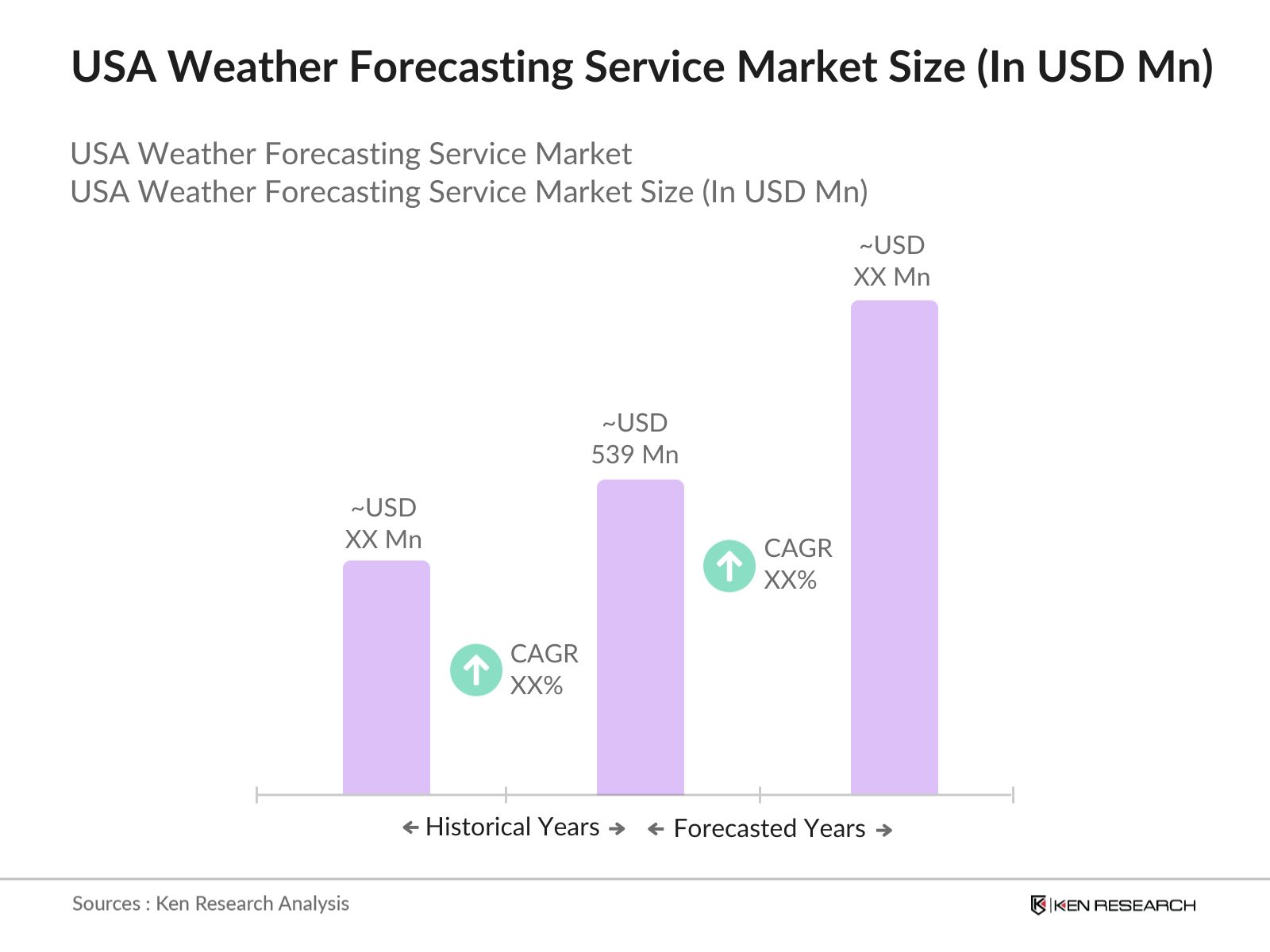
- The USA dominates the global weather forecasting service market due to its advanced meteorological infrastructure, government investments through agencies such as the National Oceanic and Atmospheric Administration (NOAA), and strong private sector involvement. Cities like Washington, D.C., New York, and Houston are key hubs, as they are centers of decision-making for industries highly dependent on weather forecasting data, including energy, agriculture, and transport.
- The Biden-Harris administration has invested $100 million in a new high-performance computing (HPC) system, Rhea, to enhance NOAA's research capabilities. This initiative supports advanced weather, climate, and ecosystem predictions by boosting NOAA's computational power. The system will accelerate the use of artificial intelligence and machine learning for improved forecasting and environmental modeling. Installed at the NOAA Environmental Security Computing Center, this investment is aimed at strengthening the nation's climate resilience and advancing scientific research.
USA Weather Forecasting Service Market Segmentation
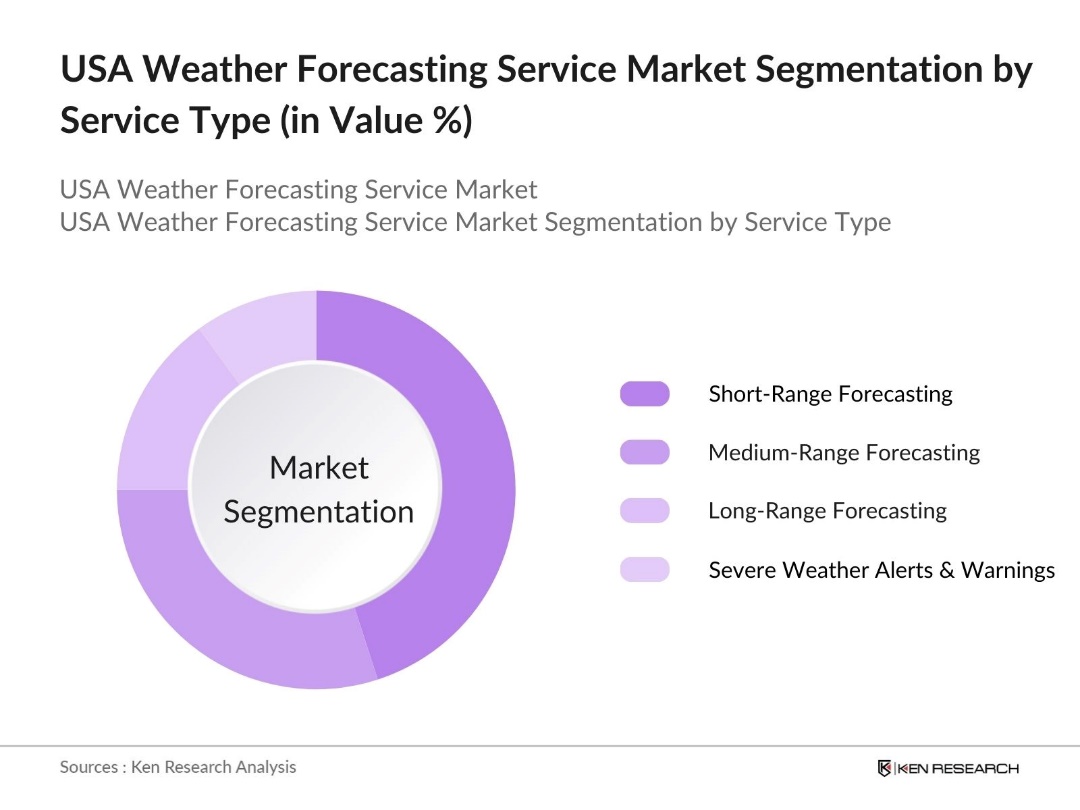
By Service Type: The USA weather forecasting market is segmented by service type into short-range forecasting, medium-range forecasting, long-range forecasting, and severe weather alerts and warnings. In 2023, short-range forecasting held the dominant share of the market. This is largely because most industries, including transportation and logistics, depend heavily on immediate weather conditions to make quick decisions and ensure operational safety. The demand for this service type is also driven by the increasing unpredictability of weather patterns, necessitating constant updates on current conditions.
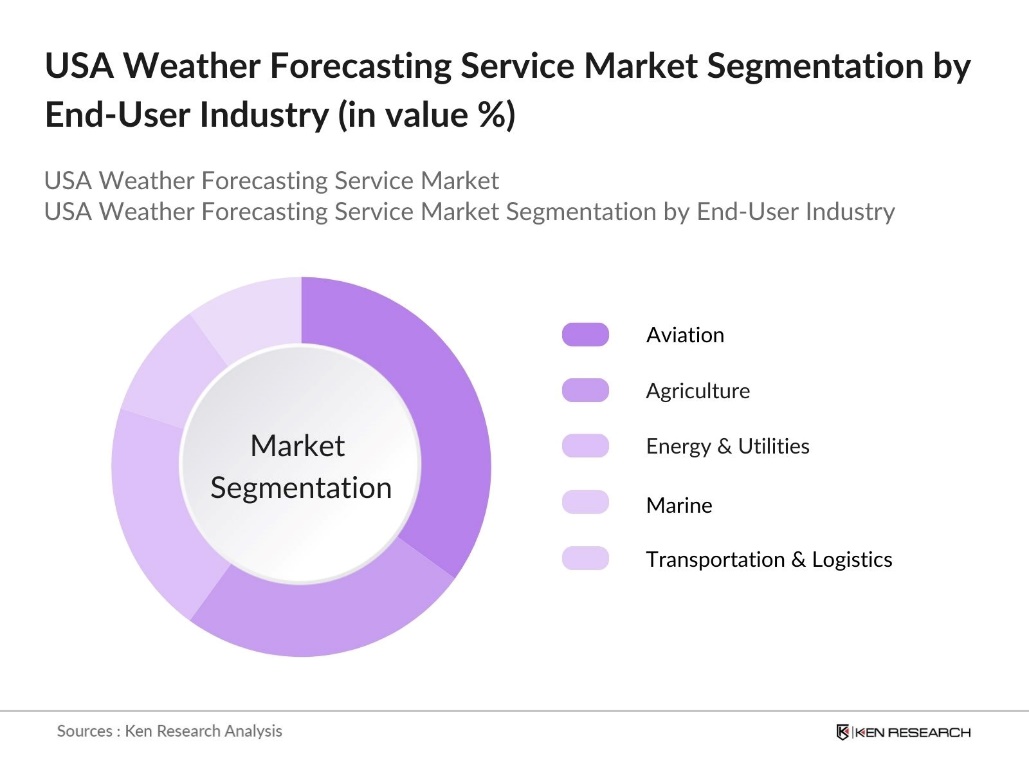
By End-User Industry: The USA weather forecasting market is segmented by end-user industry into agriculture, aviation, energy & utilities, marine, and transportation & logistics. In 2023, aviation accounted for the largest market share. The aviation industry requires precise, real-time weather data to ensure safe and efficient flight operations. Accurate forecasting helps in mitigating flight delays, managing fuel consumption, and ensuring passenger safety, making aviation a significant user of weather forecasting services. Additionally, the increasing number of flights and the rising focus on improving air travel efficiency further contribute to the dominance of this segment.
USA Weather Forecasting Service Market Competitive Landscape
The market is dominated by several key players, both from the public and private sectors. The competitive landscape is characterized by a mix of global companies providing diverse forecasting services, ranging from traditional meteorological data to advanced AI-driven solutions. These companies invest heavily in R&D to enhance their predictive accuracy and serve a broader range of industries.
|
Company Name |
Establishment Year |
Headquarters |
No. of Employees |
Revenue |
Technological Integration |
Subscription Models |
Regional Coverage |
Recent M&A Activities |
|
The Weather Company (IBM) |
1981 |
New York, USA |
||||||
|
AccuWeather |
1962 |
Pennsylvania, USA |
||||||
|
DTN (Data Transmission Network) |
1984 |
Minnesota, USA |
||||||
|
Spire Global |
2012 |
Virginia, USA |
||||||
|
Earth Networks |
1993 |
Maryland, USA |
USA Weather Forecasting Service Industry Analysis
Growth Drivers
- Increased Demand for Accurate Weather Prediction (Market-Specific Growth Factor): The USA sees a sharp rise in the demand for accurate weather forecasting due to its weather-sensitive industries like agriculture and aviation. In 2024, the National Weather Service (NWS is gradually implementing their Hazard Simplification Project. As of October 2024, there is some consolidation for cold weather and freeze alerts. For instance, the agriculture sectors reliance on precision forecasting for crop planning and disaster mitigation has contributed to this surge in demand.
- Expansion of Weather-Dependent Industries (e.g., Agriculture, Aviation, Energy): Agriculture, aviation, and energy sectors in the US significantly rely on weather forecasts, leading to the market's expansion. The US aviation industry faces 40,087 weather-related delays in 2022, underscoring the need for real-time, precise weather data to ensure operational efficiency. Additionally, the renewable energy sector, particularly wind and solar, integrates weather data to optimize energy output, reflecting strong market reliance on forecasting services.
- Rising Adoption of Advanced Meteorological Technologies (AI, IoT, Supercomputing): The adoption of AI, IoT, and supercomputing is enhancing meteorological systems by improving the accuracy and speed of weather forecasts. AI refines predictive models, IoT sensors enable real-time data collection, and supercomputers process vast datasets for high-resolution forecasts. These technologies are crucial for industries like agriculture, aviation, and logistics, which rely on precise weather information for efficient operations.
Market Challenges
- High Operational Costs: Operational costs are a major challenge for the weather forecasting market. Maintaining advanced meteorological infrastructure, such as satellites and radar systems, requires significant capital investment. These high expenses are often passed down to service providers, making it difficult to offer accurate and affordable services. This issue is particularly challenging for smaller companies, which struggle to balance the costs of maintaining advanced systems with competitive pricing.
- Data Privacy Concerns (Data Sovereignty and Ownership): Data privacy and sovereignty concerns are increasing for weather service providers, especially with the rise of mobile apps and IoT devices that handle weather-related data. As weather data intersects with personal information, regulatory oversight grows, leading to stricter laws on data storage and sharing. These regulations can limit the free flow of meteorological data between public and private entities, complicating service delivery.
USA Weather Forecasting Service Market Future Outlook
The USA weather forecasting service market is expected to continue experiencing significant growth over the next several years. Key factors driving this growth include ongoing advancements in AI and IoT technology, as well as the increasing need for accurate weather data across industries like agriculture, aviation, and energy. Additionally, climate change and unpredictable weather patterns are prompting a greater reliance on forecasting services to manage risks and reduce losses.
Market Opportunities
- Increasing Use of Weather Data in Smart City Initiatives; Smart city initiatives in the US are increasingly using weather data to improve urban planning, traffic management, and disaster preparedness. Cities are integrating real-time weather forecasts into their systems to manage weather-related disruptions, optimize resources, and enhance public safety. This growing use of localized weather data in smart city frameworks drives the demand for precise forecasting services tailored to urban needs.
- Emergence of Mobile Weather Forecasting Apps: The rise of mobile weather apps is creating new opportunities for weather forecasting providers. With a growing number of smartphone users relying on apps for on-demand weather updates, personalized and hyper-localized forecasting services are becoming more popular. Mobile apps are now a primary source of weather information, leading to the development of tailored subscription-based models for businesses and consumers alike.
Scope of the Report
|
By Service Type |
Short-Range Forecasting Medium-Range Forecasting Long-Range Forecasting Severe Weather Alerts and Warnings |
|
By End-User Industry |
Agriculture Aviation Energy & Utilities Marine Transportation & Logistics |
|
By Technology |
AI-Based Forecasting Supercomputing Forecasting Satellite Data Forecasting Weather Radar |
|
By Distribution Channel |
B2B Weather Forecasting Services B2C Weather Forecasting Services Government/Public Sector Forecasting |
|
By Region |
Northeast Midwest South West |
Products
Key Target Audience
Aviation Companies
Technology Industry
Transportation & Logistics Firms
Satellite Companies
Government and Regulatory Bodies (NOAA, National Weather Service)
Investors and venture capital Firms
Banks and Financial Institutions
Companies
Players Mentioned in the Report
The Weather Company (IBM)
AccuWeather
MeteoGroup
DTN (Data Transmission Network)
StormGeo
Earth Networks
Weathernews Inc.
Pelmorex Weather Networks
Spire Global
National Oceanic and Atmospheric Administration (NOAA)
Table of Contents
1. USA Weather Forecasting Service Market Overview
1.1. Definition and Scope
1.2. Market Taxonomy
1.3. Market Growth Rate (Market-Specific Growth Trends)
1.4. Market Segmentation Overview
2. USA Weather Forecasting Service Market Size (In USD Mn)
2.1. Historical Market Size
2.2. Year-On-Year Growth Analysis
2.3. Key Market Developments and Milestones (Key Market Advancements)
3. USA Weather Forecasting Service Market Analysis
3.1. Growth Drivers
3.1.1. Increased Demand for Accurate Weather Prediction (Market-Specific Growth Factor)
3.1.2. Expansion of Weather-Dependent Industries (e.g., Agriculture, Aviation, Energy)
3.1.3. Government Investments in Meteorological Infrastructure
3.1.4. Rising Adoption of Advanced Meteorological Technologies (AI, IoT, Supercomputing)
3.2. Market Challenges
3.2.1. High Operational Costs
3.2.2. Data Privacy Concerns (Data Sovereignty and Ownership)
3.2.3. Limited Coverage in Remote Areas (Market-Specific Geographic Limitation)
3.2.4. Technical Complexity of Real-Time Data Integration (Challenges in System Implementation)
3.3. Opportunities
3.3.1. Increasing Use of Weather Data in Smart City Initiatives
3.3.2. Emergence of Mobile Weather Forecasting Apps
3.3.3. Opportunities in Predictive Analytics for Climate Change
3.3.4. Expansion of Customizable Weather Forecasting Solutions for Niche Markets
3.4. Trends
3.4.1. Integration with AI-Powered Weather Forecasting Models
3.4.2. Use of Satellites and Drones for Enhanced Forecast Accuracy
3.4.3. Cloud-Based Data Processing and Sharing
3.4.4. Growth in Subscription-Based Forecasting Services (B2B & B2C)
3.5. Government Regulations
3.5.1. National Weather Service Regulations (NOAA Standards)
3.5.2. Data Sharing Mandates Between Private and Public Sectors
3.5.3. Weather Data Compliance Requirements (Meteorological Data Accuracy Standards)
3.6. SWOT Analysis (Strengths, Weaknesses, Opportunities, Threats)
3.7. Stakeholder Ecosystem (Meteorologists, Government Bodies, Private Sector)
3.8. Porters Five Forces (Competitive Dynamics Specific to Weather Forecasting Services)
3.9. Competitive Landscape
4. USA Weather Forecasting Service Market Segmentation
4.1. By Service Type (In Value %)
4.1.1. Short-Range Forecasting
4.1.2. Medium-Range Forecasting
4.1.3. Long-Range Forecasting
4.1.4. Severe Weather Alerts and Warnings
4.2. By End-User Industry (In Value %)
4.2.1. Agriculture
4.2.2. Aviation
4.2.3. Energy & Utilities
4.2.4. Marine
4.2.5. Transportation & Logistics
4.3. By Technology (In Value %)
4.3.1. AI-Based Forecasting
4.3.2. Supercomputing Forecasting
4.3.3. Satellite Data Forecasting
4.3.4. Weather Radar
4.4. By Distribution Channel (In Value %)
4.4.1. B2B Weather Forecasting Services
4.4.2. B2C Weather Forecasting Services
4.4.3. Government/Public Sector Forecasting
4.5. By Region (In Value %)
4.5.1. Northeast
4.5.2. Midwest
4.5.3. South
4.5.4. West
5. USA Weather Forecasting Service Market Competitive Analysis
5.1. Detailed Profiles of Major Companies
5.1.1. The Weather Company (IBM)
5.1.2. AccuWeather
5.1.3. MeteoGroup
5.1.4. DTN (Data Transmission Network)
5.1.5. StormGeo
5.1.6. Earth Networks
5.1.7. Weathernews Inc.
5.1.8. Pelmorex Weather Networks
5.1.9. Spire Global
5.1.10. National Oceanic and Atmospheric Administration (NOAA)
5.1.11. ClimaCell (Tomorrow.io)
5.1.12. Environdata Weather Stations
5.1.13. WeatherBug
5.1.14. Skymet Weather Services
5.1.15. Climavision
5.2. Cross Comparison Parameters (Number of Employees, Headquarters, Inception Year, Revenue, Market Share, Regional Coverage, Technological Integration, Subscription Models)
5.3. Market Share Analysis
5.4. Strategic Initiatives
5.5. Mergers and Acquisitions
5.6. Investment Analysis
5.7. Venture Capital Funding
5.8. Government Grants
5.9. Private Equity Investments
6. USA Weather Forecasting Service Market Regulatory Framework
6.1. Federal Weather Regulation Standards (NOAA Regulations)
6.2. Compliance Requirements (Data Collection, Reporting)
6.3. Certification Processes (Accreditation for Forecasting Accuracy)
7. USA Weather Forecasting Service Future Market Size (In USD Mn)
7.1. Future Market Size Projections
7.2. Key Factors Driving Future Market Growth
8. USA Weather Forecasting Service Future Market Segmentation
8.1. By Service Type (In Value %)
8.2. By End-User Industry (In Value %)
8.3. By Technology (In Value %)
8.4. By Distribution Channel (In Value %)
8.5. By Region (In Value %)
9. USA Weather Forecasting Service Market Analysts Recommendations
9.1. TAM/SAM/SOM Analysis
9.2. Customer Cohort Analysis
9.3. Marketing Initiatives
9.4. White Space Opportunity Analysis
Disclaimer Contact UsResearch Methodology
Step 1: Identification of Key Variables
The initial stage involves mapping all significant stakeholders within the USA Weather Forecasting Service Market. This is achieved through comprehensive desk research, using a combination of secondary sources and proprietary databases to gather a detailed understanding of market dynamics. The primary goal is to identify the critical variables impacting this market.
Step 2: Market Analysis and Construction
This phase involves collecting and analyzing historical data relevant to the USA Weather Forecasting Service Market. The focus is on evaluating market penetration, service provider dynamics, and revenue generation. We also examine key quality metrics for service reliability, which is essential for producing accurate forecasts.
Step 3: Hypothesis Validation and Expert Consultation
Market hypotheses are formulated and subsequently validated through consultations with industry experts. These interviews are conducted using computer-assisted telephone interviews (CATIs) with key industry practitioners to verify the accuracy and reliability of the data.
Step 4: Research Synthesis and Final Output
The final step entails synthesizing the data collected from industry participants, consolidating insights from multiple weather forecasting service providers to confirm the accuracy of the findings. This approach ensures that the final report presents a comprehensive analysis of the USA Weather Forecasting Service Market.
Frequently Asked Questions
01. How big is the USA Weather Forecasting Service Market?
The USA weather forecasting service market, valued at USD 539 million, is driven by increased demand from sectors such as agriculture, aviation, and energy, along with advancements in AI and IoT technologies.
02. What are the challenges in the USA Weather Forecasting Service Market?
Challenges in USA weather forecasting service market include high operational costs, technical complexities in real-time data integration, and limited coverage in remote areas. These factors can impact the expansion of forecasting services across the country.
03. Who are the major players in the USA Weather Forecasting Service Market?
Key players in the USA weather forecasting service market include The Weather Company (IBM), AccuWeather, DTN, Spire Global, and Earth Networks. These companies dominate due to their technological integration, extensive market reach, and strong industry relationships.
04. What are the growth drivers of the USA Weather Forecasting Service Market?
The USA weather forecasting service market is primarily driven by increased demand for real-time and accurate weather data across various industries. Advancements in AI and IoT technologies and government investments in meteorological infrastructure also play a crucial role in driving market growth.
Why Buy From Us?

What makes us stand out is that our consultants follows Robust, Refine and Result (RRR) methodology. i.e. Robust for clear definitions, approaches and sanity checking, Refine for differentiating respondents facts and opinions and Result for presenting data with story

We have set a benchmark in the industry by offering our clients with syndicated and customized market research reports featuring coverage of entire market as well as meticulous research and analyst insights.

While we don't replace traditional research, we flip the method upside down. Our dual approach of Top Bottom & Bottom Top ensures quality deliverable by not just verifying company fundamentals but also looking at the sector and macroeconomic factors.

With one step in the future, our research team constantly tries to show you the bigger picture. We help with some of the tough questions you may encounter along the way: How is the industry positioned? Best marketing channel? KPI's of competitors? By aligning every element, we help maximize success.

Our report gives you instant access to the answers and sources that other companies might choose to hide. We elaborate each steps of research methodology we have used and showcase you the sample size to earn your trust.

If you need any support, we are here! We pride ourselves on universe strength, data quality, and quick, friendly, and professional service.