
USA Welding Consumables Market Outlook to 2030
Region:United States
Author(s):Meenakshi Bisht
Product Code:KROD8743
Region:United States
Author(s):Meenakshi Bisht
Product Code:KROD8743
December 2024
85
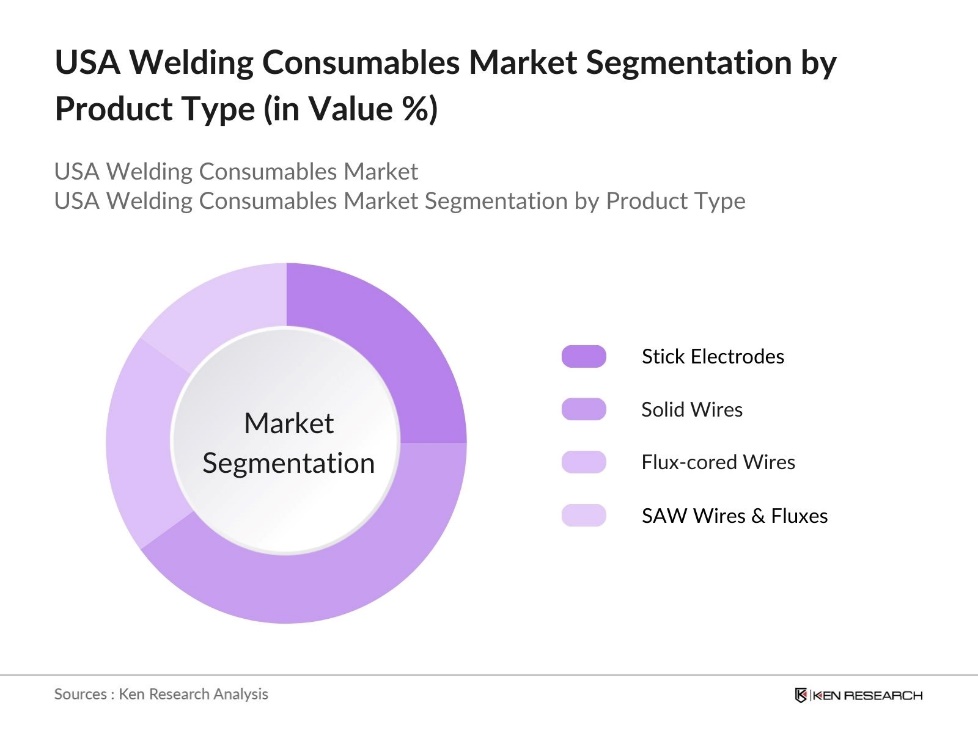
By Product Type: The market is segmented by product type into stick electrodes, solid wires, flux-cored wires, and SAW wires & fluxes. Recently, solid wires have had a dominant market share due to their widespread use in gas metal arc welding (GMAW) processes, especially in the automotive and construction sectors. Solid wires offer higher efficiency, better control, and faster welding speed, making them more favorable compared to other types. Their flexibility in use across various applications also gives them a competitive advantage.
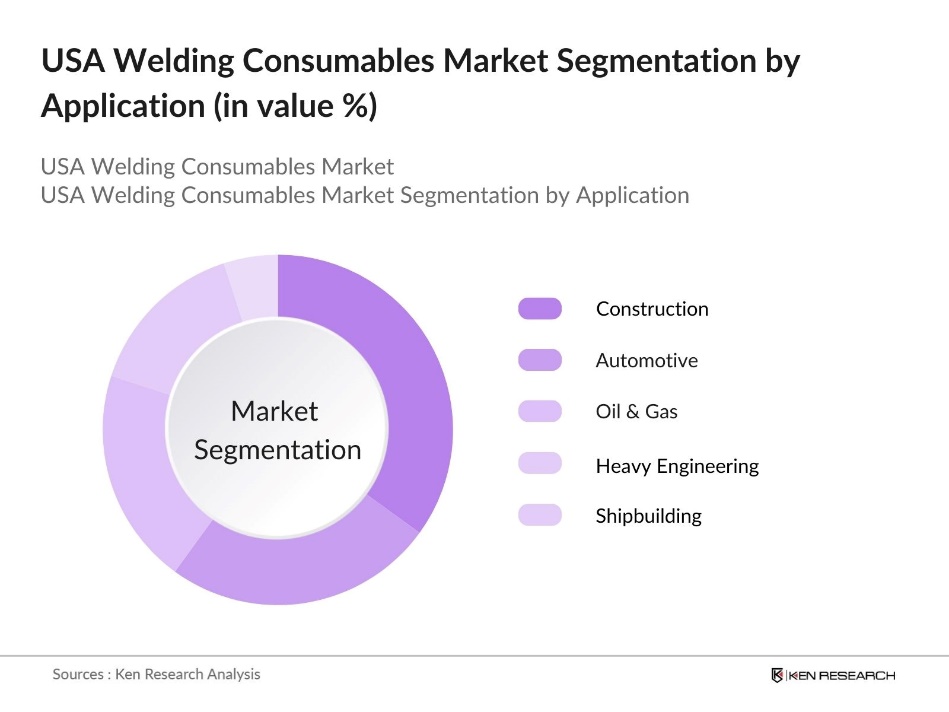
By Application: The market is segmented by application into construction, automotive, oil & gas, heavy engineering, and shipbuilding. Among these, the construction sector holds the largest market share. The continued growth in residential, commercial, and industrial construction projects has driven demand for welding consumables. In particular, the construction of bridges, highways, and renewable energy plants requires extensive welding work, especially in structural steel fabrication, which boosts the use of welding consumables.
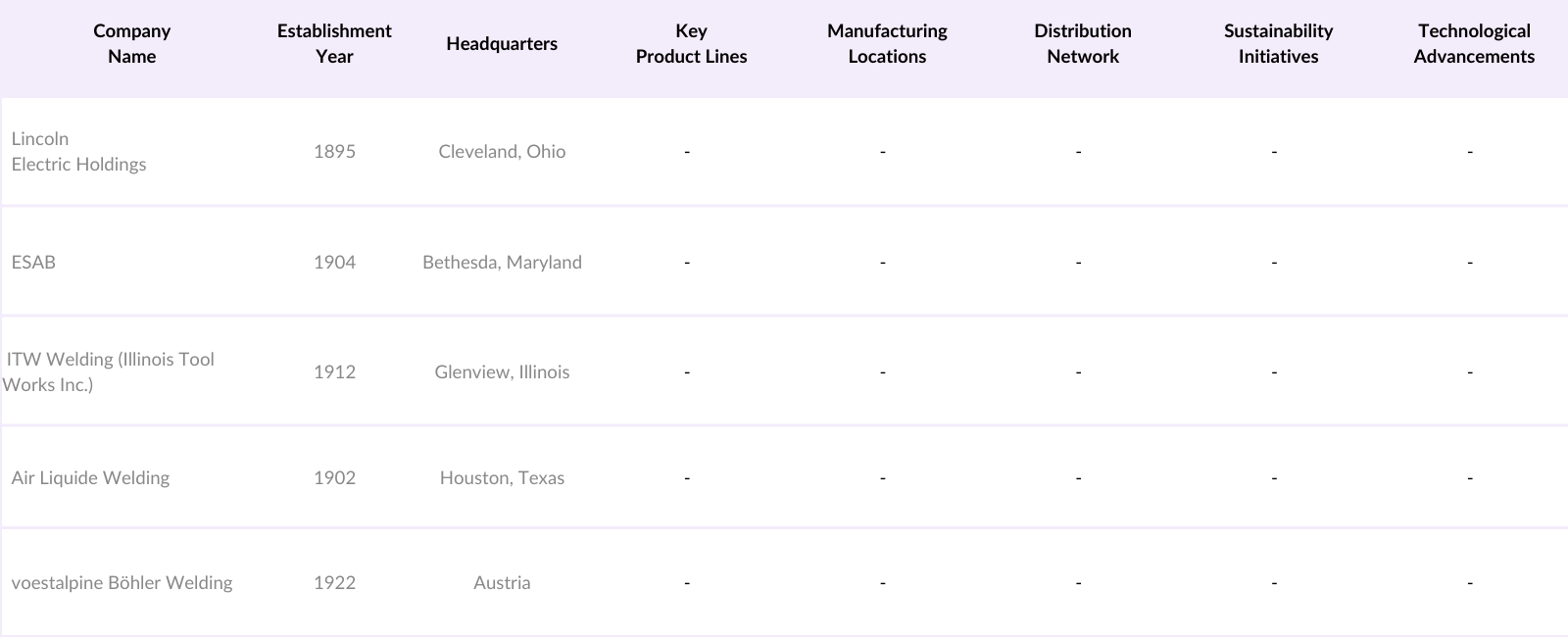
The USA Welding Consumables Market is characterized by the presence of major global players who are continuously investing in research and development to bring advanced products to the market. Companies like Lincoln Electric Holdings, ESAB, and ITW Welding dominate the market with their extensive distribution networks and a focus on technological innovations, such as automation in welding processes. The competitive landscape is marked by product differentiation, strategic collaborations, and mergers & acquisitions.
Over the next several years, the USA Welding Consumables Market is expected to see moderate growth, driven by infrastructure development initiatives, technological advancements in welding processes, and the rising demand from the automotive and energy sectors. The increasing use of automation in welding, along with the need for high-strength materials, will further propel the market forward. Additionally, the introduction of green welding technologies to meet environmental standards is likely to open up new opportunities for market players.
|
Product Type |
Stick Electrode Solid Wires Flux-cored Wires SAW Wires & Fluxes |
|
Application |
Construction Automotive Oil & Gas Heavy Engineering Shipbuilding |
|
Technology |
SMAW GMAW GTAW FCAW |
|
End-User |
Automotive & Transportation Building & Construction Power Generation Aerospace & Defense Marine |
|
Region |
North America Europe Asia Pacific Latin America Middle East & Africa |
1.1. Definition and Scope
1.2. Market Taxonomy (Product Types, Applications, Technology, End-Users, Regions)
1.3. Market Growth Rate (Analysis by Volume & Value)
1.4. Market Segmentation Overview
2.1. Historical Market Size
2.2. Year-on-Year Growth Analysis (By Product Type and Application)
2.3. Key Market Developments and Milestones
3.1. Growth Drivers
3.1.1. Infrastructure Development Projects (e.g., Transportation, Energy, and Utilities)
3.1.2. Increasing Automotive Production
3.1.3. Advancements in Metal Fabrication Technologies
3.1.4. Rising Demand for Lightweight Vehicles
3.2. Market Challenges
3.2.1. Fluctuations in Raw Material Prices (Steel, Nickel)
3.2.2. Shortage of Skilled Welders
3.2.3. Environmental Regulations on Fumes and Waste Materials
3.3. Opportunities
3.3.1. Growing Offshore Oil & Gas Projects
3.3.2. Adoption of Automated Welding Systems
3.3.3. Demand for High-Strength Steel in Construction
3.4. Trends
3.4.1. Growing Adoption of Robotics in Welding
3.4.2. Shift Towards Flux-cored Arc Welding (FCAW) in Shipbuilding
3.4.3. Development of Environmentally Friendly Welding Consumables
3.5. Regulatory Landscape
3.5.1. OSHA (Occupational Safety and Health Administration) Guidelines
3.5.2. EPA (Environmental Protection Agency) Regulations
3.5.3. Certification Standards (AWS - American Welding Society)
3.6. SWOT Analysis
3.7. Stakeholder Ecosystem (Welding Consumables Manufacturers, Distributors, End-Users)
3.8. Porters Five Forces Analysis
3.8.1. Supplier Power (Raw Material Price Volatility)
3.8.2. Buyer Power (Influence of Large OEMs and Contractors)
3.8.3. Competitive Rivalry (Fragmented Market Landscape)
3.9. Competitive Landscape
4.1. By Product Type (In Value %)
4.1.1. Stick Electrodes
4.1.2. Solid Wires
4.1.3. Flux-cored Wires
4.1.4. SAW Wires & Fluxes
4.2. By Application (In Value %)
4.2.1. Construction
4.2.2. Automotive
4.2.3. Oil & Gas
4.2.4. Heavy Engineering
4.2.5. Shipbuilding
4.3. By Technology (In Value %)
4.3.1. Shielded Metal Arc Welding (SMAW)
4.3.2. Gas Metal Arc Welding (GMAW)
4.3.3. Gas Tungsten Arc Welding (GTAW)
4.3.4. Flux-cored Arc Welding (FCAW)
4.4. By End-User (In Value %)
4.4.1. Automotive & Transportation
4.4.2. Building & Construction
4.4.3. Power Generation
4.4.4. Aerospace & Defense
4.4.5. Marine
5.1. Detailed Profiles of Major Companies
5.1.1. Lincoln Electric Holdings, Inc.
5.1.2. ESAB
5.1.3. ITW Welding (Illinois Tool Works Inc.)
5.1.4. Air Liquide Welding
5.1.5. voestalpine Bhler Welding
5.1.6. Hyundai Welding Co. Ltd.
5.1.7. The Linde Group
5.1.8. Kiswel Inc.
5.1.9. Ador Welding Limited
5.1.10. Sandvik Materials Technology
5.1.11. EWM AG
5.1.12. Fronius International GmbH
5.1.13. Miller Electric Mfg. LLC
5.1.14. Kobe Steel, Ltd.
5.1.15. Welding Alloys Group
5.2. Cross Comparison Parameters (Product Offerings, Market Presence, Strategic Alliances, R&D Investments, Revenue, Market Share, Manufacturing Capabilities, Sustainability Initiatives)
5.3. Market Share Analysis (By Company, Product Type, and Application)
5.4. Strategic Initiatives
5.4.1. Product Launches
5.4.2. Collaborations & Partnerships
5.4.3. Geographic Expansions
5.5. Mergers & Acquisitions
5.6. Investment Analysis
5.7. Private Equity Investments
6.1. Industry Standards and Certifications (AWS, ASME, ISO)
6.2. Compliance Requirements (OSHA, EPA)
6.3. Trade Tariffs and Duties (Impact on Imports/Exports)
7.1. Future Market Size Projections
7.2. Key Factors Driving Future Market Growth
8.1. By Product Type
8.2. By Application
8.3. By Technology
8.4. By End-User
8.5. By Region
9.1. TAM/SAM/SOM Analysis
9.2. Customer Cohort Analysis (By Application and Technology)
9.3. Marketing Initiatives
9.4. White Space Opportunity Analysis
Disclaimer Contact UsThe research began with a thorough analysis of key stakeholders in the USA Welding Consumables Market. Primary sources included databases such as the American Welding Society (AWS) and government statistics. The aim was to map out critical variables such as product demand, application sectors, and technological trends.
Historical data on the market were gathered to analyze product penetration and application distribution. This data provided a foundation for estimating the market size and share of individual segments. Performance metrics like production efficiency and sales revenue were also scrutinized.
We engaged in consultations with industry experts through Computer Assisted Telephone Interviews (CATIs). Insights from welding manufacturers and distributors were gathered to validate market trends, especially concerning product innovations and sectoral demand.
The final phase involved synthesizing the data and feedback from industry consultations. The resulting report was then cross-verified with both government databases and proprietary market data to ensure accuracy and reliability of the market projections and trends.
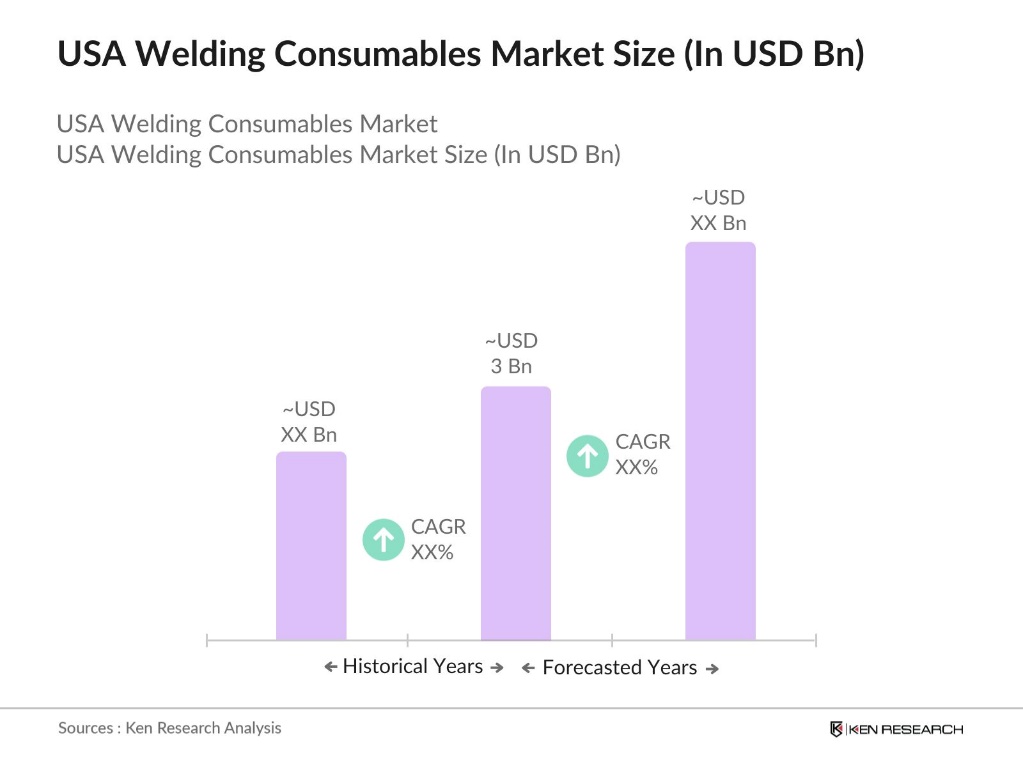
The USA Welding Consumables Market is valued at USD 3 billion, driven by demand from sectors like construction, automotive, and oil & gas.
Challenges in USA Welding Consumables Market include fluctuations in raw material prices, a shortage of skilled welders, and stringent environmental regulations concerning emissions and waste disposal.
Major players in USA Welding Consumables Market include Lincoln Electric Holdings, ESAB, ITW Welding, Air Liquide Welding, and voestalpine Bhler Welding, among others.
The USA Welding Consumables Market is driven by growth in the construction and automotive sectors, technological advancements in welding processes, and increasing demand for lightweight, durable materials.

What makes us stand out is that our consultants follows Robust, Refine and Result (RRR) methodology. i.e. Robust for clear definitions, approaches and sanity checking, Refine for differentiating respondents facts and opinions and Result for presenting data with story

We have set a benchmark in the industry by offering our clients with syndicated and customized market research reports featuring coverage of entire market as well as meticulous research and analyst insights.

While we don't replace traditional research, we flip the method upside down. Our dual approach of Top Bottom & Bottom Top ensures quality deliverable by not just verifying company fundamentals but also looking at the sector and macroeconomic factors.

With one step in the future, our research team constantly tries to show you the bigger picture. We help with some of the tough questions you may encounter along the way: How is the industry positioned? Best marketing channel? KPI's of competitors? By aligning every element, we help maximize success.

Our report gives you instant access to the answers and sources that other companies might choose to hide. We elaborate each steps of research methodology we have used and showcase you the sample size to earn your trust.

If you need any support, we are here! We pride ourselves on universe strength, data quality, and quick, friendly, and professional service.