















Vietnam Polyamide Market Outlook 2030
Region:Asia
Author(s):Shivani Mehra
Product Code:KROD4094
December 2024
88
About the Report
Vietnam Polyamide Market Overview
- The Vietnam Polyamide market is valued at USD 523 million based on a five-year historical analysis, driven by the rising demand from the automotive, electrical, and textile industries. The market has witnessed consistent growth due to Vietnam's rapid industrialization, supported by government incentives for local production and industrial expansion. Additionally, the polymer's broad applicability in manufacturing lightweight components for automotive and electronic devices has further solidified its presence in the market.
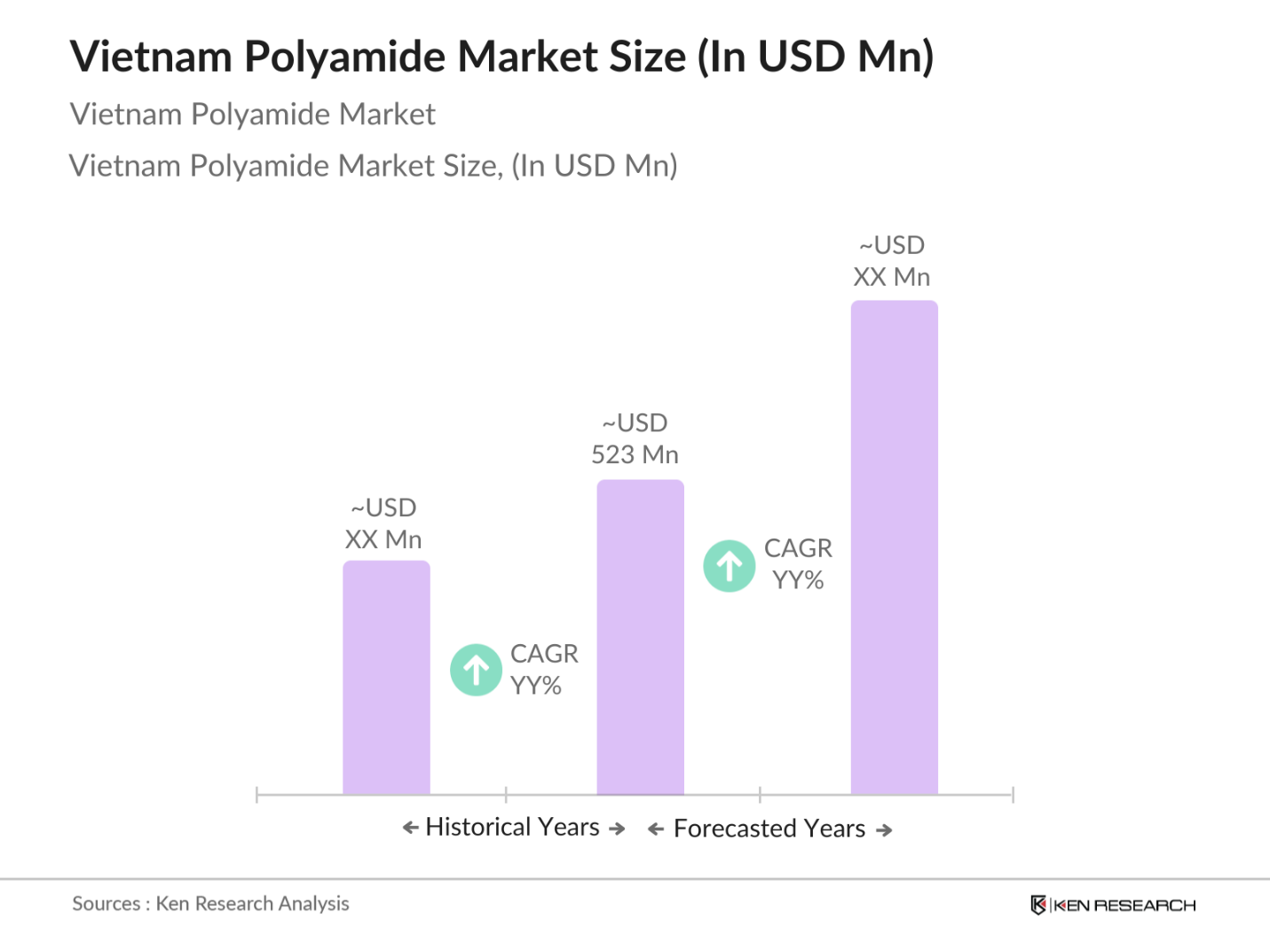
- The dominance of the northern and southern regions of Vietnam in the polyamide market is largely attributed to their established industrial zones, which house major automotive, electronics, and textile manufacturing clusters. Cities like Hanoi and Ho Chi Minh City have become major industrial hubs due to government support, better infrastructure, and proximity to key seaports, making them strategic locations for polyamide consumption. These cities also benefit from foreign direct investment (FDI), boosting polyamide demand for local production.
- Vietnam's 2023 environmental policy mandates a reduction in industrial emissions, impacting polyamide manufacturers who rely on energy-intensive processes. The government has introduced stricter emissions regulations, requiring polyamide producers to adopt energy-efficient technologies to comply with these new standards. This is expected to increase operational costs but also opens opportunities for investment in cleaner production methods. Non-compliance with these regulations could result in significant penalties, including fines and potential production shutdowns, which makes adherence crucial for manufacturers
Vietnam Polyamide Market Segmentation
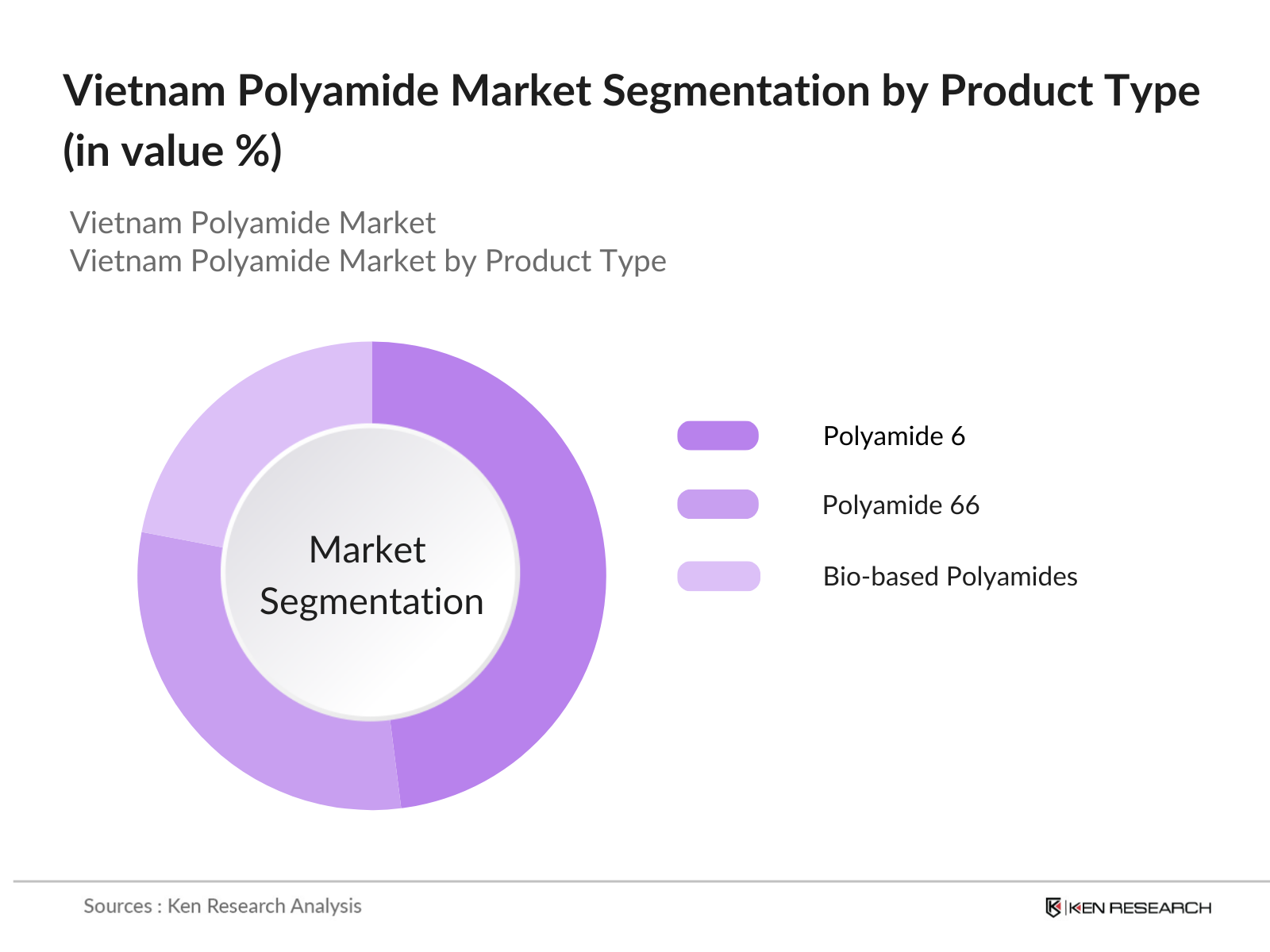
- By Product Type: The Vietnam Polyamide market is segmented by product type into Polyamide 6, Polyamide 66, and Bio-based Polyamides. Recently, Polyamide 6 has gained a dominant market share within this segmentation. This dominance can be attributed to its cost-effectiveness and superior processing properties, which make it a preferred choice for applications in the automotive and textile industries. Additionally, Polyamide 6 is widely used for injection molding, making it highly suitable for manufacturing complex components, further driving its popularity in Vietnam's growing manufacturing sector.
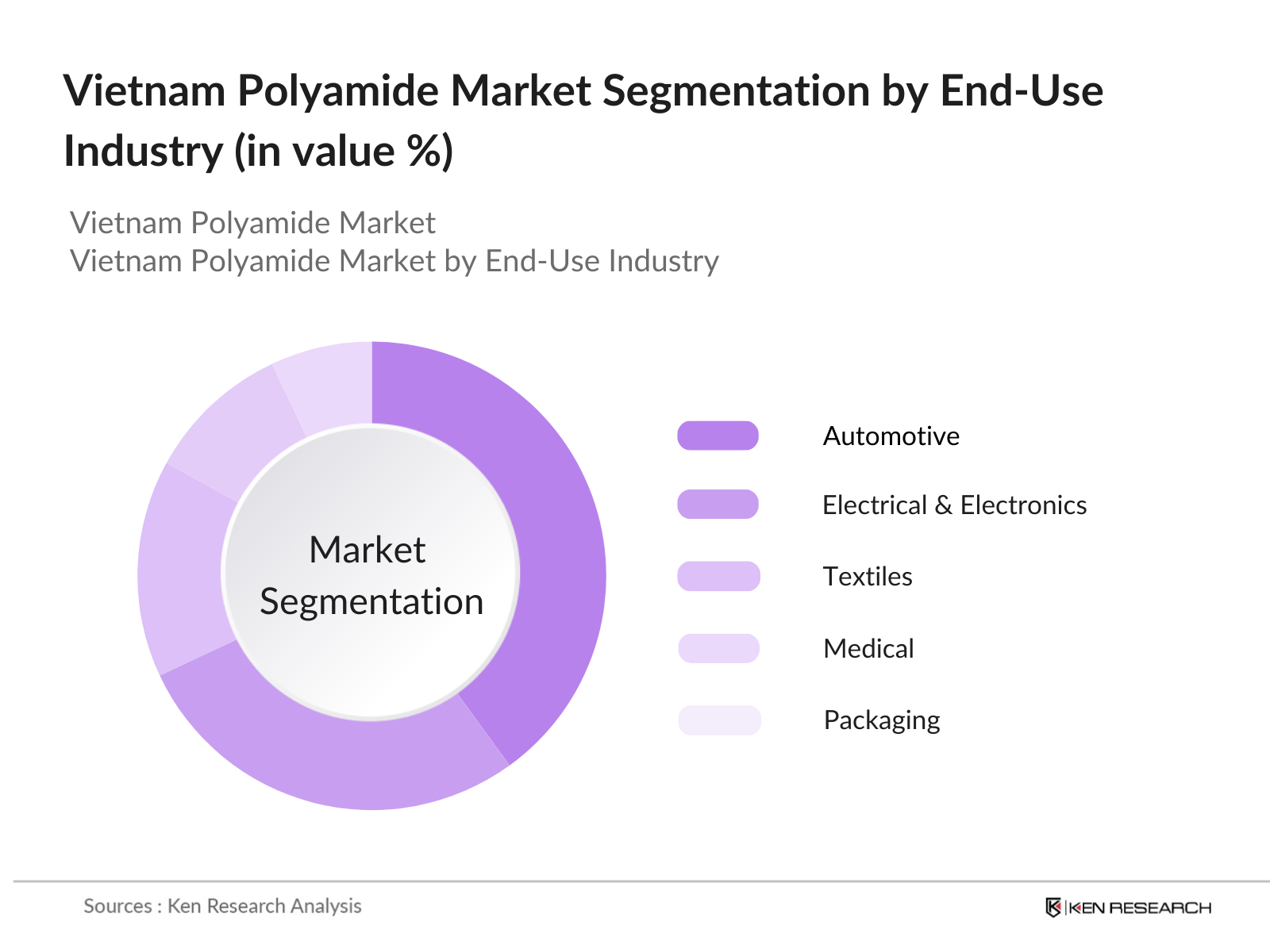
- By End-Use Industry: The Vietnam Polyamide market is segmented by end-use industry into automotive, electrical & electronics, textiles, medical, and packaging. The automotive industry has maintained a dominant market share under this segmentation. This is primarily due to the increasing production of lightweight vehicles and the need for durable materials in manufacturing engine components, gears, and bearings. Polyamides are widely used in the automotive sector due to their resistance to heat and wear, making them ideal for engine compartments and fuel system applications, which has led to sustained demand from automotive manufacturers.
Vietnam Polyamide Market Competitive Landscape
The Vietnam Polyamide market is dominated by a few major players, including multinational companies such as BASF SE and DuPont de Nemours, Inc. These companies have established a significant presence due to their large production capacities, strong R&D investments, and extensive distribution networks. This consolidation emphasizes the influence of these companies in shaping the market, especially as they continue to innovate with sustainable bio-based polyamides and establish new supply chains to meet the growing demand from the automotive and electronics industries in Vietnam.
|
Company |
Established |
Headquarters |
Production Capacity |
R&D Investments |
Sustainability Initiatives |
Polymer Innovation |
Regional Footprint |
Key Partnerships |
|
BASF SE |
1865 |
Ludwigshafen, Germany |
- | - | - | - | - | - |
|
DuPont de Nemours, Inc. |
1802 |
Wilmington, USA |
- | - | - | - | - | - |
|
Royal DSM |
1902 |
Heerlen, Netherlands |
- | - | - | - | - | - |
|
Arkema S.A. |
2004 |
Colombes, France |
- | - | - | - | - | - |
|
Evonik Industries AG |
2007 |
Essen, Germany |
- | - | - | - | - | - |
Vietnam Polyamide Market Analysis
Market Growth Drivers
- Increasing Demand in Automotive Industry: The automotive industry in Vietnam is growing rapidly, with the production of motor vehicles reaching over 250,000 units in 2023, up from approximately 180,000 units in 2021, according to government records. Polyamide is essential for manufacturing lightweight automotive components, crucial in achieving fuel efficiency targets. Vietnam's automotive export sector is also strengthening, with plans to increase exports to markets in ASEAN and beyond, fostering higher demand for polyamides. In particular, domestic manufacturers are seeing increased demand for polyamides in the production of engine covers, airbags, and electrical connectors.
- Expanding Electronics and Electrical Sectors: Vietnams electronics sector, a significant component of the national economy, reached $108 billion in exports in 2022, making it a regional hub for electronic component manufacturing. The use of polyamides in electronics, particularly in electrical insulators, circuit board housings, and cable insulation, has surged. Multinational corporations, including Samsung and LG, have increased their investments in Vietnam, leading to an amplified demand for high-performance materials like polyamide in their manufacturing processes.
- Growth in Textile Manufacturing and Exports: Vietnams textile industry saw an export value of $40 billion in 2023, a growth driven by its integration into global supply chains. Polyamide fibers, especially nylon, are increasingly used in textiles due to their durability and resistance to wear. The countrys ability to process these materials domestically enhances the competitiveness of its textile industry. This aligns with the governments goal of increasing value-added textile production, supported by trade agreements such as the Comprehensive and Progressive Agreement for Trans-Pacific Partnership (CPTPP)
Market Challenges
- High Raw Material Costs (Polymer Sourcing and Petrochemical Prices): Polyamide production is highly dependent on petrochemical derivatives, primarily caprolactam. Vietnam imports significant volumes of petrochemical feedstocks, leaving the industry exposed to international price fluctuations. In 2023, global crude oil prices ranged between $80-$100 per barrel, impacting the cost of caprolactam. Domestic manufacturers face steep production costs due to limited local petrochemical processing capabilities, making them reliant on imports, which in turn, raises the cost of polyamide production.
- Limited Local Production Capacities (Domestic Supply Constraints): Vietnam's domestic production of polyamides remains constrained, with only a few specialized facilities operating. These limited capacities mean that domestic demand, particularly in the automotive and electronics industries, outstrips supply, leading to increased imports. In 2023, Vietnam imported over $150 million worth of polyamide-based products, highlighting the supply-demand imbalance. Expansion plans for local production are underway, but these remain in the early stages
Vietnam Polyamide Market Future Outlook
Over the next few years, the Vietnam Polyamide market is expected to show significant growth driven by increasing demand from the automotive and electronics sectors. The government's focus on industrialization, coupled with foreign investments in Vietnam's growing manufacturing sector, will continue to drive the market. Furthermore, advancements in bio-based and sustainable polyamide materials will play a crucial role as industries move towards environmentally-friendly alternatives. This shift will open up new opportunities for both domestic manufacturers and international players entering the market.
Market Opportunities:
- Rise in Bio-based Polyamides (Sustainability Focus): With increasing global focus on sustainability, bio-based polyamides, derived from renewable sources such as castor oil, are gaining traction in Vietnam. In 2023, government-backed initiatives encouraged local manufacturers to adopt bio-based production methods, aligning with the country's commitment to reducing plastic waste. Bio-based polyamides are particularly gaining popularity in the automotive and electronics sectors, where manufacturers seek eco-friendly alternatives to traditional petrochemical-based polymers.
- Lightweight Material Demand in Automotive Industry: Vietnams automotive sector continues to prioritize lightweight materials to enhance fuel efficiency and reduce emissions. Polyamides strength-to-weight ratio makes it an ideal material for automotive components such as engine covers, air intake manifolds, and under-the-hood parts. With over 250,000 vehicles produced in Vietnam in 2023, the demand for lightweight materials such as polyamide is expected to remain strong, driven by consumer demand for more fuel-efficient vehicles
Scope of the Report
|
By Product Type |
Polyamide 6 Polyamide 66 Bio-based Polyamides |
|
By End-Use Industry |
Automotive Electrical & Electronics Textiles Medical Packaging |
|
By Grade |
Injection Molding Grade Extrusion Grade Fiber Grade |
|
By Processing Method |
Extrusion Injection Molding 3D Printing |
|
By Region |
North-East Midwest West Coast Southern States |
Products
Key Target Audience
Automotive Manufacturers
Electronics and Electrical Components Manufacturers
Textile Producers
Medical Device Manufacturers
Packaging Industry Players
Investments and Venture Capitalist Firms
Government and Regulatory Bodies (Vietnam Ministry of Industry and Trade, Vietnam Environment Administration)
R&D Institutions and Material Science Companies
Companies
Players Mentioned in the report
BASF SE
DuPont de Nemours, Inc.
Royal DSM
Arkema S.A.
Evonik Industries AG
UBE Industries, Ltd.
Ascend Performance Materials LLC
Lanxess AG
EMS-Chemie Holding AG
Radici Group
Asahi Kasei Corporation
Kuraray Co., Ltd.
Solvay S.A.
AdvanSix Inc.
Toray Industries Inc.
Table of Contents
1. Vietnam Polyamide Market Overview
1.1. Definition and Scope
1.2. Market Taxonomy
1.3. Market Growth Rate (Polyamide Demand Fluctuations, Industrial Integration)
1.4. Market Segmentation Overview
2. Vietnam Polyamide Market Size (In USD Billion)
2.1. Historical Market Size
2.2. Year-On-Year Growth Analysis (Market-Specific Investment Trends, Polymer Consumption Patterns)
2.3. Key Market Developments and Milestones
3. Vietnam Polyamide Market Analysis
3.1. Growth Drivers
3.1.1. Increasing Demand in Automotive Industry
3.1.2. Expanding Electronics and Electrical Sectors
3.1.3. Growth in Textile Manufacturing and Exports
3.1.4. Government Initiatives for Industrialization
3.2. Market Challenges
3.2.1. High Raw Material Costs (Polymer Sourcing and Petrochemical Prices)
3.2.2. Limited Local Production Capacities (Domestic Supply Constraints)
3.2.3. Environmental Regulations (Impact on Production Processes)
3.3. Opportunities
3.3.1. Technological Advancements in Production Methods (Recycling, Enhanced Polymer Quality)
3.3.2. Expanding Application in Medical Devices (Healthcare Sector Influence)
3.3.3. International Partnerships for Research and Development (Collaborative Opportunities)
3.4. Trends
3.4.1. Rise in Bio-based Polyamides (Sustainability Focus)
3.4.2. Lightweight Material Demand in Automotive Industry
3.4.3. Shifts Towards Recycled Polyamides
3.5. Government Regulation
3.5.1. Vietnams Industrial Policy (Polyamide Production Incentives)
3.5.2. Environmental and Emission Standards for Manufacturing
3.5.3. Import Tariff Adjustments for Polyamide Resins
3.6. SWOT Analysis
3.7. Stakeholder Ecosystem (Manufacturers, Suppliers, End-Users)
3.8. Porters Five Forces (Vietnam-Specific Competitive Environment)
3.9. Competition Ecosystem
4. Vietnam Polyamide Market Segmentation
4.1. By Product Type (In Value %)
4.1.1. Polyamide 6
4.1.2. Polyamide 66
4.1.3. Bio-based Polyamides
4.2. By End-Use Industry (In Value %)
4.2.1. Automotive
4.2.2. Electrical & Electronics
4.2.3. Textiles
4.2.4. Medical
4.2.5. Packaging
4.3. By Grade (In Value %)
4.3.1. Injection Molding Grade
4.3.2. Extrusion Grade
4.3.3. Fiber Grade
4.4. By Processing Method (In Value %)
4.4.1. Extrusion
4.4.2. Injection Molding
4.4.3. 3D Printing
4.5. By Region (In Value %)
4.5.1. Northern Vietnam
4.5.2. Central Vietnam
4.5.3. Southern Vietnam
5. Vietnam Polyamide Market Competitive Analysis
5.1 Detailed Profiles of Major Companies
5.1.1. BASF SE
5.1.2. DuPont de Nemours, Inc.
5.1.3. Royal DSM
5.1.4. Arkema S.A.
5.1.5. Evonik Industries AG
5.1.6. UBE Industries, Ltd.
5.1.7. Ascend Performance Materials LLC
5.1.8. Lanxess AG
5.1.9. EMS-Chemie Holding AG
5.1.10. Radici Group
5.1.11. Asahi Kasei Corporation
5.1.12. Kuraray Co., Ltd.
5.1.13. Solvay S.A.
5.1.14. AdvanSix Inc.
5.1.15. Toray Industries Inc.
5.2 Cross Comparison Parameters (Production Capacity, Product Portfolio, Regional Footprint, Vertical Integration, Revenue, R&D Investments, Strategic Collaborations, Sustainability Initiatives)
5.3. Market Share Analysis
5.4. Strategic Initiatives (Mergers, Acquisitions, Joint Ventures)
5.5. Investment Analysis (Key Capex Projects, FDI in Vietnam)
5.6. Venture Capital Funding (Focus on Bio-based Polyamides)
5.7. Government Grants
5.8. Private Equity Investments
6. Vietnam Polyamide Market Regulatory Framework
6.1. Environmental Standards
6.2. Compliance Requirements for Polyamide Manufacturers
6.3. Certification Processes
7. Vietnam Polyamide Market Future Market Size (In USD Billion)
7.1. Future Market Size Projections
7.2. Key Factors Driving Future Market Growth
8. Vietnam Polyamide Market Future Market Segmentation
8.1. By Product Type (In Value %)
8.2. By End-Use Industry (In Value %)
8.3. By Grade (In Value %)
8.4. By Processing Method (In Value %)
8.5. By Region (In Value %)
9. Vietnam Polyamide Market Analysts Recommendations
9.1. TAM/SAM/SOM Analysis
9.2. Marketing Initiatives for Growth
9.3. White Space Opportunity Analysis
Disclaimer Contact UsResearch Methodology
Step 1: Identification of Key Variables
The initial phase involves mapping out all relevant stakeholders within the Vietnam Polyamide market. This is achieved through comprehensive desk research using secondary sources like government reports, proprietary databases, and industry publications. The aim is to identify the primary factors influencing the market, including production trends, regulatory impact, and technological advancements.
Step 2: Market Analysis and Construction
This phase focuses on analyzing historical data to understand the dynamics of the Vietnam Polyamide market. A deep dive into market penetration, supply-demand patterns, and revenue generation will be conducted. Key performance indicators for the major segments are also assessed to provide a reliable foundation for further analysis.
Step 3: Hypothesis Validation and Expert Consultation
Once market hypotheses are formulated, they will be validated through interviews with industry experts. These consultations will be conducted using computer-assisted telephone interviews (CATIs), ensuring direct insights from manufacturers, suppliers, and other key players. This process will allow for accurate validation of market assumptions and projected trends.
Step 4: Research Synthesis and Final Output
In the final phase, the research data will be synthesized, and a detailed market report will be generated. This will involve cross-verifying key data points with industry leaders and ensuring the final output reflects the most accurate and up-to-date insights for the Vietnam Polyamide market.
Frequently Asked Questions
01. How big is the Vietnam Polyamide Market?
The Vietnam Polyamide market is valued at USD 523 million, driven by the growing demand from industries like automotive, textiles, and electronics. The market's consistent expansion is supported by government incentives and industrial growth in major cities.
02. What are the challenges in the Vietnam Polyamide Market?
Challenges in the Vietnam Polyamide market include high raw material costs, environmental regulations, and limited local production capacities, which put pressure on manufacturers to balance demand with cost-effective solutions.
03. Who are the major players in the Vietnam Polyamide Market?
Key players in the Vietnam Polyamide market include BASF SE, DuPont de Nemours, Inc., Royal DSM, Arkema S.A., and Evonik Industries AG. These companies have significant influence due to their production capabilities and strong presence in Vietnam's industrial hubs.
04. What are the growth drivers of the Vietnam Polyamide Market?
The market is propelled by demand from the automotive sector, advancements in electronics, and the rise of sustainable bio-based polyamides. Government policies promoting industrialization also play a pivotal role in supporting the market.
Why Buy From Us?

What makes us stand out is that our consultants follows Robust, Refine and Result (RRR) methodology. i.e. Robust for clear definitions, approaches and sanity checking, Refine for differentiating respondents facts and opinions and Result for presenting data with story

We have set a benchmark in the industry by offering our clients with syndicated and customized market research reports featuring coverage of entire market as well as meticulous research and analyst insights.

While we don't replace traditional research, we flip the method upside down. Our dual approach of Top Bottom & Bottom Top ensures quality deliverable by not just verifying company fundamentals but also looking at the sector and macroeconomic factors.

With one step in the future, our research team constantly tries to show you the bigger picture. We help with some of the tough questions you may encounter along the way: How is the industry positioned? Best marketing channel? KPI's of competitors? By aligning every element, we help maximize success.

Our report gives you instant access to the answers and sources that other companies might choose to hide. We elaborate each steps of research methodology we have used and showcase you the sample size to earn your trust.

If you need any support, we are here! We pride ourselves on universe strength, data quality, and quick, friendly, and professional service.