















Vietnam Robotic Lawn Mower Market Outlook to 2030
Region:Asia
Author(s):Paribhasha Tiwari
Product Code:KROD6456
December 2024
97
About the Report
Vietnam Robotic Lawn Mower Market Overview
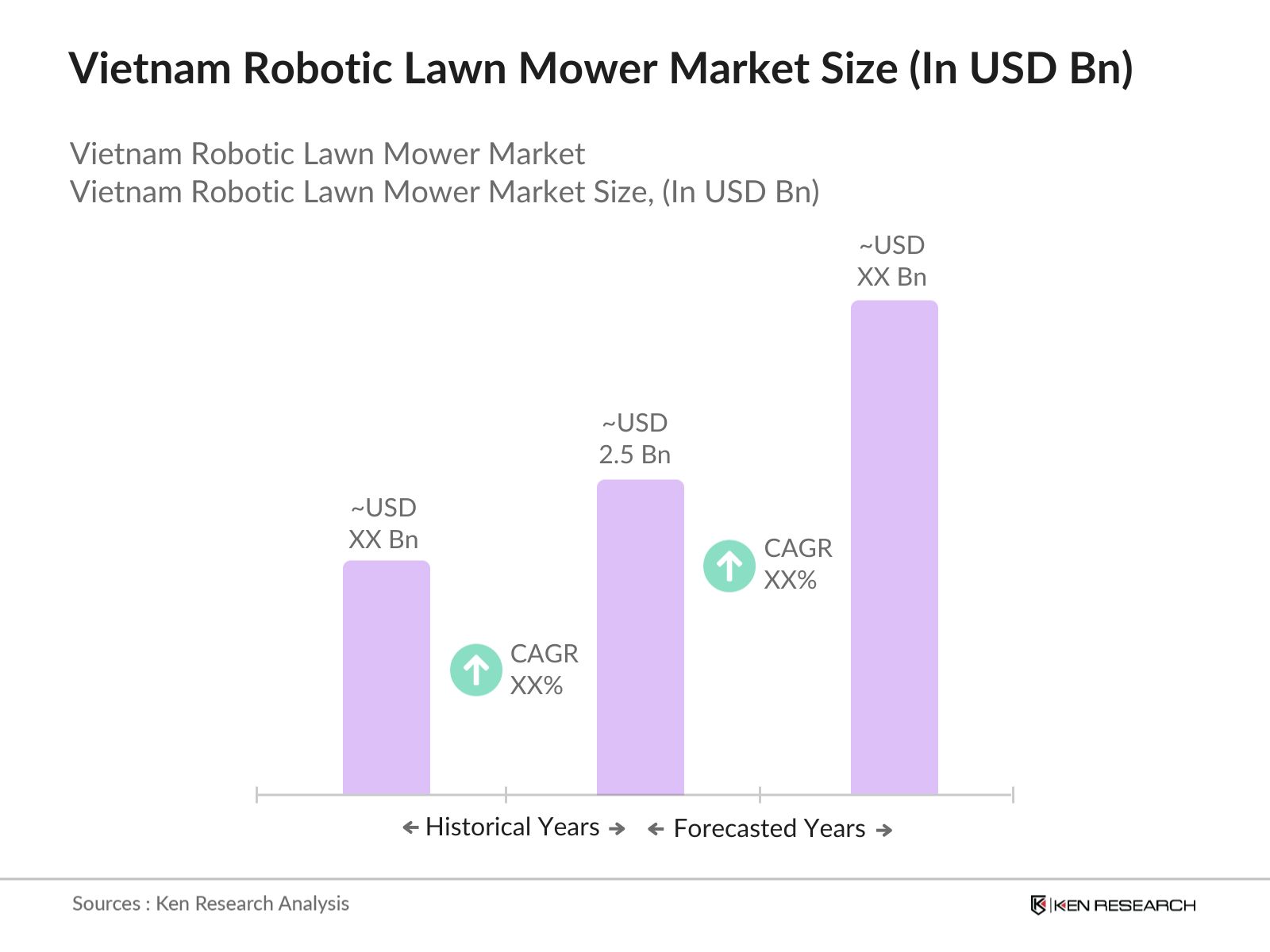
- The Vietnam robotic lawn mower market, valued at USD 2.5 billion, is driven by increasing demand for convenient, low-maintenance landscaping solutions in residential and commercial properties. As urbanization continues to expand in Vietnam, homeowners and property managers are investing more in automated technologies that reduce the need for manual upkeep, particularly for tasks such as lawn mowing. The push for sustainable, energy-efficient solutions has also played a significant role, as battery-powered robotic mowers align well with environmental goals.
- Key urban centers, including Hanoi and Ho Chi Minh City, are the most prominent contributors to the market. The dominance of these cities is due to the concentration of higher-income households, larger property sizes, and commercial landscapes that require regular maintenance. Ho Chi Minh City, with its expansive residential and commercial development, exhibits a particularly high adoption rate.
- In 2023, manufacturers have focused on creating compact and cost-effective models that cater specifically to the needs of consumers in densely populated areas, where smaller lawns are common.This shift is driven by the increasing urbanization in Vietnam, which has led to a demand for efficient lawn care solutions that save time and effort.
Vietnam Robotic Lawn Mower Market Segmentation
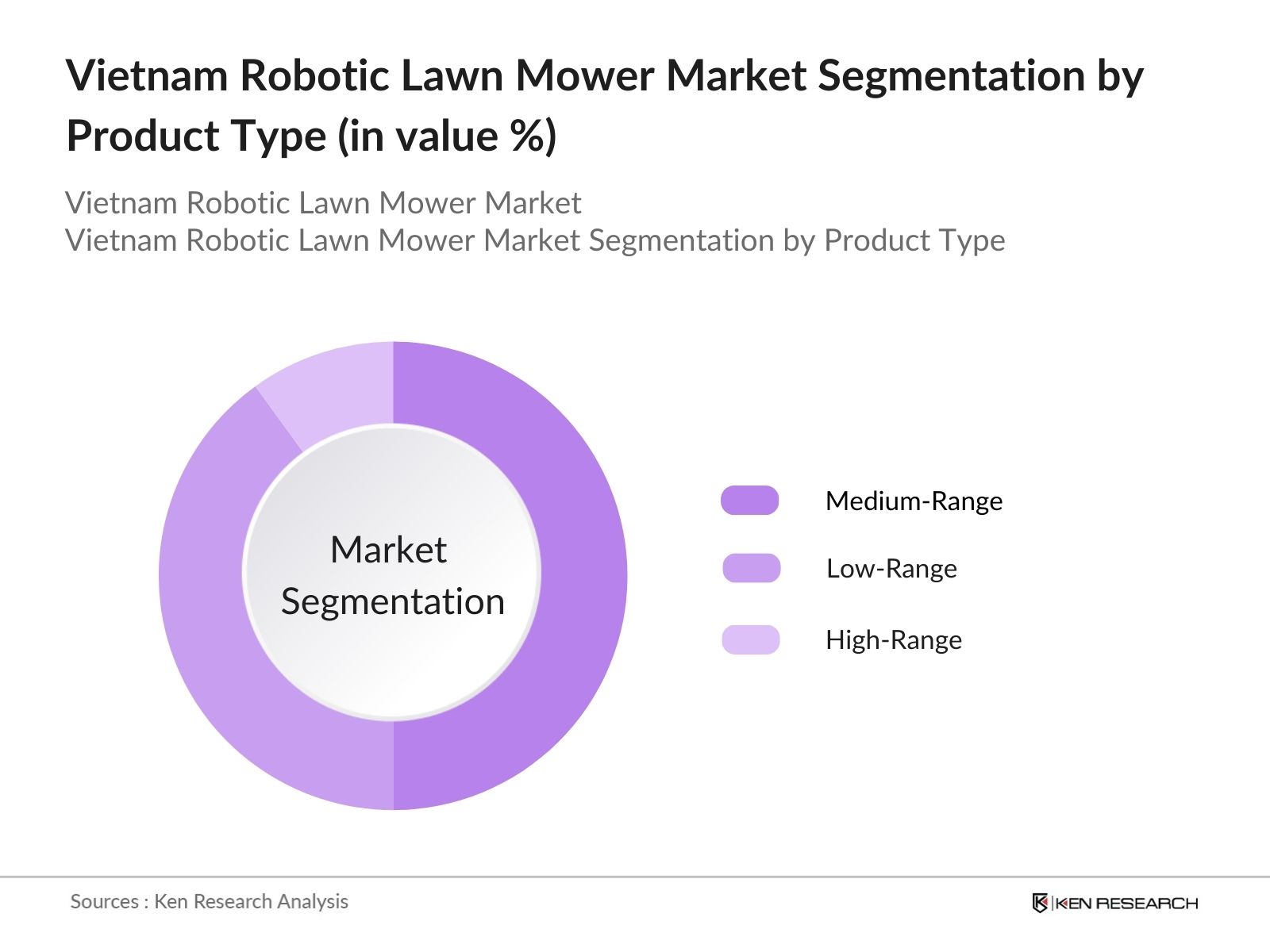
By Product Type: The Vietnam robotic lawn mower market is segmented into three major product types: low-range, medium-range, and high-range robotic lawn mowers. Medium-range models currently hold the dominant share in the product type segmentation. This segments popularity is largely due to the balance it offers between price and performance. Medium-range robotic mowers are equipped with advanced features such as GPS navigation and AI-powered obstacle detection, which make them suitable for most standard residential lawns without incurring the high costs associated with premium models.
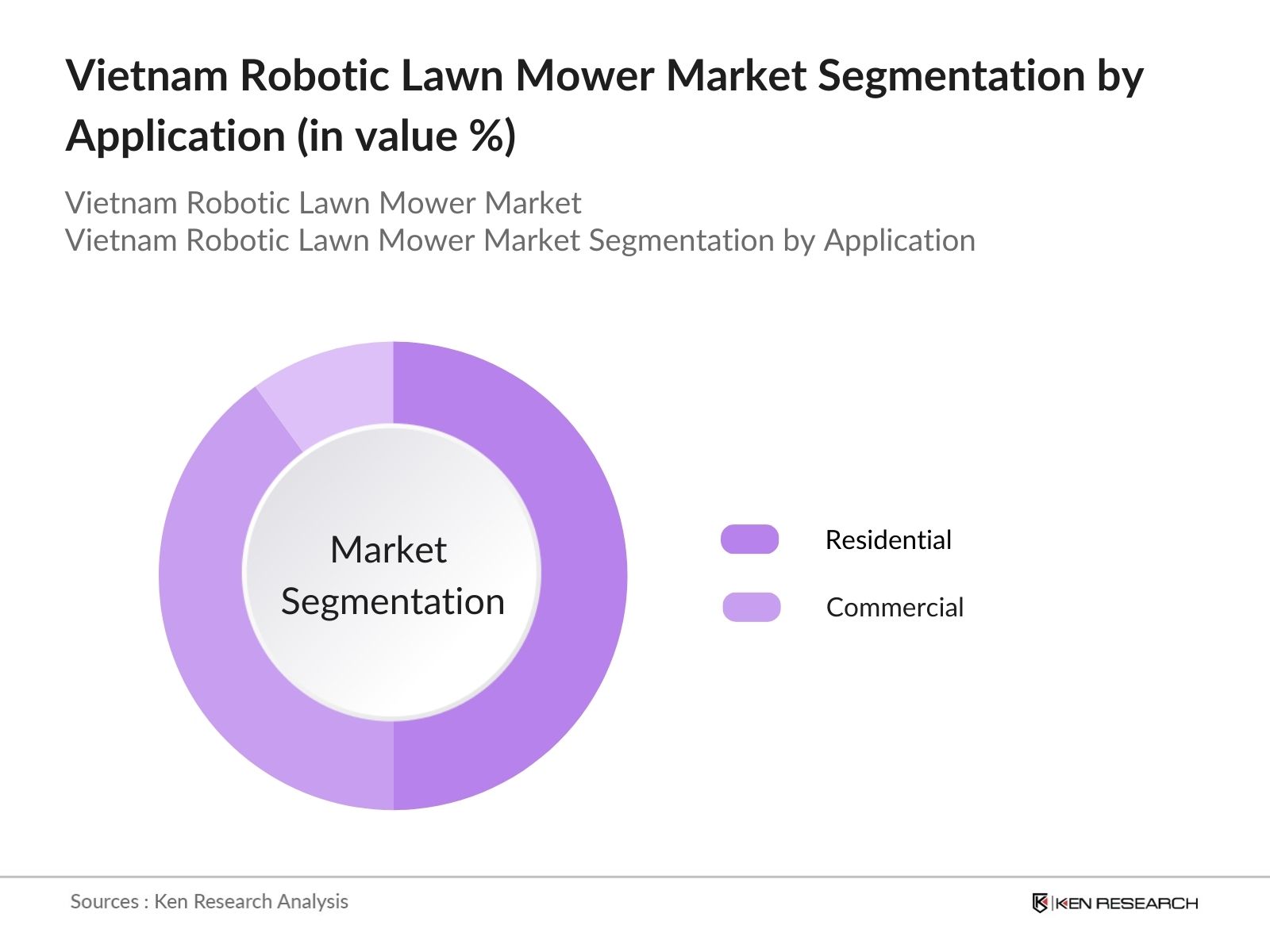
By Application: The application of robotic lawn mowers is categorized into two main segments: residential use and commercial use. In Vietnam, residential use leads the market share under the application category, as individual homeowners have shown a keen interest in automating routine tasks like lawn care. The adoption is largely driven by the growing middle and upper-middle classes, who are increasingly opting for solutions that free up personal time and reduce manual labor.
Vietnam Robotic Lawn Mower Market Competitive Landscape
The Vietnam robotic lawn mower market is characterized by a mix of established international brands and emerging players. International companies such as Husqvarna, Honda, and Bosch are prominent, capitalizing on their strong brand presence and advanced technological capabilities. These companies have successfully captured consumer trust through high-quality products that offer durability, reliability, and advanced technology. The competitive landscape is fairly consolidated, with a handful of major players controlling a significant portion of the market. This consolidation emphasizes the impact of well-established brands that leverage economies of scale, distribution networks, and continual R&D investments to sustain their leadership. Smaller or emerging players are increasingly entering the market with competitive pricing and region-specific models, aiming to attract a broader demographic, including budget-conscious consumers.
|
Company Name |
Establishment Year |
Headquarters |
Market Presence |
Technology Integration |
Regional Focus |
Revenue (USD) |
Sustainability Initiatives |
|---|---|---|---|---|---|---|---|
|
Husqvarna Group |
1689 |
Stockholm, Sweden |
- |
- |
- |
- |
- |
|
Honda Motor Co., Ltd. |
1948 |
Tokyo, Japan |
- |
- |
- |
- |
- |
|
Robert Bosch GmbH |
1886 |
Gerlingen, Germany |
- |
- |
- |
- |
- |
|
STIGA S.p.A. |
1934 |
Castelfranco, Italy |
- |
- |
- |
- |
- |
|
Zucchetti Centro Sistemi S.p.A. |
1985 |
Terranuova, Italy |
- |
- |
- |
- |
- |
Vietnam Robotic Lawn Mower Market Future Outlook
Over the next five years, the Vietnam robotic lawn mower market is expected to experience accelerated growth. Key drivers include the continuous adoption of smart technologies, such as AI and IoT, as well as the increasing awareness of eco-friendly landscaping solutions. Additionally, the expansion of distribution channels, both online and offline, will make robotic lawn mowers more accessible to a broader consumer base. Manufacturers are likely to focus on developing more affordable models to capture price-sensitive segments, alongside premium models featuring enhanced capabilities for commercial use.
Market Opportunities
- Expansion into Smart Home Integration: With the increasing adoption of smart home technologies in Vietnam, robotic lawn mowers with advanced features like IoT connectivity, voice assistant integration, and remote control via smartphone apps present significant growth opportunities. These smart features can cater to tech-savvy homeowners looking for automated solutions.
- Growing Urbanization and Landscaping Demand: The rapid urbanization and development of residential complexes, commercial spaces, and green urban projects in Vietnam create a rising demand for landscaping and lawn maintenance. This trend can drive the adoption of robotic lawn mowers, especially in high-end residential and commercial properties seeking efficient and eco-friendly solutions.
Scope of the Report
|
Segment |
Sub-Segments |
|---|---|
|
By Range |
Low-Range Robotic Lawn Mowers |
|
By End User |
Residential Users |
|
By Distribution Channel |
Retail Stores |
|
By Battery Capacity |
Up to 20V |
|
By Region |
North |
Products
Key Target Audience
Robotic Lawn Mower Manufacturers
Component Suppliers
Residential Property Developers
Commercial Landscaping Companies
Retailers and Distributors
Investors and Venture Capitalist Firms
Government and Regulatory Bodies (e.g., Ministry of Industry and Trade)
Environmental Organizations
Companies
Players Mentioned in the Report:
Husqvarna Group
Honda Motor Co., Ltd.
Robert Bosch GmbH
STIGA S.p.A.
Zucchetti Centro Sistemi S.p.A.
Deere & Company
MTD Products Inc.
The Toro Company
AL-KO Kober SE
Worx (Positec Tool Corporation)
Table of Contents
1. Vietnam Robotic Lawn Mower Market Overview
1.1 Definition and Scope
1.2 Market Taxonomy
1.3 Market Growth Rate
1.4 Market Segmentation Overview
2. Vietnam Robotic Lawn Mower Market Size (In USD Million)
2.1 Historical Market Size
2.2 Year-On-Year Growth Analysis
2.3 Key Market Developments and Milestones
3. Vietnam Robotic Lawn Mower Market Analysis
3.1 Growth Drivers
3.1.1 Urbanization and Landscaping Trends
3.1.2 Technological Advancements in Automation
3.1.3 Rising Disposable Income
3.1.4 Environmental Sustainability Awareness
3.2 Market Challenges
3.2.1 High Initial Investment Costs
3.2.2 Limited Consumer Awareness
3.2.3 Technical and Maintenance Issues
3.3 Opportunities
3.3.1 Expansion into Commercial Landscaping
3.3.2 Integration with Smart Home Systems
3.3.3 Government Initiatives for Green Spaces
3.4 Trends
3.4.1 Adoption of IoT and AI Technologies
3.4.2 Development of Energy-Efficient Models
3.4.3 Increased Use of Mobile Applications for Control
3.5 Government Regulations
3.5.1 Environmental Protection Laws
3.5.2 Import and Export Policies
3.5.3 Safety Standards for Robotic Equipment
3.6 SWOT Analysis
3.7 Stakeholder Ecosystem
3.8 Porters Five Forces Analysis
3.9 Competitive Landscape
4. Vietnam Robotic Lawn Mower Market Segmentation
4.1 By Range (In Value %)
4.1.1 Low-Range Robotic Lawn Mowers
4.1.2 Medium-Range Robotic Lawn Mowers
4.1.3 High-Range Robotic Lawn Mowers
4.2 By End User (In Value %)
4.2.1 Residential Users
4.2.2 Commercial Users
4.3 By Distribution Channel (In Value %)
4.3.1 Retail Stores
4.3.2 Online Platforms
4.4 By Battery Capacity (In Value %)
4.4.1 Up to 20V
4.4.2 20V to 30V
4.4.3 More than 30V
4.5 By Region (In Value %)
4.5.1 Northern Vietnam
4.5.2 Central Vietnam
4.5.3 Southern Vietnam
5. Vietnam Robotic Lawn Mower Market Competitive Analysis
5.1 Detailed Profiles of Major Companies
5.1.1 Husqvarna Group
5.1.2 Robert Bosch GmbH
5.1.3 Deere & Company
5.1.4 Honda Motor Co., Ltd.
5.1.5 STIGA S.p.A.
5.1.6 The Toro Company
5.1.7 MTD Products Inc.
5.1.8 Zucchetti Centro Sistemi S.p.A.
5.1.9 AL-KO KOBER SE
5.1.10 Yamabiko Corporation
5.1.11 Emak S.p.A.
5.1.12 Makita Corporation
5.1.13 Stanley Black & Decker, Inc.
5.1.14 Hitachi Koki Co., Ltd.
5.1.15 Greenworks Tools
5.2 Cross Comparison Parameters (Number of Employees, Headquarters, Inception Year, Revenue, Product Portfolio, Market Share, R&D Investment, Regional Presence)
5.3 Market Share Analysis
5.4 Strategic Initiatives
5.5 Mergers and Acquisitions
5.6 Investment Analysis
5.7 Venture Capital Funding
5.8 Government Grants
5.9 Private Equity Investments
6. Vietnam Robotic Lawn Mower Market Regulatory Framework
6.1 Environmental Standards
6.2 Compliance Requirements
6.3 Certification Processes
7. Vietnam Robotic Lawn Mower Future Market Size (In USD Million)
7.1 Future Market Size Projections
7.2 Key Factors Driving Future Market Growth
8. Vietnam Robotic Lawn Mower Future Market Segmentation
8.1 By Range (In Value %)
8.2 By End User (In Value %)
8.3 By Distribution Channel (In Value %)
8.4 By Battery Capacity (In Value %)
8.5 By Region (In Value %)
9. Vietnam Robotic Lawn Mower Market Analysts Recommendations
9.1 Total Addressable Market (TAM), Serviceable Available Market (SAM), and Serviceable Obtainable Market (SOM) Analysis
9.2 Customer Cohort Analysis
9.3 Marketing Initiatives
9.4 White Space Opportunity Analysis
Disclaimer Contact UsResearch Methodology
Step 1: Identification of Key Variables
The initial phase involves constructing an ecosystem map encompassing all major stakeholders within the Vietnam Robotic Lawn Mower Market. This step is supported by extensive desk research, utilizing a combination of secondary and proprietary databases to gather comprehensive industry-level information. The primary objective is to identify and define the critical variables that influence market dynamics.
Step 2: Market Analysis and Construction
In this phase, we compile and analyze historical data related to market penetration, the ratio of marketplaces to service providers, and the resultant revenue generation. Furthermore, service quality statistics are assessed to ensure the reliability and accuracy of revenue estimates, based on historical data and trends.
Step 3: Hypothesis Validation and Expert Consultation
Market hypotheses are developed and subsequently validated through computer-assisted telephone interviews (CATIs) with industry experts representing a diverse range of companies. These consultations provide valuable operational and financial insights, which are instrumental in refining and corroborating the market data.
Step 4: Research Synthesis and Final Output
The final phase involves direct engagement with multiple robotic lawn mower manufacturers to acquire detailed insights into product segments, sales performance, consumer preferences, and other pertinent factors. This interaction serves to verify and complement the statistics derived from the bottom-up approach, thereby ensuring a comprehensive, accurate, and validated analysis of the Vietnam Robotic Lawn Mower market.
Frequently Asked Questions
01. How big is the Vietnam Robotic Lawn Mower Market?
The Vietnam Robotic Lawn Mower Market is valued at USD 2.5 billion, driven by the increasing adoption of automated solutions in residential and commercial landscaping.
02. What are the challenges in the Vietnam Robotic Lawn Mower Market?
Challenges in the Vietnam Robotic Lawn Mower Market include high initial investment costs, technical limitations in varied terrains, and limited consumer awareness, which may hinder market growth.
03. Who are the major players in the Vietnam Robotic Lawn Mower Market?
Key players in the Vietnam Robotic Lawn Mower Market include Husqvarna Group, Honda Motor Co., Ltd., Robert Bosch GmbH, STIGA S.p.A., and Zucchetti Centro Sistemi S.p.A., dominating due to technological innovation and extensive distribution networks.
04. What are the growth drivers of the Vietnam Robotic Lawn Mower Market?
Growth drivers of Vietnam Robotic Lawn Mower Market encompass urbanization, technological advancements in automation, rising disposable income levels, and environmental sustainability initiatives.
Why Buy From Us?

What makes us stand out is that our consultants follows Robust, Refine and Result (RRR) methodology. i.e. Robust for clear definitions, approaches and sanity checking, Refine for differentiating respondents facts and opinions and Result for presenting data with story

We have set a benchmark in the industry by offering our clients with syndicated and customized market research reports featuring coverage of entire market as well as meticulous research and analyst insights.

While we don't replace traditional research, we flip the method upside down. Our dual approach of Top Bottom & Bottom Top ensures quality deliverable by not just verifying company fundamentals but also looking at the sector and macroeconomic factors.

With one step in the future, our research team constantly tries to show you the bigger picture. We help with some of the tough questions you may encounter along the way: How is the industry positioned? Best marketing channel? KPI's of competitors? By aligning every element, we help maximize success.

Our report gives you instant access to the answers and sources that other companies might choose to hide. We elaborate each steps of research methodology we have used and showcase you the sample size to earn your trust.

If you need any support, we are here! We pride ourselves on universe strength, data quality, and quick, friendly, and professional service.