
Vietnam Supermarket Chain Market Outlook to 2030
Region:Asia
Author(s):Sanjeev
Product Code:KROD10168
October 2024
98
About the Report
Vietnam Supermarket Chain Market Overview
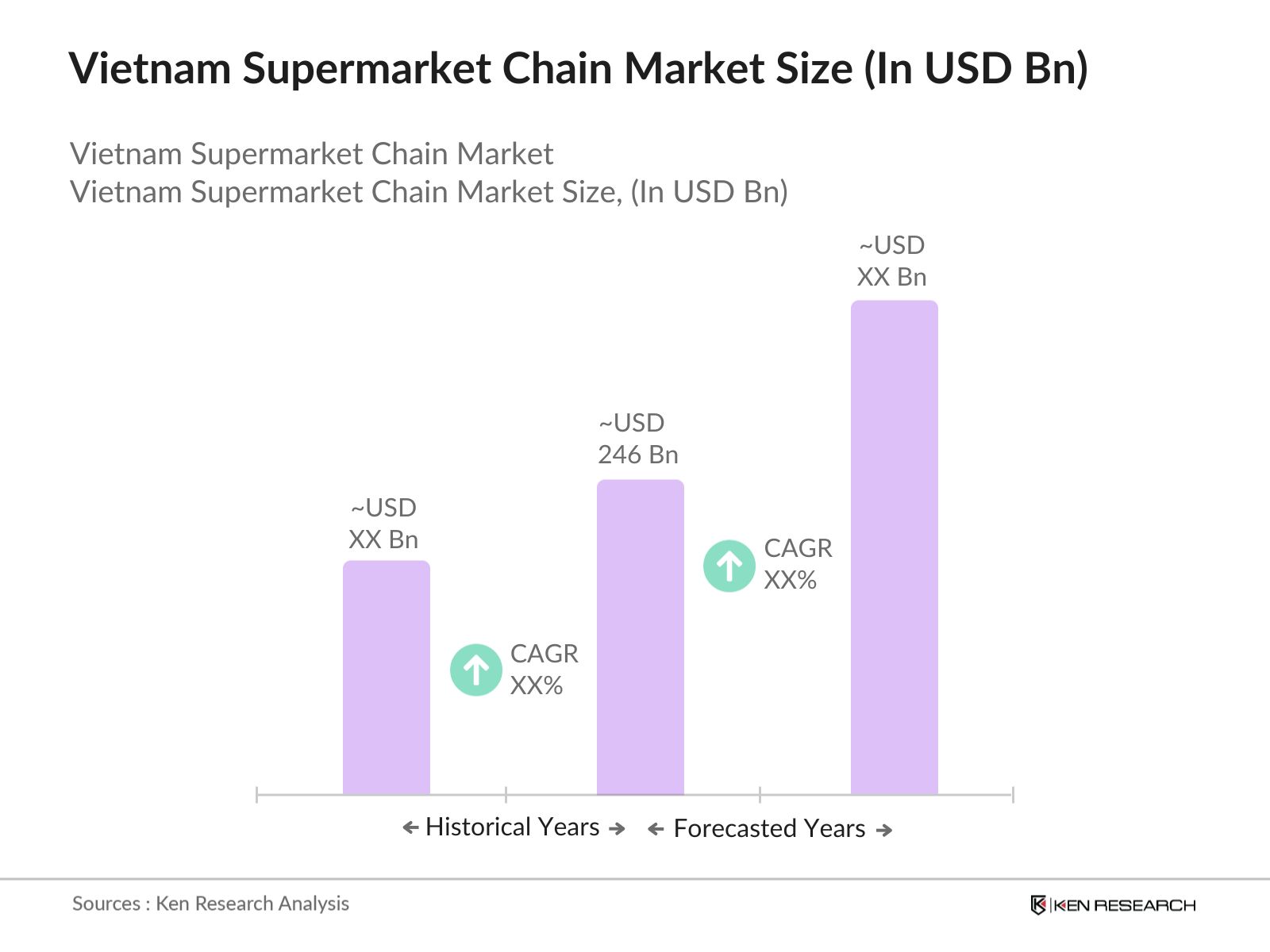
The Vietnam supermarket chain market is valued at USD 246 billion. This market is driven by the rapid expansion of urban centers and increasing disposable incomes among the middle class, especially in key metropolitan areas. Supermarkets are becoming the preferred shopping destination for convenience and accessibility, further encouraged by government support for modern trade infrastructure and foreign investment in retail sectors. Vietnams growing retail sector has seen a significant shift from traditional wet markets to modern supermarkets and hypermarkets due to these factors.
 Dominant cities such as Hanoi and Ho Chi Minh City play a crucial role in this market. These cities are characterized by higher urbanization rates, better infrastructure, and the presence of an affluent consumer base that favors modern retail formats. Moreover, these cities attract foreign retailers due to the higher spending power of their population and a robust demand for imported products, which is limited in other parts of the country.Vietnams trade and retail sector is heavily regulated, with stringent licensing requirements for both domestic and foreign retailers. According to the Ministry of Industry and Trade, retailers must obtain various permits, including those for food safety and product quality, before establishing new stores. In 2023, the government simplified these procedures as part of its efforts to attract foreign investments, reducing the processing time for retail licenses from 90 to 45 days. However, navigating these regulations remains a challenge for smaller retailers and foreign companies looking to enter the market.
Vietnam Supermarket Chain Market Segmentation
Vietnams supermarket chain market is segmented by store format and by product category.
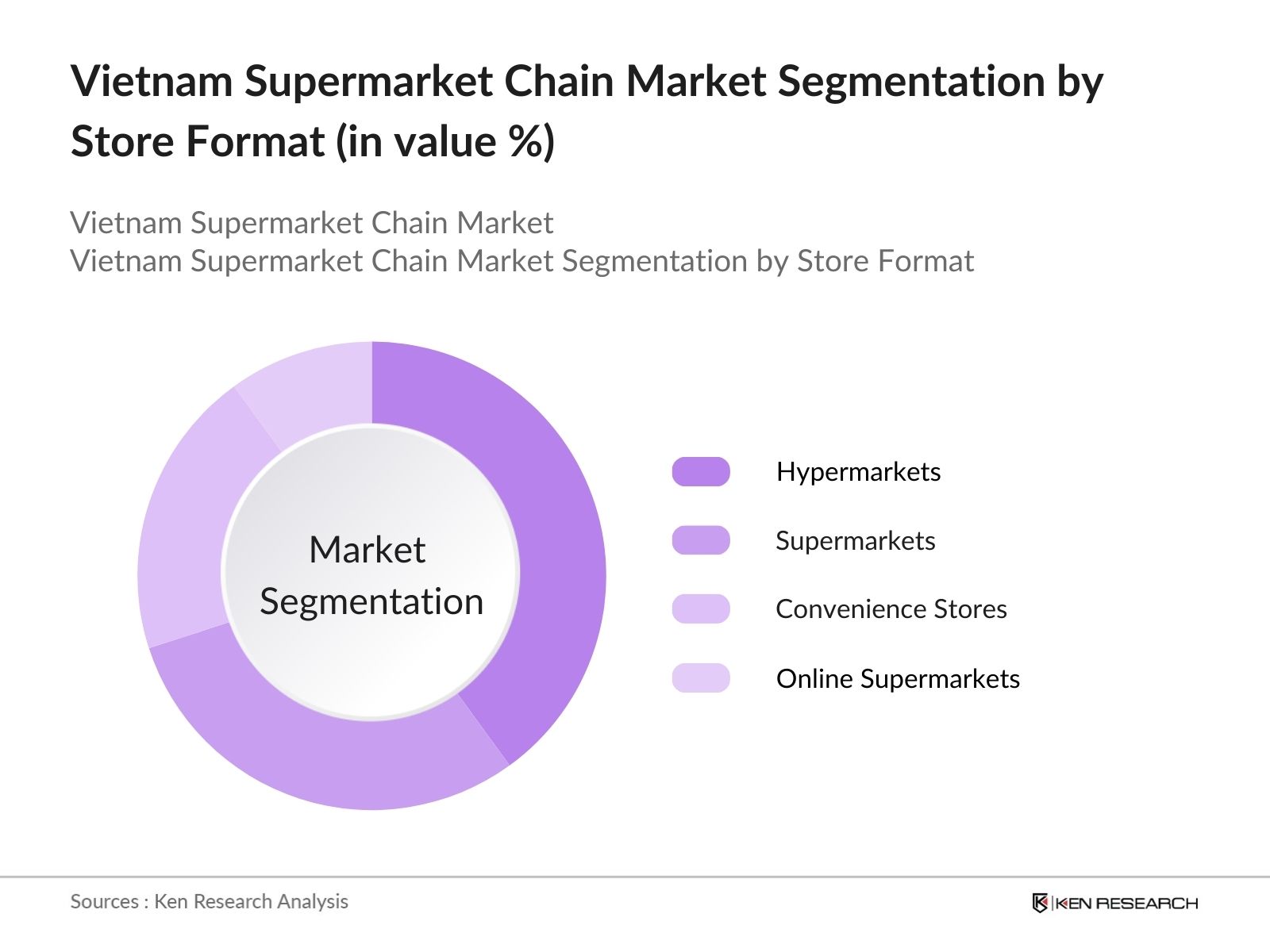
- By Store Format: The market is segmented by store format into hypermarkets, supermarkets, convenience stores, and online supermarkets. Recently, hypermarkets have seen a dominant market share within this segmentation due to their extensive product variety and the ability to offer competitive pricing through economies of scale. Key brands like Big C and MM Mega Market have built a strong presence in this segment, leveraging large retail spaces and bulk purchasing options for consumers. Consumers are drawn to hypermarkets due to their ability to meet the needs of bulk buyers and provide a wide selection of products under one roof, often accompanied by promotional pricing.
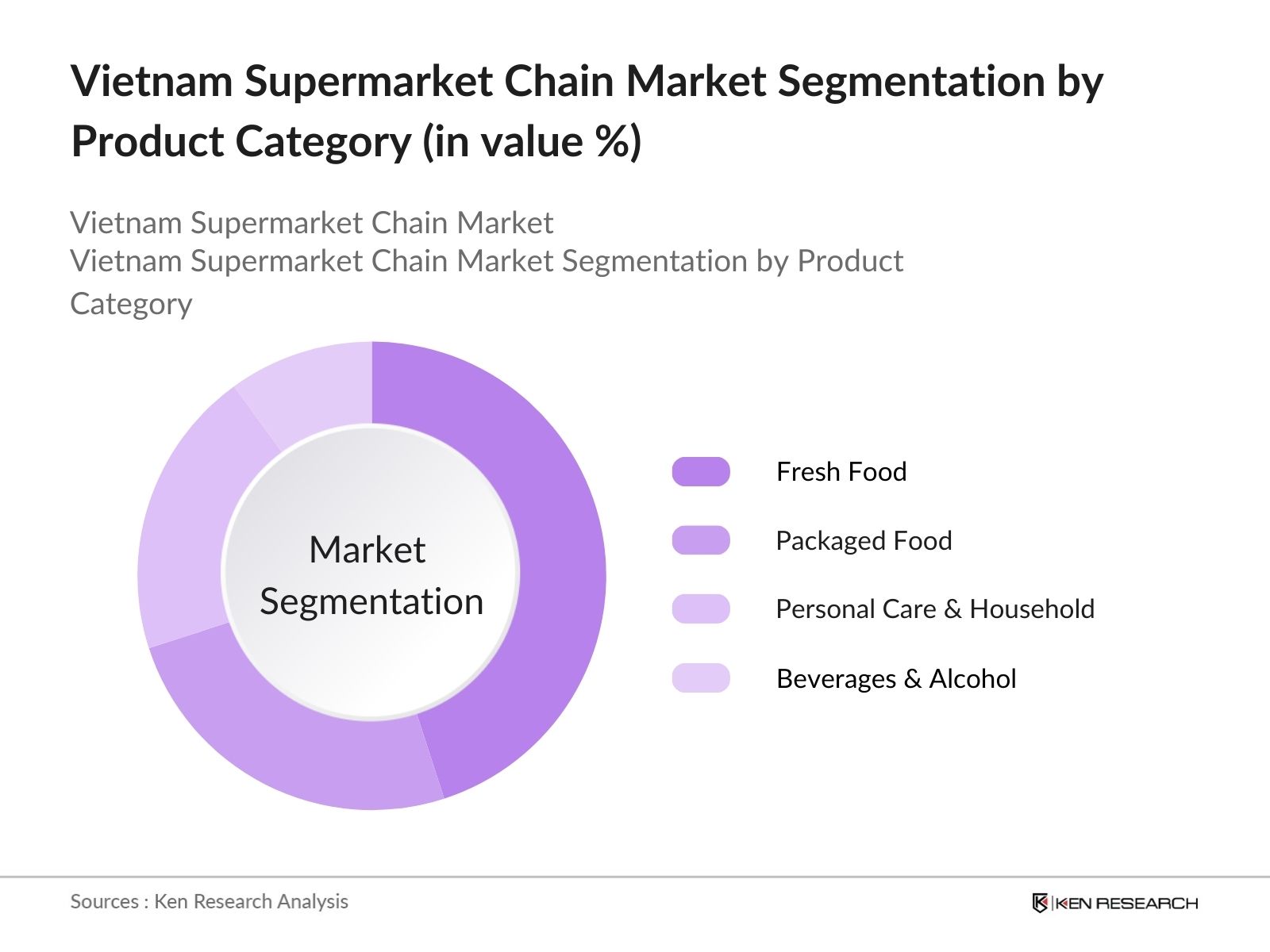
- By Product Category: The market is also segmented by product category into fresh food, packaged food, personal care & household products, and beverages & alcohol. Fresh food, particularly in categories like fruits, vegetables, and meats, holds a dominant market share due to the rising consumer preference for fresh and locally sourced products. Consumers in Vietnam prioritize freshness in their grocery shopping, and supermarkets have developed supply chains and partnerships with local farmers to ensure the timely availability of fresh produce. This consumer preference for health and freshness aligns with the increasing trend towards healthier eating habits in urban areas.
Vietnam Supermarket Chain Market Competitive Landscape
The Vietnam supermarket chain market is dominated by several local and international players. The market has become highly competitive as global brands enter the Vietnamese retail sector and local chains expand their reach. Supermarket chains like Saigon Co.op and VinMart have maintained their dominance by expanding their footprint across urban and suburban areas, leveraging technology in operations, and investing in omnichannel retail strategies.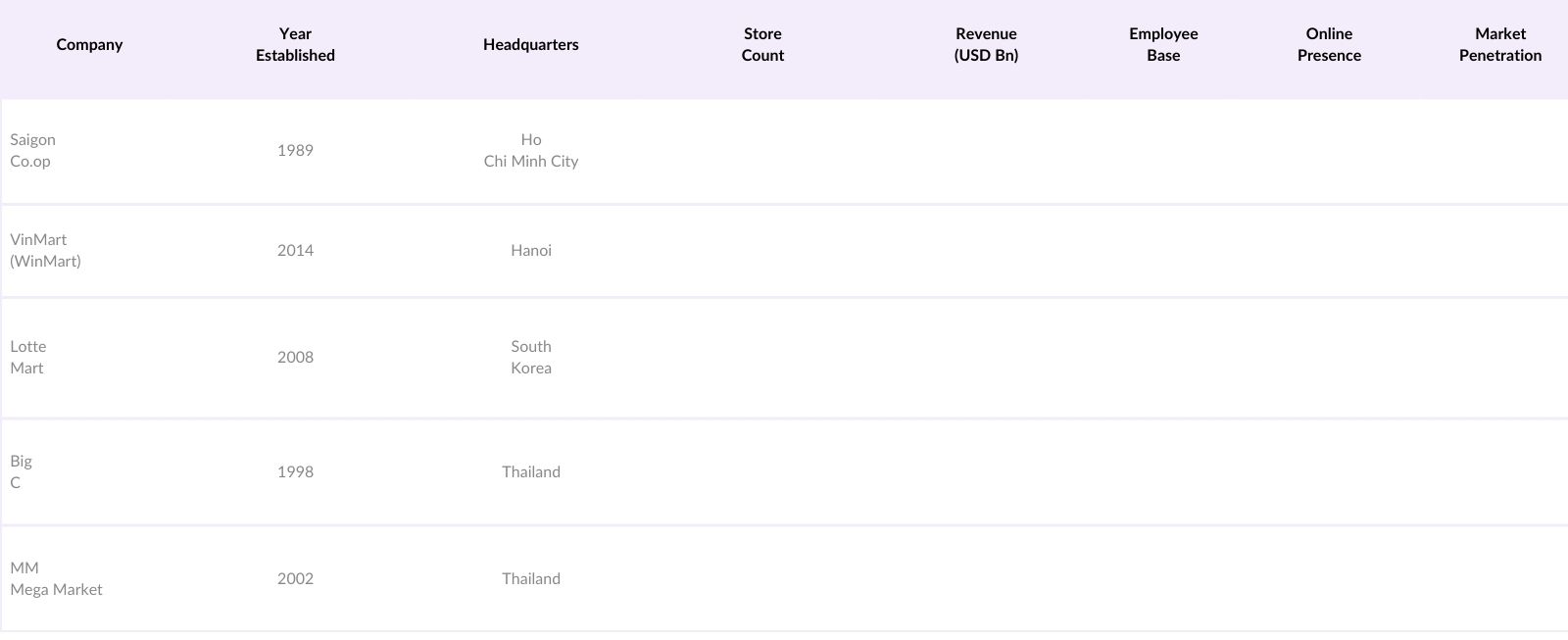
Vietnam Supermarket Chain Market Analysis
Growth Drivers
- Urbanization and Changing Consumer Behavior: Urbanization in Vietnam has increased significantly, with approximately 38 million people living in urban areas as of 2024, a number that has grown steadily since 2022. This shift in population has directly influenced consumer behavior, as urban consumers demand more convenience, diverse products, and modern retail formats. Supermarkets have become central to this transformation, offering tailored shopping experiences that cater to time-constrained city dwellers. The rapid urban expansion in cities like Ho Chi Minh and Hanoi has led to greater demand for organized retail outlets. These trends are supported by data from Vietnam's Ministry of Planning and Investment, highlighting increased urban infrastructure development.
- Rising Middle-Class Income: Vietnams middle-class population is projected to exceed 25 million by 2025, fueled by economic growth, job creation, and rising incomes in both urban and rural areas. This income growth has been a significant driver for the supermarket chain market, as middle-class consumers have more disposable income to spend on premium products, imported goods, and convenience. As of 2024, the average household income in urban Vietnam is estimated to be over 160 million VND per year, according to government statistics. This financial shift supports greater spending in supermarkets and retail chains.
- Expansion of E-commerce Integration: Vietnam's e-commerce market, which was valued at over $23 billion in 2023, is playing a pivotal role in supermarket chains' growth as they increasingly integrate online platforms with their brick-and-mortar stores. Supermarkets now offer hybrid models with home delivery, click-and-collect services, and mobile apps, significantly enhancing consumer convenience. Companies like VinMart and Co.opmart have invested in e-commerce capabilities to cater to the tech-savvy younger demographic. The General Statistics Office of Vietnam reports a surge in online shopping behavior, with 57% of the population purchasing groceries online in 2024.
Market Challenges
- Infrastructure Gaps in Rural Areas: Despite rapid urbanization, Vietnams rural areas still face significant infrastructure challenges that limit supermarket expansion. Many regions lack reliable transportation networks and power supply systems, making it difficult for retailers to build and maintain modern supermarkets. The Ministry of Transport in Vietnam has reported that only 65% of rural roads are paved, impacting the distribution logistics of supermarket chains. Additionally, limited access to cold storage facilities in these areas hampers the distribution of perishable goods, increasing operational challenges for supermarket chains targeting rural consumers.
- Intense Competition from Local Retailers: The rise of local grocery stores and traditional markets remains a significant challenge for supermarket chains in Vietnam. Local retailers, known as "wet markets," have deep roots in both urban and rural communities, accounting for about 65% of total grocery sales in the country, as of 2023, according to government data. These markets offer low-cost products and cater to traditional shopping habits, making it challenging for supermarket chains to capture market share. The Vietnam Chamber of Commerce and Industry has identified this competition as a key obstacle to modern retail growth, especially in rural areas where price sensitivity is high.
Vietnam Supermarket Chain Market Future Outlook
Over the next five years, the Vietnam supermarket chain market is expected to experience significant growth driven by continuous urbanization, increasing consumer purchasing power, and the expansion of digital retail channels. The rise of e-commerce and online grocery shopping, combined with the ongoing investments in improving logistics and supply chain infrastructure, will be key drivers for this growth. Supermarkets are likely to adopt a more omnichannel approach to meet the demands of tech-savvy, convenience-driven consumers, while expanding into rural areas to tap into the growing demand for modern retail formats.
Market Opportunities
- Growth in Health-Conscious and Organic Product Demand: The demand for organic and health-conscious products has grown in Vietnam, with the countrys organic food market expanding by 30% between 2022 and 2023. Supermarket chains are capitalizing on this trend by introducing organic sections and partnering with local organic farms. In 2024, more than 2,000 supermarkets in Vietnam offered organic product lines, compared to just 1,200 in 2022. This shift is partly driven by increasing consumer awareness of food safety and health, particularly in urban areas, where lifestyle diseases such as diabetes and hypertension are on the rise, according to the Ministry of Health.
- Expansion into Second and Third-Tier Cities: Vietnams second and third-tier cities, such as Da Nang, Can Tho, and Hai Phong, are emerging as significant opportunities for supermarket chains due to their growing populations and increasing consumer demand. The Ministry of Construction projects that these cities will experience population growth rates of over 4% annually from 2023 to 2025. This urban expansion, combined with rising household incomes in these areas, presents a lucrative opportunity for supermarket chains to expand beyond Ho Chi Minh City and Hanoi. As of 2024, several major supermarket chains have announced plans to open a combined 200 new stores in these regions.
Scope of the Report
|
||
|
By Product Category |
Fresh Food |
|
|
By Ownership Model |
Chain Supermarkets |
|
|
By Customer Type |
Residential Consumers |
|
|
By Region |
North East West South |
Products
Key Target Audience
Retail and Supermarket Chains
Food and Beverage Manufacturers
Consumer Goods Suppliers
Real Estate Developers
Logistics and Supply Chain Companies
Investors and Venture Capital Firms
Government and Regulatory Bodies (Ministry of Industry and Trade, Ministry of Planning and Investment)
E-commerce and Payment Gateway Providers
Companies
Players Mentioned in the Report:
Saigon Co.op
VinMart (WinMart)
Lotte Mart
Big C
MM Mega Market
Bach Hoa Xanh
Circle K Vietnam
FamilyMart
AEON Vietnam
Satra
Emart Vietnam
VinMart+
Tops Market Vietnam
Intimex Supermarkets
Co.opXtra
Table of Contents
1. Vietnam Supermarket Chain Market Overview
1.1. Definition and Scope
1.2. Market Taxonomy
1.3. Market Dynamics Overview
1.4. Market Segmentation Overview
2. Vietnam Supermarket Chain Market Size (In USD Mn)
2.1. Historical Market Size
2.2. Year-On-Year Growth Analysis
2.3. Key Market Developments and Milestones
3. Vietnam Supermarket Chain Market Analysis
3.1. Growth Drivers
3.1.1. Urbanization and Changing Consumer Behavior
3.1.2. Rising Middle-Class Income
3.1.3. Expansion of E-commerce Integration
3.1.4. Government Initiatives Supporting Retail Expansion
3.2. Market Challenges
3.2.1. Infrastructure Gaps in Rural Areas
3.2.2. Intense Competition from Local Retailers
3.2.3. High Operational Costs (Energy, Staffing)
3.3. Opportunities
3.3.1. Growth in Health-Conscious and Organic Product Demand
3.3.2. Expansion into Second and Third-Tier Cities
3.3.3. Collaboration with Digital Payment Providers
3.4. Trends
3.4.1. Rise of Convenience Store Formats in Urban Areas
3.4.2. Integration of Loyalty Programs and AI-driven Personalization
3.4.3. Sustainability Initiatives in Packaging and Waste Reduction
3.5. Government Regulations
3.5.1. Trade and Retail Licensing Laws
3.5.2. Food Safety Standards
3.5.3. Environmental and Waste Management Regulations
3.6. SWOT Analysis
3.7. Stakeholder Ecosystem
3.8. Porters Five Forces
3.9. Competition Ecosystem
4. Vietnam Supermarket Chain Market Segmentation
4.1. By Store Format (In Value %)
4.1.1. Hypermarkets
4.1.2. Supermarkets
4.1.3. Convenience Stores
4.1.4. Online Supermarkets
4.2. By Product Category (In Value %)
4.2.1. Fresh Food
4.2.2. Packaged Food
4.2.3. Personal Care & Household Products
4.2.4. Beverages & Alcohol
4.3. By Ownership Model (In Value %)
4.3.1. Chain Supermarkets
4.3.2. Independent Operators
4.4. By Customer Type (In Value %)
4.4.1. Residential Consumers
4.4.2. Institutional Buyers
4.4.3. Tourists & Expatriates
4.5. By Region (In Value %)
4.5.1. North
4.5.2. West
4.5.3. East
4.5.4. South
5. Vietnam Supermarket Chain Market Competitive Analysis
5.1 Detailed Profiles of Major Companies
5.1.1. Saigon Co.op
5.1.2. VinMart (WinMart)
5.1.3. Lotte Mart
5.1.4. Big C
5.1.5. AEON Vietnam
5.1.6. MM Mega Market
5.1.7. Bach Hoa Xanh
5.1.8. Circle K Vietnam
5.1.9. FamilyMart
5.1.10. VinMart+
5.1.11. Co.opXtra
5.1.12. Emart Vietnam
5.1.13. Satra
5.1.14. Intimex Supermarkets
5.1.15. Tops Market Vietnam
5.2 Cross Comparison Parameters (Revenue, Store Footprint, Customer Base, Product Diversity, Geographic Reach, Technology Adoption, Online Integration, Loyalty Programs)
5.3 Market Share Analysis
5.4 Strategic Initiatives
5.5 Mergers and Acquisitions
5.6 Investment Analysis
5.7 Venture Capital Funding
5.8 Government Grants
5.9 Private Equity Investments
6. Vietnam Supermarket Chain Market Regulatory Framework
6.1 Trade and Retailing Policies
6.2 Compliance with Labor Laws
6.3 Licensing and Permits
6.4 Import Regulations
6.5 Local Sourcing Mandates
7. Vietnam Supermarket Chain Future Market Size (In USD Mn)
7.1 Future Market Size Projections
7.2 Key Factors Driving Future Market Growth
8. Vietnam Supermarket Chain Future Market Segmentation
8.1 By Store Format (In Value %)
8.2 By Product Category (In Value %)
8.3 By Ownership Model (In Value %)
8.4 By Customer Type (In Value %)
8.5 By Region (In Value %)
9. Vietnam Supermarket Chain Market Analysts Recommendations
9.1 TAM/SAM/SOM Analysis
9.2 Consumer Behavior Analysis
9.3 Digital Transformation Strategies
9.4 Strategic Growth Opportunities
Disclaimer
Contact Us
Research Methodology
Step 1: Identification of Key Variables
The initial step involves mapping out all stakeholders within the Vietnam supermarket chain market. This process includes desk research and consultations with industry insiders to identify the critical variables that influence market trends, such as consumer behavior, regulatory changes, and retail competition.
Step 2: Market Analysis and Construction
This phase includes a thorough analysis of historical data on market performance, consumer preferences, and store footprints. It also examines the distribution channels and the role of technology in enhancing customer experience and operational efficiency.
Step 3: Hypothesis Validation and Expert Consultation
Market hypotheses are tested through interviews with industry experts. These consultations offer insights into operational challenges, emerging trends, and future market potential, refining the accuracy of projections and forecasts.
Step 4: Research Synthesis and Final Output
In this final phase, the data gathered from both primary and secondary sources are synthesized to deliver a comprehensive and validated report. This step ensures that the insights provided are robust, actionable, and reliable for business decision-making.
Frequently Asked Questions
01. How big is the Vietnam supermarket chain market?
The Vietnam supermarket chain market is valued at USD 246 billion, driven by urbanization and the increasing preference for modern retail formats over traditional wet markets.
02. What are the challenges in the Vietnam supermarket chain market?
Key challenges in Vietnam supermarket chain market include high operational costs, competition from traditional retailers, and infrastructure gaps, particularly in rural areas, which limit the expansion of modern supermarket chains.
03. Who are the major players in the Vietnam supermarket chain market?
Leading players in Vietnam supermarket chain market include Saigon Co.op, VinMart (WinMart), Lotte Mart, Big C, and MM Mega Market, all of which have significant market penetration and wide store networks.
04. What are the growth drivers of the Vietnam supermarket chain market?
The Vietnam supermarket chain market is driven by rising disposable incomes, urbanization, consumer preference for modern retail, and increasing foreign investments in Vietnams retail sector.
05. What are the dominant segments in the Vietnam supermarket chain market?
Hypermarkets lead the Vietnam supermarket chain market due to their ability to offer a wide variety of products at competitive prices, while fresh food remains the dominant product category due to consumer preferences for local and fresh products.
Why Buy From Us?

What makes us stand out is that our consultants follows Robust, Refine and Result (RRR) methodology. i.e. Robust for clear definitions, approaches and sanity checking, Refine for differentiating respondents facts and opinions and Result for presenting data with story

We have set a benchmark in the industry by offering our clients with syndicated and customized market research reports featuring coverage of entire market as well as meticulous research and analyst insights.

While we don't replace traditional research, we flip the method upside down. Our dual approach of Top Bottom & Bottom Top ensures quality deliverable by not just verifying company fundamentals but also looking at the sector and macroeconomic factors.

With one step in the future, our research team constantly tries to show you the bigger picture. We help with some of the tough questions you may encounter along the way: How is the industry positioned? Best marketing channel? KPI's of competitors? By aligning every element, we help maximize success.

Our report gives you instant access to the answers and sources that other companies might choose to hide. We elaborate each steps of research methodology we have used and showcase you the sample size to earn your trust.

If you need any support, we are here! We pride ourselves on universe strength, data quality, and quick, friendly, and professional service.