About the Report
Base Year 2024Italy AI-Powered Cultural Heritage Tourism Market Overview
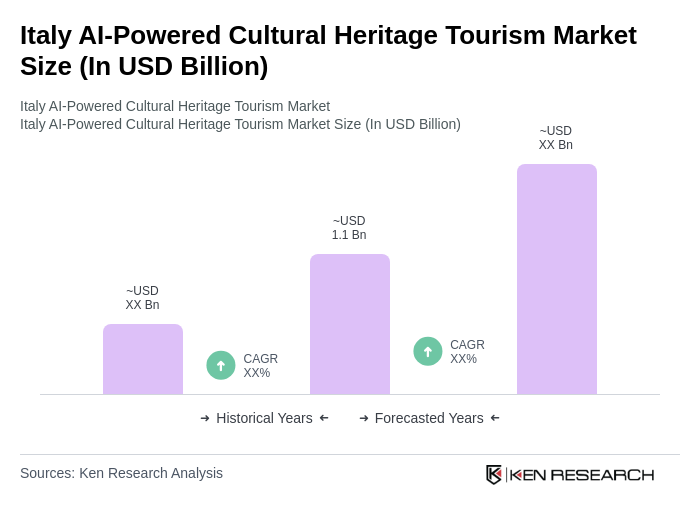
- The Italy AI-Powered Cultural Heritage Tourism Market is valued at USD 1.1 billion, based on a five-year historical analysis. This valuation reflects the increasing adoption of artificial intelligence technologies to enhance visitor experiences through personalized services, interactive digital content, and immersive storytelling. Growth is further propelled by rising digital engagement, the proliferation of smart museum solutions, and the demand for innovative travel experiences among both domestic and international tourists.
- Key cities such as Rome, Florence, and Venice continue to dominate the market due to their extensive cultural heritage and historical significance. These cities attract millions of tourists annually, supported by over 4,000 museums and 6,000 archaeological sites across Italy. The robust demand for AI-powered solutions in these locations is driven by the presence of iconic landmarks such as the Colosseum, Uffizi Gallery, and Leaning Tower of Pisa, as well as the integration of digital platforms that enhance exploration and visitor satisfaction.
- In 2023, the Italian government enacted the ITALEA Roots Tourism Program under the Ministry of Foreign Affairs and International Cooperation. This initiative allocates EUR 200 million to support the development and deployment of AI-driven applications, digital platforms, and personalized travel experiences for cultural heritage tourism. The regulation mandates compliance with digital accessibility standards and encourages partnerships between cultural institutions and technology providers to foster innovation and ensure the sustainable preservation of Italy's cultural assets.
Italy AI-Powered Cultural Heritage Tourism Market Segmentation
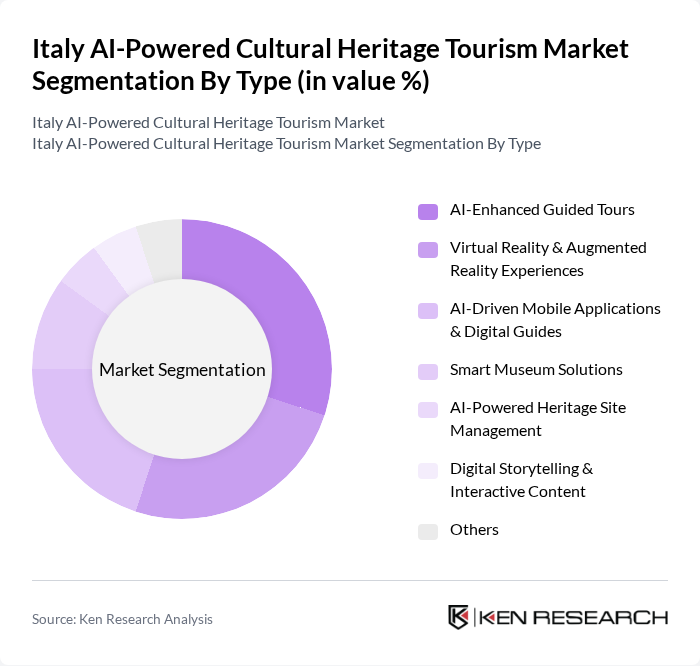
By Type:The market is segmented into AI-Enhanced Guided Tours, Virtual Reality & Augmented Reality Experiences, AI-Driven Mobile Applications & Digital Guides, Smart Museum Solutions, AI-Powered Heritage Site Management, Digital Storytelling & Interactive Content, and Others. AI-Enhanced Guided Tours are gaining significant traction due to their ability to deliver personalized, real-time information and interactive experiences to tourists. The integration of AI in guided tours and museum solutions is increasingly preferred for its capacity to boost user engagement, satisfaction, and accessibility, aligning with the latest trends in experiential and digital tourism.
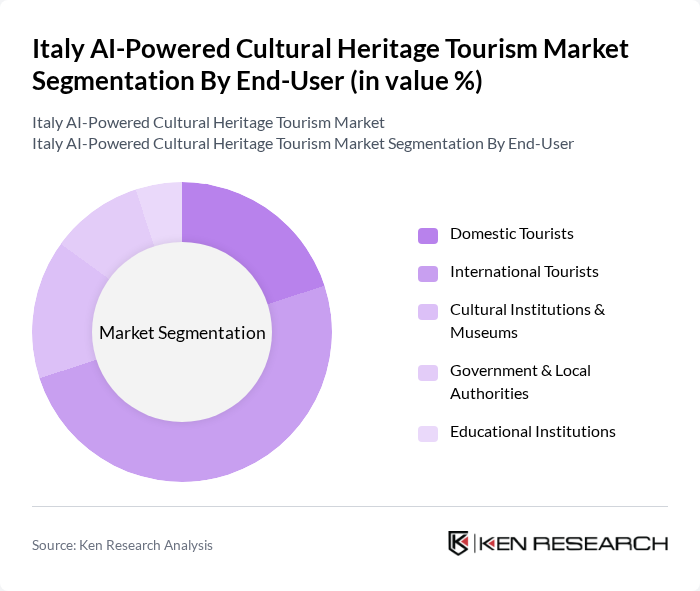
By End-User:The end-user segmentation includes Domestic Tourists, International Tourists, Cultural Institutions & Museums, Government & Local Authorities, and Educational Institutions. International Tourists represent the largest segment, driven by the influx of visitors seeking immersive and authentic cultural experiences. The growing trend of experiential travel and digital engagement has led to increased demand for AI-powered solutions that cater to the unique preferences of international travelers, while cultural institutions and museums are rapidly adopting smart technologies to enhance accessibility and visitor satisfaction.
Italy AI-Powered Cultural Heritage Tourism Market Competitive Landscape
The Italy AI-Powered Cultural Heritage Tourism Market is characterized by a dynamic mix of regional and international players. Leading participants such as Musement (Italy), D’Uva (Italy), Centrica (Italy), Smartify, CulturaGO, WeGoTrip, izi.TRAVEL, ARtGlass (Italy/US), Travel Appeal (Italy), GetYourGuide, Context Travel, Viator, TripAdvisor Experiences, MyWoWo (Italy), Prometheus (Italy) contribute to innovation, geographic expansion, and service delivery in this space.
Italy AI-Powered Cultural Heritage Tourism Market Industry Analysis
Growth Drivers
- Increased Digital Engagement:The Italian tourism sector has seen a significant rise in digital engagement, with over 70% of travelers using online platforms for planning trips. In future, Italy is projected to have over 50 million international tourist arrivals, contributing approximately €45 billion to the economy. This digital shift is driven by the increasing use of smartphones, with over 80% of users accessing travel-related apps, enhancing the demand for AI-powered solutions that provide personalized experiences and streamline travel planning.
- Enhanced Visitor Experience:AI technologies are transforming visitor experiences in Italy's cultural heritage sites. For instance, the introduction of AI-driven virtual guides has improved visitor satisfaction rates by approximately 30%. In future, the Italian government aims to invest over €500 million in enhancing visitor experiences through technology. This investment is expected to attract more tourists, as personalized and immersive experiences become a key differentiator in the competitive tourism landscape, driving growth in the AI-powered cultural heritage sector.
- Government Support for Tourism:The Italian government has committed to boosting tourism through various initiatives, allocating over €1 billion for tourism recovery in future. This funding supports the integration of AI technologies in cultural heritage tourism, aiming to enhance operational efficiency and visitor engagement. Additionally, government-backed programs are promoting digital transformation in the sector, encouraging local businesses to adopt AI solutions, which is expected to significantly increase the overall attractiveness of Italy as a cultural tourism destination.
Market Challenges
- High Initial Investment Costs:Implementing AI technologies in cultural heritage tourism requires substantial initial investments, often exceeding €200,000 for small to medium enterprises. Many local businesses struggle to secure funding, limiting their ability to adopt innovative solutions. In future, the average ROI for AI investments in tourism is projected to be around 15%, which may deter stakeholders from investing in necessary technologies, thereby hindering market growth and innovation in the sector.
- Data Privacy Concerns:With the rise of AI in tourism, data privacy has become a significant concern. In future, 60% of travelers express apprehension about how their personal data is used by AI systems. Compliance with GDPR regulations is mandatory, and failure to adhere can result in fines up to €22 million or 4% of annual revenue. This challenge creates a barrier for businesses looking to implement AI solutions, as they must navigate complex legal frameworks while ensuring customer trust.
Italy AI-Powered Cultural Heritage Tourism Market Future Outlook
The future of Italy's AI-powered cultural heritage tourism market appears promising, driven by technological advancements and increasing consumer demand for personalized experiences. As international tourism continues to rebound, the integration of AI with augmented reality and smart tourism solutions will likely enhance visitor engagement. Additionally, partnerships with local businesses will foster innovation and create unique offerings, positioning Italy as a leader in the cultural tourism sector. The focus on sustainable practices will further align with global tourism trends, ensuring long-term growth and resilience.
Market Opportunities
- Growth in International Tourism:With international tourist arrivals expected to reach over 50 million in future, there is a significant opportunity for AI-powered solutions to cater to diverse traveler needs. This influx can drive demand for personalized experiences, enhancing visitor satisfaction and loyalty, ultimately benefiting local economies and cultural heritage sites.
- Integration of AI with Augmented Reality:The fusion of AI and augmented reality presents a unique opportunity to create immersive experiences at cultural sites. In future, the market for AR in tourism is projected to grow to over €1 billion, allowing visitors to engage with history in innovative ways, thereby attracting tech-savvy travelers and enhancing educational value.
Scope of the Report
| Segment | Sub-Segments |
|---|---|
| By Type | AI-Enhanced Guided Tours Virtual Reality & Augmented Reality Experiences AI-Driven Mobile Applications & Digital Guides Smart Museum Solutions AI-Powered Heritage Site Management Digital Storytelling & Interactive Content Others |
| By End-User | Domestic Tourists International Tourists Cultural Institutions & Museums Government & Local Authorities Educational Institutions |
| By Application | Historical Site Interpretation Museum & Gallery Experiences Genealogy & Ancestry Tourism Cultural Festivals & Events Educational & Research Programs |
| By Distribution Channel | Online Travel Agencies (OTAs) Direct Institutional Platforms Mobile Applications Partnerships with Hotels & Tour Operators |
| By Pricing Model | Subscription-Based Pay-Per-Use Freemium & Premium Upgrades Package Deals |
| By Customer Segment | Families Solo Travelers Educational Groups Corporate & Incentive Groups |
| By Policy Support | Government Grants Tax Incentives Public-Private Partnerships EU Funding Initiatives Others |
Key Target Audience
Investors and Venture Capitalist Firms
Government and Regulatory Bodies (e.g., Italian Ministry of Cultural Heritage and Activities, Italian National Tourism Agency)
Cultural Heritage Organizations
Tourism Boards and Destination Marketing Organizations
Technology Providers and AI Solution Developers
Travel Agencies and Tour Operators
Local Municipalities and City Councils
Heritage Site Management Authorities
Players Mentioned in the Report:
Musement (Italy)
DUva (Italy)
Centrica (Italy)
Smartify
CulturaGO
WeGoTrip
izi.TRAVEL
ARtGlass (Italy/US)
Travel Appeal (Italy)
GetYourGuide
Context Travel
Viator
TripAdvisor Experiences
MyWoWo (Italy)
Prometheus (Italy)
Table of Contents
Market Assessment Phase
1. Executive Summary and Approach
2. Italy AI-Powered Cultural Heritage Tourism Market Overview
2.1 Key Insights and Strategic Recommendations
2.2 Italy AI-Powered Cultural Heritage Tourism Market Overview
2.3 Definition and Scope
2.4 Evolution of Market Ecosystem
2.5 Timeline of Key Regulatory Milestones
2.6 Value Chain & Stakeholder Mapping
2.7 Business Cycle Analysis
2.8 Policy & Incentive Landscape
3. Italy AI-Powered Cultural Heritage Tourism Market Analysis
3.1 Growth Drivers
3.1.1 Increased Digital Engagement
3.1.2 Enhanced Visitor Experience
3.1.3 Government Support for Tourism
3.1.4 Technological Advancements in AI
3.2 Market Challenges
3.2.1 High Initial Investment Costs
3.2.2 Data Privacy Concerns
3.2.3 Limited Awareness Among Stakeholders
3.2.4 Competition from Traditional Tourism
3.3 Market Opportunities
3.3.1 Growth in International Tourism
3.3.2 Integration of AI with Augmented Reality
3.3.3 Development of Smart Tourism Solutions
3.3.4 Partnerships with Local Businesses
3.4 Market Trends
3.4.1 Rise of Personalized Travel Experiences
3.4.2 Increasing Use of Mobile Applications
3.4.3 Focus on Sustainable Tourism Practices
3.4.4 Adoption of AI for Cultural Preservation
3.5 Government Regulation
3.5.1 Regulations on Data Usage
3.5.2 Guidelines for AI Implementation
3.5.3 Support for Cultural Heritage Initiatives
3.5.4 Compliance with Tourism Standards
4. SWOT Analysis
5. Stakeholder Analysis
6. Porter's Five Forces Analysis
7. Italy AI-Powered Cultural Heritage Tourism Market Market Size, 2019-2024
7.1 By Value
7.2 By Volume
7.3 By Average Selling Price
8. Italy AI-Powered Cultural Heritage Tourism Market Segmentation
8.1 By Type
8.1.1 AI-Enhanced Guided Tours
8.1.2 Virtual Reality & Augmented Reality Experiences
8.1.3 AI-Driven Mobile Applications & Digital Guides
8.1.4 Smart Museum Solutions
8.1.5 AI-Powered Heritage Site Management
8.1.6 Digital Storytelling & Interactive Content
8.1.7 Others
8.2 By End-User
8.2.1 Domestic Tourists
8.2.2 International Tourists
8.2.3 Cultural Institutions & Museums
8.2.4 Government & Local Authorities
8.2.5 Educational Institutions
8.3 By Application
8.3.1 Historical Site Interpretation
8.3.2 Museum & Gallery Experiences
8.3.3 Genealogy & Ancestry Tourism
8.3.4 Cultural Festivals & Events
8.3.5 Educational & Research Programs
8.4 By Distribution Channel
8.4.1 Online Travel Agencies (OTAs)
8.4.2 Direct Institutional Platforms
8.4.3 Mobile Applications
8.4.4 Partnerships with Hotels & Tour Operators
8.5 By Pricing Model
8.5.1 Subscription-Based
8.5.2 Pay-Per-Use
8.5.3 Freemium & Premium Upgrades
8.5.4 Package Deals
8.6 By Customer Segment
8.6.1 Families
8.6.2 Solo Travelers
8.6.3 Educational Groups
8.6.4 Corporate & Incentive Groups
8.7 By Policy Support
8.7.1 Government Grants
8.7.2 Tax Incentives
8.7.3 Public-Private Partnerships
8.7.4 EU Funding Initiatives
8.7.5 Others
9. Italy AI-Powered Cultural Heritage Tourism Market Competitive Analysis
9.1 Market Share of Key Players
9.2 Cross Comparison of Key Players
9.2.1 Company Name
9.2.2 Specialization (e.g., AI-guided tours, AR/VR, digital ticketing, smart museum solutions)
9.2.3 Group Size (Large, Medium, or Small as per industry convention)
9.2.4 Revenue Growth Rate (Italy/Europe segment)
9.2.5 Number of Cultural Heritage Sites/Projects Served
9.2.6 Customer Acquisition Cost
9.2.7 Customer Retention Rate
9.2.8 Market Penetration Rate (Italy AI-powered heritage segment)
9.2.9 Average Order Value
9.2.10 Digital Engagement Metrics (app downloads, active users, social reach)
9.2.11 Partnerships with Cultural Institutions
9.2.12 Innovation Index (AI/tech deployment in heritage context)
9.3 SWOT Analysis of Top Players
9.4 Pricing Analysis
9.5 Detailed Profile of Major Companies
9.5.1 Musement (Italy)
9.5.2 D’Uva (Italy)
9.5.3 Centrica (Italy)
9.5.4 Smartify
9.5.5 CulturaGO
9.5.6 WeGoTrip
9.5.7 izi.TRAVEL
9.5.8 ARtGlass (Italy/US)
9.5.9 Travel Appeal (Italy)
9.5.10 GetYourGuide
9.5.11 Context Travel
9.5.12 Viator
9.5.13 TripAdvisor Experiences
9.5.14 MyWoWo (Italy)
9.5.15 Prometheus (Italy)
10. Italy AI-Powered Cultural Heritage Tourism Market End-User Analysis
10.1 Procurement Behavior of Key Ministries
10.1.1 Engagement with Local Communities
10.1.2 Budget Allocation for Cultural Projects
10.1.3 Collaboration with Technology Providers
10.2 Corporate Spend on Infrastructure & Energy
10.2.1 Investment in Smart Technologies
10.2.2 Funding for Cultural Heritage Projects
10.2.3 Partnerships with Local Businesses
10.3 Pain Point Analysis by End-User Category
10.3.1 Accessibility Issues
10.3.2 Lack of Awareness
10.3.3 High Costs of AI Solutions
10.4 User Readiness for Adoption
10.4.1 Familiarity with Technology
10.4.2 Willingness to Pay for Enhanced Experiences
10.5 Post-Deployment ROI and Use Case Expansion
10.5.1 Measurement of Visitor Satisfaction
10.5.2 Analysis of Revenue Growth
10.5.3 Opportunities for Upselling
11. Italy AI-Powered Cultural Heritage Tourism Market Future Size, 2025-2030
11.1 By Value
11.2 By Volume
11.3 By Average Selling Price
Go-To-Market Strategy Phase
1. Whitespace Analysis + Business Model Canvas
1.1 Market Gaps Identification
1.2 Value Proposition Development
1.3 Revenue Streams Analysis
1.4 Key Partnerships
1.5 Customer Segmentation
1.6 Cost Structure
1.7 Channels of Distribution
2. Marketing and Positioning Recommendations
2.1 Branding Strategies
2.2 Product USPs
3. Distribution Plan
3.1 Urban Retail vs Rural NGO Tie-ups
4. Channel & Pricing Gaps
4.1 Underserved Routes
4.2 Pricing Bands
5. Unmet Demand & Latent Needs
5.1 Category Gaps
5.2 Consumer Segments
6. Customer Relationship
6.1 Loyalty Programs
6.2 After-sales Service
7. Value Proposition
7.1 Sustainability
7.2 Integrated Supply Chains
8. Key Activities
8.1 Regulatory Compliance
8.2 Branding
8.3 Distribution Setup
9. Entry Strategy Evaluation
9.1 Domestic Market Entry Strategy
9.1.1 Product Mix
9.1.2 Pricing Band
9.1.3 Packaging
9.2 Export Entry Strategy
9.2.1 Target Countries
9.2.2 Compliance Roadmap
10. Entry Mode Assessment
10.1 JV
10.2 Greenfield
10.3 M&A
10.4 Distributor Model
11. Capital and Timeline Estimation
11.1 Capital Requirements
11.2 Timelines
12. Control vs Risk Trade-Off
12.1 Ownership vs Partnerships
13. Profitability Outlook
13.1 Breakeven Analysis
13.2 Long-term Sustainability
14. Potential Partner List
14.1 Distributors
14.2 JVs
14.3 Acquisition Targets
15. Execution Roadmap
15.1 Phased Plan for Market Entry
15.1.1 Market Setup
15.1.2 Market Entry
15.1.3 Growth Acceleration
15.1.4 Scale & Stabilize
15.2 Key Activities and Milestones
15.2.1 Activity Planning
15.2.2 Milestone Tracking
Research Methodology
Phase 1: Approach1
Desk Research
- Analysis of tourism statistics from the Italian National Institute of Statistics (ISTAT)
- Review of cultural heritage reports from UNESCO and local tourism boards
- Examination of market trends and forecasts from industry publications and white papers
Primary Research
- Interviews with cultural heritage site managers and tourism operators
- Surveys conducted with tourists who have utilized AI-powered services
- Focus groups with local stakeholders, including government officials and community leaders
Validation & Triangulation
- Cross-validation of findings through multiple data sources, including academic journals and market reports
- Triangulation of insights from primary interviews with secondary data trends
- Sanity checks through expert panel reviews comprising tourism and AI specialists
Phase 2: Market Size Estimation1
Top-down Assessment
- Estimation of total tourism revenue in Italy, focusing on cultural heritage segments
- Analysis of government spending on cultural heritage preservation and promotion
- Incorporation of growth rates from AI technology adoption in tourism
Bottom-up Modeling
- Data collection from AI technology providers serving the tourism sector
- Estimation of user adoption rates among cultural heritage sites
- Calculation of average revenue per user (ARPU) for AI-powered tourism services
Forecasting & Scenario Analysis
- Multi-factor regression analysis incorporating tourism growth, AI adoption rates, and consumer preferences
- Scenario modeling based on potential regulatory changes affecting tourism and technology
- Development of baseline, optimistic, and pessimistic forecasts through 2030
Phase 3: CATI Sample Composition1
| Scope Item/Segment | Sample Size | Target Respondent Profiles |
|---|---|---|
| Cultural Heritage Site Managers | 60 | Site Directors, Operations Managers |
| Tourism Operators Utilizing AI | 50 | Business Owners, Technology Officers |
| Tourists Engaging with AI Services | 100 | Domestic and International Tourists |
| Local Government Officials | 40 | Tourism Development Officers, Cultural Affairs Managers |
| AI Technology Providers in Tourism | 40 | Product Managers, Sales Directors |
Frequently Asked Questions
What is the current value of the Italy AI-Powered Cultural Heritage Tourism Market?
The Italy AI-Powered Cultural Heritage Tourism Market is valued at approximately USD 1.1 billion, reflecting the growing adoption of AI technologies to enhance visitor experiences through personalized services and immersive storytelling.
Which cities in Italy are leading in cultural heritage tourism?
What initiatives has the Italian government taken to support cultural heritage tourism?
What types of AI-powered solutions are available in the cultural heritage tourism market?
Other Regional/Country Reports
Indonesia AI-Powered Cultural Heritage Tourism Market
Malaysia AI-Powered Cultural Heritage Tourism Market
KSA AI-Powered Cultural Heritage Tourism Market
APAC AI-Powered Cultural Heritage Tourism Market
SEA AI-Powered Cultural Heritage Tourism Market
Vietnam AI-Powered Cultural Heritage Tourism Market
Other Adjacent Reports
Qatar AI Tourism Technology Market
Mexico Virtual Reality Tourism Market
Malaysia Augmented Reality Heritage Market
Egypt Digital Museum Solutions Market
Singapore Smart Heritage Management Market
Japan Cultural Preservation Tech Market
South Africa Personalized Travel AI Market
South Korea Sustainable Cultural Tourism Market
Germany Educational Heritage Experiences Market
Kuwait Digital Storytelling Platforms Market
Why Buy From Us?

What makes us stand out is that our consultants follow Robust, Refine and Result (RRR) methodology. Robust for clear definitions, approaches and sanity checking, Refine for differentiating respondents' facts and opinions, and Result for presenting data with story.

We have set a benchmark in the industry by offering our clients with syndicated and customized market research reports featuring coverage of entire market as well as meticulous research and analyst insights.

While we don't replace traditional research, we flip the method upside down. Our dual approach of Top Bottom & Bottom Top ensures quality deliverable by not just verifying company fundamentals but also looking at the sector and macroeconomic factors.

With one step in the future, our research team constantly tries to show you the bigger picture. We help with some of the tough questions you may encounter along the way: How is the industry positioned? Best marketing channel? KPI's of competitors? By aligning every element, we help maximize success.

Our report gives you instant access to the answers and sources that other companies might choose to hide. We elaborate each steps of research methodology we have used and showcase you the sample size to earn your trust.

If you need any support, we are here! We pride ourselves on universe strength, data quality, and quick, friendly, and professional service.