About the Report
Base Year 2024Listen to the audio summary
Italy Sustainable Tourism and Eco-Hospitality Market Overview
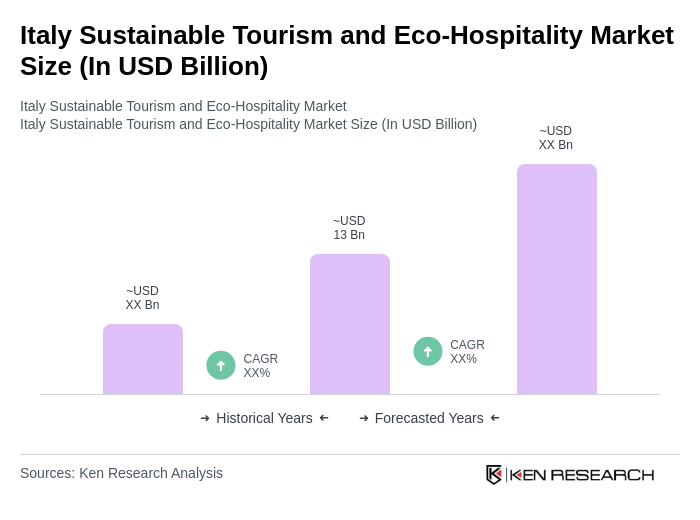
- The Italy Sustainable Tourism and Eco-Hospitality Market is valued at approximately USD 13 billion, based on a five-year historical analysis. This growth is primarily driven by increasing consumer awareness of environmental issues, a shift towards sustainable travel practices, and government initiatives promoting eco-friendly tourism. The rise in eco-conscious travelers has led to a surge in demand for sustainable accommodations and services, significantly impacting the market's expansion .
- Key cities such as Florence, Venice, and Rome dominate the market due to their rich cultural heritage, natural beauty, and established infrastructure for sustainable tourism. These cities attract a high volume of international tourists seeking eco-friendly options, supported by local policies that encourage sustainable practices in hospitality and tourism sectors. Additionally, there is a growing trend towards regional diversification, with increased interest in rural areas and lesser-known destinations, aligning with national efforts to reduce overtourism and promote authentic experiences .
- In 2023, the Italian government implemented the "National Strategy for Sustainable Tourism" (Strategia Nazionale per il Turismo Sostenibile, issued by the Ministero del Turismo, 2023), which aims to promote eco-friendly practices across the tourism sector. This strategy includes financial incentives for businesses adopting sustainable practices, such as energy-efficient technologies and waste reduction initiatives, thereby fostering a more sustainable tourism environment. The strategy mandates compliance with environmental standards and supports the adoption of circular economy principles within the hospitality industry .
Italy Sustainable Tourism and Eco-Hospitality Market Segmentation
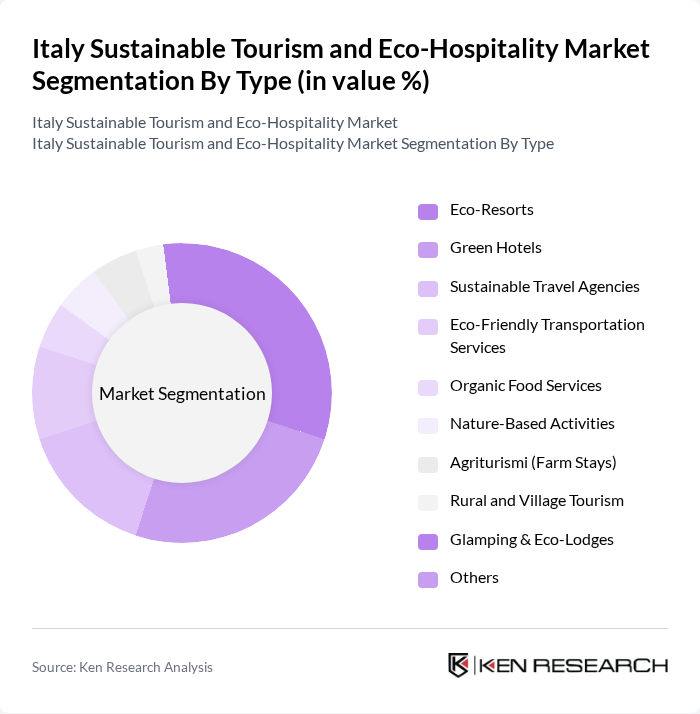
By Type:The market is segmented into various types, including Eco-Resorts, Green Hotels, Sustainable Travel Agencies, Eco-Friendly Transportation Services, Organic Food Services, Nature-Based Activities, Agriturismi (Farm Stays), Rural and Village Tourism, Glamping & Eco-Lodges, and Others. Each of these segments caters to the growing demand for sustainable travel options, with Eco-Resorts and Green Hotels leading the way due to their comprehensive sustainability practices and appeal to eco-conscious travelers. Rural and village tourism, as well as nature-based activities, are experiencing increased demand as travelers seek authentic and environmentally responsible experiences .
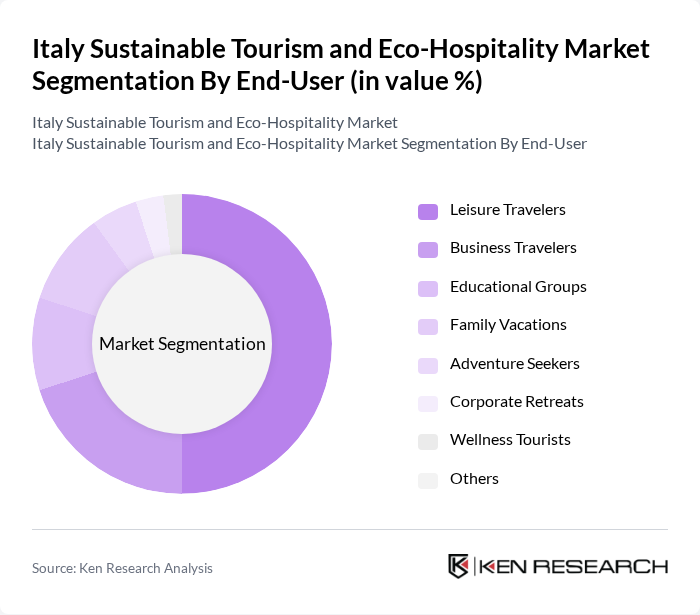
By End-User:The end-user segmentation includes Leisure Travelers, Business Travelers, Educational Groups, Family Vacations, Adventure Seekers, Corporate Retreats, Wellness Tourists, and Others. Leisure Travelers dominate the market, driven by a growing trend towards experiential travel and a desire for sustainable options that align with their values. There is also a notable increase in demand from families and young travelers seeking authentic, nature-based, and wellness-oriented experiences .
Italy Sustainable Tourism and Eco-Hospitality Market Competitive Landscape
The Italy Sustainable Tourism and Eco-Hospitality Market is characterized by a dynamic mix of regional and international players. Leading participants such as Ecobnb, Legambiente Turismo, Green Pearls, Bio Agriturismo Il Cerreto, Agriturismo Podere di Maggio, Borgo Pignano, Lefay Resorts & SPA Lago di Garda, Hotel Milano Scala, Hotel Ristorante Giardino, Eremito Hotelito del Alma, Cascina Rodiani, Adler Spa Resort Sicilia, Il Gabbiano Lago di Vico, Oasyhotel, Green Globe contribute to innovation, geographic expansion, and service delivery in this space.
Italy Sustainable Tourism and Eco-Hospitality Market Industry Analysis
Growth Drivers
- Increasing Consumer Awareness of Sustainability:In future, approximately 70% of Italian travelers prioritize sustainability when choosing accommodations, reflecting a significant shift in consumer behavior. This trend is supported by a future report from the Italian National Institute of Statistics, which indicated that 45 million Italians actively seek eco-friendly options. The growing awareness is further fueled by educational campaigns and social media, leading to a surge in demand for sustainable tourism experiences across the country.
- Government Incentives for Eco-Friendly Practices:The Italian government allocated €1.5 billion in future to promote sustainable tourism initiatives, including grants for eco-friendly hospitality projects. This funding aims to support the development of green infrastructure and encourage businesses to adopt sustainable practices. Additionally, tax breaks for eco-certifications have increased participation in green programs, with over 1,200 establishments receiving financial support to enhance their sustainability efforts, thus driving market growth.
- Rise in Eco-Conscious Travel Preferences:In future, eco-tourism is projected to account for 30% of Italy's overall tourism revenue, driven by a growing segment of travelers who prioritize environmental responsibility. A survey by the Italian Tourism Agency revealed that 60% of respondents are willing to pay more for eco-friendly accommodations. This shift is indicative of a broader trend towards sustainable travel, with many consumers actively seeking experiences that minimize their environmental impact while supporting local economies.
Market Challenges
- High Initial Investment Costs:The transition to sustainable hospitality often requires significant upfront investments, with estimates suggesting that eco-friendly renovations can cost up to €500,000 for mid-sized hotels. Many operators struggle to secure financing for these projects, particularly in a competitive market where traditional hospitality models dominate. This financial barrier limits the ability of smaller establishments to adopt sustainable practices, hindering overall market growth in the eco-hospitality sector.
- Limited Consumer Knowledge on Eco-Hospitality:Despite increasing awareness, a substantial portion of the Italian population remains uninformed about eco-hospitality options. A future study indicated that 40% of travelers could not identify eco-friendly certifications or practices. This knowledge gap poses a challenge for businesses aiming to attract eco-conscious consumers. Without effective education and marketing strategies, the potential for growth in the sustainable tourism sector may be stunted, limiting market expansion.
Italy Sustainable Tourism and Eco-Hospitality Market Future Outlook
The future of Italy's sustainable tourism and eco-hospitality market appears promising, driven by increasing consumer demand for environmentally responsible travel options. As more travelers seek unique, eco-friendly experiences, businesses are likely to innovate and adapt to these preferences. Additionally, ongoing government support and investment in sustainable infrastructure will further enhance the market's growth potential. The integration of technology and local partnerships will also play a crucial role in shaping the future landscape of eco-tourism in Italy.
Market Opportunities
- Growth in Eco-Tourism Packages:The demand for eco-tourism packages is expected to rise, with an estimated increase of 25% in bookings for future. This trend presents an opportunity for hospitality providers to develop tailored experiences that highlight local culture and sustainability, attracting a broader audience and enhancing revenue streams.
- Partnerships with Local Communities:Collaborating with local communities can enhance the authenticity of eco-tourism experiences. By investing in community-based projects, hospitality businesses can create unique offerings that resonate with travelers. This approach not only supports local economies but also fosters a deeper connection between visitors and the destinations they explore, driving sustainable growth.
Scope of the Report
| Segment | Sub-Segments |
|---|---|
| By Type | Eco-Resorts Green Hotels Sustainable Travel Agencies Eco-Friendly Transportation Services Organic Food Services Nature-Based Activities Agriturismi (Farm Stays) Rural and Village Tourism Glamping & Eco-Lodges Others |
| By End-User | Leisure Travelers Business Travelers Educational Groups Family Vacations Adventure Seekers Corporate Retreats Wellness Tourists Others |
| By Service Type | Accommodation Services Food and Beverage Services Tour and Activity Services Transportation Services Wellness Services Event Management Services Eco-Education & Interpretation Services Others |
| By Booking Channel | Online Travel Agencies Direct Bookings Travel Agents Mobile Applications Social Media Platforms Sustainable Tourism Platforms Others |
| By Price Range | Budget Mid-Range Luxury Premium Others |
| By Customer Demographics | Age Groups Income Levels Travel Preferences Family Size Nationality Others |
| By Duration of Stay | Short-Term Stays Medium-Term Stays Long-Term Stays Others |
Key Target Audience
Investors and Venture Capitalist Firms
Government and Regulatory Bodies (e.g., Italian Ministry of Tourism, ENIT - Italian National Tourist Board)
Eco-Hotel Operators and Managers
Tourism Boards and Destination Management Organizations
Local Communities and Indigenous Groups
Environmental NGOs and Advocacy Groups
Travel Agencies and Tour Operators specializing in sustainable travel
Hospitality Technology Solution Providers
Players Mentioned in the Report:
Ecobnb
Legambiente Turismo
Green Pearls
Bio Agriturismo Il Cerreto
Agriturismo Podere di Maggio
Borgo Pignano
Lefay Resorts & SPA Lago di Garda
Hotel Milano Scala
Hotel Ristorante Giardino
Eremito Hotelito del Alma
Cascina Rodiani
Adler Spa Resort Sicilia
Il Gabbiano Lago di Vico
Oasyhotel
Green Globe
Table of Contents
Market Assessment Phase
1. Executive Summary and Approach
2. Italy Sustainable Tourism and Eco-Hospitality Market Overview
2.1 Key Insights and Strategic Recommendations
2.2 Italy Sustainable Tourism and Eco-Hospitality Market Overview
2.3 Definition and Scope
2.4 Evolution of Market Ecosystem
2.5 Timeline of Key Regulatory Milestones
2.6 Value Chain & Stakeholder Mapping
2.7 Business Cycle Analysis
2.8 Policy & Incentive Landscape
3. Italy Sustainable Tourism and Eco-Hospitality Market Analysis
3.1 Growth Drivers
3.1.1 Increasing Consumer Awareness of Sustainability
3.1.2 Government Incentives for Eco-Friendly Practices
3.1.3 Rise in Eco-Conscious Travel Preferences
3.1.4 Development of Sustainable Infrastructure
3.2 Market Challenges
3.2.1 High Initial Investment Costs
3.2.2 Limited Consumer Knowledge on Eco-Hospitality
3.2.3 Regulatory Compliance Complexity
3.2.4 Competition from Traditional Hospitality
3.3 Market Opportunities
3.3.1 Growth in Eco-Tourism Packages
3.3.2 Partnerships with Local Communities
3.3.3 Technological Innovations in Sustainability
3.3.4 Expansion of Green Certifications
3.4 Market Trends
3.4.1 Increased Use of Renewable Energy Sources
3.4.2 Focus on Local and Organic Food Offerings
3.4.3 Integration of Smart Technologies in Hospitality
3.4.4 Emphasis on Unique Local Experiences
3.5 Government Regulation
3.5.1 Environmental Protection Laws
3.5.2 Incentives for Green Certifications
3.5.3 Regulations on Waste Management
3.5.4 Standards for Energy Efficiency
4. SWOT Analysis
5. Stakeholder Analysis
6. Porter's Five Forces Analysis
7. Italy Sustainable Tourism and Eco-Hospitality Market Market Size, 2019-2024
7.1 By Value
7.2 By Volume
7.3 By Average Selling Price
8. Italy Sustainable Tourism and Eco-Hospitality Market Segmentation
8.1 By Type
8.1.1 Eco-Resorts
8.1.2 Green Hotels
8.1.3 Sustainable Travel Agencies
8.1.4 Eco-Friendly Transportation Services
8.1.5 Organic Food Services
8.1.6 Nature-Based Activities
8.1.7 Agriturismi (Farm Stays)
8.1.8 Rural and Village Tourism
8.1.9 Glamping & Eco-Lodges
8.1.10 Others
8.2 By End-User
8.2.1 Leisure Travelers
8.2.2 Business Travelers
8.2.3 Educational Groups
8.2.4 Family Vacations
8.2.5 Adventure Seekers
8.2.6 Corporate Retreats
8.2.7 Wellness Tourists
8.2.8 Others
8.3 By Service Type
8.3.1 Accommodation Services
8.3.2 Food and Beverage Services
8.3.3 Tour and Activity Services
8.3.4 Transportation Services
8.3.5 Wellness Services
8.3.6 Event Management Services
8.3.7 Eco-Education & Interpretation Services
8.3.8 Others
8.4 By Booking Channel
8.4.1 Online Travel Agencies
8.4.2 Direct Bookings
8.4.3 Travel Agents
8.4.4 Mobile Applications
8.4.5 Social Media Platforms
8.4.6 Sustainable Tourism Platforms
8.4.7 Others
8.5 By Price Range
8.5.1 Budget
8.5.2 Mid-Range
8.5.3 Luxury
8.5.4 Premium
8.5.5 Others
8.6 By Customer Demographics
8.6.1 Age Groups
8.6.2 Income Levels
8.6.3 Travel Preferences
8.6.4 Family Size
8.6.5 Nationality
8.6.6 Others
8.7 By Duration of Stay
8.7.1 Short-Term Stays
8.7.2 Medium-Term Stays
8.7.3 Long-Term Stays
8.7.4 Others
9. Italy Sustainable Tourism and Eco-Hospitality Market Competitive Analysis
9.1 Market Share of Key Players(Micro, Small, Medium, Large Enterprises)
9.2 Cross Comparison of Key Players
9.2.1 Company Name
9.2.2 Group Size (Large, Medium, or Small as per industry convention)
9.2.3 Revenue Growth Rate
9.2.4 Customer Satisfaction Score (e.g., Net Promoter Score, online review ratings)
9.2.5 Market Penetration Rate (share of eco-certified rooms/units, % of sustainable offerings)
9.2.6 Average Length of Stay (nights per guest)
9.2.7 Average Daily Rate (ADR) / Pricing Strategy
9.2.8 Repeat Customer Rate (%)
9.2.9 Sustainability Certification Rate (% properties with recognized eco-labels)
9.2.10 Carbon Emissions per Guest Night (kg CO?e)
9.2.11 Water and Energy Consumption per Guest Night
9.2.12 Employee Training and Development Rate (% staff trained in sustainability)
9.2.13 Local Sourcing Rate (% of goods/services sourced locally)
9.2.14 Waste Diversion Rate (% waste recycled/composted)
9.3 SWOT Analysis of Top Players
9.4 Pricing Analysis(By Class and Payload)
9.5 Detailed Profile of Major Companies
9.5.1 Ecobnb
9.5.2 Legambiente Turismo
9.5.3 Green Pearls
9.5.4 Bio Agriturismo Il Cerreto
9.5.5 Agriturismo Podere di Maggio
9.5.6 Borgo Pignano
9.5.7 Lefay Resorts & SPA Lago di Garda
9.5.8 Hotel Milano Scala
9.5.9 Hotel Ristorante Giardino
9.5.10 Eremito Hotelito del Alma
9.5.11 Cascina Rodiani
9.5.12 Adler Spa Resort Sicilia
9.5.13 Il Gabbiano Lago di Vico
9.5.14 Oasyhotel
9.5.15 Green Globe
10. Italy Sustainable Tourism and Eco-Hospitality Market End-User Analysis
10.1 Procurement Behavior of Key Ministries
10.1.1 Budget Allocation for Sustainable Projects
10.1.2 Preference for Local Suppliers
10.1.3 Compliance with Environmental Standards
10.1.4 Evaluation of Sustainability Impact
10.2 Corporate Spend on Infrastructure & Energy
10.2.1 Investment in Renewable Energy Sources
10.2.2 Funding for Eco-Friendly Infrastructure
10.2.3 Budget for Sustainable Practices
10.3 Pain Point Analysis by End-User Category
10.3.1 Cost of Sustainable Options
10.3.2 Availability of Eco-Friendly Services
10.3.3 Awareness of Sustainable Practices
10.4 User Readiness for Adoption
10.4.1 Interest in Eco-Friendly Options
10.4.2 Willingness to Pay for Sustainability
10.4.3 Knowledge of Sustainable Practices
10.5 Post-Deployment ROI and Use Case Expansion
10.5.1 Measurement of Sustainability Impact
10.5.2 Expansion of Eco-Friendly Offerings
10.5.3 Customer Feedback and Adaptation
11. Italy Sustainable Tourism and Eco-Hospitality Market Future Size, 2025-2030
11.1 By Value
11.2 By Volume
11.3 By Average Selling Price
Go-To-Market Strategy Phase
1. Whitespace Analysis + Business Model Canvas
1.1 Identification of Market Gaps
1.2 Business Model Development
1.3 Value Proposition Analysis
1.4 Revenue Streams Identification
1.5 Cost Structure Analysis
1.6 Key Partnerships
1.7 Customer Segmentation
2. Marketing and Positioning Recommendations
2.1 Branding Strategies
2.2 Product USPs
2.3 Target Audience Identification
2.4 Communication Strategies
2.5 Digital Marketing Approaches
2.6 Offline Marketing Strategies
2.7 Customer Engagement Tactics
3. Distribution Plan
3.1 Urban Retail Strategies
3.2 Rural NGO Tie-Ups
3.3 Online Distribution Channels
3.4 Partnerships with Local Businesses
3.5 Direct Sales Approaches
3.6 Distribution Network Optimization
4. Channel & Pricing Gaps
4.1 Underserved Routes
4.2 Pricing Bands Analysis
4.3 Competitor Pricing Strategies
4.4 Customer Price Sensitivity
4.5 Value-Based Pricing Models
4.6 Dynamic Pricing Opportunities
5. Unmet Demand & Latent Needs
5.1 Category Gaps Identification
5.2 Consumer Segments Analysis
5.3 Emerging Trends in Consumer Preferences
5.4 Feedback Mechanisms for Demand Assessment
5.5 Future Needs Forecasting
6. Customer Relationship
6.1 Loyalty Programs Development
6.2 After-Sales Service Strategies
6.3 Customer Feedback Integration
6.4 Community Engagement Initiatives
6.5 Personalization of Services
6.6 Customer Retention Strategies
7. Value Proposition
7.1 Sustainability Initiatives
7.2 Integrated Supply Chains
7.3 Unique Selling Points
7.4 Customer-Centric Approaches
7.5 Competitive Advantage Analysis
8. Key Activities
8.1 Regulatory Compliance
8.2 Branding Initiatives
8.3 Distribution Setup
8.4 Training and Development Programs
8.5 Marketing Campaigns
8.6 Performance Monitoring
9. Entry Strategy Evaluation
9.1 Domestic Market Entry Strategy
9.1.1 Product Mix Considerations
9.1.2 Pricing Band Analysis
9.1.3 Packaging Strategies
9.2 Export Entry Strategy
9.2.1 Target Countries Identification
9.2.2 Compliance Roadmap Development
10. Entry Mode Assessment
10.1 Joint Ventures
10.2 Greenfield Investments
10.3 Mergers & Acquisitions
10.4 Distributor Model Evaluation
11. Capital and Timeline Estimation
11.1 Capital Requirements Analysis
11.2 Timelines for Market Entry
12. Control vs Risk Trade-Off
12.1 Ownership vs Partnerships
13. Profitability Outlook
13.1 Breakeven Analysis
13.2 Long-Term Sustainability Assessment
14. Potential Partner List
14.1 Distributors Identification
14.2 Joint Ventures Opportunities
14.3 Acquisition Targets
15. Execution Roadmap
15.1 Phased Plan for Market Entry
15.1.1 Market Setup
15.1.2 Market Entry
15.1.3 Growth Acceleration
15.1.4 Scale & Stabilize
15.2 Key Activities and Milestones
15.2.1 Milestone Planning
15.2.2 Activity Tracking
Research Methodology
Phase 1: Approach1
Desk Research
- Analysis of tourism statistics from the Italian National Institute of Statistics (ISTAT)
- Review of sustainability reports from leading eco-hospitality brands operating in Italy
- Examination of government publications on sustainable tourism initiatives and policies
Primary Research
- Interviews with managers of eco-friendly hotels and resorts across various regions in Italy
- Surveys targeting tourists who have engaged in sustainable travel experiences
- Focus groups with local tourism boards and environmental organizations
Validation & Triangulation
- Cross-validation of findings through multiple data sources, including industry reports and academic studies
- Triangulation of insights from primary interviews with secondary data trends
- Sanity checks conducted through expert reviews from sustainability consultants
Phase 2: Market Size Estimation1
Top-down Assessment
- Estimation of the overall tourism market size in Italy, focusing on the sustainable segment
- Analysis of growth rates in eco-tourism compared to traditional tourism sectors
- Incorporation of demographic trends and consumer preferences towards sustainable travel
Bottom-up Modeling
- Collection of data on occupancy rates and average daily rates from eco-hospitality establishments
- Estimation of revenue generated from sustainable tourism activities and experiences
- Calculation of market size based on the number of eco-friendly accommodations and their capacity
Forecasting & Scenario Analysis
- Multi-variable forecasting using trends in environmental awareness and travel behavior shifts
- Scenario analysis based on potential regulatory changes and economic conditions affecting tourism
- Development of optimistic, pessimistic, and baseline growth projections through 2030
Phase 3: CATI Sample Composition1
| Scope Item/Segment | Sample Size | Target Respondent Profiles |
|---|---|---|
| Eco-Hotel Managers | 60 | General Managers, Sustainability Managers |
| Sustainable Tour Operators | 50 | Operations Managers, Marketing Managers |
| Travelers Engaged in Eco-Tourism | 120 | Frequent Travelers, Eco-Conscious Consumers |
| Local Government Tourism Officials | 40 | Tourism Development Officers, Policy Makers |
| Environmental NGOs | 40 | Program Managers, Advocacy Coordinators |
Frequently Asked Questions
What is the current value of the Italy Sustainable Tourism and Eco-Hospitality Market?
The Italy Sustainable Tourism and Eco-Hospitality Market is valued at approximately USD 13 billion, reflecting a significant growth driven by increasing consumer awareness of environmental issues and a shift towards sustainable travel practices.
Which cities in Italy are leading in sustainable tourism?
What government initiatives support sustainable tourism in Italy?
What types of accommodations are included in the sustainable tourism market?
Other Regional/Country Reports
Indonesia Sustainable Tourism and Eco-Hospitality Market
Malaysia Sustainable Tourism and Eco-Hospitality Market
KSA Sustainable Tourism and Eco-Hospitality Market
APAC Sustainable Tourism and Eco-Hospitality Market
SEA Sustainable Tourism and Eco-Hospitality Market
Vietnam Sustainable Tourism and Eco-Hospitality Market
Other Adjacent Reports
South Korea Eco-Resorts Market
Vietnam Green Hotels Market
Brazil Sustainable Travel Agencies Market
Oman Eco-Friendly Transportation Services Market
Mexico Organic Food Services Market
Brazil Nature-Based Activities Market
Oman Agritourism MarketThailand Rural Tourism Market
APAC glamping market Size, Share, Growth Drivers, Trends, Opportunities & Forecast 2025–2030Global wellness tourism market Size, Share, Growth Drivers, Trends, Opportunities & Forecast 2025–2030Why Buy From Us?

What makes us stand out is that our consultants follow Robust, Refine and Result (RRR) methodology. Robust for clear definitions, approaches and sanity checking, Refine for differentiating respondents' facts and opinions, and Result for presenting data with story.

We have set a benchmark in the industry by offering our clients with syndicated and customized market research reports featuring coverage of entire market as well as meticulous research and analyst insights.

While we don't replace traditional research, we flip the method upside down. Our dual approach of Top Bottom & Bottom Top ensures quality deliverable by not just verifying company fundamentals but also looking at the sector and macroeconomic factors.

With one step in the future, our research team constantly tries to show you the bigger picture. We help with some of the tough questions you may encounter along the way: How is the industry positioned? Best marketing channel? KPI's of competitors? By aligning every element, we help maximize success.

Our report gives you instant access to the answers and sources that other companies might choose to hide. We elaborate each steps of research methodology we have used and showcase you the sample size to earn your trust.

If you need any support, we are here! We pride ourselves on universe strength, data quality, and quick, friendly, and professional service.