Region:Asia
Author(s):Geetanshi
Product Code:KRAD0104
Pages:99
Published On:August 2025
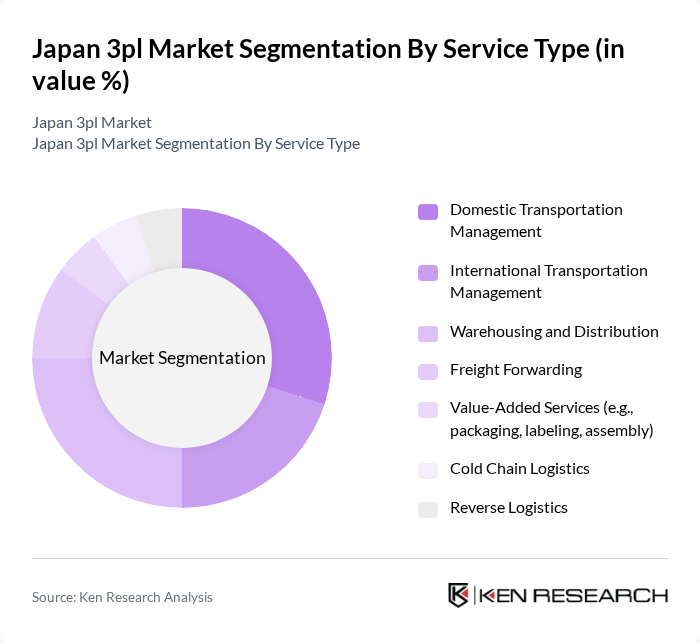
By Service Type:The service type segmentation of the market includes various categories such as Domestic Transportation Management, International Transportation Management, Warehousing and Distribution, Freight Forwarding, Value-Added Services, Cold Chain Logistics, and Reverse Logistics. Among these, Domestic Transportation Management remains the leading sub-segment, supported by the surge in local deliveries due to e-commerce growth and consumer demand for rapid delivery. The adoption of just-in-time inventory practices and the integration of real-time tracking and automation technologies further reinforce this trend .
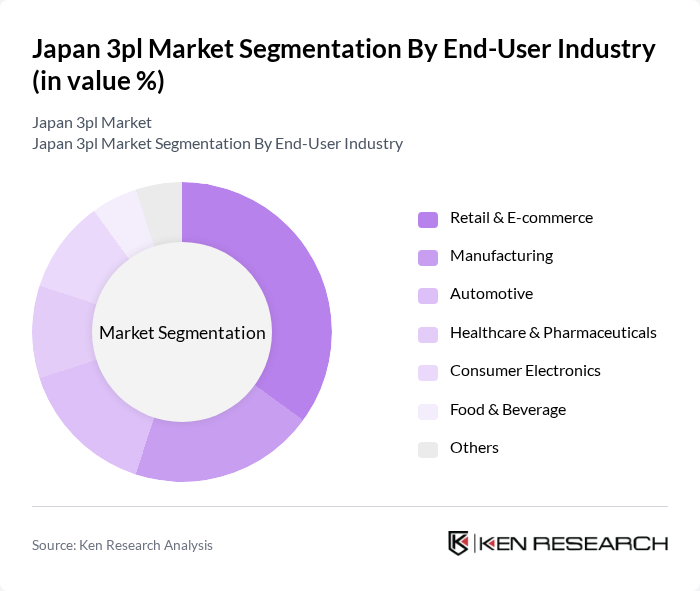
By End-User Industry:The end-user industry segmentation includes Retail & E-commerce, Manufacturing, Automotive, Healthcare & Pharmaceuticals, Consumer Electronics, Food & Beverage, and Others. While Retail & E-commerce is a dominant segment due to the rapid growth of online shopping and demand for home delivery, the Manufacturing and Automotive sectors also represent significant shares, driven by Japan’s strong industrial base and complex supply chains. The need for specialized logistics, such as temperature-controlled and just-in-time delivery, is particularly pronounced in these sectors .
The Japan 3PL market is characterized by a dynamic mix of regional and international players. Leading participants such as Nippon Express Co., Ltd., Yamato Holdings Co., Ltd., Sagawa Express Co., Ltd., Hitachi Transport System, Ltd., Seino Holdings Co., Ltd., Kintetsu World Express, Inc., Mitsui-Soko Holdings Co., Ltd., Marubeni Logistics Corporation, Sankyu Inc., SG Holdings Co., Ltd. (Sagawa Express), Kuehne + Nagel Ltd., DSV A/S, CEVA Logistics Japan K.K., DB Schenker Japan K.K., Yusen Logistics Co., Ltd. contribute to innovation, geographic expansion, and service delivery in this space.
The future of the Japan 3PL market appears promising, driven by ongoing digital transformation and a heightened focus on sustainability. As companies increasingly adopt advanced technologies, such as AI and IoT, operational efficiencies are expected to improve significantly. Additionally, the push for environmentally friendly logistics solutions will likely lead to innovative practices that align with consumer preferences. Overall, the market is poised for growth as it adapts to evolving consumer demands and technological advancements.
| Segment | Sub-Segments |
|---|---|
| By Service Type | Domestic Transportation Management International Transportation Management Warehousing and Distribution Freight Forwarding Value-Added Services (e.g., packaging, labeling, assembly) Cold Chain Logistics Reverse Logistics |
| By End-User Industry | Retail & E-commerce Manufacturing Automotive Healthcare & Pharmaceuticals Consumer Electronics Food & Beverage Others |
| By Mode of Transportation | Road Rail Air Sea Intermodal |
| By Contract Type | Dedicated Contract Carriage Shared/General Contract Logistics |
| By Company Size | Large Enterprises Small & Medium Enterprises (SMEs) |
| By Region | Kanto Kansai Chubu Kyushu & Okinawa Tohoku Hokkaido Others |
| Scope Item/Segment | Sample Size | Target Respondent Profiles |
|---|---|---|
| Retail Logistics Management | 60 | Logistics Managers, Supply Chain Executives |
| Automotive Supply Chain Solutions | 50 | Operations Directors, Procurement Managers |
| Electronics Distribution Networks | 40 | Warehouse Managers, Logistics Coordinators |
| Pharmaceutical Logistics Services | 45 | Quality Assurance Managers, Regulatory Affairs Specialists |
| E-commerce Fulfillment Strategies | 50 | eCommerce Operations Managers, Customer Experience Leaders |
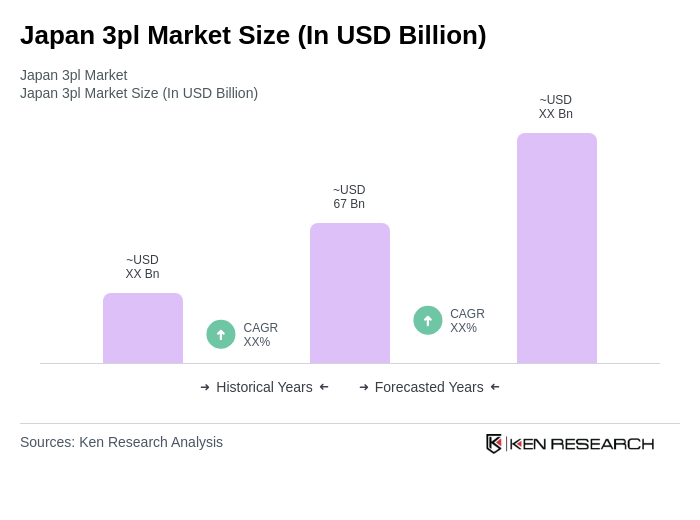
The Japan 3PL market is valued at approximately USD 67 billion, driven by the increasing demand for efficient logistics solutions, the rapid expansion of e-commerce, and the need for supply chain optimization.

What makes us stand out is that our consultants follow Robust, Refine and Result (RRR) methodology. Robust for clear definitions, approaches and sanity checking, Refine for differentiating respondents' facts and opinions, and Result for presenting data with story.

We have set a benchmark in the industry by offering our clients with syndicated and customized market research reports featuring coverage of entire market as well as meticulous research and analyst insights.

While we don't replace traditional research, we flip the method upside down. Our dual approach of Top Bottom & Bottom Top ensures quality deliverable by not just verifying company fundamentals but also looking at the sector and macroeconomic factors.

With one step in the future, our research team constantly tries to show you the bigger picture. We help with some of the tough questions you may encounter along the way: How is the industry positioned? Best marketing channel? KPI's of competitors? By aligning every element, we help maximize success.

Our report gives you instant access to the answers and sources that other companies might choose to hide. We elaborate each steps of research methodology we have used and showcase you the sample size to earn your trust.

If you need any support, we are here! We pride ourselves on universe strength, data quality, and quick, friendly, and professional service.













