About the Report
Base Year 2024Japan Coding Bootcamp Market Overview
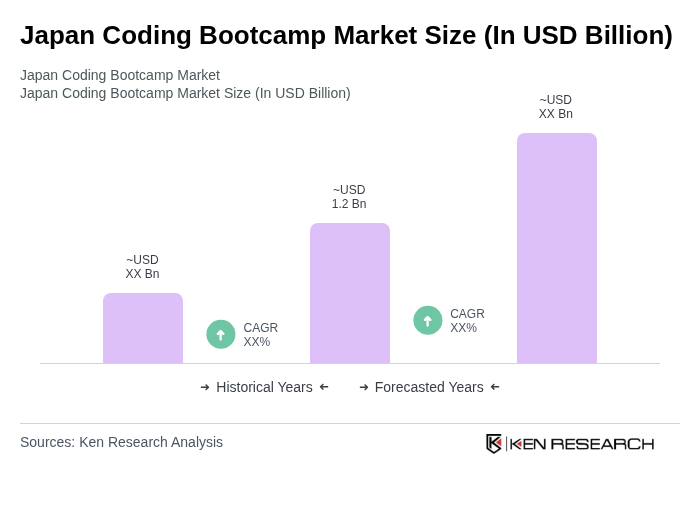
- The Japan Coding Bootcamp Market is valued at USD 1.2 billion, based on a five-year historical analysis. This growth is primarily driven by the increasing demand for tech talent, the rise of digital transformation across industries, and the need for upskilling in programming and software development. The market has seen a surge in enrollment as individuals seek to enhance their employability in a competitive job market.
- Tokyo, Osaka, and Yokohama are the dominant cities in the Japan Coding Bootcamp Market. Tokyo, as the capital, hosts a plethora of tech companies and startups, creating a high demand for skilled developers. Osaka and Yokohama follow closely, benefiting from their growing tech ecosystems and proximity to major industries, which further fuels the demand for coding education.
- In 2023, the Japanese government implemented a new initiative aimed at promoting digital skills among the workforce. This initiative includes funding for coding bootcamps and partnerships with educational institutions to enhance curriculum offerings. The government aims to equip citizens with essential tech skills to meet the demands of a rapidly evolving job market.
Japan Coding Bootcamp Market Segmentation
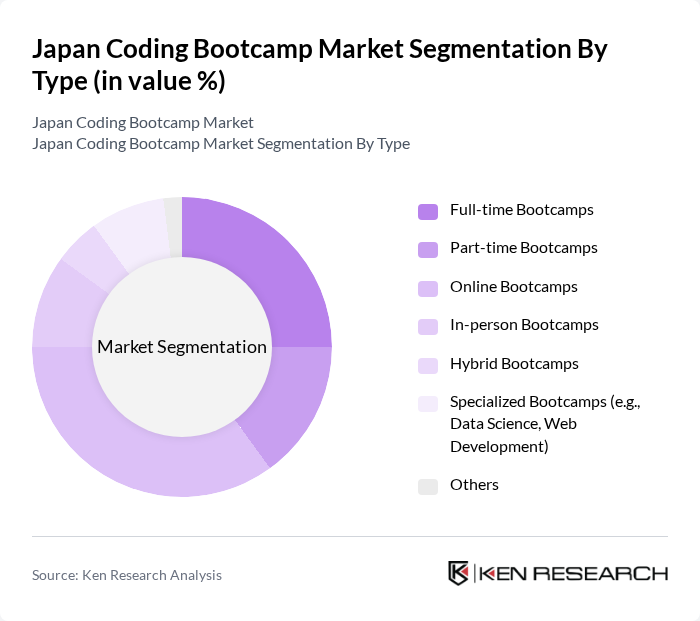
By Type:The market is segmented into various types of bootcamps, including Full-time Bootcamps, Part-time Bootcamps, Online Bootcamps, In-person Bootcamps, Hybrid Bootcamps, Specialized Bootcamps (e.g., Data Science, Web Development), and Others. Among these, Online Bootcamps have gained significant traction due to their flexibility and accessibility, allowing learners to study at their own pace. Full-time Bootcamps also remain popular for those seeking immersive experiences. The demand for Specialized Bootcamps is rising as industries look for niche skills.
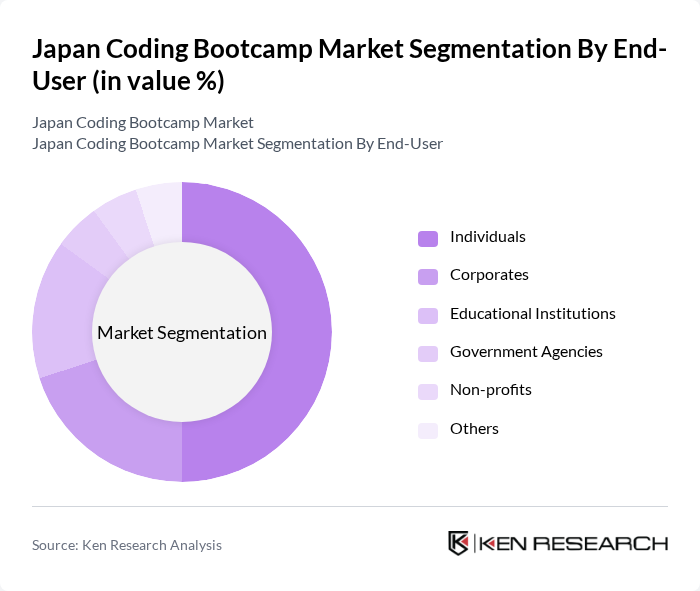
By End-User:The end-user segmentation includes Individuals, Corporates, Educational Institutions, Government Agencies, Non-profits, and Others. Individuals represent the largest segment, driven by the need for career advancement and skill acquisition. Corporates are increasingly investing in bootcamps for employee training, while Educational Institutions are collaborating with bootcamps to enhance their curriculum. Government Agencies and Non-profits are also engaging in partnerships to promote digital literacy.
Japan Coding Bootcamp Market Competitive Landscape
The Japan Coding Bootcamp Market is characterized by a dynamic mix of regional and international players. Leading participants such as Le Wagon, CodeCamp, TechAcademy, DMM WEBCAMP, NTT Data Institute of Management, G's Academy, Progate, Code Chrysalis, BrainPad Academy, Samurai Academy, Digital Hollywood, Tech Boost, CoderDojo, Skillhouse, and Code Ninja contribute to innovation, geographic expansion, and service delivery in this space.
Japan Coding Bootcamp Market Industry Analysis
Growth Drivers
- Increasing Demand for Tech Talent:The demand for tech talent in Japan is projected to reach 1.2 million by 2024, driven by the digital transformation across industries. The World Economic Forum indicates that 85 million jobs may be displaced by automation, while 97 million new roles will emerge, emphasizing the need for skilled workers. This gap creates a robust market for coding bootcamps, which can quickly equip individuals with necessary skills to meet employer demands.
- Government Initiatives Promoting Digital Skills:The Japanese government has allocated ¥1.2 trillion (approximately $8.4 billion) for digital education initiatives in the future. This funding aims to enhance digital literacy and support coding bootcamps, making them more accessible. Programs like the "Future of Work" initiative are designed to upskill the workforce, thereby increasing enrollment in bootcamps and fostering a culture of continuous learning in technology.
- Rise of Remote Work and Online Learning:The shift towards remote work has accelerated the adoption of online learning platforms, with a reported 60% increase in online course enrollments in the future. This trend is expected to continue, as companies increasingly seek flexible training solutions. Bootcamps that offer remote learning options can tap into this growing market, catering to a wider audience and providing opportunities for individuals in various locations.
Market Challenges
- High Competition Among Bootcamps:The coding bootcamp sector in Japan is highly competitive, with over 200 bootcamps operating as of the future. This saturation makes it challenging for new entrants to differentiate themselves. Established bootcamps often have strong brand recognition and partnerships with tech companies, making it difficult for newcomers to attract students and secure job placements for graduates.
- Perception of Bootcamp Quality:Many potential students remain skeptical about the quality of coding bootcamps, with only 30% believing they provide adequate training compared to traditional education. This perception is compounded by the lack of standardized accreditation, leading to concerns about the effectiveness of various programs. Addressing these quality concerns is crucial for bootcamps to gain credibility and attract more students.
Japan Coding Bootcamp Market Future Outlook
The future of the Japan coding bootcamp market appears promising, driven by increasing digitalization and a growing emphasis on tech skills. As companies continue to adapt to technological advancements, bootcamps will play a vital role in bridging the skills gap. Furthermore, the integration of innovative teaching methods and partnerships with industry leaders will enhance the effectiveness of training programs, ensuring that graduates are well-prepared for the evolving job market.
Market Opportunities
- Expansion into Underserved Regions:There is significant potential for bootcamps to expand into rural areas, where access to tech education is limited. By establishing local partnerships and offering tailored programs, bootcamps can tap into a new student base, addressing regional disparities in tech education and employment opportunities.
- Development of Specialized Courses:Creating specialized courses in emerging technologies, such as AI and blockchain, can attract professionals seeking to upskill. With Japan's focus on innovation, bootcamps that offer cutting-edge training will likely see increased enrollment, positioning themselves as leaders in niche markets and enhancing their appeal to tech-savvy individuals.
Scope of the Report
| Segment | Sub-Segments |
|---|---|
| By Type | Full-time Bootcamps Part-time Bootcamps Online Bootcamps In-person Bootcamps Hybrid Bootcamps Specialized Bootcamps (e.g., Data Science, Web Development) Others |
| By End-User | Individuals Corporates Educational Institutions Government Agencies Non-profits Others |
| By Delivery Mode | Online Learning In-person Classes Blended Learning Corporate Training Sessions Others |
| By Duration | Short-term (less than 3 months) Medium-term (3 to 6 months) Long-term (more than 6 months) Others |
| By Certification Type | Industry-recognized Certifications University-affiliated Certifications Proprietary Certifications Others |
| By Target Audience | Beginners Intermediate Learners Advanced Professionals Career Changers Others |
| By Geographic Focus | Urban Areas Rural Areas International Students Others |
Key Target Audience
Investors and Venture Capitalist Firms
Government and Regulatory Bodies (e.g., Ministry of Education, Culture, Sports, Science and Technology)
Corporate Training Departments
Tech Startups and Entrepreneurs
Non-Profit Organizations focused on Education and Workforce Development
Recruitment Agencies specializing in Technology and IT
Industry Associations related to Technology and Education
Financial Institutions providing funding for educational initiatives
Players Mentioned in the Report:
Le Wagon
CodeCamp
TechAcademy
DMM WEBCAMP
NTT Data Institute of Management
G's Academy
Progate
Code Chrysalis
BrainPad Academy
Samurai Academy
Digital Hollywood
Tech Boost
CoderDojo
Skillhouse
Code Ninja
Table of Contents
Market Assessment Phase
1. Executive Summary and Approach
2. Japan Coding Bootcamp Market Overview
2.1 Key Insights and Strategic Recommendations
2.2 Japan Coding Bootcamp Market Overview
2.3 Definition and Scope
2.4 Evolution of Market Ecosystem
2.5 Timeline of Key Regulatory Milestones
2.6 Value Chain & Stakeholder Mapping
2.7 Business Cycle Analysis
2.8 Policy & Incentive Landscape
3. Japan Coding Bootcamp Market Analysis
3.1 Growth Drivers
3.1.1 Increasing demand for tech talent
3.1.2 Government initiatives promoting digital skills
3.1.3 Rise of remote work and online learning
3.1.4 Partnerships with tech companies for job placements
3.2 Market Challenges
3.2.1 High competition among bootcamps
3.2.2 Perception of bootcamp quality
3.2.3 Rapidly changing technology landscape
3.2.4 Limited awareness among potential students
3.3 Market Opportunities
3.3.1 Expansion into underserved regions
3.3.2 Development of specialized courses
3.3.3 Collaboration with universities
3.3.4 Growth in corporate training programs
3.4 Market Trends
3.4.1 Increased focus on soft skills training
3.4.2 Adoption of hybrid learning models
3.4.3 Use of AI and data analytics in curriculum
3.4.4 Emphasis on job placement success rates
3.5 Government Regulation
3.5.1 Accreditation requirements for bootcamps
3.5.2 Funding and grants for educational programs
3.5.3 Consumer protection laws for education services
3.5.4 Data privacy regulations affecting online learning
4. SWOT Analysis
5. Stakeholder Analysis
6. Porter's Five Forces Analysis
7. Japan Coding Bootcamp Market Market Size, 2019-2024
7.1 By Value
7.2 By Volume
7.3 By Average Selling Price
8. Japan Coding Bootcamp Market Segmentation
8.1 By Type
8.1.1 Full-time Bootcamps
8.1.2 Part-time Bootcamps
8.1.3 Online Bootcamps
8.1.4 In-person Bootcamps
8.1.5 Hybrid Bootcamps
8.1.6 Specialized Bootcamps (e.g., Data Science, Web Development)
8.1.7 Others
8.2 By End-User
8.2.1 Individuals
8.2.2 Corporates
8.2.3 Educational Institutions
8.2.4 Government Agencies
8.2.5 Non-profits
8.2.6 Others
8.3 By Delivery Mode
8.3.1 Online Learning
8.3.2 In-person Classes
8.3.3 Blended Learning
8.3.4 Corporate Training Sessions
8.3.5 Others
8.4 By Duration
8.4.1 Short-term (less than 3 months)
8.4.2 Medium-term (3 to 6 months)
8.4.3 Long-term (more than 6 months)
8.4.4 Others
8.5 By Certification Type
8.5.1 Industry-recognized Certifications
8.5.2 University-affiliated Certifications
8.5.3 Proprietary Certifications
8.5.4 Others
8.6 By Target Audience
8.6.1 Beginners
8.6.2 Intermediate Learners
8.6.3 Advanced Professionals
8.6.4 Career Changers
8.6.5 Others
8.7 By Geographic Focus
8.7.1 Urban Areas
8.7.2 Rural Areas
8.7.3 International Students
8.7.4 Others
9. Japan Coding Bootcamp Market Competitive Analysis
9.1 Market Share of Key Players
9.2 Cross Comparison of Key Players
9.2.1 Company Name
9.2.2 Group Size (Large, Medium, or Small as per industry convention)
9.2.3 Student Enrollment Numbers
9.2.4 Job Placement Rate
9.2.5 Course Completion Rate
9.2.6 Customer Satisfaction Score
9.2.7 Pricing Strategy
9.2.8 Revenue Growth Rate
9.2.9 Course Diversity
9.2.10 Brand Recognition
9.3 SWOT Analysis of Top Players
9.4 Pricing Analysis
9.5 Detailed Profile of Major Companies
9.5.1 Le Wagon
9.5.2 CodeCamp
9.5.3 TechAcademy
9.5.4 DMM WEBCAMP
9.5.5 NTT Data Institute of Management
9.5.6 G's Academy
9.5.7 Progate
9.5.8 Code Chrysalis
9.5.9 BrainPad Academy
9.5.10 Samurai Academy
9.5.11 Digital Hollywood
9.5.12 Tech Boost
9.5.13 CoderDojo
9.5.14 Skillhouse
9.5.15 Code Ninja
10. Japan Coding Bootcamp Market End-User Analysis
10.1 Procurement Behavior of Key Ministries
10.1.1 Budget Allocation for Digital Skills Training
10.1.2 Evaluation Criteria for Bootcamp Selection
10.1.3 Collaboration with Private Bootcamps
10.1.4 Feedback Mechanisms for Course Effectiveness
10.2 Corporate Spend on Infrastructure & Energy
10.2.1 Investment in Employee Training Programs
10.2.2 Budget for Technology Upgrades
10.2.3 Partnerships with Educational Institutions
10.2.4 Trends in Corporate Learning Expenditures
10.3 Pain Point Analysis by End-User Category
10.3.1 Skill Gaps in the Workforce
10.3.2 Difficulty in Finding Qualified Candidates
10.3.3 High Turnover Rates in Tech Roles
10.3.4 Need for Continuous Learning Opportunities
10.4 User Readiness for Adoption
10.4.1 Awareness of Bootcamp Offerings
10.4.2 Willingness to Invest in Education
10.4.3 Perceived Value of Bootcamp Certifications
10.4.4 Readiness to Transition to Tech Careers
10.5 Post-Deployment ROI and Use Case Expansion
10.5.1 Measurement of Training Effectiveness
10.5.2 Long-term Career Advancement Opportunities
10.5.3 Impact on Company Performance Metrics
10.5.4 Expansion of Training Programs Based on Feedback
11. Japan Coding Bootcamp Market Future Size, 2025-2030
11.1 By Value
11.2 By Volume
11.3 By Average Selling Price
Go-To-Market Strategy Phase
1. Whitespace Analysis + Business Model Canvas
1.1 Market Gaps Identification
1.2 Value Proposition Development
1.3 Revenue Streams Analysis
1.4 Cost Structure Evaluation
1.5 Key Partnerships Exploration
1.6 Customer Segmentation
1.7 Channels of Distribution
2. Marketing and Positioning Recommendations
2.1 Branding Strategies
2.2 Product USPs
2.3 Target Audience Engagement
2.4 Digital Marketing Tactics
2.5 Offline Marketing Strategies
2.6 Community Building Initiatives
2.7 Feedback and Improvement Mechanisms
3. Distribution Plan
3.1 Urban Retail vs Rural NGO Tie-ups
3.2 Online Distribution Channels
3.3 Partnerships with Corporates
3.4 Educational Institution Collaborations
3.5 Event Participation and Sponsorships
3.6 Direct Sales Strategies
3.7 Customer Support and Service
4. Channel & Pricing Gaps
4.1 Underserved Routes
4.2 Pricing Bands
4.3 Competitor Pricing Analysis
4.4 Value-Based Pricing Strategies
4.5 Discounts and Promotions
4.6 Customer Perception of Pricing
4.7 Pricing Adjustments Based on Market Feedback
5. Unmet Demand & Latent Needs
5.1 Category Gaps
5.2 Consumer Segments
5.3 Emerging Trends in Learning
5.4 Feedback from Potential Students
5.5 Opportunities for New Course Offerings
5.6 Demand for Flexible Learning Options
5.7 Insights from Industry Experts
6. Customer Relationship
6.1 Loyalty Programs
6.2 After-sales Service
6.3 Customer Feedback Mechanisms
6.4 Community Engagement Initiatives
6.5 Alumni Networks
6.6 Continuous Learning Opportunities
6.7 Customer Retention Strategies
7. Value Proposition
7.1 Sustainability
7.2 Integrated Supply Chains
7.3 Unique Selling Points of Bootcamps
7.4 Alignment with Industry Needs
7.5 Long-term Career Benefits
7.6 Community Impact
7.7 Innovation in Learning Methods
8. Key Activities
8.1 Regulatory Compliance
8.2 Branding
8.3 Distribution Setup
8.4 Curriculum Development
8.5 Marketing Campaigns
8.6 Partnership Development
8.7 Performance Monitoring
9. Entry Strategy Evaluation
9.1 Domestic Market Entry Strategy
9.1.1 Product Mix
9.1.2 Pricing Band
9.1.3 Packaging
9.2 Export Entry Strategy
9.2.1 Target Countries
9.2.2 Compliance Roadmap
10. Entry Mode Assessment
10.1 JV
10.2 Greenfield
10.3 M&A
10.4 Distributor Model
11. Capital and Timeline Estimation
11.1 Capital Requirements
11.2 Timelines
12. Control vs Risk Trade-Off
12.1 Ownership vs Partnerships
13. Profitability Outlook
13.1 Breakeven Analysis
13.2 Long-term Sustainability
14. Potential Partner List
14.1 Distributors
14.2 JVs
14.3 Acquisition Targets
15. Execution Roadmap
15.1 Phased Plan for Market Entry
15.1.1 Market Setup
15.1.2 Market Entry
15.1.3 Growth Acceleration
15.1.4 Scale & Stabilize
15.2 Key Activities and Milestones
15.2.1 Milestone Planning
15.2.2 Performance Tracking
Research Methodology
Phase 1: Approach1
Desk Research
- Analysis of government reports on the education and technology sectors in Japan
- Review of market studies and white papers from educational institutions and tech organizations
- Examination of online coding bootcamp platforms and their course offerings, pricing, and enrollment statistics
Primary Research
- Interviews with founders and directors of established coding bootcamps in Japan
- Surveys targeting recent graduates of coding bootcamps to assess job placement and satisfaction rates
- Focus groups with industry employers to understand hiring trends and skill requirements
Validation & Triangulation
- Cross-validation of findings through multiple data sources, including academic institutions and industry reports
- Triangulation of insights from bootcamp graduates, employers, and educational authorities
- Sanity checks through expert panel discussions with industry veterans and educators
Phase 2: Market Size Estimation1
Top-down Assessment
- Estimation of the total addressable market based on the number of tech job openings in Japan
- Analysis of demographic trends indicating the potential student population interested in tech careers
- Incorporation of government initiatives promoting digital skills and workforce development
Bottom-up Modeling
- Enrollment data from leading coding bootcamps to establish average course sizes and growth rates
- Revenue estimates based on tuition fees and additional services offered by bootcamps
- Cost analysis of bootcamp operations to determine profitability and sustainability
Forecasting & Scenario Analysis
- Multi-factor regression analysis incorporating tech industry growth, digital transformation trends, and educational shifts
- Scenario modeling based on varying levels of government support and economic conditions
- Baseline, optimistic, and pessimistic projections for bootcamp enrollment and market growth through 2030
Phase 3: CATI Sample Composition1
| Scope Item/Segment | Sample Size | Target Respondent Profiles |
|---|---|---|
| Established Coding Bootcamps | 100 | Founders, Program Directors |
| Recent Bootcamp Graduates | 150 | Graduates within the last 2 years |
| Tech Industry Employers | 80 | HR Managers, Hiring Managers |
| Educational Institutions | 60 | Deans, Career Services Directors |
| Government Education Officials | 40 | Policy Makers, Program Administrators |
Frequently Asked Questions
What is the current value of the Japan Coding Bootcamp Market?
The Japan Coding Bootcamp Market is valued at approximately USD 1.2 billion, reflecting significant growth driven by the increasing demand for tech talent and the rise of digital transformation across various industries.
Which cities are the main hubs for coding bootcamps in Japan?
What government initiatives support coding bootcamps in Japan?
What types of coding bootcamps are available in Japan?
Other Regional/Country Reports
Indonesia Coding Bootcamp Market Report Size Share Growth Drivers Trends Opportunities And Forecast 2025–2030
Malaysia Coding Bootcamp Market Report Size Share Growth Drivers Trends Opportunities And Forecast 2025–2030
KSA Coding Bootcamp Market Report Size Share Growth Drivers Trends Opportunities And Forecast 2025–2030
APAC Coding Bootcamp Market Report Size Share Growth Drivers Trends Opportunities And Forecast 2025–2030
SEA Coding Bootcamp Market Report Size Share Growth Drivers Trends Opportunities And Forecast 2025–2030
Other Adjacent Reports
Malaysia Vocational Training Market
Japan IT Education Market
South Korea Software Development Training Market
Germany Data Science Training Market
Germany Web Development Education Market
China Corporate Training Market Size, Share & Forecast, By Service Type, Delivery Model & End-Use Industry, 2026-2031Indonesia Educational Technology Market
Qatar Tech Recruitment Market
Mexico Digital Skills Development Market
Why Buy From Us?

What makes us stand out is that our consultants follow Robust, Refine and Result (RRR) methodology. Robust for clear definitions, approaches and sanity checking, Refine for differentiating respondents' facts and opinions, and Result for presenting data with story.

We have set a benchmark in the industry by offering our clients with syndicated and customized market research reports featuring coverage of entire market as well as meticulous research and analyst insights.

While we don't replace traditional research, we flip the method upside down. Our dual approach of Top Bottom & Bottom Top ensures quality deliverable by not just verifying company fundamentals but also looking at the sector and macroeconomic factors.

With one step in the future, our research team constantly tries to show you the bigger picture. We help with some of the tough questions you may encounter along the way: How is the industry positioned? Best marketing channel? KPI's of competitors? By aligning every element, we help maximize success.

Our report gives you instant access to the answers and sources that other companies might choose to hide. We elaborate each steps of research methodology we have used and showcase you the sample size to earn your trust.

If you need any support, we are here! We pride ourselves on universe strength, data quality, and quick, friendly, and professional service.