About the Report
Base Year 2024Listen to the audio summary
Japan EMS Billing Services Market Overview
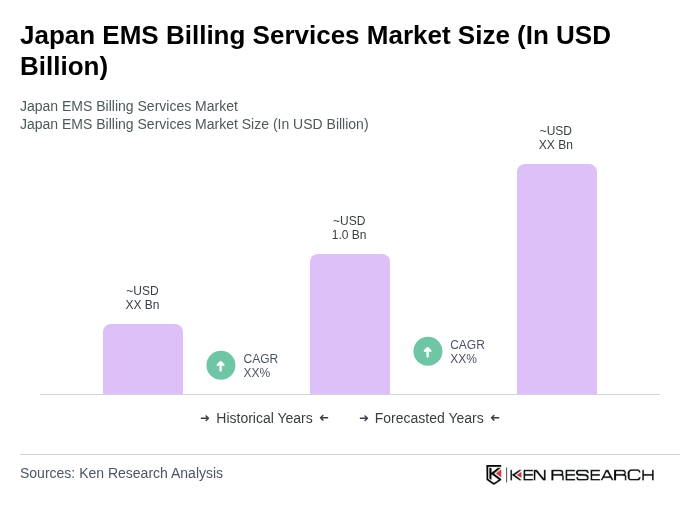
- The Japan EMS Billing Services Market is valued at USD 1.0 billion, based on a five-year historical analysis and its share within the broader global emergency medical services billing and billing software markets. This growth is primarily driven by the increasing demand for efficient billing solutions in emergency medical services, coupled with the rising complexity of healthcare regulations and reimbursement processes, including coordination between municipal ambulance services and public health insurance schemes. The market is also supported by advancements in technology such as integrated EMS billing software, automation, and interoperability with hospital information systems, which enhance the accuracy and speed of billing operations.
- Key cities such as Tokyo, Osaka, and Yokohama dominate the market due to their high population density, higher EMS call volumes, and advanced healthcare infrastructure. These urban centers have a significant number of emergency medical service providers, including municipal fire/EMS departments and hospital-based ambulance services, which drives the demand for efficient billing services and specialized revenue cycle management. Additionally, the presence of major healthcare institutions and technology companies in these regions fosters innovation and competition in the EMS billing sector, particularly in areas such as cloud-based billing platforms, data analytics, and integration with electronic medical records.
- A key regulatory driver for digitalization of medical billing, including EMS-related claims, is the Act on Assurance of Medical Care for Elderly People (Act No. 80 of 1982) and its subsequent amendments, under which the Ministry of Health, Labour and Welfare (MHLW) has progressively mandated the use of electronic claims (DPC/receipt) systems for medical institutions and insurers, supported by the “Guidelines for Promotion of Online Eligibility Verification and Electronic Claims” issued by MHLW. These measures aim to streamline the billing process, reduce errors, and improve the overall efficiency of healthcare delivery by promoting standardized electronic data formats and online transmission of claims. Compliance with these requirements, along with local government digital transformation initiatives in emergency medical services, is enhancing the adoption of EMS billing software and outsourced billing services across Japan, further driving market growth.
Japan EMS Billing Services Market Segmentation
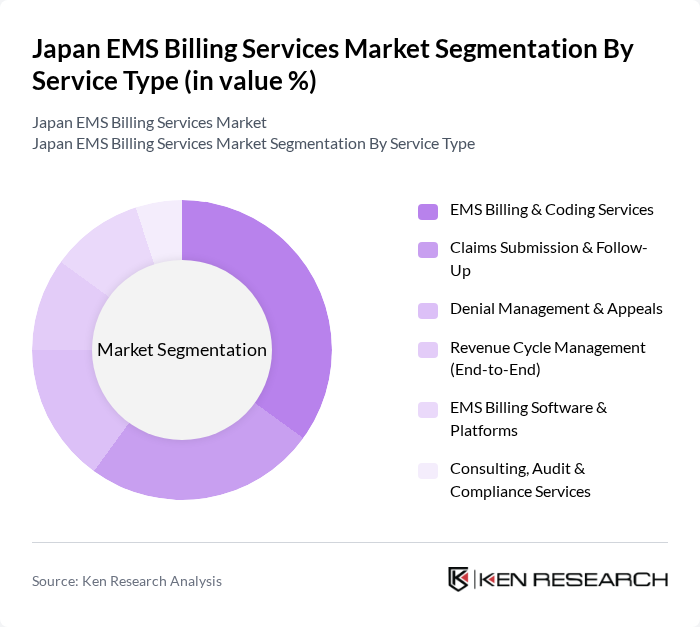
By Service Type:The service type segmentation includes various subsegments such as EMS Billing & Coding Services, Claims Submission & Follow-Up, Denial Management & Appeals, Revenue Cycle Management (End-to-End), EMS Billing Software & Platforms, and Consulting, Audit & Compliance Services. EMS Billing & Coding Services is a leading subsegment, driven by the increasing complexity of medical coding standards, payer-specific rules, and documentation requirements needed to ensure accurate billing and proper reimbursement. The demand for efficient claims submission and follow-up services is also rising, as healthcare providers seek to minimize revenue loss due to denied or delayed claims and to improve cash flow through faster adjudication and resubmission processes. In parallel, adoption of EMS billing software and platforms is increasing as providers prioritize automation, audit readiness, and compliance with evolving reimbursement and data security requirements.
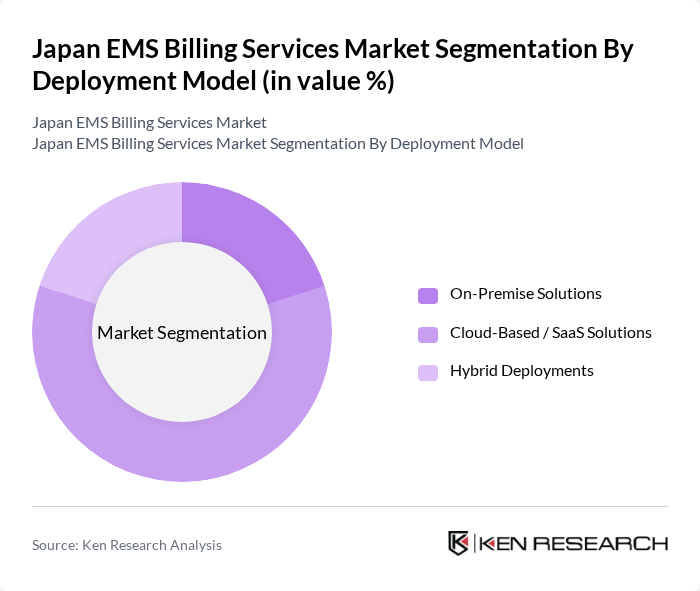
By Deployment Model:The deployment model segmentation includes On-Premise Solutions, Cloud-Based / SaaS Solutions, and Hybrid Deployments. Cloud-Based / SaaS Solutions are currently the most popular choice among EMS providers due to their flexibility, scalability, lower upfront capital expenditure, and ability to support remote access and multi-site operations. The trend towards digital transformation in healthcare and government-backed healthcare IT initiatives is driving the adoption of cloud-based solutions, as they allow for easier updates, rapid incorporation of new billing codes and payer rules, and smoother integration with hospital information systems, electronic medical records, and e-claims platforms.
Japan EMS Billing Services Market Competitive Landscape
The Japan EMS Billing Services Market is characterized by a dynamic mix of regional and international players. Leading participants such as NTT DATA Corporation, Fujitsu Limited, NEC Corporation, Hitachi, Ltd., SoftBank Group Corp., Rakuten Group, Inc., GMO Payment Gateway, Inc., DeNA Co., Ltd., SCSK Corporation, LINE Yahoo Corporation, Money Forward, Inc., Freee K.K., Uzabase, Inc., Square, Inc., and PayPay Corporation contribute to innovation, geographic expansion, and service delivery in this space, particularly through healthcare IT solutions, payment processing platforms, and cloud-based financial management tools used by healthcare and EMS providers.
Japan EMS Billing Services Market Industry Analysis
Growth Drivers
- Increasing Demand for Efficient Billing Solutions:The Japanese EMS billing services market is experiencing a surge in demand for efficient billing solutions, driven by the need for streamlined operations. In future, Japan's service sector is projected to contribute approximately ¥1,100 trillion to the economy, highlighting the necessity for effective billing systems. Companies are increasingly seeking solutions that reduce billing errors and enhance cash flow management, with a focus on automation and integration, which are essential for maintaining competitiveness in a rapidly evolving market.
- Technological Advancements in Billing Software:The rapid evolution of billing software technology is a significant growth driver in Japan's EMS billing services market. In future, the software development industry in Japan is expected to reach ¥11 trillion, indicating robust investment in innovative solutions. Enhanced functionalities such as real-time analytics, automated invoicing, and user-friendly interfaces are becoming standard. These advancements not only improve operational efficiency but also enable businesses to adapt to changing consumer preferences and regulatory requirements, fostering market growth.
- Rising Adoption of Electronic Payment Systems:The shift towards electronic payment systems is transforming the billing landscape in Japan. In future, electronic payment transactions are projected to exceed ¥220 trillion, reflecting a growing consumer preference for digital payment methods. This trend is encouraging businesses to adopt EMS billing services that integrate seamlessly with electronic payment platforms, enhancing transaction speed and security. The convenience and efficiency of electronic payments are driving demand for advanced billing solutions that cater to this evolving consumer behavior.
Market Challenges
- High Competition Among Service Providers:The Japan EMS billing services market faces intense competition, with numerous providers vying for market share. In future, the number of registered billing service companies is expected to exceed 1,600, leading to price wars and reduced profit margins. This competitive landscape compels companies to continuously innovate and differentiate their offerings. As a result, maintaining a unique value proposition becomes crucial for survival, challenging smaller players to keep pace with larger, more established firms.
- Regulatory Compliance Complexities:Navigating the regulatory landscape poses significant challenges for EMS billing service providers in Japan. Compliance with data protection regulations, such as the Act on the Protection of Personal Information, requires substantial investment in security measures. Additionally, the evolving nature of electronic payment standards necessitates ongoing adjustments to billing systems. Failure to comply can result in hefty fines and reputational damage, making regulatory adherence a critical concern for service providers in this competitive market.
Japan EMS Billing Services Market Future Outlook
The future of the Japan EMS billing services market appears promising, driven by technological advancements and evolving consumer preferences. As businesses increasingly prioritize customer experience, the demand for user-friendly billing solutions is expected to rise. Furthermore, the integration of artificial intelligence and machine learning technologies will enhance billing accuracy and efficiency. Companies that adapt to these trends and invest in innovative solutions will likely gain a competitive edge, positioning themselves favorably in a dynamic market landscape.
Market Opportunities
- Expansion into Underserved Regions:There is a significant opportunity for EMS billing service providers to expand into underserved regions of Japan. With rural areas increasingly adopting digital solutions, targeting these markets can lead to substantial growth. By offering tailored services that address local needs, companies can capture new customer segments and enhance their market presence.
- Development of Customized Billing Solutions:The demand for customized billing solutions is on the rise, as businesses seek to differentiate themselves. By developing tailored services that cater to specific industry needs, EMS providers can enhance customer satisfaction and loyalty. This approach not only addresses unique billing challenges but also positions companies as leaders in innovation within the market.
Scope of the Report
| Segment | Sub-Segments |
|---|---|
| By Service Type | EMS Billing & Coding Services Claims Submission & Follow-Up Denial Management & Appeals Revenue Cycle Management (End-to-End) EMS Billing Software & Platforms Consulting, Audit & Compliance Services |
| By Deployment Model | On-Premise Solutions Cloud-Based / SaaS Solutions Hybrid Deployments |
| By EMS Provider Type | Municipal / Fire Department EMS Hospital-Based EMS Private Ambulance Operators Air & Specialized EMS Providers |
| By Payer Type | Public Health Insurance (e.g., SHI/NHI) Private Health Insurers Self-Pay / Out-of-Pocket Corporate / Occupational Payers |
| By Outsourcing Model | In-House EMS Billing Partially Outsourced Billing Fully Outsourced Billing Services |
| By Customer Size | Small EMS Providers (SMEs) Medium EMS Providers Large EMS Networks |
| By Region (Japan) | Kanto Region Kansai / Kinki Region Chubu / Central Region Kyushu–Okinawa Region Tohoku Region Chugoku Region Hokkaido Region Shikoku Region |
Key Target Audience
Investors and Venture Capitalist Firms
Government and Regulatory Bodies (e.g., Ministry of Health, Labour and Welfare)
Healthcare Providers and Hospitals
Insurance Companies
Billing and Coding Service Providers
Healthcare Technology Companies
Industry Associations (e.g., Japan Medical Association)
Financial Institutions
Players Mentioned in the Report:
NTT DATA Corporation
Fujitsu Limited
NEC Corporation
Hitachi, Ltd.
SoftBank Group Corp.
Rakuten Group, Inc.
GMO Payment Gateway, Inc.
DeNA Co., Ltd.
SCSK Corporation
LINE Yahoo Corporation
Money Forward, Inc.
Freee K.K.
Uzabase, Inc.
Square, Inc.
PayPay Corporation
Table of Contents
Market Assessment Phase
1. Executive Summary and Approach
2. Japan EMS Billing Services Market Overview
2.1 Key Insights and Strategic Recommendations
2.2 Japan EMS Billing Services Market Overview
2.3 Definition and Scope
2.4 Evolution of Market Ecosystem
2.5 Timeline of Key Regulatory Milestones
2.6 Value Chain & Stakeholder Mapping
2.7 Business Cycle Analysis
2.8 Policy & Incentive Landscape
3. Japan EMS Billing Services Market Analysis
3.1 Growth Drivers
3.1.1 Increasing demand for efficient billing solutions
3.1.2 Technological advancements in billing software
3.1.3 Rising adoption of electronic payment systems
3.1.4 Government initiatives promoting digital transformation
3.2 Market Challenges
3.2.1 High competition among service providers
3.2.2 Regulatory compliance complexities
3.2.3 Data security concerns
3.2.4 Limited awareness among potential users
3.3 Market Opportunities
3.3.1 Expansion into underserved regions
3.3.2 Development of customized billing solutions
3.3.3 Partnerships with fintech companies
3.3.4 Integration of AI and machine learning technologies
3.4 Market Trends
3.4.1 Shift towards cloud-based billing systems
3.4.2 Increasing focus on customer experience
3.4.3 Growth of subscription-based billing models
3.4.4 Emphasis on sustainability in billing practices
3.5 Government Regulation
3.5.1 Data protection regulations
3.5.2 Compliance with electronic payment standards
3.5.3 Taxation policies affecting billing services
3.5.4 Consumer protection laws
4. SWOT Analysis
5. Stakeholder Analysis
6. Porter's Five Forces Analysis
7. Japan EMS Billing Services Market Size, 2019-2024
7.1 By Value
7.2 By Volume
7.3 By Average Selling Price
8. Japan EMS Billing Services Market Segmentation
8.1 By Service Type
8.1.1 EMS Billing & Coding Services
8.1.2 Claims Submission & Follow-Up
8.1.3 Denial Management & Appeals
8.1.4 Revenue Cycle Management (End-to-End)
8.1.5 EMS Billing Software & Platforms
8.1.6 Consulting, Audit & Compliance Services
8.2 By Deployment Model
8.2.1 On-Premise Solutions
8.2.2 Cloud-Based / SaaS Solutions
8.2.3 Hybrid Deployments
8.3 By EMS Provider Type
8.3.1 Municipal / Fire Department EMS
8.3.2 Hospital-Based EMS
8.3.3 Private Ambulance Operators
8.3.4 Air & Specialized EMS Providers
8.4 By Payer Type
8.4.1 Public Health Insurance (e.g., SHI/NHI)
8.4.2 Private Health Insurers
8.4.3 Self-Pay / Out-of-Pocket
8.4.4 Corporate / Occupational Payers
8.5 By Outsourcing Model
8.5.1 In-House EMS Billing
8.5.2 Partially Outsourced Billing
8.5.3 Fully Outsourced Billing Services
8.6 By Customer Size
8.6.1 Small EMS Providers (SMEs)
8.6.2 Medium EMS Providers
8.6.3 Large EMS Networks
8.7 By Region (Japan)
8.7.1 Kanto Region
8.7.2 Kansai / Kinki Region
8.7.3 Chubu / Central Region
8.7.4 Kyushu–Okinawa Region
8.7.5 Tohoku Region
8.7.6 Chugoku Region
8.7.7 Hokkaido Region
8.7.8 Shikoku Region
9. Japan EMS Billing Services Market Competitive Analysis
9.1 Market Share of Key Players
9.2 Cross Comparison of Key Players
9.2.1 Company Name
9.2.2 Group Size (Large, Medium, or Small as per industry convention)
9.2.3 Annual EMS Billing Revenue (Japan, USD Million)
9.2.4 Number of EMS Provider Clients (Active)
9.2.5 Average Revenue Per EMS Client
9.2.6 Customer Acquisition Cost per EMS Client
9.2.7 Contracted Recurring Revenue Share (% of Total)
9.2.8 Client Retention Rate (12-Month %)
9.2.9 Net Revenue Retention Rate (% incl. Upsell)
9.2.10 EBITDA Margin (%) from EMS Billing Services
9.2.11 Days Sales Outstanding (DSO) – EMS Billing
9.2.12 Average Implementation Time per Client (Months)
9.2.13 SLAs Met (% of Contracts Meeting SLA Targets)
9.2.14 Customer Satisfaction / NPS Score
9.3 SWOT Analysis of Top Players
9.4 Pricing Analysis
9.5 Detailed Profile of Major Companies
9.5.1 NTT DATA Corporation
9.5.2 Fujitsu Limited
9.5.3 NEC Corporation
9.5.4 Hitachi, Ltd.
9.5.5 SoftBank Group Corp.
9.5.6 Rakuten Group, Inc.
9.5.7 GMO Payment Gateway, Inc.
9.5.8 DeNA Co., Ltd.
9.5.9 SCSK Corporation
9.5.10 LINE Yahoo Corporation
9.5.11 Money Forward, Inc.
9.5.12 Freee K.K.
9.5.13 Uzabase, Inc.
9.5.14 Square, Inc.
9.5.15 PayPay Corporation
10. Japan EMS Billing Services Market End-User Analysis
10.1 Procurement Behavior of Key Ministries
10.1.1 Budget Allocation Trends
10.1.2 Decision-Making Processes
10.1.3 Preferred Billing Solutions
10.1.4 Vendor Selection Criteria
10.2 Corporate Spend on Infrastructure & Energy
10.2.1 Investment Trends
10.2.2 Budget Prioritization
10.2.3 Spending on Digital Solutions
10.2.4 Cost-Saving Initiatives
10.3 Pain Point Analysis by End-User Category
10.3.1 Billing Accuracy Issues
10.3.2 Integration Challenges
10.3.3 Customer Support Limitations
10.3.4 Compliance Difficulties
10.4 User Readiness for Adoption
10.4.1 Awareness Levels
10.4.2 Training Needs
10.4.3 Technology Adoption Rates
10.4.4 Feedback Mechanisms
10.5 Post-Deployment ROI and Use Case Expansion
10.5.1 Performance Metrics
10.5.2 User Satisfaction Levels
10.5.3 Scalability Potential
10.5.4 Future Use Cases
11. Japan EMS Billing Services Market Future Size, 2025-2030
11.1 By Value
11.2 By Volume
11.3 By Average Selling Price
Go-To-Market Strategy Phase
1. Whitespace Analysis + Business Model Canvas
1.1 Market Gaps Identification
1.2 Business Model Development
2. Marketing and Positioning Recommendations
2.1 Branding Strategies
2.2 Product USPs
3. Distribution Plan
3.1 Urban Retail Strategies
3.2 Rural NGO Tie-Ups
4. Channel & Pricing Gaps
4.1 Underserved Routes
4.2 Pricing Bands Analysis
5. Unmet Demand & Latent Needs
5.1 Category Gaps
5.2 Consumer Segments
6. Customer Relationship
6.1 Loyalty Programs
6.2 After-Sales Service
7. Value Proposition
7.1 Sustainability Initiatives
7.2 Integrated Supply Chains
8. Key Activities
8.1 Regulatory Compliance
8.2 Branding Efforts
8.3 Distribution Setup
9. Entry Strategy Evaluation
9.1 Domestic Market Entry Strategy
9.1.1 Product Mix Considerations
9.1.2 Pricing Band Strategy
9.1.3 Packaging Options
9.2 Export Entry Strategy
9.2.1 Target Countries
9.2.2 Compliance Roadmap
10. Entry Mode Assessment
10.1 Joint Ventures
10.2 Greenfield Investments
10.3 Mergers & Acquisitions
10.4 Distributor Model
11. Capital and Timeline Estimation
11.1 Capital Requirements
11.2 Timelines for Implementation
12. Control vs Risk Trade-Off
12.1 Ownership Considerations
12.2 Partnerships Evaluation
13. Profitability Outlook
13.1 Breakeven Analysis
13.2 Long-Term Sustainability
14. Potential Partner List
14.1 Distributors
14.2 Joint Ventures
14.3 Acquisition Targets
15. Execution Roadmap
15.1 Phased Plan for Market Entry
15.1.1 Market Setup
15.1.2 Market Entry
15.1.3 Growth Acceleration
15.1.4 Scale & Stabilize
15.2 Key Activities and Milestones
15.2.1 Milestone Planning
15.2.2 Activity Tracking
Research Methodology
Phase 1: Approach1
Desk Research
- Analysis of government publications and healthcare reports on EMS billing regulations in Japan
- Review of industry white papers and market analysis reports from healthcare associations
- Examination of financial statements and annual reports from leading EMS billing service providers
Primary Research
- Interviews with billing managers at hospitals and healthcare facilities utilizing EMS services
- Surveys with healthcare administrators to understand billing challenges and trends
- Field interviews with regulatory experts in the Japanese healthcare billing landscape
Validation & Triangulation
- Cross-validation of findings through multiple data sources including government and industry reports
- Triangulation of insights from primary interviews with secondary data trends
- Sanity checks conducted through expert panel discussions and feedback sessions
Phase 2: Market Size Estimation1
Top-down Assessment
- Estimation of total healthcare expenditure in Japan and its allocation to EMS billing services
- Segmentation of the market by healthcare provider types and service offerings
- Incorporation of demographic trends and aging population impact on EMS billing demand
Bottom-up Modeling
- Collection of service volume data from major EMS billing companies operating in Japan
- Operational cost analysis based on service pricing models and reimbursement rates
- Volume x cost calculations to derive revenue estimates for different service segments
Forecasting & Scenario Analysis
- Multi-factor regression analysis incorporating technological advancements and regulatory changes
- Scenario modeling based on potential shifts in healthcare policies and reimbursement frameworks
- Development of baseline, optimistic, and pessimistic forecasts through 2030
Phase 3: CATI Sample Composition1
| Scope Item/Segment | Sample Size | Target Respondent Profiles |
|---|---|---|
| Hospital EMS Billing Practices | 100 | Billing Managers, Financial Officers |
| Private Clinic EMS Billing Insights | 80 | Clinic Administrators, Practice Managers |
| Insurance Provider Billing Interactions | 70 | Claims Adjusters, Policy Analysts |
| Regulatory Compliance in EMS Billing | 60 | Compliance Officers, Legal Advisors |
| Technological Adoption in EMS Billing | 90 | IT Managers, System Analysts |
Frequently Asked Questions
What is the current value of the Japan EMS Billing Services Market?
The Japan EMS Billing Services Market is valued at approximately USD 1.0 billion, reflecting a significant demand for efficient billing solutions in emergency medical services, driven by complex healthcare regulations and reimbursement processes.
What factors are driving growth in the Japan EMS Billing Services Market?
Which cities are the key players in the Japan EMS Billing Services Market?
What are the main service types offered in the Japan EMS Billing Services Market?
Other Regional/Country Reports
Other Adjacent Reports
Singapore Healthcare Billing Software Market
Apac Asc Revenue Cycle Management Market Report Size, Share, Growth Drivers, Trends, Opportunities & Forecast 2025–2030 Emergency Medical Services MarketOman Medical Coding Services Market
Indonesia Healthcare IT Solutions Market
KSA Cloud-Based Billing Solutions Market
Global electronic health records market report size, share, growth drivers, trends, opportunities & forecast 2025–2030Japan Healthcare Payment Processing Market
UAE Hospital Information Systems Market Size, Share, Growth Drivers, Trends, Opportunities & Forecast 2025–2030Singapore Medical Claims Processing Market
Why Buy From Us?

What makes us stand out is that our consultants follow Robust, Refine and Result (RRR) methodology. Robust for clear definitions, approaches and sanity checking, Refine for differentiating respondents' facts and opinions, and Result for presenting data with story.

We have set a benchmark in the industry by offering our clients with syndicated and customized market research reports featuring coverage of entire market as well as meticulous research and analyst insights.

While we don't replace traditional research, we flip the method upside down. Our dual approach of Top Bottom & Bottom Top ensures quality deliverable by not just verifying company fundamentals but also looking at the sector and macroeconomic factors.

With one step in the future, our research team constantly tries to show you the bigger picture. We help with some of the tough questions you may encounter along the way: How is the industry positioned? Best marketing channel? KPI's of competitors? By aligning every element, we help maximize success.

Our report gives you instant access to the answers and sources that other companies might choose to hide. We elaborate each steps of research methodology we have used and showcase you the sample size to earn your trust.

If you need any support, we are here! We pride ourselves on universe strength, data quality, and quick, friendly, and professional service.