About the Report
Base Year 2024APAC ASC Revenue Cycle Management Market Overview
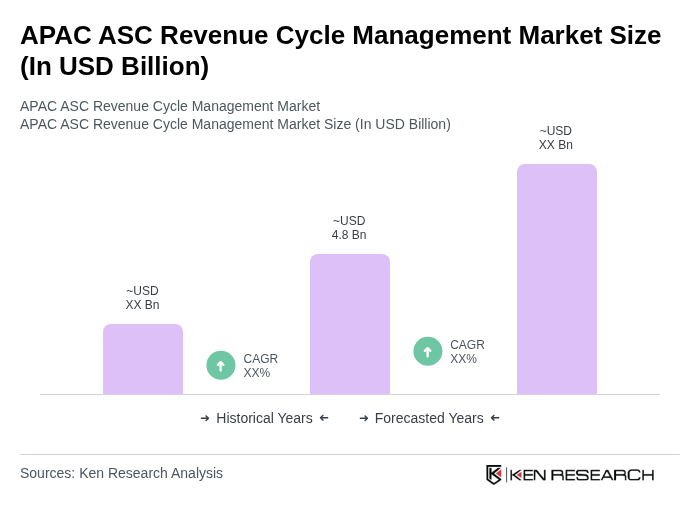
- The APAC ASC Revenue Cycle Management Market is valued at USD 4.8 billion, based on a five-year historical analysis. This growth is primarily driven by the increasing demand for efficient healthcare services, the rise in outpatient surgeries, the need for improved financial management in healthcare facilities, rapid urbanization, increasing disposable income levels, growing awareness about outpatient surgical procedures, aging population, rising prevalence of lifestyle-related diseases, and expanding healthcare infrastructure with adoption of digital health technologies including electronic health records, telemedicine, and cloud-based solutions. The market is also supported by technological advancements in healthcare IT solutions, which enhance operational efficiency and patient care.
- Key players in this market include countries like China, Japan, and India, which dominate due to their large populations, increasing healthcare expenditure, and rapid urbanization. These nations are investing heavily in healthcare infrastructure and technology, leading to a higher adoption of revenue cycle management solutions in ambulatory surgical centers.
- The Ayushman Bharat Digital Mission, 2021 issued by the Ministry of Health and Family Welfare, Government of India, establishes a digital health ecosystem by creating unique health IDs, digital health records, and standardized health data exchange across public and private facilities. This initiative requires healthcare providers to adopt interoperable digital solutions with compliance to data standards, unique identification for beneficiaries, and integration with national registries to enable seamless revenue cycle processes including claims management and billing in ambulatory surgical centers.
APAC ASC Revenue Cycle Management Market Segmentation
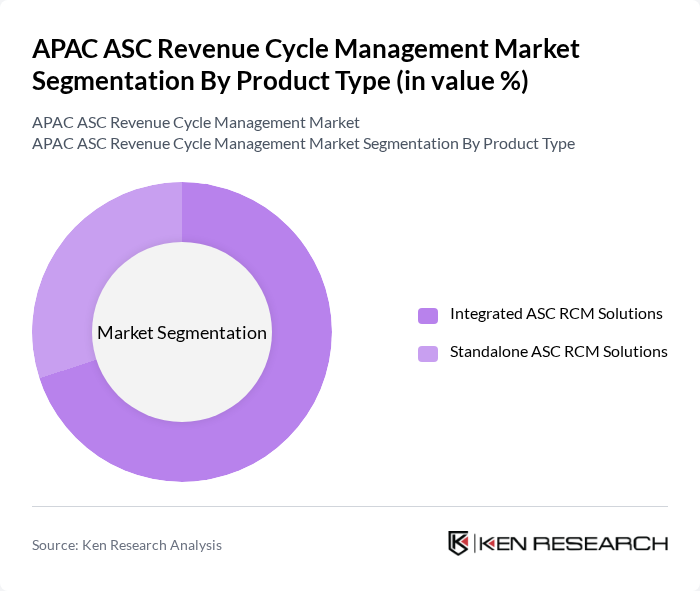
By Product Type:The product type segmentation includes Integrated ASC RCM Solutions and Standalone ASC RCM Solutions. Integrated solutions are gaining traction due to their ability to provide a comprehensive approach to revenue cycle management, allowing for seamless data flow and improved efficiency by integrating functions such as billing, scheduling, coding, and collections into a single platform that streamlines operations and reduces errors. Standalone solutions, while still relevant, are often chosen by smaller facilities that require specific functionalities without the need for a full suite of services.
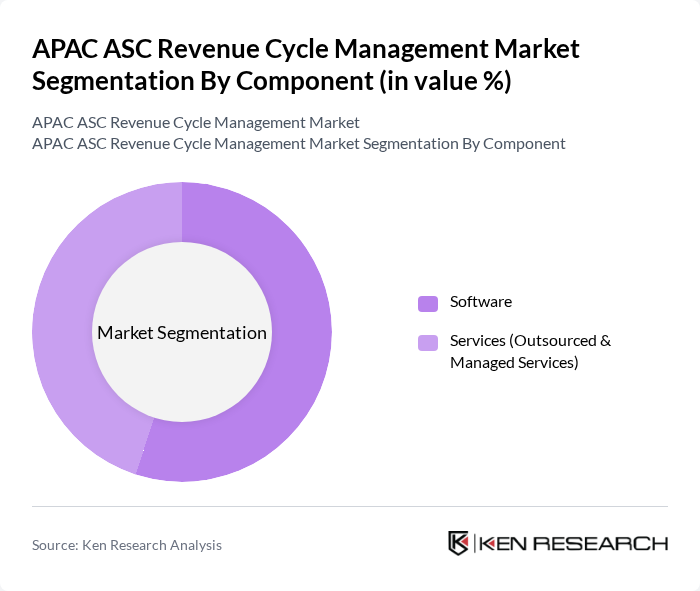
By Component:The component segmentation consists of Software and Services (Outsourced & Managed Services). Software solutions are increasingly preferred due to their ability to automate processes and enhance accuracy in billing and coding. Services, particularly outsourced options, are also in demand as healthcare facilities seek to reduce operational costs and focus on core competencies while ensuring compliance and efficiency in revenue management.
APAC ASC Revenue Cycle Management Market Competitive Landscape
The APAC ASC Revenue Cycle Management Market is characterized by a dynamic mix of regional and international players. Leading participants such as Optum (UnitedHealth Group), R1 RCM Inc., Oracle Health (formerly Cerner Corporation), McKesson Corporation, Change Healthcare (UnitedHealth Group), nThrive (Aviant Health), GeBBS Healthcare Solutions, Conifer Health Solutions, MedAssist (Firstsource Solutions Ltd.), Omega Healthcare, AGS Health, Access Healthcare, Cognizant Technology Solutions, Wipro Limited, TCS (Tata Consultancy Services) contribute to innovation, geographic expansion, and service delivery in this space.
APAC ASC Revenue Cycle Management Market Industry Analysis
Growth Drivers
- Increasing Demand for Cost-Effective Healthcare Solutions:The APAC region is witnessing a significant shift towards cost-effective healthcare solutions, driven by rising healthcare expenditures, which reached approximately $1.7 trillion in future. With healthcare costs projected to increase by 6% annually, Ambulatory Surgical Centers (ASCs) are becoming a preferred choice for patients seeking affordable surgical options. This trend is further supported by government initiatives aimed at reducing healthcare costs, thereby enhancing the demand for efficient revenue cycle management (RCM) solutions in ASCs.
- Technological Advancements in RCM Software:The integration of advanced technologies in RCM software is transforming the operational landscape of ASCs. In future, the global investment in healthcare IT reached $300 billion, with a significant portion allocated to RCM solutions. Innovations such as automation, cloud computing, and data analytics are streamlining billing processes and improving accuracy. As ASCs adopt these technologies, they can enhance operational efficiency, reduce errors, and ultimately improve revenue collection, driving growth in the RCM market.
- Rising Patient Volumes in Ambulatory Surgical Centers (ASCs):The patient volume in ASCs is projected to increase significantly, with estimates indicating a rise to 60 million procedures annually in future. This surge is attributed to the growing preference for outpatient surgeries, which are less costly and offer quicker recovery times. As patient volumes rise, the demand for effective RCM solutions becomes critical to manage billing and collections efficiently, thereby propelling market growth in the APAC region.
Market Challenges
- Complex Billing Processes:The complexity of billing processes in ASCs poses a significant challenge to effective revenue cycle management. With over 75% of ASCs reporting difficulties in navigating intricate billing regulations and coding requirements, inefficiencies can lead to delayed reimbursements. This complexity is exacerbated by the diverse payer mix, which includes private insurers, government programs, and self-pay patients, making it essential for ASCs to adopt streamlined RCM solutions to mitigate these challenges.
- Data Security and Privacy Concerns:As ASCs increasingly adopt digital solutions for RCM, data security and privacy concerns have become paramount. In future, healthcare data breaches affected over 45 million individuals in the APAC region, highlighting vulnerabilities in patient information management. Compliance with regulations such as HIPAA is critical, yet many ASCs struggle to implement robust security measures. This challenge necessitates a focus on secure RCM solutions to protect sensitive patient data and maintain trust.
APAC ASC Revenue Cycle Management Market Future Outlook
The APAC ASC revenue cycle management market is poised for significant evolution, driven by the increasing adoption of technology and a shift towards value-based care models. As ASCs prioritize patient engagement and satisfaction, the integration of advanced analytics and reporting capabilities will become essential. Furthermore, the expansion of telehealth services is expected to enhance patient access and streamline billing processes, creating a more efficient revenue cycle. These trends will shape the future landscape of RCM in the region, fostering innovation and improved financial performance.
Market Opportunities
- Expansion of Telehealth Services:The rapid growth of telehealth services, which saw a 35% increase in usage in future, presents a significant opportunity for RCM providers. By integrating telehealth into their offerings, ASCs can enhance patient access and streamline billing processes, ultimately improving revenue collection and operational efficiency.
- Integration of AI and Machine Learning in RCM:The adoption of AI and machine learning technologies in RCM is gaining traction, with investments in these areas expected to reach $20 billion in future. This integration can optimize billing processes, reduce errors, and enhance predictive analytics, providing ASCs with a competitive edge in managing their revenue cycles effectively.
Scope of the Report
| Segment | Sub-Segments |
|---|---|
| By Product Type | Integrated ASC RCM Solutions Standalone ASC RCM Solutions |
| By Component | Software Services (Outsourced & Managed Services) |
| By Delivery / Deployment Mode | Cloud-Based Web-Based On-Premise |
| By RCM Stage | Front-Office (Patient Access & Pre-Authorization) Mid-Office (Clinical Documentation & Coding) Back-Office (Billing, Collections & Denial Management) |
| By End-User | Independent Ambulatory Surgical Centers Hospital-Owned / Health System–Affiliated ASCs ASC Management Companies |
| By Country | China Japan India South Korea Australia & New Zealand ASEAN (Indonesia, Thailand, Malaysia, Singapore, Vietnam, Others) Rest of Asia Pacific |
| By Technology Enablement | AI-Enabled & Automation-Driven RCM Analytics & Business Intelligence–Enabled RCM Traditional / Rules-Based RCM Platforms |
Key Target Audience
Investors and Venture Capitalist Firms
Government and Regulatory Bodies (e.g., Ministry of Health, National Health Service, Health Insurance Regulatory Authority)
Healthcare Providers and Ambulatory Surgical Centers
Health Insurance Companies
Billing and Coding Service Providers
Healthcare IT Solution Providers
Medical Equipment Manufacturers
Pharmaceutical Companies
Players Mentioned in the Report:
Optum (UnitedHealth Group)
R1 RCM Inc.
Oracle Health (formerly Cerner Corporation)
McKesson Corporation
Change Healthcare (UnitedHealth Group)
nThrive (Aviant Health)
GeBBS Healthcare Solutions
Conifer Health Solutions
MedAssist (Firstsource Solutions Ltd.)
Omega Healthcare
AGS Health
Access Healthcare
Cognizant Technology Solutions
Wipro Limited
TCS (Tata Consultancy Services)
Table of Contents
Market Assessment Phase
1. Executive Summary and Approach
2. APAC ASC Revenue Cycle Management Market Overview
2.1 Key Insights and Strategic Recommendations
2.2 APAC ASC Revenue Cycle Management Market Overview
2.3 Definition and Scope
2.4 Evolution of Market Ecosystem
2.5 Timeline of Key Regulatory Milestones
2.6 Value Chain & Stakeholder Mapping
2.7 Business Cycle Analysis
2.8 Policy & Incentive Landscape
3. APAC ASC Revenue Cycle Management Market Analysis
3.1 Growth Drivers
3.1.1 Increasing demand for cost-effective healthcare solutions
3.1.2 Technological advancements in RCM software
3.1.3 Rising patient volumes in Ambulatory Surgical Centers (ASCs)
3.1.4 Enhanced regulatory compliance requirements
3.2 Market Challenges
3.2.1 Complex billing processes
3.2.2 Data security and privacy concerns
3.2.3 High competition among service providers
3.2.4 Limited awareness of RCM benefits
3.3 Market Opportunities
3.3.1 Expansion of telehealth services
3.3.2 Integration of AI and machine learning in RCM
3.3.3 Growing partnerships between ASCs and RCM providers
3.3.4 Increasing focus on patient engagement and satisfaction
3.4 Market Trends
3.4.1 Shift towards value-based care models
3.4.2 Adoption of cloud-based RCM solutions
3.4.3 Emphasis on analytics and reporting capabilities
3.4.4 Rise of patient-centric billing practices
3.5 Government Regulation
3.5.1 Implementation of ICD-10 coding standards
3.5.2 Changes in reimbursement policies
3.5.3 Compliance with HIPAA regulations
3.5.4 Introduction of value-based payment models
4. SWOT Analysis
5. Stakeholder Analysis
6. Porter's Five Forces Analysis
7. APAC ASC Revenue Cycle Management Market Size, 2019-2024
7.1 By Value
7.2 By Volume
7.3 By Average Selling Price
8. APAC ASC Revenue Cycle Management Market Segmentation
8.1 By Product Type
8.1.1 Integrated ASC RCM Solutions
8.1.2 Standalone ASC RCM Solutions
8.2 By Component
8.2.1 Software
8.2.2 Services (Outsourced & Managed Services)
8.3 By Delivery / Deployment Mode
8.3.1 Cloud-Based
8.3.2 Web-Based
8.3.3 On-Premise
8.4 By RCM Stage
8.4.1 Front-Office (Patient Access & Pre-Authorization)
8.4.2 Mid-Office (Clinical Documentation & Coding)
8.4.3 Back-Office (Billing, Collections & Denial Management)
8.5 By End-User
8.5.1 Independent Ambulatory Surgical Centers
8.5.2 Hospital-Owned / Health System–Affiliated ASCs
8.5.3 ASC Management Companies
8.6 By Country
8.6.1 China
8.6.2 Japan
8.6.3 India
8.6.4 South Korea
8.6.5 Australia & New Zealand
8.6.6 ASEAN (Indonesia, Thailand, Malaysia, Singapore, Vietnam, Others)
8.6.7 Rest of Asia Pacific
8.7 By Technology Enablement
8.7.1 AI-Enabled & Automation-Driven RCM
8.7.2 Analytics & Business Intelligence–Enabled RCM
8.7.3 Traditional / Rules-Based RCM Platforms
9. APAC ASC Revenue Cycle Management Market Competitive Analysis
9.1 Market Share of Key Players
9.2 Cross Comparison of Key Players
9.2.1 Company Name
9.2.2 APAC ASC RCM Revenue (USD Million)
9.2.3 APAC ASC RCM Revenue Growth Rate (%)
9.2.4 Number of ASC Clients in APAC
9.2.5 Average Claim First-Pass Resolution Rate (%)
9.2.6 Average Days in Accounts Receivable (A/R)
9.2.7 Denial Rate for ASC Claims (%)
9.2.8 Average Claim Processing / Turnaround Time (Days)
9.2.9 Client Retention Rate (%)
9.2.10 Share of Cloud-Based Deployments in APAC Portfolio (%)
9.2.11 R&D / Product Development Spend as % of Revenue
9.2.12 Geographic Coverage within APAC (Number of Countries Served)
9.3 SWOT Analysis of Top Players
9.4 Pricing Analysis
9.5 Detailed Profile of Major Companies
9.5.1 Optum (UnitedHealth Group)
9.5.2 R1 RCM Inc.
9.5.3 Oracle Health (formerly Cerner Corporation)
9.5.4 McKesson Corporation
9.5.5 Change Healthcare (UnitedHealth Group)
9.5.6 nThrive (Aviant Health)
9.5.7 GeBBS Healthcare Solutions
9.5.8 Conifer Health Solutions
9.5.9 MedAssist (Firstsource Solutions Ltd.)
9.5.10 Omega Healthcare
9.5.11 AGS Health
9.5.12 Access Healthcare
9.5.13 Cognizant Technology Solutions
9.5.14 Wipro Limited
9.5.15 TCS (Tata Consultancy Services)
10. APAC ASC Revenue Cycle Management Market End-User Analysis
10.1 Procurement Behavior of Key Ministries
10.1.1 Budget Allocation Trends
10.1.2 Decision-Making Processes
10.1.3 Preferred Vendors
10.1.4 Compliance Requirements
10.2 Corporate Spend on Infrastructure & Energy
10.2.1 Investment Trends
10.2.2 Budget Prioritization
10.2.3 Long-term Contracts
10.2.4 Cost Management Strategies
10.3 Pain Point Analysis by End-User Category
10.3.1 Billing Inefficiencies
10.3.2 Compliance Challenges
10.3.3 Technology Integration Issues
10.3.4 Patient Engagement Difficulties
10.4 User Readiness for Adoption
10.4.1 Training Needs
10.4.2 Technology Familiarity
10.4.3 Change Management Strategies
10.4.4 Support Requirements
10.5 Post-Deployment ROI and Use Case Expansion
10.5.1 Performance Metrics
10.5.2 Case Studies
10.5.3 User Feedback
10.5.4 Future Expansion Plans
11. APAC ASC Revenue Cycle Management Market Future Size, 2025-2030
11.1 By Value
11.2 By Volume
11.3 By Average Selling Price
Go-To-Market Strategy Phase
1. Whitespace Analysis + Business Model Canvas
1.1 Market Gaps Identification
1.2 Business Model Development
2. Marketing and Positioning Recommendations
2.1 Branding Strategies
2.2 Product USPs
3. Distribution Plan
3.1 Urban Retail vs Rural NGO Tie-ups
4. Channel & Pricing Gaps
4.1 Underserved Routes
4.2 Pricing Bands
5. Unmet Demand & Latent Needs
5.1 Category Gaps
5.2 Consumer Segments
6. Customer Relationship
6.1 Loyalty Programs
6.2 After-Sales Service
7. Value Proposition
7.1 Sustainability
7.2 Integrated Supply Chains
8. Key Activities
8.1 Regulatory Compliance
8.2 Branding
8.3 Distribution Setup
9. Entry Strategy Evaluation
9.1 Domestic Market Entry Strategy
9.1.1 Product Mix
9.1.2 Pricing Band
9.1.3 Packaging
9.2 Export Entry Strategy
9.2.1 Target Countries
9.2.2 Compliance Roadmap
10. Entry Mode Assessment
10.1 JV
10.2 Greenfield
10.3 M&A
10.4 Distributor Model
11. Capital and Timeline Estimation
11.1 Capital Requirements
11.2 Timelines
12. Control vs Risk Trade-Off
12.1 Ownership vs Partnerships
13. Profitability Outlook
13.1 Breakeven Analysis
13.2 Long-Term Sustainability
14. Potential Partner List
14.1 Distributors
14.2 JVs
14.3 Acquisition Targets
15. Execution Roadmap
15.1 Phased Plan for Market Entry
15.1.1 Market Setup
15.1.2 Market Entry
15.1.3 Growth Acceleration
15.1.4 Scale & Stabilize
15.2 Key Activities and Milestones
15.2.1 Activity Planning
15.2.2 Milestone Tracking
Research Methodology
Phase 1: Approach1
Desk Research
- Industry reports from healthcare associations and market research firms
- Government publications on healthcare expenditure and policy changes
- Academic journals and white papers on revenue cycle management trends
Primary Research
- Interviews with CFOs and revenue cycle managers in healthcare institutions
- Surveys targeting billing and coding specialists across various healthcare settings
- Field interviews with IT managers overseeing RCM software implementations
Validation & Triangulation
- Cross-validation of findings with industry benchmarks and financial reports
- Triangulation of data from primary interviews and secondary sources
- Sanity checks through expert panel discussions and feedback sessions
Phase 2: Market Size Estimation1
Top-down Assessment
- Analysis of total healthcare spending in APAC countries as a baseline
- Segmentation of RCM services by healthcare provider types and service lines
- Incorporation of growth rates from telehealth and digital health initiatives
Bottom-up Modeling
- Revenue estimates from leading RCM service providers based on service offerings
- Cost analysis of RCM processes including billing, coding, and collections
- Volume of patient transactions and average revenue per transaction calculations
Forecasting & Scenario Analysis
- Multi-variable regression analysis incorporating demographic shifts and healthcare access
- Scenario modeling based on regulatory changes and technological advancements
- Baseline, optimistic, and pessimistic forecasts through 2030
Phase 3: CATI Sample Composition1
| Scope Item/Segment | Sample Size | Target Respondent Profiles |
|---|---|---|
| Hospital Revenue Cycle Management | 120 | CFOs, Revenue Cycle Directors |
| Ambulatory Care RCM Services | 100 | Practice Managers, Billing Specialists |
| Health Insurance Claims Processing | 80 | Claims Managers, Underwriting Officers |
| Telehealth Revenue Management | 70 | Telehealth Coordinators, IT Managers |
| Long-term Care RCM Solutions | 60 | Facility Administrators, Financial Officers |
Frequently Asked Questions
What is the current value of the APAC ASC Revenue Cycle Management Market?
The APAC ASC Revenue Cycle Management Market is valued at approximately USD 4.8 billion, driven by the increasing demand for efficient healthcare services, outpatient surgeries, and advancements in healthcare IT solutions.
What factors are driving growth in the APAC ASC Revenue Cycle Management Market?
Which countries are leading in the APAC ASC Revenue Cycle Management Market?
What are the main product types in the APAC ASC Revenue Cycle Management Market?
Other Regional/Country Reports
Indonesia Revenue Cycle Management Market
Malaysia Revenue Cycle Management Market
SEA Revenue Cycle Management Market
Other Adjacent Reports
Singapore Medical Coding Services Market
Belgium Health Insurance Processing Market
Philippines Outpatient Care Services Market
Vietnam Healthcare IT Solutions Market
Why Buy From Us?

What makes us stand out is that our consultants follow Robust, Refine and Result (RRR) methodology. Robust for clear definitions, approaches and sanity checking, Refine for differentiating respondents' facts and opinions, and Result for presenting data with story.

We have set a benchmark in the industry by offering our clients with syndicated and customized market research reports featuring coverage of entire market as well as meticulous research and analyst insights.

While we don't replace traditional research, we flip the method upside down. Our dual approach of Top Bottom & Bottom Top ensures quality deliverable by not just verifying company fundamentals but also looking at the sector and macroeconomic factors.

With one step in the future, our research team constantly tries to show you the bigger picture. We help with some of the tough questions you may encounter along the way: How is the industry positioned? Best marketing channel? KPI's of competitors? By aligning every element, we help maximize success.

Our report gives you instant access to the answers and sources that other companies might choose to hide. We elaborate each steps of research methodology we have used and showcase you the sample size to earn your trust.

If you need any support, we are here! We pride ourselves on universe strength, data quality, and quick, friendly, and professional service.