Region:Asia
Author(s):Shubham
Product Code:KRAC0670
Pages:81
Published On:August 2025
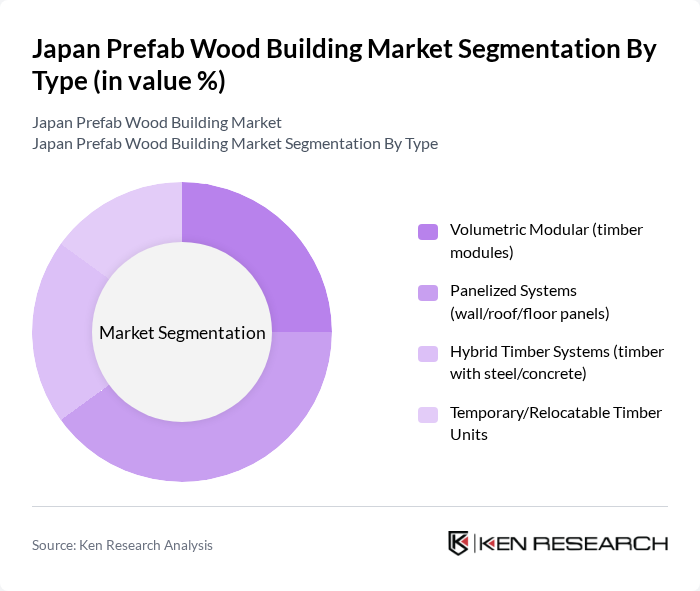
By Type:The market is segmented into four main types: Volumetric Modular (timber modules), Panelized Systems (wall/roof/floor panels), Hybrid Timber Systems (timber with steel/concrete), and Temporary/Relocatable Timber Units. Among these, Panelized Systems are currently leading the market due to their flexibility in design and ease of assembly, which align with Japan’s established industrialized housing ecosystem and large detached housing players that predominantly deploy panelized/light-frame wood solutions.
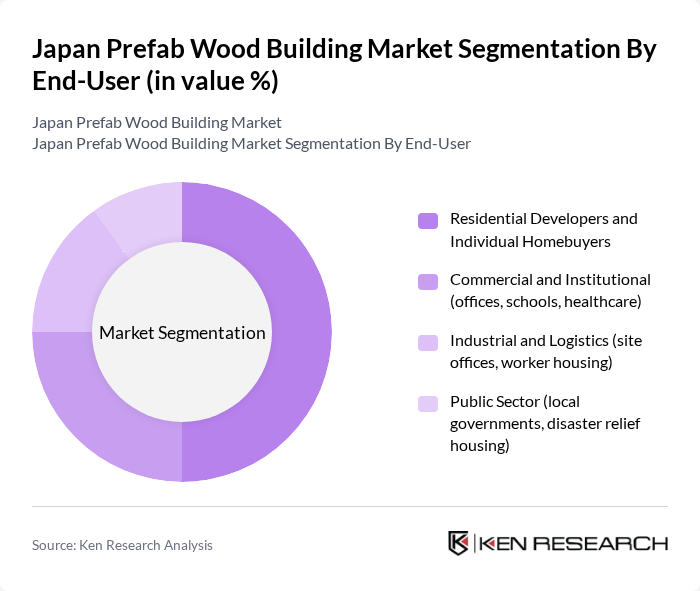
By End-User:The end-user segmentation includes Residential Developers and Individual Homebuyers, Commercial and Institutional (offices, schools, healthcare), Industrial and Logistics (site offices, worker housing), and Public Sector (local governments, disaster relief housing). The Residential Developers and Individual Homebuyers segment is currently the most dominant, supported by Japan’s mature detached housing manufacturers and consumer preference for energy-efficient, factory-built wood homes, alongside incentives for efficient, sustainable housing solutions.
The Japan Prefab Wood Building Market is characterized by a dynamic mix of regional and international players. Leading participants such as Sekisui House, Ltd., Daiwa House Industry Co., Ltd., Asahi Kasei Homes Corporation, Misawa Homes Co., Ltd., Sumitomo Forestry Co., Ltd., Panasonic Homes Co., Ltd., Toyota Housing Corporation, Ichijo Co., Ltd. (Ichijo Komuten), Aqurahome Co., Ltd., Sekisui Chemical Co., Ltd. (Sekisui Heim), Open House Group Co., Ltd., Obayashi Corporation, Shimizu Corporation, Taisei Corporation, Haseko Corporation contribute to innovation, geographic expansion, and service delivery in this space.
The future of the Japan prefab wood building market appears promising, driven by increasing urbanization and a growing emphasis on sustainability. As the government continues to support prefabrication through financial incentives and regulatory reforms, the market is likely to expand. Additionally, advancements in technology will enhance the efficiency and customization of prefab solutions, making them more appealing to consumers. The integration of smart home technologies will further attract buyers, positioning the market for significant growth in the coming years.
| Segment | Sub-Segments |
|---|---|
| By Type | Volumetric Modular (timber modules) Panelized Systems (wall/roof/floor panels) Hybrid Timber Systems (timber with steel/concrete) Temporary/Relocatable Timber Units |
| By End-User | Residential Developers and Individual Homebuyers Commercial and Institutional (offices, schools, healthcare) Industrial and Logistics (site offices, worker housing) Public Sector (local governments, disaster relief housing) |
| By Application | Single-Family Detached (custom and spec homes) Multi-Family/Mid-rise Apartments Low-rise Commercial and Community Facilities Hospitality and Student Housing |
| By Sales Channel | Direct-to-Owner (in-house sales by major builders) Dealer/Agency Networks General Contractors/EPC Partnerships Online Lead Generation/Configurator Platforms |
| By Distribution Mode | Factory-built, Site-assembled Panels Factory-finished Volumetric Modules Kit-of-Parts (precut lumber/LVL packages) Turnkey Design–Manufacture–Assembly (DMA) |
| By Price Range | Budget (? ¥200,000 per m²) Mid-Range (¥200,001–¥350,000 per m²) Premium (? ¥350,001 per m²) |
| By Timber/Engineered Wood System | Cross-Laminated Timber (CLT) Glulam (GLT) Columns and Beams Laminated Veneer Lumber (LVL) / Parallel Strand Lumber (PSL) Conventional Light-Frame (2x4/2x6) and Post-and-Beam |
| Scope Item/Segment | Sample Size | Target Respondent Profiles |
|---|---|---|
| Residential Prefab Wood Construction | 120 | Architects, Home Builders, Project Managers |
| Commercial Wood Building Projects | 100 | Construction Managers, Developers, Engineers |
| Wood Material Suppliers | 80 | Procurement Managers, Sales Representatives |
| Regulatory Compliance in Prefab Construction | 60 | Regulatory Affairs Specialists, Compliance Officers |
| Sustainability Practices in Wood Building | 70 | Sustainability Consultants, Environmental Engineers |
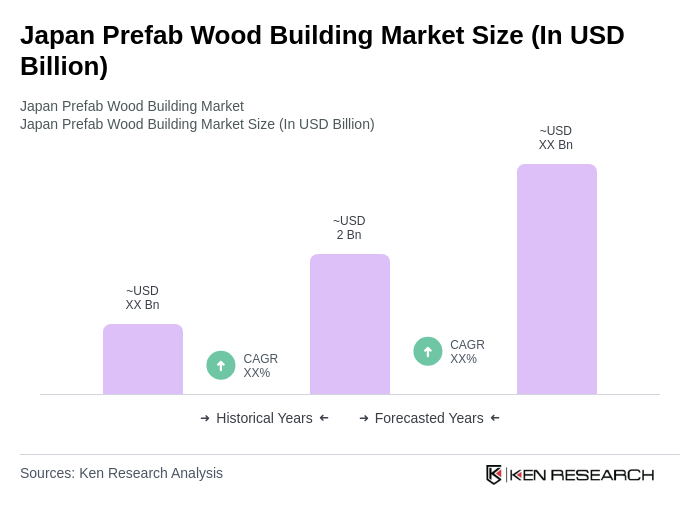
The Japan Prefab Wood Building Market is valued at approximately USD 2 billion, reflecting a significant growth trend driven by sustainable construction practices, urbanization, and the need for rapid housing solutions in disaster-prone areas.

What makes us stand out is that our consultants follow Robust, Refine and Result (RRR) methodology. Robust for clear definitions, approaches and sanity checking, Refine for differentiating respondents' facts and opinions, and Result for presenting data with story.

We have set a benchmark in the industry by offering our clients with syndicated and customized market research reports featuring coverage of entire market as well as meticulous research and analyst insights.

While we don't replace traditional research, we flip the method upside down. Our dual approach of Top Bottom & Bottom Top ensures quality deliverable by not just verifying company fundamentals but also looking at the sector and macroeconomic factors.

With one step in the future, our research team constantly tries to show you the bigger picture. We help with some of the tough questions you may encounter along the way: How is the industry positioned? Best marketing channel? KPI's of competitors? By aligning every element, we help maximize success.

Our report gives you instant access to the answers and sources that other companies might choose to hide. We elaborate each steps of research methodology we have used and showcase you the sample size to earn your trust.

If you need any support, we are here! We pride ourselves on universe strength, data quality, and quick, friendly, and professional service.













