About the Report
Base Year 2024Japan Real Estate and Co-Working Spaces Market Overview
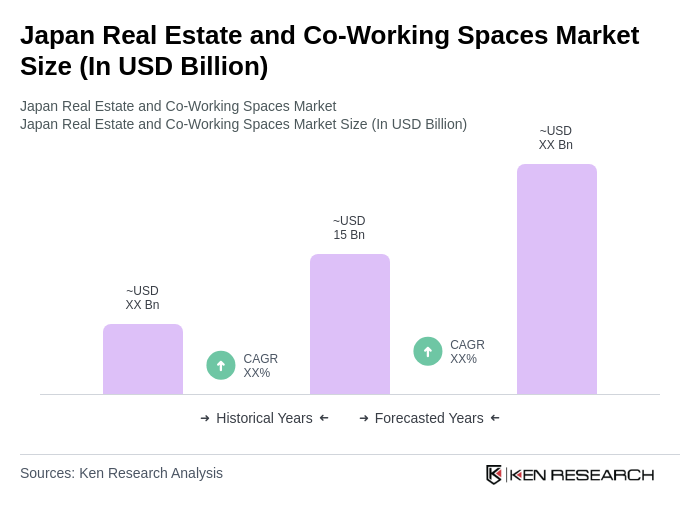
- The Japan Real Estate and Co-Working Spaces Market is valued at USD 15 billion, based on a five-year historical analysis. This growth is primarily driven by urbanization, a shift towards flexible workspaces, and the increasing demand for collaborative environments among businesses. The rise of remote work and the gig economy has further accelerated the need for co-working spaces, making them a vital component of the real estate sector.
- Tokyo, Osaka, and Yokohama are the dominant cities in this market due to their economic significance, high population density, and concentration of businesses. Tokyo, as the capital, serves as a hub for multinational corporations and startups alike, while Osaka and Yokohama offer strategic locations for companies looking to expand their reach in Japan. The vibrant business ecosystem in these cities fosters innovation and attracts talent, further driving the demand for real estate and co-working spaces.
- In 2023, the Japanese government implemented a new regulation aimed at promoting sustainable building practices in the real estate sector. This regulation mandates that all new commercial buildings must meet specific energy efficiency standards and incorporate green technologies. The initiative is part of Japan's broader commitment to reducing carbon emissions and promoting environmentally friendly practices in urban development.
Japan Real Estate and Co-Working Spaces Market Segmentation
By Type:The market is segmented into various types, including Private Offices, Shared Desks, Meeting Rooms, Event Spaces, Virtual Offices, and Others. Each of these sub-segments caters to different customer needs and preferences, reflecting the diverse nature of the workspace environment.
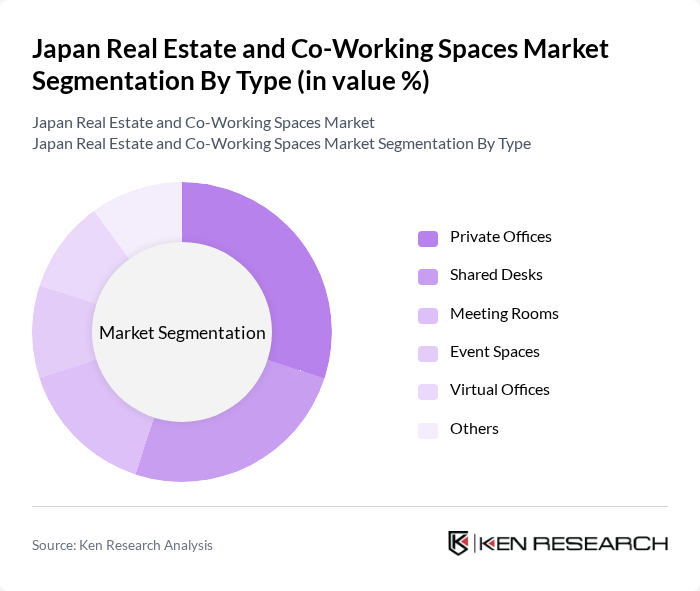
The Private Offices segment is currently dominating the market due to the increasing preference for dedicated workspaces among businesses. Companies are recognizing the importance of having a private area for their teams to enhance productivity and maintain confidentiality. Shared Desks are also gaining traction, particularly among freelancers and startups looking for cost-effective solutions. The demand for Meeting Rooms and Event Spaces is driven by the need for collaborative environments, while Virtual Offices cater to businesses seeking flexibility without the need for physical space.
By End-User:The market is segmented by end-users, including Startups, Freelancers, SMEs, Corporates, and Others. Each segment has unique requirements and preferences that influence their choice of workspace.
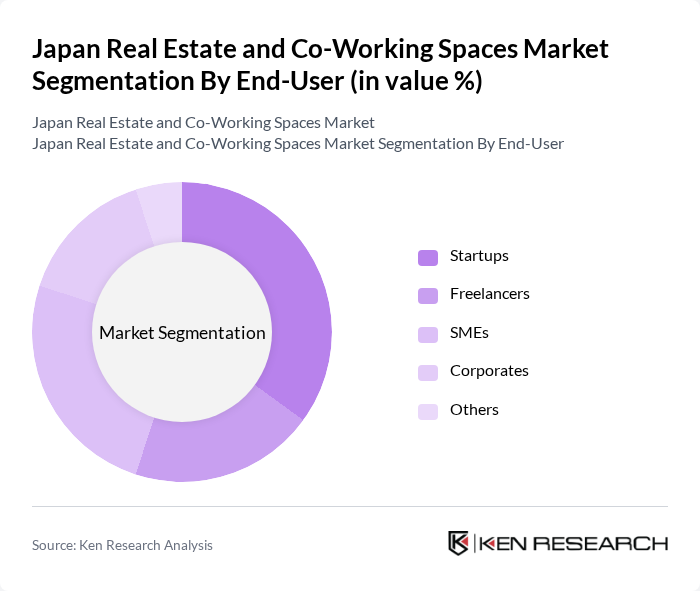
The Startups segment leads the market, driven by the need for flexible and affordable workspace solutions. Startups often require short-term leases and collaborative environments to foster innovation. Freelancers are also a significant segment, seeking flexible arrangements that allow them to work independently while having access to professional amenities. SMEs are increasingly adopting co-working spaces to reduce overhead costs, while Corporates are exploring these options for project-based work and team collaborations. The Others segment includes various niche users who may not fit into the primary categories.
Japan Real Estate and Co-Working Spaces Market Competitive Landscape
The Japan Real Estate and Co-Working Spaces Market is characterized by a dynamic mix of regional and international players. Leading participants such as WeWork Japan, Regus Japan, The Hive Japan, Spaces Japan, Workstyler, Creative Office, Open Office, Co-Working Tokyo, The Executive Centre, Fabbit, BIZcomfort, COWORKING SPACE, Kotozuki, The Workary, Co-Working Lab contribute to innovation, geographic expansion, and service delivery in this space.
Japan Real Estate and Co-Working Spaces Market Industry Analysis
Growth Drivers
- Urbanization and Population Density:Japan's urban population reached approximately 92% in the future, with Tokyo alone housing over 14 million residents. This high density drives demand for real estate, particularly in urban centers where space is limited. The World Bank reported that urban areas contribute about 80% of Japan's GDP, highlighting the economic significance of urbanization. As more people flock to cities, the need for co-working spaces that accommodate flexible work arrangements continues to rise, further fueling market growth.
- Rise of Remote Work Culture:The COVID-19 pandemic accelerated the adoption of remote work in Japan, with 40% of companies implementing flexible work policies in the future. This shift has led to a significant increase in demand for co-working spaces, as businesses seek adaptable solutions for their workforce. According to the Ministry of Internal Affairs and Communications, remote work has improved productivity for 60% of employees, reinforcing the need for collaborative environments that support this new work culture and driving investment in co-working facilities.
- Increased Demand for Flexible Workspaces:The demand for flexible workspaces in Japan surged, with co-working space occupancy rates reaching 75% in major cities in the future. This trend is driven by startups and SMEs seeking cost-effective solutions amid rising real estate prices. The Japan External Trade Organization reported that the number of co-working spaces increased by 30% from 2020 to the future, indicating a robust market response to the evolving needs of businesses. This flexibility is essential for companies navigating economic uncertainties and workforce changes.
Market Challenges
- High Real Estate Prices:Japan's real estate market faces significant challenges due to high property prices, particularly in urban areas. In the future, the average price per square meter in Tokyo reached ¥1,000,000, making it one of the most expensive cities globally. This high cost limits the availability of affordable co-working spaces, posing a barrier for startups and small businesses. The Japan Real Estate Institute noted that these prices have increased by 15% over the past five years, further complicating market entry for new players.
- Regulatory Hurdles:The co-working space sector in Japan faces various regulatory challenges, including zoning laws that restrict the establishment of new facilities. In the future, approximately 25% of proposed co-working spaces were delayed or denied due to regulatory issues. The Ministry of Land, Infrastructure, Transport and Tourism has acknowledged the need for reform, but progress remains slow. These hurdles can deter investment and limit the growth potential of co-working spaces, impacting overall market dynamics.
Japan Real Estate and Co-Working Spaces Market Future Outlook
The future of Japan's real estate and co-working spaces market appears promising, driven by ongoing urbanization and the increasing acceptance of hybrid work models. As companies continue to adapt to flexible work arrangements, the demand for innovative workspace solutions is expected to rise. Additionally, advancements in technology and a growing emphasis on sustainability will likely shape the market landscape, encouraging the development of eco-friendly co-working spaces that cater to environmentally conscious businesses and employees alike.
Market Opportunities
- Expansion of Co-Working Models:The co-working model is evolving, with opportunities for niche spaces targeting specific industries, such as tech or creative sectors. This specialization can attract a dedicated clientele, enhancing occupancy rates. The Japan Co-Working Association reported a 20% increase in niche co-working spaces in the future, indicating a growing trend that can be leveraged for market expansion.
- Integration of Technology in Workspaces:The integration of smart technology in co-working spaces presents a significant opportunity. Features like IoT-enabled devices and advanced booking systems can enhance user experience and operational efficiency. A survey by the Japan Business Federation found that 70% of companies are willing to invest in tech-driven workspaces, highlighting the potential for growth in this area as businesses seek to modernize their work environments.
Scope of the Report
| Segment | Sub-Segments |
|---|---|
| By Type | Private Offices Shared Desks Meeting Rooms Event Spaces Virtual Offices Others |
| By End-User | Startups Freelancers SMEs Corporates Others |
| By Location | Urban Centers Suburban Areas Rural Areas Others |
| By Service Model | Membership-Based Pay-As-You-Go Long-Term Leases Others |
| By Industry | Technology Finance Creative Industries Education Others |
| By Amenities Offered | High-Speed Internet Meeting Facilities Kitchen and Lounge Areas Event Hosting Others |
| By Pricing Model | Hourly Rates Daily Rates Monthly Memberships Annual Contracts Others |
Key Target Audience
Investors and Venture Capitalist Firms
Government and Regulatory Bodies (e.g., Ministry of Land, Infrastructure, Transport and Tourism)
Real Estate Developers
Property Management Companies
Co-Working Space Operators
Commercial Real Estate Brokers
Financial Institutions
Corporate Clients and Enterprises
Players Mentioned in the Report:
WeWork Japan
Regus Japan
The Hive Japan
Spaces Japan
Workstyler
Creative Office
Open Office
Co-Working Tokyo
The Executive Centre
Fabbit
BIZcomfort
COWORKING SPACE
Kotozuki
The Workary
Co-Working Lab
Table of Contents
Market Assessment Phase
1. Executive Summary and Approach
2. Japan Real Estate and Co-Working Spaces Market Overview
2.1 Key Insights and Strategic Recommendations
2.2 Japan Real Estate and Co-Working Spaces Market Overview
2.3 Definition and Scope
2.4 Evolution of Market Ecosystem
2.5 Timeline of Key Regulatory Milestones
2.6 Value Chain & Stakeholder Mapping
2.7 Business Cycle Analysis
2.8 Policy & Incentive Landscape
3. Japan Real Estate and Co-Working Spaces Market Analysis
3.1 Growth Drivers
3.1.1 Urbanization and Population Density
3.1.2 Rise of Remote Work Culture
3.1.3 Increased Demand for Flexible Workspaces
3.1.4 Government Initiatives Supporting Startups
3.2 Market Challenges
3.2.1 High Real Estate Prices
3.2.2 Regulatory Hurdles
3.2.3 Competition from Traditional Office Spaces
3.2.4 Economic Uncertainty
3.3 Market Opportunities
3.3.1 Expansion of Co-Working Models
3.3.2 Integration of Technology in Workspaces
3.3.3 Sustainable and Eco-Friendly Spaces
3.3.4 Partnerships with Corporates for Flexible Solutions
3.4 Market Trends
3.4.1 Hybrid Work Models
3.4.2 Increased Focus on Health and Safety
3.4.3 Customization of Workspaces
3.4.4 Growth of Niche Co-Working Spaces
3.5 Government Regulation
3.5.1 Zoning Laws Impacting Co-Working Spaces
3.5.2 Tax Incentives for Real Estate Development
3.5.3 Building Safety Regulations
3.5.4 Labor Laws Affecting Flexible Work Arrangements
4. SWOT Analysis
5. Stakeholder Analysis
6. Porter's Five Forces Analysis
7. Japan Real Estate and Co-Working Spaces Market Market Size, 2019-2024
7.1 By Value
7.2 By Volume
7.3 By Average Selling Price
8. Japan Real Estate and Co-Working Spaces Market Segmentation
8.1 By Type
8.1.1 Private Offices
8.1.2 Shared Desks
8.1.3 Meeting Rooms
8.1.4 Event Spaces
8.1.5 Virtual Offices
8.1.6 Others
8.2 By End-User
8.2.1 Startups
8.2.2 Freelancers
8.2.3 SMEs
8.2.4 Corporates
8.2.5 Others
8.3 By Location
8.3.1 Urban Centers
8.3.2 Suburban Areas
8.3.3 Rural Areas
8.3.4 Others
8.4 By Service Model
8.4.1 Membership-Based
8.4.2 Pay-As-You-Go
8.4.3 Long-Term Leases
8.4.4 Others
8.5 By Industry
8.5.1 Technology
8.5.2 Finance
8.5.3 Creative Industries
8.5.4 Education
8.5.5 Others
8.6 By Amenities Offered
8.6.1 High-Speed Internet
8.6.2 Meeting Facilities
8.6.3 Kitchen and Lounge Areas
8.6.4 Event Hosting
8.6.5 Others
8.7 By Pricing Model
8.7.1 Hourly Rates
8.7.2 Daily Rates
8.7.3 Monthly Memberships
8.7.4 Annual Contracts
8.7.5 Others
9. Japan Real Estate and Co-Working Spaces Market Competitive Analysis
9.1 Market Share of Key Players
9.2 Cross Comparison of Key Players
9.2.1 Company Name
9.2.2 Group Size (Large, Medium, or Small as per industry convention)
9.2.3 Occupancy Rate
9.2.4 Revenue per Available Workspace
9.2.5 Customer Retention Rate
9.2.6 Pricing Strategy
9.2.7 Average Contract Length
9.2.8 Net Promoter Score (NPS)
9.2.9 Market Growth Rate
9.2.10 Customer Acquisition Cost (CAC)
9.3 SWOT Analysis of Top Players
9.4 Pricing Analysis
9.5 Detailed Profile of Major Companies
9.5.1 WeWork Japan
9.5.2 Regus Japan
9.5.3 The Hive Japan
9.5.4 Spaces Japan
9.5.5 Workstyler
9.5.6 Creative Office
9.5.7 Open Office
9.5.8 Co-Working Tokyo
9.5.9 The Executive Centre
9.5.10 Fabbit
9.5.11 BIZcomfort
9.5.12 COWORKING SPACE
9.5.13 Kotozuki
9.5.14 The Workary
9.5.15 Co-Working Lab
10. Japan Real Estate and Co-Working Spaces Market End-User Analysis
10.1 Procurement Behavior of Key Ministries
10.1.1 Government Contracts for Office Spaces
10.1.2 Budget Allocation for Flexible Workspaces
10.1.3 Evaluation Criteria for Co-Working Spaces
10.2 Corporate Spend on Infrastructure & Energy
10.2.1 Investment in Co-Working Facilities
10.2.2 Budgeting for Office Upgrades
10.2.3 Energy Efficiency Initiatives
10.3 Pain Point Analysis by End-User Category
10.3.1 Cost Management
10.3.2 Space Utilization
10.3.3 Flexibility Needs
10.4 User Readiness for Adoption
10.4.1 Awareness of Co-Working Benefits
10.4.2 Willingness to Transition to Flexible Workspaces
10.5 Post-Deployment ROI and Use Case Expansion
10.5.1 Measuring ROI from Co-Working Investments
10.5.2 Expansion of Use Cases in Co-Working
11. Japan Real Estate and Co-Working Spaces Market Future Size, 2025-2030
11.1 By Value
11.2 By Volume
11.3 By Average Selling Price
Go-To-Market Strategy Phase
1. Whitespace Analysis + Business Model Canvas
1.1 Market Gaps Identification
1.2 Business Model Framework
2. Marketing and Positioning Recommendations
2.1 Branding Strategies
2.2 Product USPs
3. Distribution Plan
3.1 Urban Retail vs Rural NGO Tie-Ups
4. Channel & Pricing Gaps
4.1 Underserved Routes
4.2 Pricing Bands
5. Unmet Demand & Latent Needs
5.1 Category Gaps
5.2 Consumer Segments
6. Customer Relationship
6.1 Loyalty Programs
6.2 After-Sales Service
7. Value Proposition
7.1 Sustainability
7.2 Integrated Supply Chains
8. Key Activities
8.1 Regulatory Compliance
8.2 Branding
8.3 Distribution Setup
9. Entry Strategy Evaluation
9.1 Domestic Market Entry Strategy
9.1.1 Product Mix
9.1.2 Pricing Band
9.1.3 Packaging
9.2 Export Entry Strategy
9.2.1 Target Countries
9.2.2 Compliance Roadmap
10. Entry Mode Assessment
10.1 JV
10.2 Greenfield
10.3 M&A
10.4 Distributor Model
11. Capital and Timeline Estimation
11.1 Capital Requirements
11.2 Timelines
12. Control vs Risk Trade-Off
12.1 Ownership vs Partnerships
13. Profitability Outlook
13.1 Breakeven Analysis
13.2 Long-Term Sustainability
14. Potential Partner List
14.1 Distributors
14.2 JVs
14.3 Acquisition Targets
15. Execution Roadmap
15.1 Phased Plan for Market Entry
15.1.1 Market Setup
15.1.2 Market Entry
15.1.3 Growth Acceleration
15.1.4 Scale & Stabilize
15.2 Key Activities and Milestones
15.2.1 Activity Timeline
15.2.2 Milestone Tracking
Research Methodology
Phase 1: Approach1
Desk Research
- Analysis of government publications and reports on real estate trends in Japan
- Review of industry reports from real estate associations and co-working space organizations
- Examination of market research studies focusing on urban development and workspace trends
Primary Research
- Interviews with real estate developers and co-working space operators
- Surveys targeting corporate clients utilizing co-working spaces
- Field interviews with urban planners and real estate analysts
Validation & Triangulation
- Cross-validation of findings through multiple data sources including government and private sector reports
- Triangulation of qualitative insights from interviews with quantitative data from surveys
- Sanity checks through expert panel discussions with industry veterans
Phase 2: Market Size Estimation1
Top-down Assessment
- Estimation of total market size based on national real estate investment trends
- Segmentation of the market by geographic regions and types of co-working spaces
- Incorporation of macroeconomic indicators such as GDP growth and employment rates
Bottom-up Modeling
- Collection of occupancy rates and pricing data from leading co-working space providers
- Estimation of revenue streams based on membership models and service offerings
- Analysis of growth rates from individual co-working spaces to project overall market growth
Forecasting & Scenario Analysis
- Multi-factor regression analysis incorporating trends in remote work and urbanization
- Scenario modeling based on potential economic shifts and changes in corporate real estate strategies
- Development of baseline, optimistic, and pessimistic forecasts through 2030
Phase 3: CATI Sample Composition1
| Scope Item/Segment | Sample Size | Target Respondent Profiles |
|---|---|---|
| Co-Working Space Operators | 100 | Founders, Operations Managers |
| Corporate Clients of Co-Working Spaces | 150 | HR Managers, Facilities Managers |
| Real Estate Developers | 80 | Project Managers, Business Development Executives |
| Urban Planners and Policy Makers | 60 | City Planners, Economic Development Officers |
| Industry Experts and Analysts | 50 | Market Researchers, Real Estate Analysts |
Frequently Asked Questions
What is the current value of the Japan Real Estate and Co-Working Spaces Market?
The Japan Real Estate and Co-Working Spaces Market is valued at approximately USD 15 billion, reflecting significant growth driven by urbanization, flexible workspaces, and the demand for collaborative environments among businesses, particularly in major cities like Tokyo, Osaka, and Yokohama.
Which cities dominate the Japan Real Estate and Co-Working Spaces Market?
What factors are driving the growth of co-working spaces in Japan?
What are the main types of co-working spaces available in Japan?
Other Regional/Country Reports
Indonesia Real Estate and Co-Working Spaces Market
Malaysia Real Estate and Co-Working Spaces Market
KSA Real Estate and Co-Working Spaces Market
APAC Real Estate and Co-Working Spaces Market
SEA Real Estate and Co-Working Spaces Market
Other Adjacent Reports
Singapore PropTech Market
North America Office Furniture Market Outlook to 2030: Size, Share, Growth and TrendsKuwait Property Management Software Market Report Size Share Growth Drivers Trends Opportunities & Forecast 2025–2030Indonesia Virtual Office Services Market
Oman Startup Incubator Market
United Arab Emirates Facilities Management Market Outlook to 2026FBrazil Commercial Interior Design Market
Smart Building Technology MarketMalaysia Real Estate Investment Market
Singapore Sustainable Construction Market
Why Buy From Us?

What makes us stand out is that our consultants follow Robust, Refine and Result (RRR) methodology. Robust for clear definitions, approaches and sanity checking, Refine for differentiating respondents' facts and opinions, and Result for presenting data with story.

We have set a benchmark in the industry by offering our clients with syndicated and customized market research reports featuring coverage of entire market as well as meticulous research and analyst insights.

While we don't replace traditional research, we flip the method upside down. Our dual approach of Top Bottom & Bottom Top ensures quality deliverable by not just verifying company fundamentals but also looking at the sector and macroeconomic factors.

With one step in the future, our research team constantly tries to show you the bigger picture. We help with some of the tough questions you may encounter along the way: How is the industry positioned? Best marketing channel? KPI's of competitors? By aligning every element, we help maximize success.

Our report gives you instant access to the answers and sources that other companies might choose to hide. We elaborate each steps of research methodology we have used and showcase you the sample size to earn your trust.

If you need any support, we are here! We pride ourselves on universe strength, data quality, and quick, friendly, and professional service.