About the Report
Base Year 2024Japan Wet Waste Management Market Overview
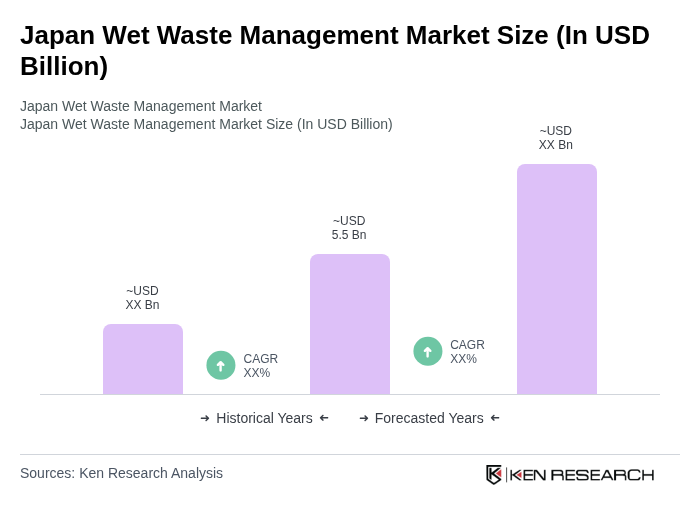
- The Japan Wet Waste Management Market is valued at approximately USD 5.5 billion, based on a five-year historical analysis and its share within the broader Japan waste management market, which is valued at over USD 50 billion for all waste streams.This growth is primarily driven by increasing urbanization, stringent environmental regulations, and a growing emphasis on sustainable waste management practices.The rising awareness of the environmental impact of waste, particularly food loss and waste, and the need for effective waste disposal and recycling solutions have further propelled the market's expansion.
- Key cities such as Tokyo, Osaka, and Yokohama dominate the market due to their high population density and significant municipal and commercial waste generation.These urban centers have implemented advanced waste management systems and technologies, including source-separated collection of combustible/organic waste, mechanical-biological treatment, and waste-to-energy incineration, making them leaders in the wet waste management sector.The concentration of industries, large commercial establishments, and the HoReCa sector in these cities also contributes to their dominance in the market.
- Japan’s policy framework for organic and food-related wet waste is anchored in instruments such as the Act on Promotion of Food Loss and Waste Reduction, 2019, issued by the Ministry of Agriculture, Forestry and Fisheries and the Ministry of the Environment, and the Food Recycling Act (Act on Promotion of Recycling and Related Activities for Treatment of Cyclical Food Resources), 2000, which promote recycling of food waste into feed, fertilizer, and energy.These laws require food-related businesses to implement reduction and recycling measures for organic waste and set targets for recycling rates, thereby encouraging the adoption of sustainable wet waste treatment technologies and supporting Japan’s circular economy policy.
Japan Wet Waste Management Market Segmentation
By Waste Type:The wet waste management market can be segmented into various waste types, including household food waste, commercial and institutional food waste, food and beverage processing waste, agricultural and livestock wet waste, sewage sludge and septic waste, and other biodegradable wet waste. Each of these subsegments plays a crucial role in the overall market dynamics, driven by specific consumer behaviors and industry practices and by Japan’s sector-specific recycling and waste-to-energy policies for organic and liquid waste.
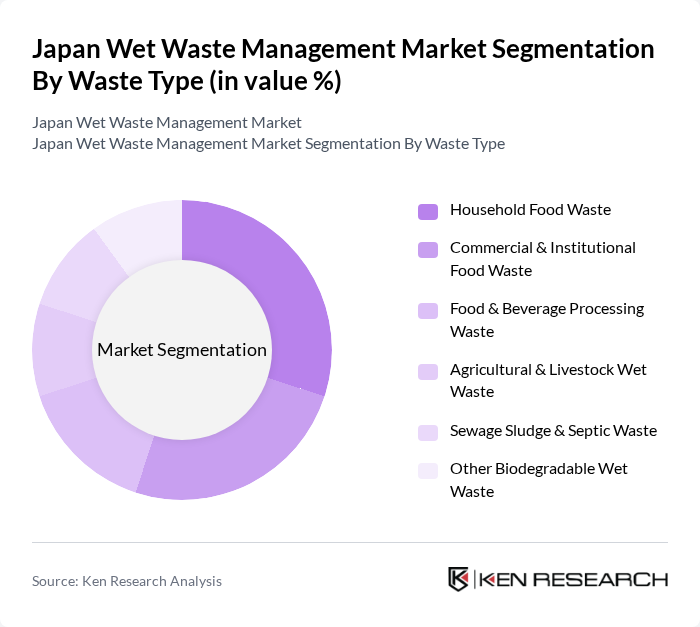
The leading subsegment in the wet waste management market is Household Food Waste, which accounts for a significant portion of the total waste generated in urban areas, as household and similar municipal waste remain the largest component of Japan’s solid waste stream.This dominance is attributed to the increasing consumer awareness regarding food waste reduction, national campaigns to cut food loss, and the implementation of household composting and source-separation initiatives by municipalities.Additionally, the rise in urban living and the growing trend of sustainable practices among consumers have further propelled the demand for effective management solutions in this subsegment, including separate collection of kitchen waste, community composting, and integration with anaerobic digestion and waste-to-energy facilities.
By Source:The market can also be segmented based on the source of wet waste, which includes residential/municipal, HoReCa (Hotels, Restaurants, Cafés), food retail & supermarkets, food & beverage manufacturing, agriculture & fisheries, and public institutions & others. Each source contributes uniquely to the overall waste generation and management strategies, reflecting differences in waste composition, contamination levels, and applicable recycling or energy recovery routes.
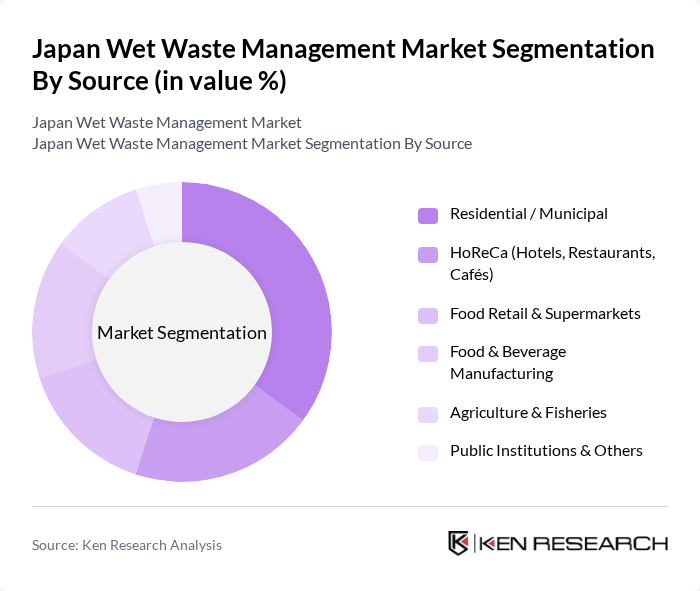
The Residential / Municipal source is the largest contributor to the wet waste management market, driven by the high volume of mixed kitchen and organic waste generated in urban households and collected through Japan’s segregated municipal waste systems.The increasing focus on community-based waste management programs, local government initiatives to promote recycling and composting, and food loss reduction targets under national policy have significantly influenced this subsegment's growth.Additionally, the rising population concentration in metropolitan regions and limited landfill capacity continue to escalate the demand for effective wet waste management solutions such as anaerobic digestion, biogas utilization, and high-efficiency incineration with energy recovery.
Japan Wet Waste Management Market Competitive Landscape
The Japan Wet Waste Management Market is characterized by a dynamic mix of regional and international players. Leading participants such as Veolia Japan K.K., JFE Engineering Corporation, SUEZ Group (Japan Operations), Daiseki Co., Ltd., Daiki Axis Co., Ltd., Mitsubishi Heavy Industries Environmental & Chemical Engineering Co., Ltd., Hitachi Zosen Corporation, Ebara Environmental Plant Co., Ltd., Kanden Energy Solution Co., Inc. (KANSAI Electric Group), Kanto Eco Energy Co., Ltd., Local Municipal Waste Management Bureaus (Tokyo, Osaka, Sapporo, etc.), Regional Biogas & Composting Operators, Major General Waste Management Companies (Japan-based), Technology Providers & EPC Players Focused on Wet Waste, Emerging Start-ups in Food Waste Recycling & Digital Solutions contribute to innovation, geographic expansion, and service delivery in this space.
Japan Wet Waste Management Market Industry Analysis
Growth Drivers
- Increasing Urbanization:Japan's urban population is projected to reach approximately 92% in future, up from about 91% in the recent past, according to the World Bank. This rapid urbanization leads to increased waste generation, with urban areas producing about 60 million tons of wet waste annually. The concentration of population in cities necessitates efficient waste management systems, driving demand for advanced wet waste management solutions to handle the growing waste volumes effectively.
- Stringent Environmental Regulations:Japan's government has implemented strict environmental regulations, including the Waste Management and Public Cleansing Law, which mandates proper waste disposal and recycling practices. In future, the government aims to reduce landfill waste by 30% from earlier levels, translating to a reduction of approximately 12 million tons. These regulations compel municipalities and businesses to invest in efficient wet waste management technologies, fostering market growth.
- Technological Advancements in Waste Processing:The Japanese wet waste management sector is witnessing significant technological innovations, with investments in advanced processing technologies expected to exceed ¥200 billion (approximately $1.8 billion) in future. Innovations such as anaerobic digestion and composting are becoming more prevalent, enhancing waste processing efficiency and reducing environmental impact. These advancements are crucial for managing the increasing volumes of wet waste generated in urban areas.
Market Challenges
- High Operational Costs:The operational costs associated with wet waste management in Japan are notably high, averaging around ¥15,000 (approximately $135) per ton of waste processed. This is primarily due to the expenses related to advanced technology implementation and compliance with stringent regulations. As a result, many municipalities struggle to allocate sufficient budgets, hindering the development of effective waste management systems and limiting market growth.
- Limited Public Participation:Public participation in waste management initiatives remains a challenge, with only about 40% of residents actively engaging in recycling programs as of 2023. This low engagement level can be attributed to a lack of awareness and education regarding waste management practices. Consequently, the limited involvement of the public in waste segregation and recycling efforts hampers the effectiveness of wet waste management strategies across the country.
Japan Wet Waste Management Market Future Outlook
The future of Japan's wet waste management market appears promising, driven by increasing urbanization and technological advancements. By in future, the integration of smart waste management solutions, such as IoT-enabled waste bins, is expected to enhance operational efficiency. Additionally, the growing emphasis on sustainability will likely lead to more public-private partnerships, fostering innovation and investment in waste processing technologies. These trends will be pivotal in addressing the challenges faced by the sector and improving overall waste management practices.
Market Opportunities
- Expansion of Recycling Programs:The Japanese government plans to invest ¥50 billion (approximately $450 million) in expanding recycling programs in future. This initiative aims to increase recycling rates from 20% to 30%, creating opportunities for businesses to develop innovative recycling technologies and services that cater to the growing demand for sustainable waste management solutions.
- Development of Sustainable Waste-to-Energy Projects:With Japan's energy needs rising, the government is promoting waste-to-energy projects, targeting a generation of 1.5 million megawatt-hours from waste in future. This initiative presents opportunities for companies to invest in waste-to-energy technologies, contributing to energy sustainability while addressing the challenges of wet waste disposal.
Scope of the Report
| Segment | Sub-Segments |
|---|---|
| By Waste Type | Household Food Waste Commercial & Institutional Food Waste Food & Beverage Processing Waste Agricultural & Livestock Wet Waste Sewage Sludge & Septic Waste Other Biodegradable Wet Waste |
| By Source | Residential / Municipal HoReCa (Hotels, Restaurants, Cafés) Food Retail & Supermarkets Food & Beverage Manufacturing Agriculture & Fisheries Public Institutions & Others |
| By Service | Collection & Transportation Sorting & Pre?processing Treatment & Recycling Disposal |
| By Treatment Technology | Composting Anaerobic Digestion / Biogas Mechanical Biological Treatment Wet Waste-to-Energy (Incineration) Other Biological & Chemical Treatments |
| By End Use of Outputs | Organic Fertilizers & Soil Conditioners Biogas for Heat & Power Biomethane / RNG for Mobility & Grid Injection Recovered Water / Process Water Others |
| By Geographic Region | Kanto Kansai Chubu Hokkaido & Tohoku Chugoku & Shikoku Kyushu & Okinawa |
Key Target Audience
Investors and Venture Capitalist Firms
Government and Regulatory Bodies (e.g., Ministry of the Environment, Japan Environmental Sanitation Center)
Waste Management Companies
Recycling Facilities
Environmental NGOs
Municipalities and Local Governments
Waste-to-Energy Plant Operators
Logistics and Transportation Companies
Players Mentioned in the Report:
Veolia Japan K.K.
JFE Engineering Corporation
SUEZ Group (Japan Operations)
Daiseki Co., Ltd.
Daiki Axis Co., Ltd.
Mitsubishi Heavy Industries Environmental & Chemical Engineering Co., Ltd.
Hitachi Zosen Corporation
Ebara Environmental Plant Co., Ltd.
Kanden Energy Solution Co., Inc. (KANSAI Electric Group)
Kanto Eco Energy Co., Ltd.
Local Municipal Waste Management Bureaus (Tokyo, Osaka, Sapporo, etc.)
Regional Biogas & Composting Operators
Major General Waste Management Companies (Japan-based)
Technology Providers & EPC Players Focused on Wet Waste
Emerging Start-ups in Food Waste Recycling & Digital Solutions
Table of Contents
Market Assessment Phase
1. Executive Summary and Approach
2. Japan Wet Waste Management Market Overview
2.1 Key Insights and Strategic Recommendations
2.2 Japan Wet Waste Management Market Overview
2.3 Definition and Scope
2.4 Evolution of Market Ecosystem
2.5 Timeline of Key Regulatory Milestones
2.6 Value Chain & Stakeholder Mapping
2.7 Business Cycle Analysis
2.8 Policy & Incentive Landscape
3. Japan Wet Waste Management Market Analysis
3.1 Growth Drivers
3.1.1 Increasing Urbanization
3.1.2 Stringent Environmental Regulations
3.1.3 Technological Advancements in Waste Processing
3.1.4 Rising Public Awareness on Waste Management
3.2 Market Challenges
3.2.1 High Operational Costs
3.2.2 Limited Public Participation
3.2.3 Inadequate Infrastructure
3.2.4 Regulatory Compliance Issues
3.3 Market Opportunities
3.3.1 Expansion of Recycling Programs
3.3.2 Investment in Smart Waste Management Solutions
3.3.3 Collaboration with Private Sector
3.3.4 Development of Sustainable Waste-to-Energy Projects
3.4 Market Trends
3.4.1 Adoption of Circular Economy Principles
3.4.2 Integration of IoT in Waste Management
3.4.3 Growth of Biodegradable Waste Solutions
3.4.4 Increased Focus on Zero Waste Initiatives
3.5 Government Regulation
3.5.1 Waste Management and Public Cleansing Law
3.5.2 Law for Promotion of Effective Utilization of Resources
3.5.3 Local Government Waste Management Policies
3.5.4 Environmental Impact Assessment Regulations
4. SWOT Analysis
5. Stakeholder Analysis
6. Porter's Five Forces Analysis
7. Japan Wet Waste Management Market Market Size, 2019-2024
7.1 By Value
7.2 By Volume
7.3 By Average Selling Price
8. Japan Wet Waste Management Market Segmentation
8.1 By Waste Type
8.1.1 Household Food Waste
8.1.2 Commercial & Institutional Food Waste
8.1.3 Food & Beverage Processing Waste
8.1.4 Agricultural & Livestock Wet Waste
8.1.5 Sewage Sludge & Septic Waste
8.1.6 Other Biodegradable Wet Waste
8.2 By Source
8.2.1 Residential / Municipal
8.2.2 HoReCa (Hotels, Restaurants, Cafés)
8.2.3 Food Retail & Supermarkets
8.2.4 Food & Beverage Manufacturing
8.2.5 Agriculture & Fisheries
8.2.6 Public Institutions & Others
8.3 By Service
8.3.1 Collection & Transportation
8.3.2 Sorting & Pre?processing
8.3.3 Treatment & Recycling
8.3.4 Disposal
8.4 By Treatment Technology
8.4.1 Composting
8.4.2 Anaerobic Digestion / Biogas
8.4.3 Mechanical Biological Treatment
8.4.4 Wet Waste-to-Energy (Incineration)
8.4.5 Other Biological & Chemical Treatments
8.5 By End Use of Outputs
8.5.1 Organic Fertilizers & Soil Conditioners
8.5.2 Biogas for Heat & Power
8.5.3 Biomethane / RNG for Mobility & Grid Injection
8.5.4 Recovered Water / Process Water
8.5.5 Others
8.6 By Geographic Region
8.6.1 Kanto
8.6.2 Kansai
8.6.3 Chubu
8.6.4 Hokkaido & Tohoku
8.6.5 Chugoku & Shikoku
8.6.6 Kyushu & Okinawa
9. Japan Wet Waste Management Market Competitive Analysis
9.1 Market Share of Key Players
9.2 Cross Comparison of Key Players
9.2.1 Company Name
9.2.2 Group Size (Large, Medium, or Small as per industry convention)
9.2.3 Japan Wet Waste Revenue (Latest FY, JPY Billion)
9.2.4 3-Year Revenue CAGR in Japan Wet Waste (%)
9.2.5 EBITDA Margin from Wet Waste Operations (%)
9.2.6 Capital Expenditure on Wet Waste Assets (Last 3 Years, JPY Billion)
9.2.7 Installed Wet Waste Processing Capacity (TPD)
9.2.8 Capacity Utilization Rate (%)
9.2.9 Share of Contracted / Long-Term Revenues (%)
9.2.10 Average Gate Fee / Service Fee per Tonne (JPY/tonne)
9.2.11 Share of High-Value Recovery (Biogas, Fertilizer, Energy) in Revenue (%)
9.2.12 CO?e Emissions Avoided per Year (Tonnes)
9.2.13 Share of Revenue from Japan vs Overseas (%)
9.3 SWOT Analysis of Top Players
9.4 Pricing Analysis
9.5 Detailed Profile of Major Companies
9.5.1 Veolia Japan K.K.
9.5.2 JFE Engineering Corporation
9.5.3 SUEZ Group (Japan Operations)
9.5.4 Daiseki Co., Ltd.
9.5.5 Daiki Axis Co., Ltd.
9.5.6 Mitsubishi Heavy Industries Environmental & Chemical Engineering Co., Ltd.
9.5.7 Hitachi Zosen Corporation
9.5.8 Ebara Environmental Plant Co., Ltd.
9.5.9 Kanden Energy Solution Co., Inc. (KANSAI Electric Group)
9.5.10 Kanto Eco Energy Co., Ltd.
9.5.11 Local Municipal Waste Management Bureaus (Tokyo, Osaka, Sapporo, etc.)
9.5.12 Regional Biogas & Composting Operators
9.5.13 Major General Waste Management Companies (Japan-based)
9.5.14 Technology Providers & EPC Players Focused on Wet Waste
9.5.15 Emerging Start-ups in Food Waste Recycling & Digital Solutions
10. Japan Wet Waste Management Market End-User Analysis
10.1 Procurement Behavior of Key Ministries
10.1.1 Ministry of the Environment
10.1.2 Ministry of Health, Labour and Welfare
10.1.3 Ministry of Agriculture, Forestry and Fisheries
10.1.4 Others
10.2 Corporate Spend on Infrastructure & Energy
10.2.1 Investment Trends
10.2.2 Budget Allocation
10.2.3 Infrastructure Development Plans
10.2.4 Others
10.3 Pain Point Analysis by End-User Category
10.3.1 Residential
10.3.2 Commercial
10.3.3 Industrial
10.3.4 Government & Utilities
10.4 User Readiness for Adoption
10.4.1 Awareness Levels
10.4.2 Training Needs
10.4.3 Technology Acceptance
10.4.4 Others
10.5 Post-Deployment ROI and Use Case Expansion
10.5.1 ROI Measurement Techniques
10.5.2 Use Case Development
10.5.3 Long-term Benefits
10.5.4 Others
11. Japan Wet Waste Management Market Future Size, 2025-2030
11.1 By Value
11.2 By Volume
11.3 By Average Selling Price
Go-To-Market Strategy Phase
1. Whitespace Analysis + Business Model Canvas
1.1 Market Gaps Identification
1.2 Business Model Development
2. Marketing and Positioning Recommendations
2.1 Branding Strategies
2.2 Product USPs
3. Distribution Plan
3.1 Urban Retail vs Rural NGO Tie-ups
4. Channel & Pricing Gaps
4.1 Underserved Routes
4.2 Pricing Bands
5. Unmet Demand & Latent Needs
5.1 Category Gaps
5.2 Consumer Segments
6. Customer Relationship
6.1 Loyalty Programs
6.2 After-sales Service
7. Value Proposition
7.1 Sustainability
7.2 Integrated Supply Chains
8. Key Activities
8.1 Regulatory Compliance
8.2 Branding
8.3 Distribution Setup
9. Entry Strategy Evaluation
9.1 Domestic Market Entry Strategy
9.1.1 Product Mix
9.1.2 Pricing Band
9.1.3 Packaging
9.2 Export Entry Strategy
9.2.1 Target Countries
9.2.2 Compliance Roadmap
10. Entry Mode Assessment
10.1 JV
10.2 Greenfield
10.3 M&A
10.4 Distributor Model
11. Capital and Timeline Estimation
11.1 Capital Requirements
11.2 Timelines
12. Control vs Risk Trade-Off
12.1 Ownership vs Partnerships
13. Profitability Outlook
13.1 Breakeven Analysis
13.2 Long-term Sustainability
14. Potential Partner List
14.1 Distributors
14.2 JVs
14.3 Acquisition Targets
15. Execution Roadmap
15.1 Phased Plan for Market Entry
15.1.1 Market Setup
15.1.2 Market Entry
15.1.3 Growth Acceleration
15.1.4 Scale & Stabilize
15.2 Key Activities and Milestones
15.2.1 Activity Planning
15.2.2 Milestone Tracking
Research Methodology
Phase 1: Approach1
Desk Research
- Analysis of government reports on waste management policies and regulations in Japan
- Review of industry publications and market reports focusing on wet waste management trends
- Examination of statistical data from the Ministry of the Environment and local municipalities
Primary Research
- Interviews with waste management service providers and municipal authorities
- Surveys conducted with environmental NGOs and sustainability experts
- Field visits to waste processing facilities to gather operational insights
Validation & Triangulation
- Cross-validation of findings through multiple data sources including government and industry reports
- Triangulation of qualitative insights from interviews with quantitative data from surveys
- Sanity checks through expert panel discussions to ensure data reliability
Phase 2: Market Size Estimation1
Top-down Assessment
- Estimation of total wet waste generated in Japan based on national waste statistics
- Segmentation of the market by waste type (organic, food waste, etc.) and disposal methods
- Incorporation of government initiatives aimed at increasing recycling rates and reducing landfill use
Bottom-up Modeling
- Collection of data on service pricing from leading waste management companies
- Estimation of waste processing volumes based on municipal contracts and service agreements
- Calculation of market size using volume x cost methodology for various waste types
Forecasting & Scenario Analysis
- Multi-variable regression analysis incorporating population growth, urbanization, and policy changes
- Scenario modeling based on potential shifts in consumer behavior and waste management technologies
- Development of baseline, optimistic, and pessimistic forecasts through 2030
Phase 3: CATI Sample Composition1
| Scope Item/Segment | Sample Size | Target Respondent Profiles |
|---|---|---|
| Municipal Waste Management Authorities | 60 | City Managers, Waste Management Coordinators |
| Private Waste Management Companies | 55 | Operations Managers, Business Development Executives |
| Environmental NGOs | 45 | Policy Analysts, Program Directors |
| Food Industry Waste Generators | 50 | Supply Chain Managers, Sustainability Officers |
| Recycling Facility Operators | 40 | Facility Managers, Process Engineers |
Frequently Asked Questions
What is the current value of the Japan Wet Waste Management Market?
The Japan Wet Waste Management Market is valued at approximately USD 5.5 billion, contributing to the broader Japan waste management market, which exceeds USD 50 billion. This growth is driven by urbanization, environmental regulations, and sustainable waste management practices.
What are the main drivers of growth in the Japan Wet Waste Management Market?
Which cities are the largest contributors to the Japan Wet Waste Management Market?
What types of waste are included in the Japan Wet Waste Management Market?
Other Regional/Country Reports
Other Adjacent Reports
South Africa Food Waste Recycling Market
Egypt Composting Equipment Market
Qatar Anaerobic Digestion Market
Singapore Sewage Treatment Market
Belgium Biogas Production Market
Egypt Municipal Solid Waste Management Market
Singapore Environmental Engineering Market
Vietnam Agricultural Waste Management Market
UAE Recycling Services Market
Why Buy From Us?

What makes us stand out is that our consultants follow Robust, Refine and Result (RRR) methodology. Robust for clear definitions, approaches and sanity checking, Refine for differentiating respondents' facts and opinions, and Result for presenting data with story.

We have set a benchmark in the industry by offering our clients with syndicated and customized market research reports featuring coverage of entire market as well as meticulous research and analyst insights.

While we don't replace traditional research, we flip the method upside down. Our dual approach of Top Bottom & Bottom Top ensures quality deliverable by not just verifying company fundamentals but also looking at the sector and macroeconomic factors.

With one step in the future, our research team constantly tries to show you the bigger picture. We help with some of the tough questions you may encounter along the way: How is the industry positioned? Best marketing channel? KPI's of competitors? By aligning every element, we help maximize success.

Our report gives you instant access to the answers and sources that other companies might choose to hide. We elaborate each steps of research methodology we have used and showcase you the sample size to earn your trust.

If you need any support, we are here! We pride ourselves on universe strength, data quality, and quick, friendly, and professional service.