
KSA Red Meat Market Outlook to 2030
Region:Saudi Arabia
Author(s):Shubham Kashyap
Product Code:KROD3080
Region:Saudi Arabia
Author(s):Shubham Kashyap
Product Code:KROD3080
November 2024
88
The KSA red meat market is highly competitive, with several domestic and international players providing a wide range of meat products. Key players include Almarai, National Agricultural Development Company (NADEC), and Almunajem Foods. These companies are continuously expanding their product portfolios to meet the growing demand for both fresh and processed meat products in the Kingdom. Investments in modern slaughterhouses, sustainable farming practices, and partnerships with international suppliers are common strategies employed by these players to strengthen their market presence.
|
Company Name |
Establishment Year |
Headquarters |
Meat Processing Capacity (Tons) |
Revenue (USD Mn) |
No. of Employees |
Livestock Population |
Sustainability Initiatives |
Cold Chain Logistics |
Market Share (2023, %) |
|
Almarai |
1977 |
Riyadh |
|||||||
|
National Agricultural Development Company |
1981 |
Riyadh |
|||||||
|
Almunajem Foods |
1950 |
Riyadh |
|||||||
|
Tanmiah Food Company |
1962 |
Jeddah |
|||||||
|
Aseer Agricultural Company |
1981 |
Abha |
Growth Drivers
Market Challenges
The KSA red meat market is expected to experience robust growth over the next five years, driven by increasing consumer demand for premium meat products, government initiatives to boost local production, and the growing middle-class population. The adoption of sustainable farming practices and technological advancements in meat processing are expected to further enhance market growth.
Future Market Opportunities
|
By Meat |
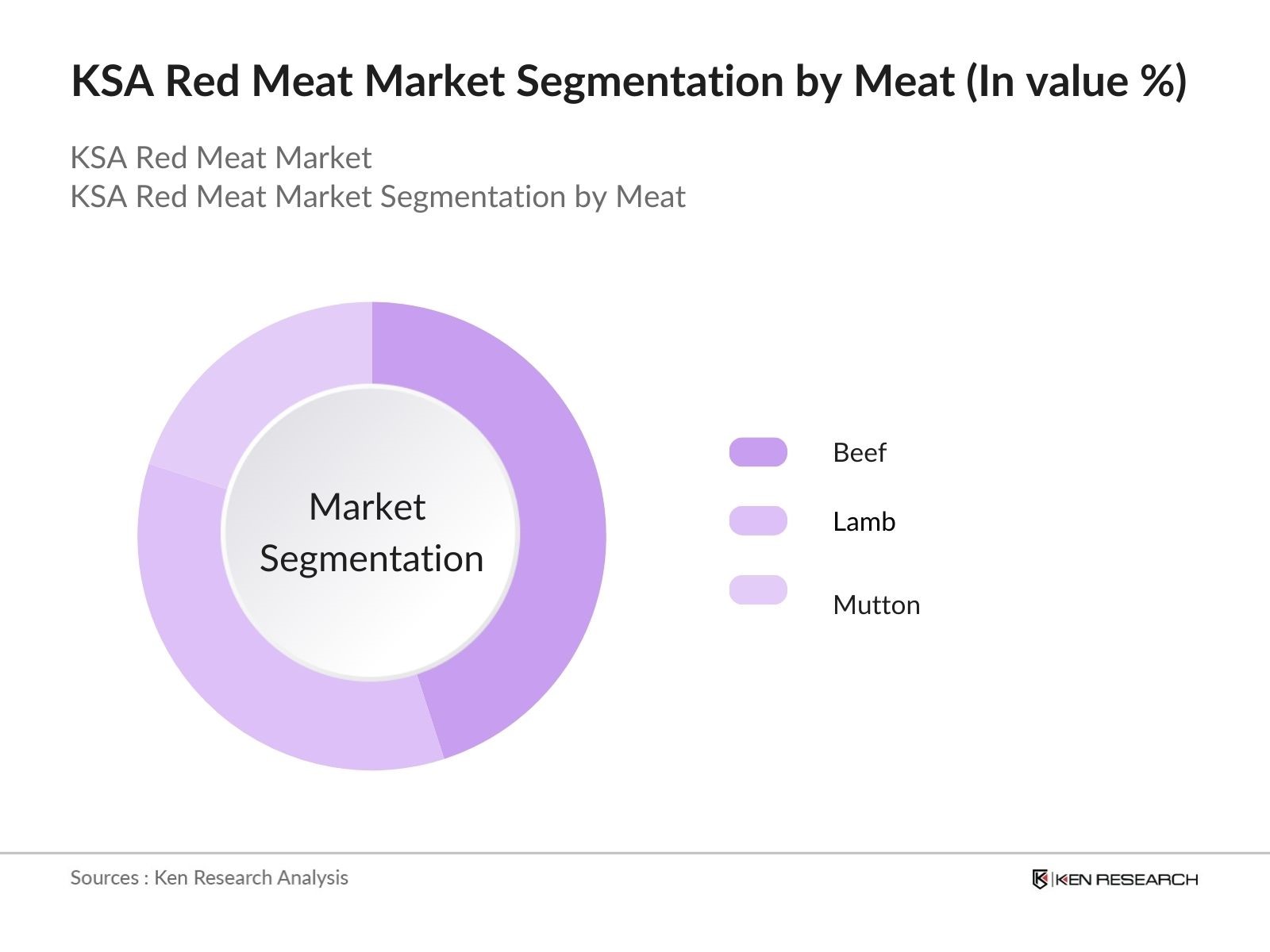
Beef Lamb Mutton |
|
By Distribution Channel |
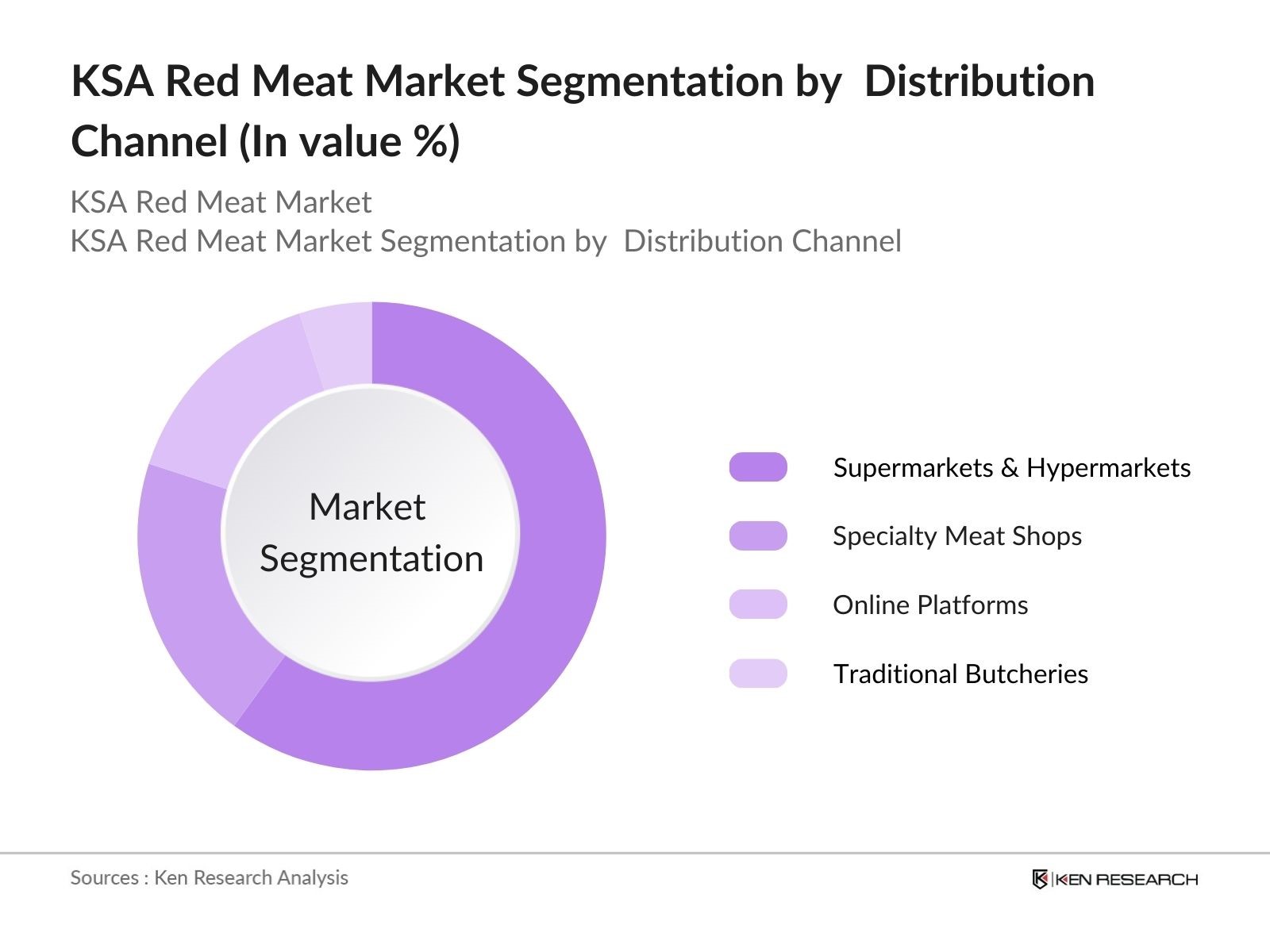
Supermarkets & Hypermarkets Specialty Meat Shops Online Platforms Traditional Butcheries |
|
By End User |
Construction Companies Architects & Designers Government Infrastructure Projects Retail & Wholesale Distributors |
|
By Color |
Households Restaurants Catering Services |
|
By Meat Processing |
Fresh Frozen Processed |
|
By Region |
Riyadh Jeddah Eastern Province Rest of Saudi Arabia |
1.1 Definition and Scope
1.2 Market Taxonomy
1.3 Market Growth Rate
1.4 Market Segmentation Overview
2.1 Historical Market Size
2.2 Year-On-Year Growth Analysis
2.3 Key Market Developments and Milestones
3.1 Growth Drivers
3.1.1 Rise in Disposable Income and Changing Consumption Patterns (Per Capita Consumption, Average Disposable Income)
3.1.2 Government Support for Local Meat Production (Government Subsidies, Vision 2030 Initiatives, Breeding Programs)
3.1.3 Population Growth and Increased Demand for Protein-Rich Diets (Population Growth Rate, Urbanization Metrics)
3.1.4 Rising Preference for Premium Meat Products (Segmented Pricing for Premium Meats)
3.2 Market Challenges
3.2.1 High Dependence on Meat Imports (Import Dependency Ratio)
3.2.2 Fluctuations in Global Meat Prices (Global Meat Price Volatility)
3.2.3 Environmental Sustainability Concerns (Water Usage, Greenhouse Gas Emissions)
3.3 Opportunities
3.3.1 Growth in E-commerce Meat Sales (E-commerce Penetration Rate in Meat Sales)
3.3.2 Increasing Demand for Halal-Certified and Organic Meat (Halal Certification, Organic Certification Metrics)
3.3.3 Expansion of Cold Chain Logistics (Cold Chain Infrastructure Investment)
3.4 Trends
3.4.1 Increasing Popularity of Processed Meat Products (Processed Meat Consumption Growth)
3.4.2 Growth of Local Meat Production Facilities (Increase in Local Slaughterhouses)
3.4.3 Adoption of Advanced Livestock Management Practices (Adoption Rate of IoT & Livestock Management Technologies)
3.5 Government Regulation
3.5.1 Vision 2030 and Agriculture Policies (Vision 2030 Goals for Livestock)
3.5.2 Import Tariffs and Trade Regulations (Meat Import Tariffs, Trade Agreements)
3.5.3 Environmental Compliance for Livestock Farming (Water Use Regulations, Emission Standards)
3.6 SWOT Analysis
3.7 Stakeholder Ecosystem
3.8 Porters Five Forces
3.9 Competition Ecosystem
4.1 By Meat Type (In Value %)
4.1.1 Beef
4.1.2 Lamb
4.1.3 Mutton
4.2 By Distribution Channel (In Value %)
4.2.1 Supermarkets & Hypermarkets
4.2.2 Specialty Meat Shops
4.2.3 Online Platforms
4.2.4 Traditional Butcheries
4.3 By End-User (In Value %)
4.3.1 Households
4.3.2 Restaurants
4.3.3 Catering Services
4.4 By Region (In Value %)
4.4.1 Riyadh
4.4.2 Jeddah
4.4.3 Eastern Province
4.4.4 Rest of Saudi Arabia
4.5 By Meat Processing Type (In Value %)
4.5.1 Fresh
4.5.2 Frozen
4.5.3 Processed
5.1 Detailed Profiles of Major Companies
5.1.1 Almarai
5.1.2 National Agricultural Development Company (NADEC)
5.1.3 Almunajem Foods
5.1.4 Al Safi Danone
5.1.5 Savola Group
5.1.6 Al Watania Agriculture
5.1.7 Tanmiah Food Company
5.1.8 Aseer Agricultural Company
5.1.9 Mazraah Meat
5.1.10 Al Kabeer Group
5.1.11 Global Food Industries
5.1.12 Fonterra Co-operative Group
5.1.13 Sadia (BRF)
5.1.14 Tyson Foods
5.1.15 JBS S.A.
5.2 Cross Comparison Parameters (No. of Employees, Headquarters, Inception Year, Revenue, Livestock Population, Meat Processing Capacity, Sustainability Initiatives, Cold Chain Infrastructure, Market Share)
5.3 Market Share Analysis
5.4 Strategic Initiatives
5.5 Mergers and Acquisitions
5.6 Investment Analysis
5.7 Venture Capital Funding
5.8 Government Grants
5.9 Private Equity Investments
6.1 Livestock Farming Regulations (Health and Safety Standards, Animal Welfare Policies)
6.2 Compliance Requirements for Meat Imports (Halal Certification, Quality Control Regulations)
6.3 Certification Processes (Halal Certification, Organic Certification)
7.1 Future Market Size Projections
7.2 Key Factors Driving Future Market Growth
8.1 By Meat Type (In Value %)
8.2 By Distribution Channel (In Value %)
8.3 By End-User (In Value %)
8.4 By Region (In Value %)
8.5 By Meat Processing Type (In Value %)
9.1 TAM/SAM/SOM Analysis
9.2 Customer Cohort Analysis
9.3 Marketing Initiatives
9.4 White Space Opportunity Analysis
The initial phase involves mapping the ecosystem of the KSA Red Meat Market, including key stakeholders such as meat producers, distributors, and government bodies. Extensive desk research was conducted using proprietary databases and secondary sources to identify market dynamics and the variables influencing supply, demand, and pricing.
In this phase, historical data on red meat consumption, production, and import levels were compiled to establish trends in the market. Factors such as urbanization, income growth, and government policies were analyzed to understand their impact on market size. The research also included an assessment of distribution channels to determine their influence on market growth.
Market hypotheses, particularly around growth drivers such as premium meat demand and local production capabilities, were validated through consultations with industry experts. These consultations were conducted using computer-assisted telephone interviews (CATIs) with leading meat producers, distributors, and logistics providers.
The final phase synthesized insights from producers and government reports, providing a comprehensive view of the KSA Red Meat Market. By combining bottom-up data from meat processors and top-down data from government sources, the report provides accurate and actionable insights for market stakeholders.
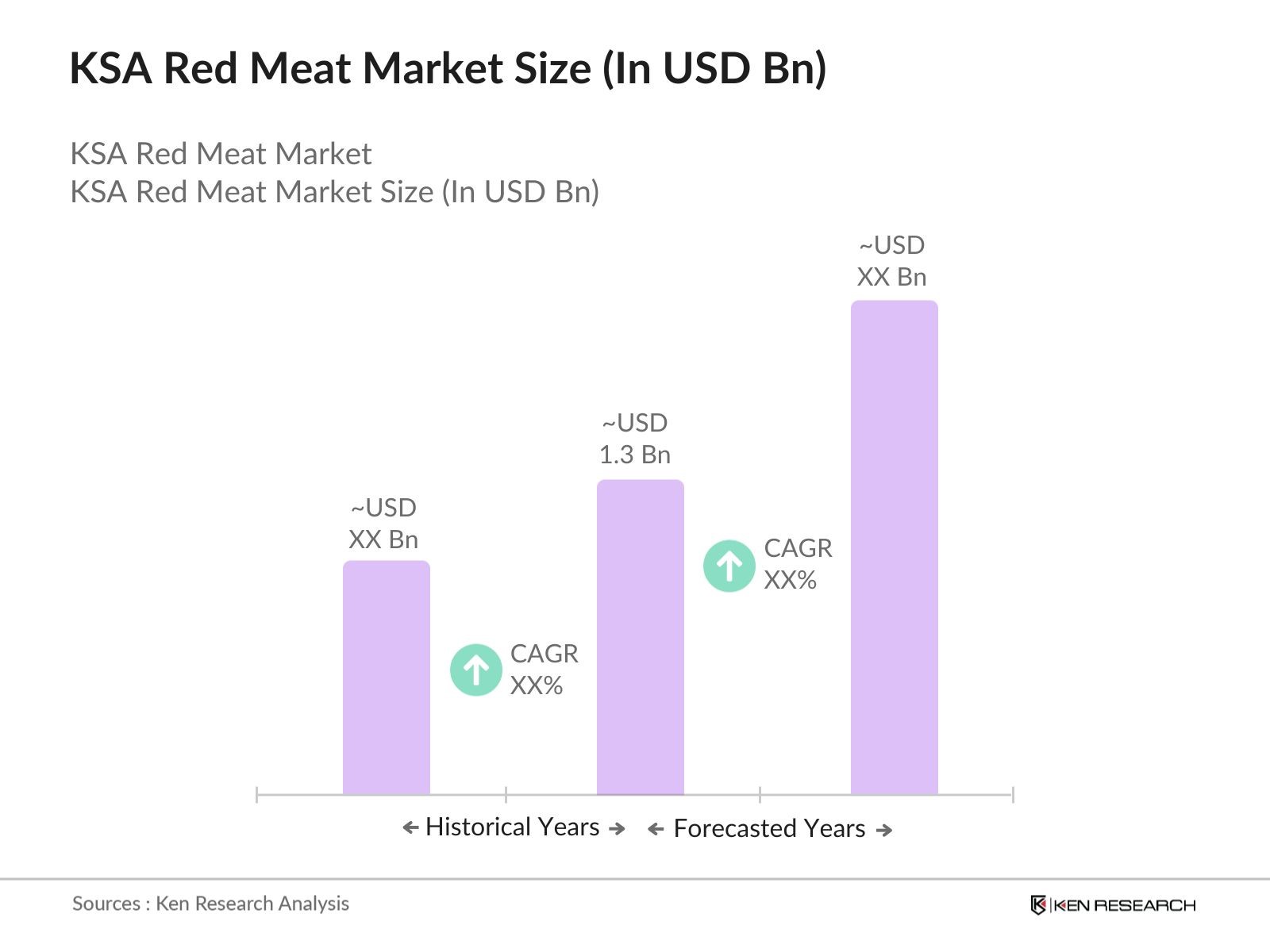
The KSA red meat market was valued at USD 1.3 billion, driven by increasing demand for protein-rich diets and government-led efforts to boost domestic meat production.
Challenges in the KSA red meat market include high dependence on meat imports, fluctuating global meat prices, and sustainability concerns regarding livestock farming practices.
Major players in the KSA red meat market include Almarai, National Agricultural Development Company (NADEC), Almunajem Foods, Tanmiah Food Company, and Aseer Agricultural Company.
The KSA red meat market growth is propelled by increasing disposable incomes, government initiatives to boost local meat production, and rising consumer demand for premium meat products in urban areas.

What makes us stand out is that our consultants follows Robust, Refine and Result (RRR) methodology. i.e. Robust for clear definitions, approaches and sanity checking, Refine for differentiating respondents facts and opinions and Result for presenting data with story

We have set a benchmark in the industry by offering our clients with syndicated and customized market research reports featuring coverage of entire market as well as meticulous research and analyst insights.

While we don't replace traditional research, we flip the method upside down. Our dual approach of Top Bottom & Bottom Top ensures quality deliverable by not just verifying company fundamentals but also looking at the sector and macroeconomic factors.

With one step in the future, our research team constantly tries to show you the bigger picture. We help with some of the tough questions you may encounter along the way: How is the industry positioned? Best marketing channel? KPI's of competitors? By aligning every element, we help maximize success.

Our report gives you instant access to the answers and sources that other companies might choose to hide. We elaborate each steps of research methodology we have used and showcase you the sample size to earn your trust.

If you need any support, we are here! We pride ourselves on universe strength, data quality, and quick, friendly, and professional service.