















KSA Textile Market Outlook to 2030
Region:Middle East
Author(s):Sanjna
Product Code:KROD3031
November 2024
91
About the Report
KSA Textile Market Overview
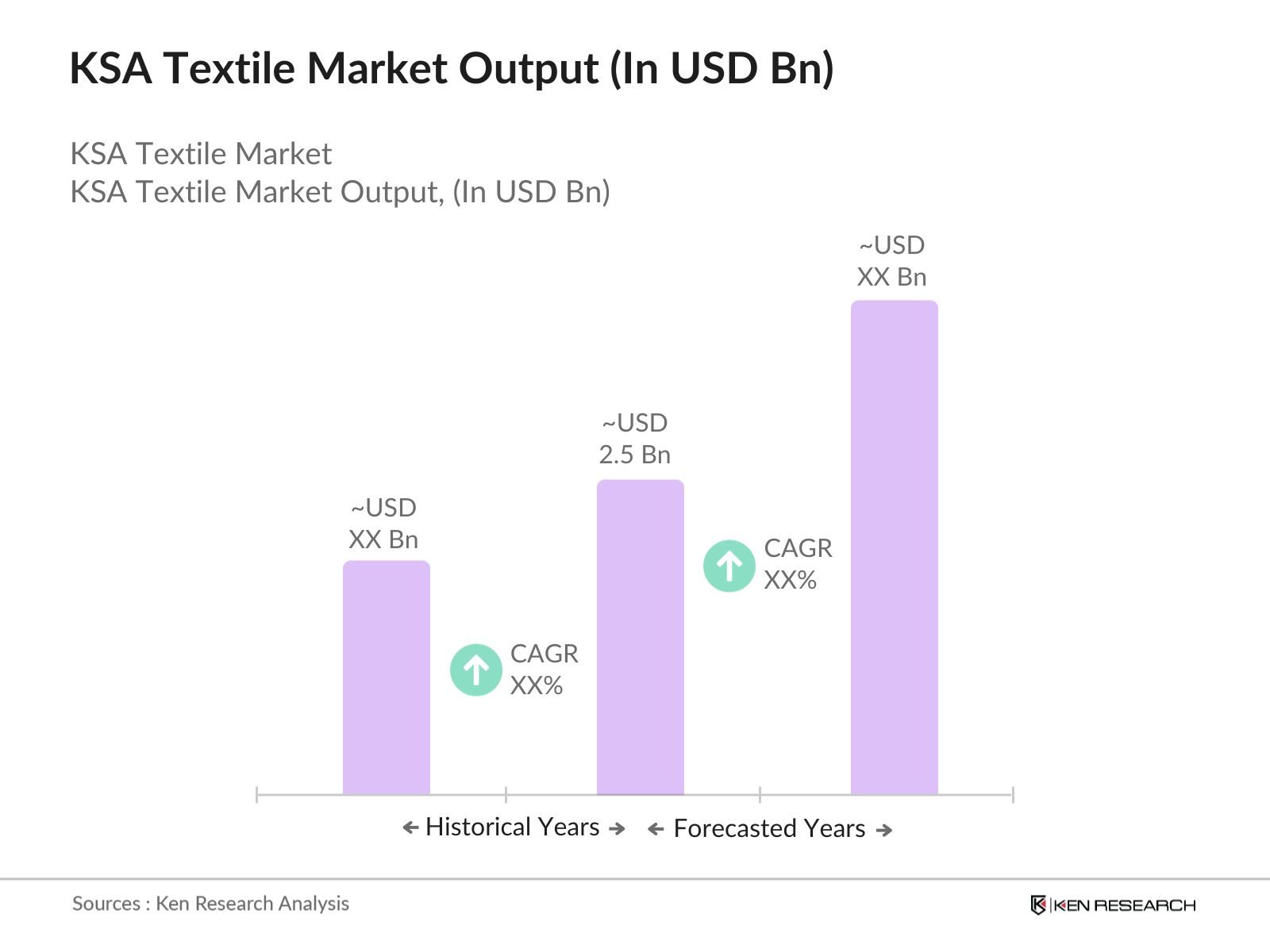
- The output of KSA textile market was USD 2.5 billion. The market is driven by several factors, including government initiatives such as Vision 2030, which emphasizes economic diversification and the localization of key industries. Increased investment in domestic manufacturing has spurred demand, alongside a growing population and rising disposable incomes. Additionally, the expanding tourism sector has contributed to increased demand for textiles in retail and hospitality settings, further bolstering the markets growth.
- Riyadh and Jeddah are the dominant cities in the KSA textile market. Riyadh, being the political and economic hub, attracts a significant portion of the country's textile manufacturing and distribution activity. Jeddah, with its strategic location as a major port city, plays a critical role in importing raw materials and exporting finished textile goods. These cities dominate due to their well-established infrastructure, access to raw materials, and proximity to key markets within and outside of Saudi Arabia.
- Saudi Arabia has implemented tariffs on imported textiles to promote domestic manufacturing. In 2024, the average tariff on imported textile goods was 5%, with certain categories like luxury fabrics seeing tariffs as high as 10%. These tariffs are part of the governments broader efforts to localize textile production and reduce the countrys dependence on imports. Additionally, the government has streamlined export procedures, making it easier for Saudi manufacturers to sell their products internationally.
KSA Textile Market Segmentation
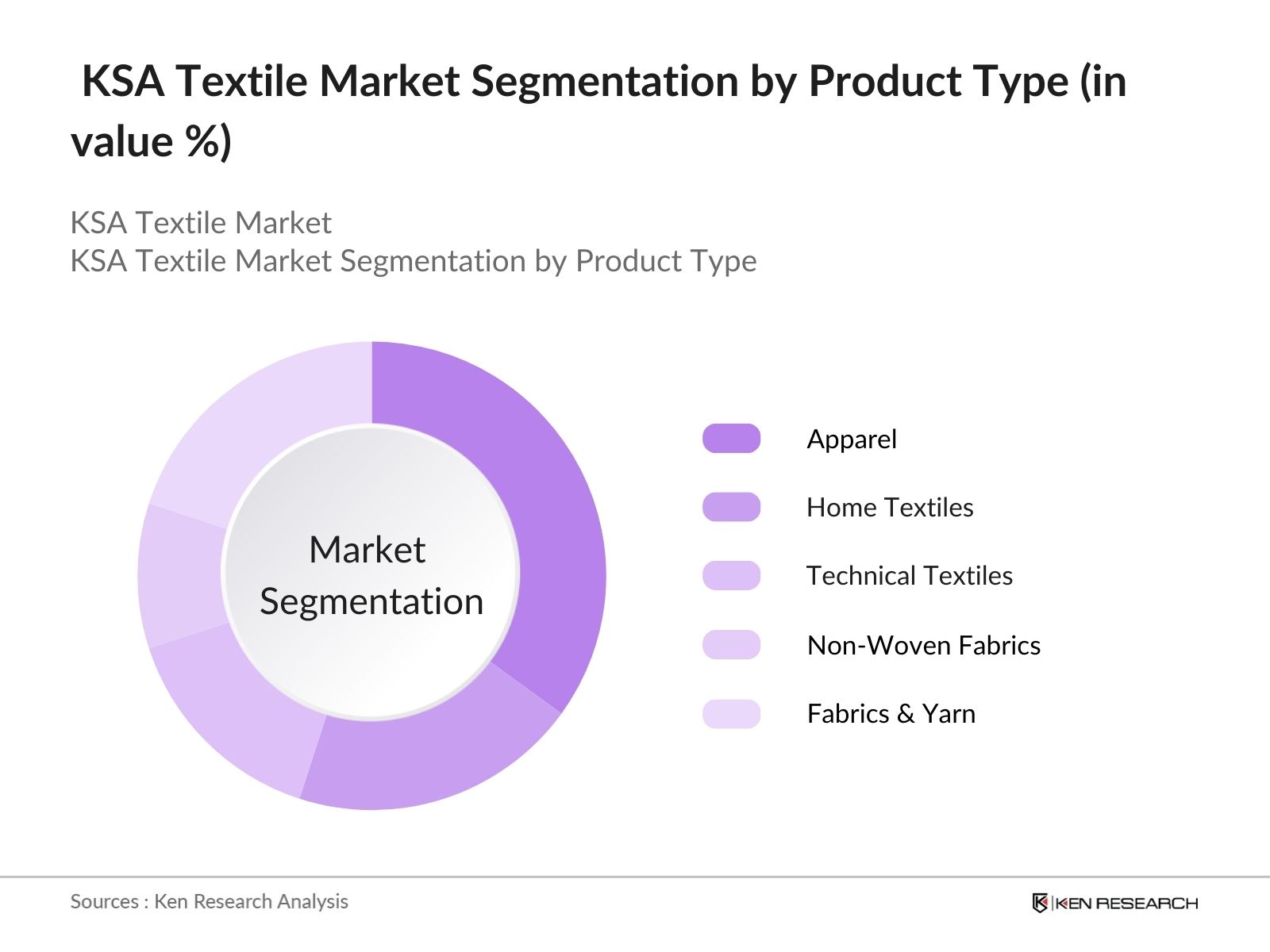
By Product Type: The KSA textile market is segmented by product type into apparel, home textiles, technical textiles, non-woven fabrics, and fabrics & yarn. Recently, apparel holds a dominant market share under the product type segmentation, owing to its demand in both the domestic retail and luxury segments. The growing middle class in Saudi Arabia, coupled with increasing fashion consciousness and a younger population, has propelled the apparel sector to a leading position. Brands like Alhokair Group and international labels have capitalized on this demand by expanding their offerings in the country.
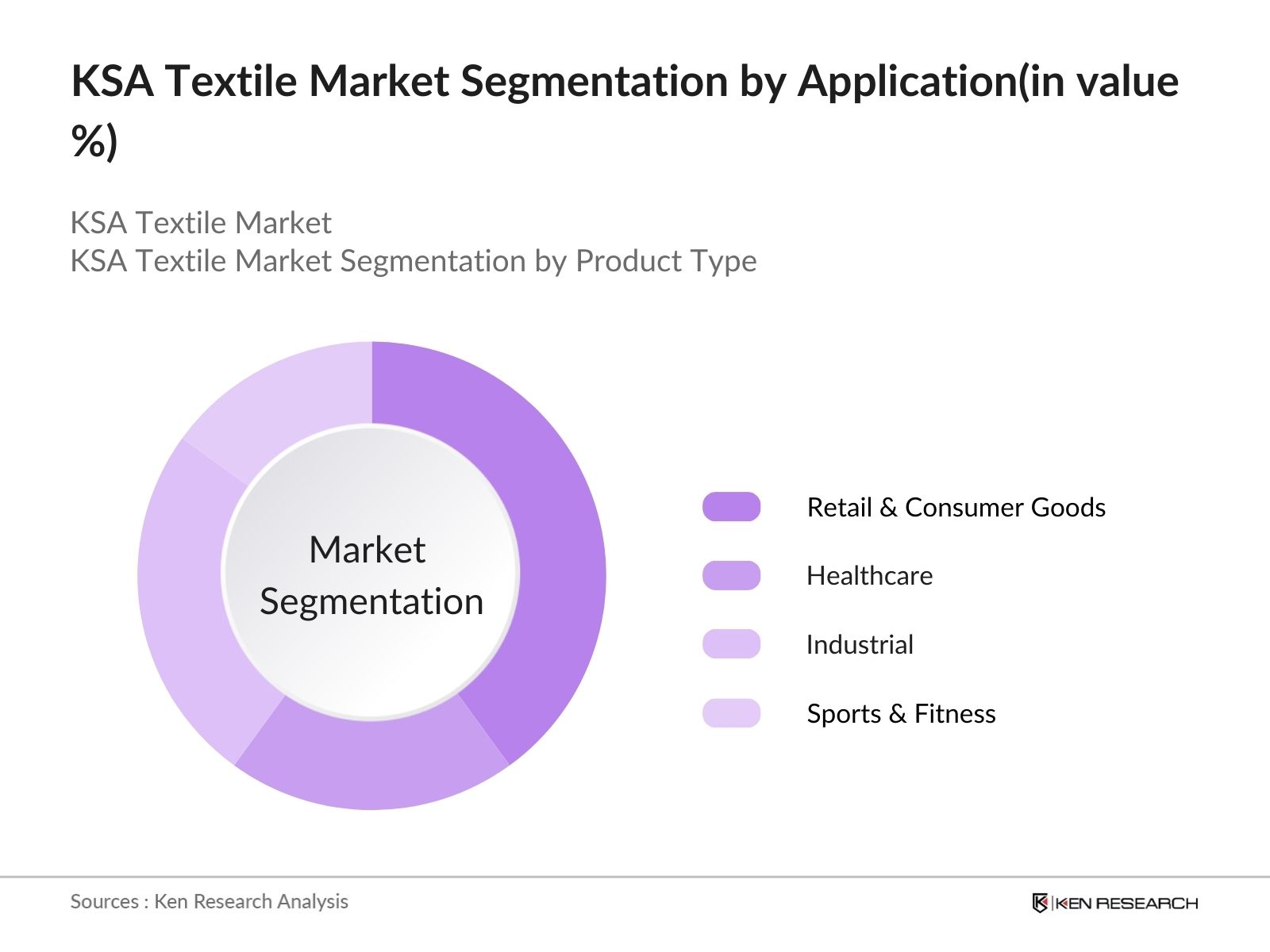
By Application: The KSA textile market is also segmented by application into retail & consumer goods, healthcare, industrial, and sports & fitness. Retail & consumer goods is the dominant sub-segment under application, largely due to the robust expansion of the retail industry in Saudi Arabia, fueled by increasing disposable income and consumer demand for high-quality textile products. With the rise of e-commerce platforms and the development of shopping malls, retail textiles have seen significant growth, further augmented by international fashion brands entering the Saudi market.
KSA Textile Market Competitive Landscape
The KSA textile market is dominated by a mix of local and international players, each contributing to the industry's development through technological advancements, localized production, and wide distribution networks. Companies like Alhokair Group and Naseej International have made strategic investments in textile manufacturing, while Zamil Industrial has ventured into technical textiles, catering to the industrial sector.
|
Company |
Establishment Year |
Headquarters |
No. of Employees |
Product Lines |
Revenue (2023) |
Manufacturing Facilities |
Key Export Markets |
Strategic Initiatives |
Market Share |
|
Alhokair Group |
1989 |
Riyadh |
- |
- |
- |
- |
- |
- |
- |
|
Saudi Industrial Export Company |
1990 |
Jeddah |
- |
- |
- |
- |
- |
- |
- |
|
Arabian Textile Company |
1995 |
Riyadh |
- |
- |
- |
- |
- |
- |
- |
|
Zamil Industrial |
1974 |
Dammam |
- |
- |
- |
- |
- |
- |
- |
|
Naseej International Trading Co |
1978 |
Jeddah |
- |
- |
- |
- |
- |
- |
- |
KSA Textile Market Analysis
Growth Drivers
- Government Initiatives (Vision 2030, Localization Efforts): The Saudi government's Vision 2030 program aims to diversify the economy and reduce reliance on oil. Textile manufacturing is one of the sectors targeted for development, with a focus on local production and reducing dependency on imports. In 2024, Saudi Arabia's Public Investment Fund (PIF) allocated USD 13.5 billion to support domestic manufacturing industries, including textiles. As part of its National Industrial Development and Logistics Program (NIDLP), USD 10.8 billion has been dedicated to stimulating textile and apparel production. Government-backed industrial zones, such as the Jeddah Industrial City, are providing incentives to attract textile manufacturers.
- Rising Demand for Sustainable Textiles: The global push toward sustainability has reached Saudi Arabia, with rising consumer demand for eco-friendly textiles. The Saudi Green Initiative emphasizes sustainability, and the textile industry has seen a shift towards organic cotton and recycled polyester. Saudi Arabia's cotton production reached 27,000 metric tons in 2023, with plans to increase sustainable fabric production through smart agriculture initiatives. Additionally, the Saudi government has implemented regulations that favor the import of sustainable textile products, which are part of Vision 2030s environmental goals.
- Growth in Tourism and Retail Apparel: Saudi Arabias tourism sector is booming, with the government investing USD 8.1 billion into developing tourism infrastructure. Saudi Arabia welcomed over100 million touristsin 2023, achieving this milestone seven years ahead of its target. As of mid-2024, Riyadh's retail market occupancy rates have climbed to90%, reflecting robust demand and a healthy market environment. This retail expansion directly correlates with the rising demand for textile products, boosting the sector's growth.
Market Challenges
- High Production Costs (Energy, Labor): Textile manufacturing in Saudi Arabia faces high production costs, particularly for energy and labor. In Q3 2021, the hourly wage of a mechanical, electrical, and plumbing (MEP) foreman in Saudi Arabia amounted to $15 (around SAR 56). These factors increase the overall cost of textile production, making it less competitive on a global scale.
- Competition from Low-Cost Imports (China, India): Saudi Arabia imports a significant portion of its textiles from low-cost producers like China and India. Saudi Arabia's textile imports are reported to exceedUSD 4 billionannually and are growing at a rate of13-15%each year. China accounts for approximately 42.58% of these imports, translating to around USD 2.04 billion. These low-cost imports present stiff competition to domestic manufacturers, who struggle to compete on price despite government localization efforts and subsidies.
KSA Textile Future Market Outlook
Over the next five years, the KSA textile market is expected to experience substantial growth. This will be driven by the continued expansion of the retail and hospitality sectors, supported by government initiatives to boost local manufacturing and reduce reliance on imports. Investments in sustainable and technical textiles are expected to be key drivers of growth, with a particular focus on smart textiles for healthcare and industrial applications. Additionally, the shift towards e-commerce will likely open new avenues for growth in the textile industry, further diversifying revenue streams for manufacturers and retailers.
Market Opportunities
- Investment in Technological Advancements (Smart Textiles, Automation): Saudi Arabia is increasingly investing in smart textiles and automation to enhance productivity and reduce reliance on imported labor. Automation in textile production is also on the rise, with industrial zones incorporating robotic technologies to streamline production. These advancements present an opportunity for Saudi manufacturers to compete globally by producing high-value, technologically advanced textiles.
- Emerging Luxury Fashion Segment: The luxury fashion segment in Saudi Arabia is expanding, supported by a growing affluent population and increasing brand collaborations. The emergence of Saudi fashion designers and collaborations with international brands are fueling demand for high-end fabrics and garments, providing lucrative opportunities for the domestic textile sector to cater to this niche market.
Scope of the Report
|
Segment |
Sub-segments |
|
Product Type |
Apparel Home Textiles Technical Textiles Non-woven Fabrics Fabrics & Yarn |
|
Application |
Retail & Consumer Goods Healthcare Industrial Sports & Fitness |
|
Technology |
Spinning Weaving Knitting Dyeing & Printing |
|
Distribution Channel |
Online Retail Physical Stores Wholesale & Distribution E-commerce |
|
Region |
Central Province Western Province Eastern Province Southern Province Northern Province |
Products
Key Target Audience
Textile Manufacturers
Retail & Consumer Goods Companies
Healthcare Providers
E-commerce Platforms
Logistics and Supply Chain Companies
Investors and Venture Capitalist Firms
Government and Regulatory Bodies (Ministry of Industry and Mineral Resources)
Companies
Major Players in the Market
Alhokair Group
Saudi Industrial Export Company
Arabian Textile Company
Zamil Industrial
Naseej International Trading Co.
Alsorayai Group
Baladna Fabrics
Shaker Group
Riyadh Textile Company
Al Abdul Karim Holding
Al Kayan Group
Al Nahar International
Saudi Yarn & Fabrics Manufacturing
National Factory for Polyester
Bayt Al Malakia
Table of Contents
1. KSA Textile Market Overview
1.1. Definition and Scope
1.2. Market Taxonomy
1.3. Market Growth Rate
1.4. Market Segmentation Overview
2. KSA Textile Market Size (In USD Bn)
2.1. Historical Market Size
2.2. Year-on-Year Growth Analysis
2.3. Key Market Developments and Milestones
3. KSA Textile Market Analysis
3.1. Growth Drivers
3.1.1. Government Initiatives (Vision 2030, Localization Efforts)
3.1.2. Rising Demand for Sustainable Textiles
3.1.3. Growth in Tourism and Retail Apparel
3.1.4. Expansion of E-commerce and Omni-channel Retailing
3.2. Market Challenges
3.2.1. High Production Costs (Energy, Labor)
3.2.2. Competition from Low-Cost Imports (China, India)
3.2.3. Scarcity of Skilled Workforce
3.3. Opportunities
3.3.1. Investment in Technological Advancements (Smart Textiles, Automation)
3.3.2. Emerging Luxury Fashion Segment
3.3.3. Expanding Middle Class and Youth Population
3.4. Trends
3.4.1. Growth in Organic and Recycled Fabrics
3.4.2. Increased Demand for Technical Textiles (Health, Sports)
3.4.3. Collaborations with International Fashion Brands
3.5. Government Regulation
3.5.1. Saudi Standards, Metrology and Quality Organization (SASO) Regulations
3.5.2. Tariffs and Import-Export Laws
3.5.3. Localization Mandates (Increased Domestic Manufacturing)
3.6. SWOT Analysis
3.7. Stakeholder Ecosystem (Manufacturers, Retailers, Raw Material Suppliers)
3.8. Porters Five Forces (Competition Intensity, Bargaining Power of Suppliers)
3.9. Competition Ecosystem
4. KSA Textile Market Segmentation
4.1. By Product Type (In Value %)
4.1.1. Apparel
4.1.2. Home Textiles (Bedding, Towels)
4.1.3. Technical Textiles (Industrial Fabrics, Medical Textiles)
4.1.4. Non-woven Fabrics
4.1.5. Fabrics & Yarn
4.2. By Application (In Value %)
4.2.1. Retail & Consumer Goods
4.2.2. Healthcare (Hospital Textiles, PPE)
4.2.3. Industrial (Workwear, Industrial Protective Fabrics)
4.2.4. Sports & Fitness
4.3. By Technology (In Value %)
4.3.1. Spinning
4.3.2. Weaving
4.3.3. Knitting
4.3.4. Dyeing & Printing
4.4. By Distribution Channel (In Value %)
4.4.1. Online Retail
4.4.2. Physical Stores (Department Stores, Specialty Stores)
4.4.3. Wholesale & Distribution
4.4.4. E-commerce
4.5. By Region (In Value %)
4.5.1. Central Province (Riyadh)
4.5.2. Western Province (Jeddah, Mecca)
4.5.3. Eastern Province (Dammam)
4.5.4. Southern Province (Asir)
4.5.5. Northern Province
5. KSA Textile Market Competitive Analysis
5.1. Detailed Profiles of Major Companies
5.1.1. Alhokair Group
5.1.2. Saudi Industrial Export Company
5.1.3. Arabian Textile Company
5.1.4. Zamil Industrial
5.1.5. Naseej International Trading Co.
5.1.6. Alsorayai Group
5.1.7. Baladna Fabrics
5.1.8. Shaker Group
5.1.9. Riyadh Textile Company
5.1.10. Al Abdul Karim Holding
5.1.11. Al Kayan Group
5.1.12. Al Nahar International
5.1.13. Saudi Yarn & Fabrics Manufacturing
5.1.14. National Factory for Polyester
5.1.15. Bayt Al Malakia
5.2. Cross Comparison Parameters (No. of Employees, Manufacturing Facilities, Revenue, Market Share, Headquarters, Distribution Network, Key Export Markets, Product Lines)
5.3. Market Share Analysis
5.4. Strategic Initiatives (Partnerships, Product Launches)
5.5. Mergers & Acquisitions
5.6. Investment Analysis
5.7. Venture Capital Funding
5.8. Government Grants
5.9. Private Equity Investments
6. KSA Textile Market Regulatory Framework
6.1. Local Manufacturing Regulations
6.2. Certification Processes (ISO, SASO)
6.3. Environmental Standards and Compliance
6.4. Import & Export Tariffs
7. KSA Textile Future Market Size (In SAR Bn)
7.1. Future Market Size Projections
7.2. Key Factors Driving Future Market Growth
8. KSA Textile Future Market Segmentation
8.1. By Product Type (In Value %)
8.2. By Application (In Value %)
8.3. By Technology (In Value %)
8.4. By Distribution Channel (In Value %)
8.5. By Region (In Value %)
9. KSA Textile Market Analysts Recommendations
9.1. TAM/SAM/SOM Analysis
9.2. Customer Cohort Analysis
9.3. Marketing Initiatives
9.4. White Space Opportunity Analysis
Research Methodology
Step 1: Identification of Key Variables
The initial phase involves constructing an ecosystem map encompassing all major stakeholders within the KSA textile market. This step is underpinned by extensive desk research, utilizing a combination of secondary and proprietary databases to gather comprehensive industry-level information. The primary objective is to identify and define the critical variables that influence market dynamics.
Step 2: Market Analysis and Construction
In this phase, we compile and analyze historical data pertaining to the KSA textile market. This includes assessing market penetration, the ratio of marketplaces to service providers, and the resultant revenue generation. Furthermore, an evaluation of product quality statistics is conducted to ensure the reliability and accuracy of the revenue estimates.
Step 3: Hypothesis Validation and Expert Consultation
Market hypotheses are developed and subsequently validated through computer-assisted telephone interviews (CATIS) with industry experts representing a diverse array of companies. These consultations provide valuable operational and financial insights directly from industry practitioners, which are instrumental in refining and corroborating the market data.
Step 4: Research Synthesis and Final Output
The final phase involves direct engagement with multiple textile manufacturers to acquire detailed insights into product segments, sales performance, consumer preferences, and other pertinent factors. This interaction serves to verify and complement the statistics derived from the bottom-up approach, ensuring a comprehensive, accurate, and validated analysis of the KSA textile market.
Frequently Asked Questions
1. How big is the KSA Textile Market?
The output of KSA textile market was USD 2.5 billion, driven by increasing local manufacturing, government initiatives like Vision 2030, and growing consumer demand in the retail and hospitality sectors.
2. What are the challenges in the KSA Textile Market?
The KSA textile market faces challenges such as high production costs, particularly in terms of energy and labor, competition from low-cost imports from countries like China and India, and a shortage of skilled workforce in the sector.
3. Who are the major players in the KSA Textile Market?
Key players in the KSA textile market include Alhokair Group, Saudi Industrial Export Company, Arabian Textile Company, Zamil Industrial, and Naseej International Trading Co. These companies dominate due to their strong local presence, investment in manufacturing, and extensive distribution networks.
4. What are the growth drivers of the KSA Textile Market?
The market is driven by factors such as government support for localization, rising disposable incomes, expanding retail and hospitality industries, and growing consumer demand for high-quality textiles, including sustainable and technical fabrics.
Why Buy From Us?

What makes us stand out is that our consultants follows Robust, Refine and Result (RRR) methodology. i.e. Robust for clear definitions, approaches and sanity checking, Refine for differentiating respondents facts and opinions and Result for presenting data with story

We have set a benchmark in the industry by offering our clients with syndicated and customized market research reports featuring coverage of entire market as well as meticulous research and analyst insights.

While we don't replace traditional research, we flip the method upside down. Our dual approach of Top Bottom & Bottom Top ensures quality deliverable by not just verifying company fundamentals but also looking at the sector and macroeconomic factors.

With one step in the future, our research team constantly tries to show you the bigger picture. We help with some of the tough questions you may encounter along the way: How is the industry positioned? Best marketing channel? KPI's of competitors? By aligning every element, we help maximize success.

Our report gives you instant access to the answers and sources that other companies might choose to hide. We elaborate each steps of research methodology we have used and showcase you the sample size to earn your trust.

If you need any support, we are here! We pride ourselves on universe strength, data quality, and quick, friendly, and professional service.