Kuwait dark tourism market report size, share, growth drivers, trends, opportunities & forecast 2025–2030

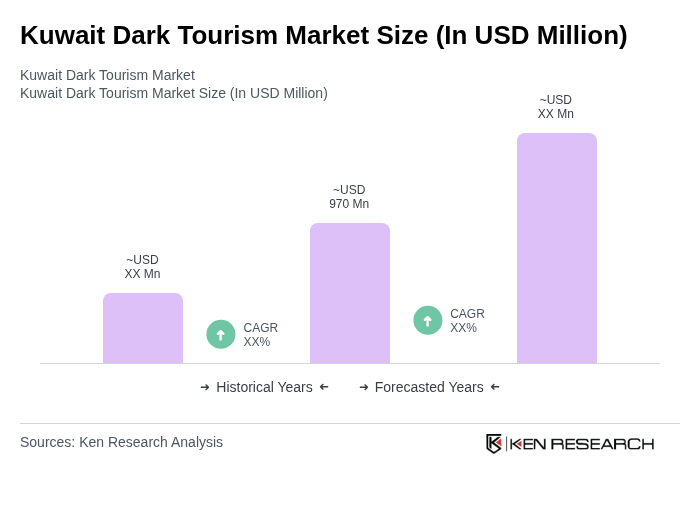
The Kuwait Dark Tourism Market, valued at USD 970 million, is growing due to rising interest in Gulf War sites, memorials, and cultural initiatives by NCCAL.

Region:Middle East

Author(s):Dev

Product Code:KRAA8389

Pages:82

Published On:November 2025
About the Report

Base Year 2024

Kuwait Dark Tourism Market Overview

  • The Kuwait Dark Tourism Market is valued at USD 970 million, based on a five-year historical analysis. This estimate aligns with the broader travel and tourism sector in Kuwait, which is valued at just over USD 1 billion, with dark tourism representing a significant and growing niche segment. Growth is primarily driven by increasing interest in historical events, cultural heritage, and the psychological allure of dark tourism experiences. The rise in international travel, digital engagement, and a growing curiosity about the darker aspects of history have significantly contributed to the market's expansion.
  • Kuwait City is the dominant hub for dark tourism in the region, attracting visitors due to its rich history and significant sites related to the Gulf War. Other notable areas include Al Ahmadi and Jahra, which host various memorials and historical sites that resonate with both local and international tourists seeking to understand Kuwait's past.
  • The "Kuwait Heritage and Dark Tourism Initiative" was established under the oversight of the National Council for Culture, Arts and Letters (NCCAL) through the Ministerial Resolution No. 46 of 2023. This initiative aims to enhance visitor experiences at historical sites and memorials, ensure the preservation of cultural heritage, and set operational standards for site management, signage, and guided tours. The regulation requires all designated dark tourism sites to comply with preservation protocols and visitor safety guidelines as stipulated by NCCAL.
Kuwait Dark Tourism Market Size

Kuwait Dark Tourism Market Segmentation

By Type:The dark tourism market can be segmented into various types, including historical sites, war memorials and conflict sites, genocide and tragedy sites, haunted and paranormal locations, disaster tourism sites, dark museums and memorial centers, abandoned places and urban exploration, and other related attractions. Each of these subsegments caters to different interests and motivations of tourists, contributing to the overall market dynamics.
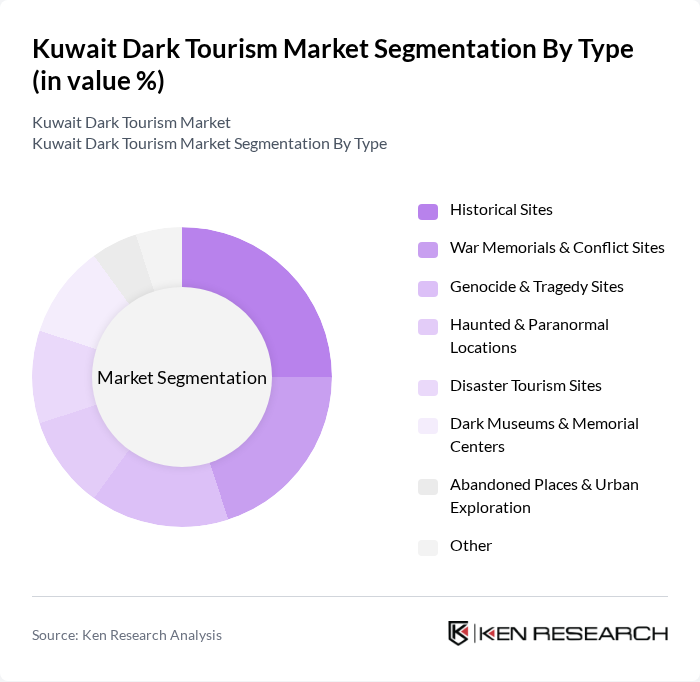
Kuwait Dark Tourism Market segmentation by Type.

By End-User:The end-user segmentation of the dark tourism market includes international tourists, domestic tourists, educational institutions and student groups, corporate and incentive groups, government and NGO delegations, and other visitors. Each group has distinct motivations and preferences, influencing their engagement with dark tourism experiences.
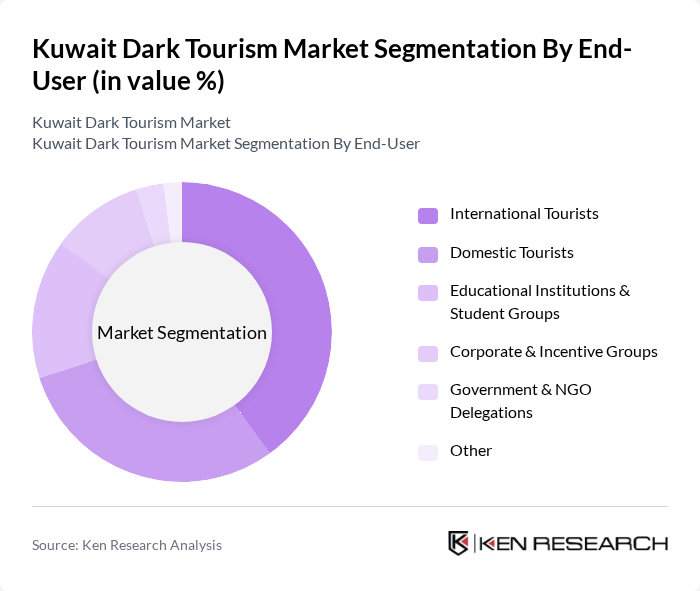
Kuwait Dark Tourism Market segmentation by End-User.

Kuwait Dark Tourism Market Competitive Landscape

The Kuwait Dark Tourism Market is characterized by a dynamic mix of regional and international players. Leading participants such as Kuwait Tourism Authority, Al-Qurain Martyrs Museum, Kuwait National Museum, The Scientific Center Kuwait, Kuwait Historical Society, Kuwait House of National Works Museum, Al-Sadu House, Failaka Island Heritage Tours, The Liberation Tower, Touristic Enterprises Company (TEC), Sheikh Abdullah Al Salem Cultural Centre, The National Council for Culture, Arts and Letters (NCCAL), Kuwait Heritage Museum, Tareq Rajab Museum, Kuwait Maritime Museum contribute to innovation, geographic expansion, and service delivery in this space.

Kuwait Tourism Authority

1960

Kuwait City, Kuwait

Al-Qurain Martyrs Museum

1991

Kuwait City, Kuwait

Kuwait National Museum

1983

Kuwait City, Kuwait

The Scientific Center Kuwait

1998

Kuwait City, Kuwait

Kuwait Historical Society

1980

Kuwait City, Kuwait

Company

Establishment Year

Headquarters

Years of Operation in Dark Tourism Segment

Number of Annual Visitors (to dark tourism sites)

Revenue from Dark Tourism Activities (USD/KWD)

Market Share in Kuwait Dark Tourism (%)

Growth Rate of Visitor Numbers (YoY %)

Online Booking Penetration (%)

Kuwait Dark Tourism Market Industry Analysis

Growth Drivers

  • Increased Interest in Historical Sites:The Kuwaiti government reported a 15% increase in visitors to historical sites in future, driven by a growing global interest in cultural heritage. The World Bank noted that tourism contributed approximately USD 4.0 billion to Kuwait's GDP in future, highlighting the economic potential of historical tourism. This trend is expected to continue as more tourists seek authentic experiences, particularly in regions rich in history and culture, such as Kuwait.
  • Rise of Social Media Influencers:In future, over 70% of travelers reported being influenced by social media when choosing destinations. Influencers showcasing Kuwait's dark tourism sites have led to a 25% increase in online engagement for local tourism boards. The Ministry of Information noted that social media campaigns have reached over 1.2 million users, effectively promoting lesser-known attractions and enhancing the visibility of dark tourism experiences in the region.
  • Cultural Heritage Preservation Initiatives:Kuwait allocated USD 600 million in future for cultural heritage preservation, aiming to restore and promote historical sites. This investment is part of a broader strategy to enhance tourism infrastructure and attract visitors interested in dark tourism. The UNESCO World Heritage designation for several sites has also increased international interest, with a reported 30% rise in inquiries about cultural tours, further driving growth in this niche market.

Market Challenges

  • Limited Awareness Among Tourists:Despite the potential, only 35% of international tourists are aware of Kuwait's dark tourism offerings, according to a tourism survey. This lack of awareness limits visitor numbers and hinders market growth. The Kuwait Tourism Authority is working to improve visibility, but the challenge remains significant, as many travelers still associate Kuwait primarily with its modern attractions rather than its historical and cultural depth.
  • Cultural Sensitivity Issues:Cultural sensitivity remains a significant challenge in promoting dark tourism in Kuwait. The Ministry of Culture reported that 45% of potential visitors expressed concerns about the appropriateness of certain sites. This sensitivity can deter tourists from engaging with dark tourism experiences, necessitating careful marketing strategies that respect local customs and traditions while promoting historical narratives that resonate with diverse audiences.

Kuwait Dark Tourism Market Future Outlook

The future of the Kuwait dark tourism market appears promising, driven by increasing global interest in experiential travel and cultural heritage. As the government continues to invest in infrastructure and marketing, the sector is likely to attract a broader audience. Additionally, the integration of technology in tours, such as virtual reality experiences, is expected to enhance visitor engagement. With a focus on sustainable practices, Kuwait can position itself as a leading destination for dark tourism in the region, appealing to both local and international travelers.

Market Opportunities

  • Development of Themed Tours:The creation of themed tours focusing on historical events and local legends presents a significant opportunity. By offering unique narratives, these tours can attract niche markets, potentially increasing visitor numbers by 20% annually. Collaborating with local historians can enhance authenticity and educational value, making these experiences more appealing to tourists seeking deeper connections with the culture.
  • Investment in Digital Marketing:Investing in digital marketing strategies can significantly enhance the visibility of Kuwait's dark tourism offerings. With a projected 30% increase in online bookings through targeted campaigns, leveraging social media and influencer partnerships can effectively reach potential travelers. This approach not only raises awareness but also fosters a community of engaged tourists eager to explore Kuwait's unique historical narratives.

Scope of the Report

SegmentSub-Segments
By Type

Historical Sites

War Memorials & Conflict Sites

Genocide & Tragedy Sites

Haunted & Paranormal Locations

Disaster Tourism Sites

Dark Museums & Memorial Centers

Abandoned Places & Urban Exploration

Other

By End-User

International Tourists

Domestic Tourists

Educational Institutions & Student Groups

Corporate & Incentive Groups

Government & NGO Delegations

Other

By Region

Capital Governorate (Kuwait City)

Hawalli Governorate

Al Ahmadi Governorate

Farwaniya Governorate

Mubarak Al-Kabeer Governorate

Jahra Governorate

Other

By Activity Type

Guided Tours

Self-Guided Tours (including digital/app-based)

Workshops, Lectures, and Events

Commemorative Ceremonies

Other

By Duration of Stay

Day Trips

Weekend Getaways

Extended Stays (3+ days)

Other

By Marketing Channel

Online Booking Platforms

Travel Agencies & Tour Operators

Social Media & Influencer Marketing

Direct/On-site Bookings

Other

By Customer Demographics

Age Groups (15-25, 26-35, 36-45, 46-55, 56+)

Income Levels

Nationalities (Kuwaiti, GCC, International)

Education Level

Other

Key Target Audience

Investors and Venture Capitalist Firms

Government and Regulatory Bodies (e.g., Kuwait Tourism Authority, Ministry of Information)

Tourism Operators and Travel Agencies

Hospitality Industry Stakeholders

Cultural Heritage Organizations

Event Organizers and Planners

Local Community Leaders and Activists

Media and Public Relations Firms

Players Mentioned in the Report:

Kuwait Tourism Authority

Al-Qurain Martyrs Museum

Kuwait National Museum

The Scientific Center Kuwait

Kuwait Historical Society

Kuwait House of National Works Museum

Al-Sadu House

Failaka Island Heritage Tours

The Liberation Tower

Touristic Enterprises Company (TEC)

Sheikh Abdullah Al Salem Cultural Centre

The National Council for Culture, Arts and Letters (NCCAL)

Kuwait Heritage Museum

Tareq Rajab Museum

Kuwait Maritime Museum

Table of Contents

Market Assessment Phase

1. Executive Summary and Approach


2. Kuwait Dark Tourism Market Overview

2.1 Key Insights and Strategic Recommendations

2.2 Kuwait Dark Tourism Market Overview

2.3 Definition and Scope

2.4 Evolution of Market Ecosystem

2.5 Timeline of Key Regulatory Milestones

2.6 Value Chain & Stakeholder Mapping

2.7 Business Cycle Analysis

2.8 Policy & Incentive Landscape


3. Kuwait Dark Tourism Market Analysis

3.1 Growth Drivers

3.1.1 Increased Interest in Historical Sites
3.1.2 Rise of Social Media Influencers
3.1.3 Cultural Heritage Preservation Initiatives
3.1.4 Government Support for Tourism Development

3.2 Market Challenges

3.2.1 Limited Awareness Among Tourists
3.2.2 Cultural Sensitivity Issues
3.2.3 Infrastructure Limitations
3.2.4 Regulatory Hurdles

3.3 Market Opportunities

3.3.1 Development of Themed Tours
3.3.2 Collaboration with Local Artists
3.3.3 Investment in Digital Marketing
3.3.4 Expansion of Educational Programs

3.4 Market Trends

3.4.1 Growth of Experiential Travel
3.4.2 Increasing Popularity of Ghost Tours
3.4.3 Focus on Sustainable Tourism Practices
3.4.4 Integration of Technology in Tours

3.5 Government Regulation

3.5.1 Tourism Licensing Requirements
3.5.2 Safety and Health Regulations
3.5.3 Cultural Heritage Protection Laws
3.5.4 Environmental Impact Assessments

4. SWOT Analysis


5. Stakeholder Analysis


6. Porter's Five Forces Analysis


7. Kuwait Dark Tourism Market Market Size, 2019-2024

7.1 By Value

7.2 By Volume

7.3 By Average Selling Price


8. Kuwait Dark Tourism Market Segmentation

8.1 By Type

8.1.1 Historical Sites
8.1.2 War Memorials & Conflict Sites
8.1.3 Genocide & Tragedy Sites
8.1.4 Haunted & Paranormal Locations
8.1.5 Disaster Tourism Sites
8.1.6 Dark Museums & Memorial Centers
8.1.7 Abandoned Places & Urban Exploration
8.1.8 Other

8.2 By End-User

8.2.1 International Tourists
8.2.2 Domestic Tourists
8.2.3 Educational Institutions & Student Groups
8.2.4 Corporate & Incentive Groups
8.2.5 Government & NGO Delegations
8.2.6 Other

8.3 By Region

8.3.1 Capital Governorate (Kuwait City)
8.3.2 Hawalli Governorate
8.3.3 Al Ahmadi Governorate
8.3.4 Farwaniya Governorate
8.3.5 Mubarak Al-Kabeer Governorate
8.3.6 Jahra Governorate
8.3.7 Other

8.4 By Activity Type

8.4.1 Guided Tours
8.4.2 Self-Guided Tours (including digital/app-based)
8.4.3 Workshops, Lectures, and Events
8.4.4 Commemorative Ceremonies
8.4.5 Other

8.5 By Duration of Stay

8.5.1 Day Trips
8.5.2 Weekend Getaways
8.5.3 Extended Stays (3+ days)
8.5.4 Other

8.6 By Marketing Channel

8.6.1 Online Booking Platforms
8.6.2 Travel Agencies & Tour Operators
8.6.3 Social Media & Influencer Marketing
8.6.4 Direct/On-site Bookings
8.6.5 Other

8.7 By Customer Demographics

8.7.1 Age Groups (15-25, 26-35, 36-45, 46-55, 56+)
8.7.2 Income Levels
8.7.3 Nationalities (Kuwaiti, GCC, International)
8.7.4 Education Level
8.7.5 Other

9. Kuwait Dark Tourism Market Competitive Analysis

9.1 Market Share of Key Players

9.2 Cross Comparison of Key Players

9.2.1 Company Name
9.2.2 Years of Operation in Dark Tourism Segment
9.2.3 Number of Annual Visitors (to dark tourism sites)
9.2.4 Revenue from Dark Tourism Activities (USD/KWD)
9.2.5 Market Share in Kuwait Dark Tourism (%)
9.2.6 Growth Rate of Visitor Numbers (YoY %)
9.2.7 Online Booking Penetration (%)
9.2.8 Customer Satisfaction Score (NPS or equivalent)
9.2.9 Number of Dark Tourism Offerings (sites/tours/events)
9.2.10 Partnerships with Educational/International Organizations
9.2.11 Digital Engagement Metrics (website traffic, social media followers)
9.2.12 Innovation Index (new tour formats, tech adoption)
9.2.13 Sustainability Initiatives (certifications, green practices)
9.2.14 Awards & Recognitions

9.3 SWOT Analysis of Top Players

9.4 Pricing Analysis

9.5 Detailed Profile of Major Companies

9.5.1 Kuwait Tourism Authority
9.5.2 Al-Qurain Martyrs Museum
9.5.3 Kuwait National Museum
9.5.4 The Scientific Center Kuwait
9.5.5 Kuwait Historical Society
9.5.6 Kuwait House of National Works Museum
9.5.7 Al-Sadu House
9.5.8 Failaka Island Heritage Tours
9.5.9 The Liberation Tower
9.5.10 Touristic Enterprises Company (TEC)
9.5.11 Sheikh Abdullah Al Salem Cultural Centre
9.5.12 The National Council for Culture, Arts and Letters (NCCAL)
9.5.13 Kuwait Heritage Museum
9.5.14 Tareq Rajab Museum
9.5.15 Kuwait Maritime Museum

10. Kuwait Dark Tourism Market End-User Analysis

10.1 Procurement Behavior of Key Ministries

10.1.1 Ministry of Information
10.1.2 Ministry of Education
10.1.3 Ministry of Tourism
10.1.4 Other

10.2 Corporate Spend on Infrastructure & Energy

10.2.1 Investment in Tourism Infrastructure
10.2.2 Funding for Cultural Events
10.2.3 Sponsorship of Historical Sites
10.2.4 Other

10.3 Pain Point Analysis by End-User Category

10.3.1 Tourists
10.3.2 Educational Institutions
10.3.3 Corporates
10.3.4 Other

10.4 User Readiness for Adoption

10.4.1 Awareness Levels
10.4.2 Interest in Dark Tourism
10.4.3 Accessibility of Sites
10.4.4 Other

10.5 Post-Deployment ROI and Use Case Expansion

10.5.1 Visitor Feedback
10.5.2 Repeat Visits
10.5.3 Partnerships with Local Businesses
10.5.4 Other

11. Kuwait Dark Tourism Market Future Size, 2025-2030

11.1 By Value

11.2 By Volume

11.3 By Average Selling Price


Go-To-Market Strategy Phase

1. Whitespace Analysis + Business Model Canvas

1.1 Market Gaps Identification

1.2 Business Model Development


2. Marketing and Positioning Recommendations

2.1 Branding Strategies

2.2 Product USPs


3. Distribution Plan

3.1 Urban Retail vs Rural NGO Tie-ups


4. Channel & Pricing Gaps

4.1 Underserved Routes

4.2 Pricing Bands


5. Unmet Demand & Latent Needs

5.1 Category Gaps

5.2 Consumer Segments


6. Customer Relationship

6.1 Loyalty Programs

6.2 After-sales Service


7. Value Proposition

7.1 Sustainability

7.2 Integrated Supply Chains


8. Key Activities

8.1 Regulatory Compliance

8.2 Branding

8.3 Distribution Setup


9. Entry Strategy Evaluation

9.1 Domestic Market Entry Strategy

9.1.1 Product Mix
9.1.2 Pricing Band
9.1.3 Packaging

9.2 Export Entry Strategy

9.2.1 Target Countries
9.2.2 Compliance Roadmap

10. Entry Mode Assessment

10.1 JV

10.2 Greenfield

10.3 M&A

10.4 Distributor Model


11. Capital and Timeline Estimation

11.1 Capital Requirements

11.2 Timelines


12. Control vs Risk Trade-Off

12.1 Ownership vs Partnerships


13. Profitability Outlook

13.1 Breakeven Analysis

13.2 Long-term Sustainability


14. Potential Partner List

14.1 Distributors

14.2 JVs

14.3 Acquisition Targets


15. Execution Roadmap

15.1 Phased Plan for Market Entry

15.1.1 Market Setup
15.1.2 Market Entry
15.1.3 Growth Acceleration
15.1.4 Scale & Stabilize

15.2 Key Activities and Milestones

15.2.1 Activity Planning
15.2.2 Milestone Tracking

Research Methodology

ApproachModellingSample

Phase 1: Approach1

Desk Research

  • Analysis of existing literature on dark tourism trends in Kuwait and the Middle East
  • Review of government tourism statistics and reports from the Kuwait Tourism Authority
  • Examination of academic journals and publications focusing on dark tourism and cultural heritage

Primary Research

  • Interviews with local tourism operators specializing in dark tourism experiences
  • Surveys conducted with tourists who have engaged in dark tourism activities in Kuwait
  • Focus group discussions with cultural historians and tourism experts in the region

Validation & Triangulation

  • Cross-validation of findings through comparison with international dark tourism case studies
  • Triangulation of data from government reports, industry insights, and expert opinions
  • Sanity checks through feedback from a panel of local tourism stakeholders

Phase 2: Market Size Estimation1

Top-down Assessment

  • Estimation of dark tourism market size based on overall tourism revenue in Kuwait
  • Segmentation of dark tourism by type of attraction (e.g., historical sites, memorials)
  • Incorporation of demographic trends and visitor statistics from regional tourism studies

Bottom-up Modeling

  • Collection of visitor data from key dark tourism sites and attractions in Kuwait
  • Analysis of pricing structures for dark tourism experiences and packages
  • Calculation of revenue potential based on visitor numbers and average spend per visitor

Forecasting & Scenario Analysis

  • Multi-factor regression analysis incorporating economic indicators and tourism growth rates
  • Scenario modeling based on potential changes in tourism policies and global travel trends
  • Development of baseline, optimistic, and pessimistic forecasts for the next five years

Phase 3: CATI Sample Composition1

Scope Item/SegmentSample SizeTarget Respondent Profiles
Local Tour Operators60Business Owners, Tour Guides
International Tourists100Travelers, Tourists Engaged in Dark Tourism
Cultural Historians40Academics, Researchers in Tourism Studies
Government Tourism Officials40Policy Makers, Tourism Development Officers
Local Residents70Community Leaders, Cultural Advocates

Frequently Asked Questions

What is the current value of the Kuwait Dark Tourism Market?

The Kuwait Dark Tourism Market is valued at approximately USD 970 million, representing a significant niche within the broader travel and tourism sector in Kuwait, which exceeds USD 1 billion. This market is experiencing growth due to increased interest in historical and cultural experiences.

What are the main drivers of growth in the Kuwait Dark Tourism Market?

Which areas in Kuwait are popular for dark tourism?

What initiatives are in place to promote dark tourism in Kuwait?

Other Regional/Country Reports

Indonesia Dark Tourism Market

Malaysia Dark Tourism Market

KSA Dark Tourism Market

APAC Dark Tourism Market

SEA Dark Tourism Market

Vietnam Dark Tourism Market

Other Adjacent Reports

Singapore Historical Tourism Market

Kuwait Cultural Heritage Market

Oman War Memorial Tourism Market

Malaysia Disaster Tourism Market

Mexico Paranormal Tourism Market

Indonesia Educational Tourism Market

Indonesia Adventure Tourism Market

Bahrain Museum Management Market

Belgium Travel Agency Services Market

Japan Heritage Preservation Market

Why Buy From Us?

Refine Robust Result (RRR) Framework

What makes us stand out is that our consultants follow Robust, Refine and Result (RRR) methodology. Robust for clear definitions, approaches and sanity checking, Refine for differentiating respondents' facts and opinions, and Result for presenting data with story.

Our Reach Is Unmatched

We have set a benchmark in the industry by offering our clients with syndicated and customized market research reports featuring coverage of entire market as well as meticulous research and analyst insights.

Shifting the Research Paradigm

While we don't replace traditional research, we flip the method upside down. Our dual approach of Top Bottom & Bottom Top ensures quality deliverable by not just verifying company fundamentals but also looking at the sector and macroeconomic factors.

More Insights-Better Decisions

With one step in the future, our research team constantly tries to show you the bigger picture. We help with some of the tough questions you may encounter along the way: How is the industry positioned? Best marketing channel? KPI's of competitors? By aligning every element, we help maximize success.

Transparency and Trust

Our report gives you instant access to the answers and sources that other companies might choose to hide. We elaborate each steps of research methodology we have used and showcase you the sample size to earn your trust.

Round the Clock Support

If you need any support, we are here! We pride ourselves on universe strength, data quality, and quick, friendly, and professional service.

Why Clients Choose Us?

400000+
Reports in repository
150+
Consulting projects a year
100+
Analysts
8000+
Client Queries in 2022








