Region:Middle East
Author(s):Dev
Product Code:KRAC2688
Pages:99
Published On:October 2025
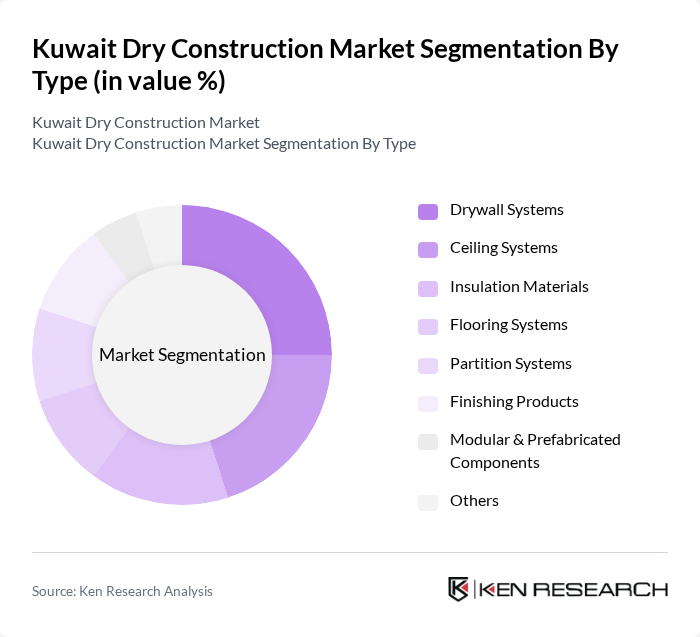
By Type:The dry construction market is segmented into drywall systems, ceiling systems, insulation materials, flooring systems, partition systems, finishing products, modular & prefabricated components, and others. Drywall systems and ceiling systems are widely adopted due to their efficiency and ease of installation, while modular and prefabricated components are gaining traction for their ability to accelerate project timelines and enhance quality control. Insulation materials and partition systems are increasingly specified to meet evolving energy efficiency and space optimization requirements in both residential and commercial projects .
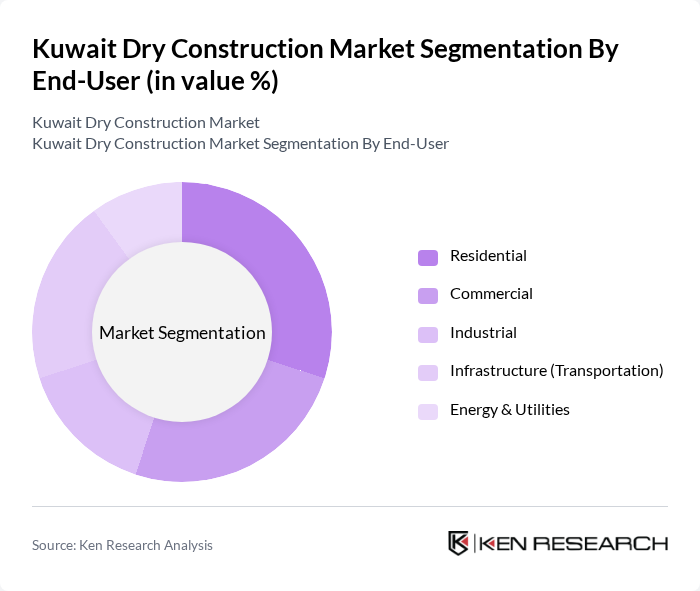
By End-User:The end-user segmentation includes residential, commercial, industrial, infrastructure (transportation), and energy & utilities sectors. Residential and commercial sectors are the primary contributors, driven by urban population growth and demand for modern, sustainable living and working spaces. Infrastructure projects, particularly in transportation, are also significant, reflecting Kuwait’s ongoing investments in road, airport, and public facility upgrades. The industrial and energy & utilities segments are adopting dry construction for operational efficiency and compliance with sustainability standards .
The Kuwait Dry Construction Market is characterized by a dynamic mix of regional and international players. Leading participants such as Mushrif Trading & Contracting Co., Kuwait Contracting & Processing Co. (KCPC), Mohammed Abdulmohsin Al-Kharafi & Sons, Alghanim Industries, KCC Engineering & Contracting Co., Kuwait Gypsum Manufacturing Co., Al-Dhow Engineering Co., Al-Hani Construction & Trading Co., Al-Qatami Global for General Trading & Contracting, Al-Mansoori Specialized Engineering, Al-Sayer Group, Al-Bahar Group, Al-Khaldiya Construction Co., Al-Mohammed Group, Al-Salam International Investment Co., Vinci Construction, Fluor Corporation, JGC Corporation contribute to innovation, geographic expansion, and service delivery in this space.
The future of the Kuwait dry construction market appears promising, driven by ongoing urbanization and government investments in infrastructure. As the demand for sustainable and efficient building solutions grows, the industry is likely to see increased adoption of innovative technologies and materials. Furthermore, collaboration with international firms may enhance local expertise and capabilities, fostering a more competitive environment. Overall, the market is poised for growth, with significant opportunities for stakeholders to capitalize on emerging trends and consumer preferences.
| Segment | Sub-Segments |
|---|---|
| By Type | Drywall Systems Ceiling Systems Insulation Materials Flooring Systems Partition Systems Finishing Products Modular & Prefabricated Components Others |
| By End-User | Residential Commercial Industrial Infrastructure (Transportation) Energy & Utilities |
| By Application | New Construction Renovation Maintenance |
| By Distribution Channel | Direct Sales Distributors Online Retail |
| By Material Type | Gypsum Board Fiber Cement Board Metal Studs Composite Panels |
| By Project Size | Small Scale Medium Scale Large Scale |
| By Policy Support | Subsidies Tax Exemptions Grants |
| Scope Item/Segment | Sample Size | Target Respondent Profiles |
|---|---|---|
| Residential Dry Construction Projects | 100 | Architects, Project Managers |
| Commercial Building Developments | 80 | Construction Managers, Developers |
| Industrial Facility Constructions | 60 | Facility Managers, Procurement Officers |
| Dry Construction Material Suppliers | 50 | Sales Managers, Product Specialists |
| Regulatory and Compliance Insights | 40 | Regulatory Officers, Compliance Managers |
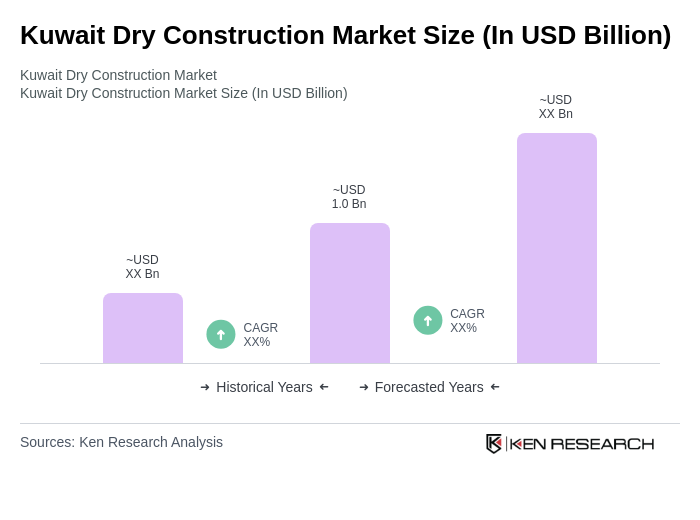
The Kuwait Dry Construction Market is valued at approximately USD 1.0 billion, reflecting its significant share within the GCC dry construction market. This valuation is based on a five-year historical analysis and highlights the market's growth potential driven by urbanization and sustainable practices.

What makes us stand out is that our consultants follow Robust, Refine and Result (RRR) methodology. Robust for clear definitions, approaches and sanity checking, Refine for differentiating respondents' facts and opinions, and Result for presenting data with story.

We have set a benchmark in the industry by offering our clients with syndicated and customized market research reports featuring coverage of entire market as well as meticulous research and analyst insights.

While we don't replace traditional research, we flip the method upside down. Our dual approach of Top Bottom & Bottom Top ensures quality deliverable by not just verifying company fundamentals but also looking at the sector and macroeconomic factors.

With one step in the future, our research team constantly tries to show you the bigger picture. We help with some of the tough questions you may encounter along the way: How is the industry positioned? Best marketing channel? KPI's of competitors? By aligning every element, we help maximize success.

Our report gives you instant access to the answers and sources that other companies might choose to hide. We elaborate each steps of research methodology we have used and showcase you the sample size to earn your trust.

If you need any support, we are here! We pride ourselves on universe strength, data quality, and quick, friendly, and professional service.













