About the Report
Base Year 2024Kuwait Glass Tableware Market Overview
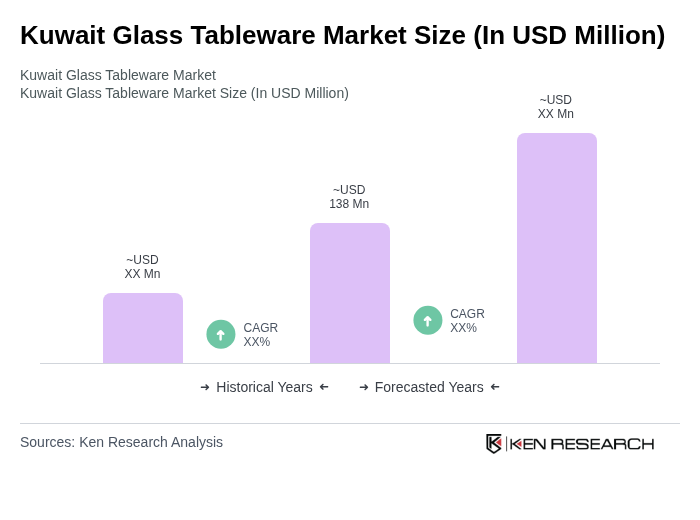
- The Kuwait Glass Tableware Market is valued at USD 138 million, based on a five-year historical analysis. This growth is primarily driven by increasing consumer demand for aesthetically pleasing and functional glassware, coupled with a rise in dining out and home entertaining trends. The market has seen a shift towards premium and designer glassware, reflecting changing consumer preferences and lifestyle choices. The global glass tableware market demonstrates strong momentum, with rising consumer demand for sustainable and recyclable materials, propelled by an increased focus on environmental concerns, alongside the hospitality sector's recovery leading to upsurge in bulk purchases for hotels and restaurants.
- Kuwait City is the dominant hub for the glass tableware market, benefiting from its status as a commercial center with a high concentration of retail outlets and restaurants. Other notable areas include Al Ahmadi and Hawalli, where affluent consumers drive demand for high-quality glass products. The urban population's growing disposable income and inclination towards luxury dining experiences further bolster market growth.
- The Kuwaiti government has established regulatory frameworks aimed at enhancing product safety standards in the glassware industry. The Kuwait Standards and Metrology Department (KSMD) oversees compliance with the Gulf Standardization Organization (GSO) standards, which require manufacturers to comply with specific safety and quality benchmarks, ensuring that all glass tableware products are free from harmful substances and meet international safety standards. This initiative aims to protect consumers and promote sustainable practices within the industry.
Kuwait Glass Tableware Market Segmentation
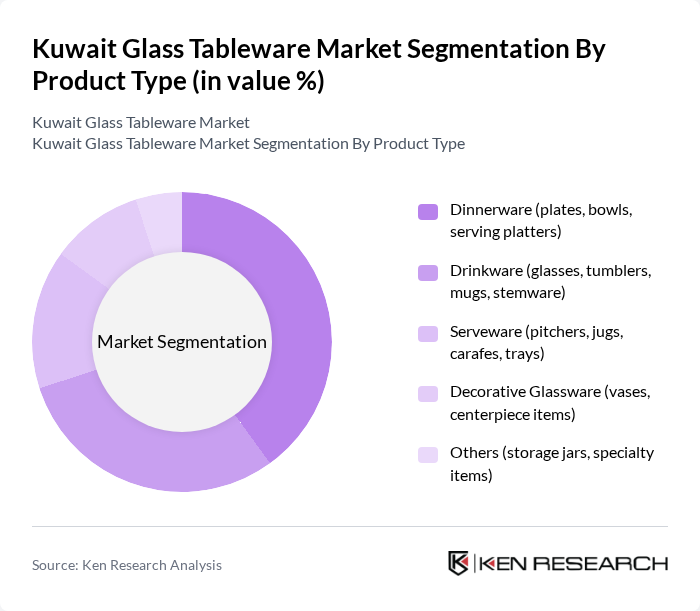
By Product Type:The product type segmentation includes various categories such as dinnerware, drinkware, serveware, decorative glassware, and others. Among these, dinnerware is the leading subsegment, driven by the increasing trend of home dining and gatherings. Consumers are increasingly investing in high-quality dinnerware that enhances their dining experience. Drinkware also holds a significant share, as consumers seek stylish and functional options for beverages.
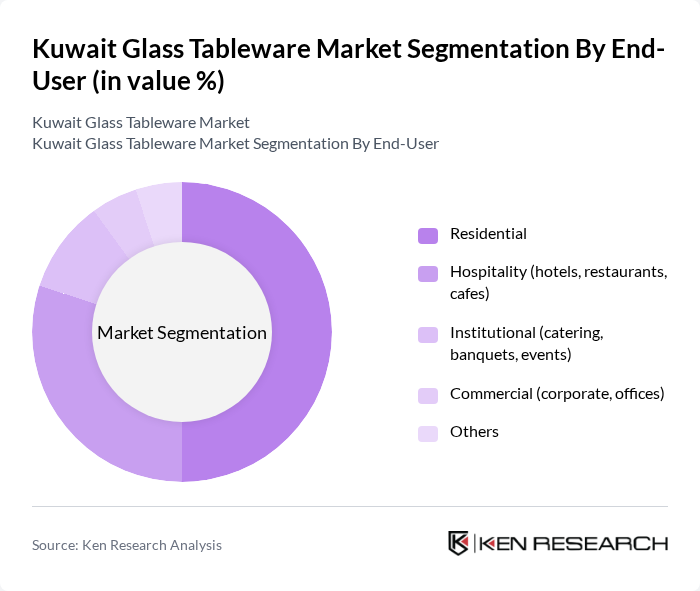
By End-User:The end-user segmentation encompasses residential, hospitality, institutional, commercial, and others. The residential segment dominates the market, as more consumers invest in quality glassware for home use. The hospitality sector is also significant, driven by the growing number of restaurants and cafes in Kuwait, which require stylish and durable glassware to enhance their dining experiences.
Kuwait Glass Tableware Market Competitive Landscape
The Kuwait Glass Tableware Market is characterized by a dynamic mix of regional and international players. Leading participants such as Gulf Glass Manufacturing Company K.S.C., Libbey Inc., Arc International, Pasabahce (?i?ecam Group), Bormioli Rocco S.p.A., Luminarc (Arc International), RAK Glass LLC, Ocean Glass Public Company Limited, Borgonovo S.p.A., Luigi Bormioli S.p.A., WMF Group GmbH, Duralex International, Royal Leerdam (Libbey Group), Zwiesel Kristallglas AG, Crystalex CZ, s.r.o. contribute to innovation, geographic expansion, and service delivery in this space.
Kuwait Glass Tableware Market Industry Analysis
Growth Drivers
- Increasing Consumer Preference for Glass Tableware:The demand for glass tableware in Kuwait is significantly driven by consumer preferences shifting towards aesthetically pleasing and durable products. In future, the glass tableware segment accounted for approximately 35% of the total tableware market, reflecting a growing inclination for premium materials. This trend is supported by a 15% increase in consumer spending on home goods, as reported by the Kuwait Central Statistical Bureau, indicating a robust market for glass products.
- Rising Disposable Income Among Kuwaiti Households:The average disposable income in Kuwait is projected to reach around KWD 1,500 per month in future, up from KWD 1,350 in future. This increase allows consumers to invest more in quality home products, including glass tableware. As disposable income rises, households are more likely to purchase premium glass items, contributing to a projected growth in the glassware market by 20% over the next year, according to the Ministry of Finance.
- Growth in the Hospitality and Restaurant Sector:The hospitality sector in Kuwait is expected to grow by 10% in future, driven by an increase in tourism and local dining experiences. This growth translates to higher demand for quality glass tableware in restaurants and hotels, which are increasingly focusing on enhancing customer experiences. The Kuwait Tourism Authority reported a 25% rise in tourist arrivals in future, further boosting the need for premium dining products in the hospitality industry.
Market Challenges
- High Competition from Alternative Materials:The glass tableware market faces significant competition from alternative materials such as plastic and ceramic, which are often cheaper and more durable. In future, plastic tableware captured approximately 40% of the market share due to its affordability and convenience. This competition poses a challenge for glass manufacturers, as they must differentiate their products through quality and design to maintain market presence amidst these alternatives.
- Fluctuating Raw Material Prices:The glass manufacturing industry is heavily reliant on raw materials such as silica sand and soda ash, whose prices have seen volatility due to global supply chain disruptions. In future, the cost of silica sand increased by 12%, impacting production costs for glass tableware manufacturers. This fluctuation can lead to increased prices for consumers, potentially reducing demand and affecting overall market growth in the coming years.
Kuwait Glass Tableware Market Future Outlook
The future of the Kuwait glass tableware market appears promising, driven by increasing consumer awareness of sustainability and the growing trend of home dining experiences. As disposable incomes rise, consumers are likely to invest in premium glass products that enhance their dining aesthetics. Additionally, the expansion of e-commerce platforms is expected to facilitate greater access to diverse glassware options, further stimulating market growth. The focus on health and safety in product materials will also shape consumer preferences, leading to innovative product offerings.
Market Opportunities
- Growing Trend of Eco-Friendly Products:With increasing environmental awareness, there is a significant opportunity for glass tableware manufacturers to promote eco-friendly products. The demand for sustainable materials is projected to rise, with a 30% increase in consumer preference for eco-friendly options noted in recent surveys. This trend can lead to innovative product lines that appeal to environmentally conscious consumers.
- Potential for Customization and Personalization:The market for customized glass tableware is expanding, with consumers seeking unique designs that reflect personal style. In future, the demand for personalized products is expected to grow by 25%, driven by social media influences and gifting trends. Manufacturers can capitalize on this opportunity by offering bespoke services, enhancing customer engagement and loyalty.
Scope of the Report
| Segment | Sub-Segments |
|---|---|
| By Product Type | Dinnerware (plates, bowls, serving platters) Drinkware (glasses, tumblers, mugs, stemware) Serveware (pitchers, jugs, carafes, trays) Decorative Glassware (vases, centerpiece items) Others (storage jars, specialty items) |
| By End-User | Residential Hospitality (hotels, restaurants, cafes) Institutional (catering, banquets, events) Commercial (corporate, offices) Others |
| By Distribution Channel | Supermarkets/Hypermarkets Specialty Stores Online Retail Direct Sales Others |
| By Design Style | Modern Traditional Artistic/Handcrafted Minimalist Others |
| By Price Range | Budget Mid-Range Premium Luxury Others |
| By Material Quality | Soda-Lime Glass Borosilicate Glass Lead Crystal Tempered Glass Others |
| By Occasion | Everyday Use Special Occasions Gifting Events Others |
Key Target Audience
Investors and Venture Capitalist Firms
Government and Regulatory Bodies (e.g., Kuwait Ministry of Commerce and Industry)
Manufacturers and Producers
Distributors and Retailers
Importers and Exporters
Hospitality Industry Stakeholders
Interior Designers and Architects
Packaging and Logistics Companies
Players Mentioned in the Report:
Gulf Glass Manufacturing Company K.S.C.
Libbey Inc.
Arc International
Pasabahce (Sisecam Group)
Bormioli Rocco S.p.A.
Luminarc (Arc International)
RAK Glass LLC
Ocean Glass Public Company Limited
Borgonovo S.p.A.
Luigi Bormioli S.p.A.
WMF Group GmbH
Duralex International
Royal Leerdam (Libbey Group)
Zwiesel Kristallglas AG
Crystalex CZ, s.r.o.
Table of Contents
Market Assessment Phase
1. Executive Summary and Approach
2. Kuwait Glass Tableware Market Overview
2.1 Key Insights and Strategic Recommendations
2.2 Kuwait Glass Tableware Market Overview
2.3 Definition and Scope
2.4 Evolution of Market Ecosystem
2.5 Timeline of Key Regulatory Milestones
2.6 Value Chain & Stakeholder Mapping
2.7 Business Cycle Analysis
2.8 Policy & Incentive Landscape
3. Kuwait Glass Tableware Market Analysis
3.1 Growth Drivers
3.1.1 Increasing consumer preference for glass tableware
3.1.2 Rising disposable income among Kuwaiti households
3.1.3 Growth in the hospitality and restaurant sector
3.1.4 Expansion of e-commerce platforms for home goods
3.2 Market Challenges
3.2.1 High competition from alternative materials
3.2.2 Fluctuating raw material prices
3.2.3 Limited local manufacturing capabilities
3.2.4 Regulatory hurdles in importation
3.3 Market Opportunities
3.3.1 Growing trend of eco-friendly products
3.3.2 Potential for customization and personalization
3.3.3 Expansion into untapped rural markets
3.3.4 Collaborations with local artisans for unique designs
3.4 Market Trends
3.4.1 Increasing demand for premium glassware
3.4.2 Shift towards online shopping
3.4.3 Rising popularity of home dining experiences
3.4.4 Focus on health and safety in product materials
3.5 Government Regulation
3.5.1 Import tariffs on glass products
3.5.2 Safety standards for food-grade materials
3.5.3 Environmental regulations on packaging
3.5.4 Incentives for local manufacturing
4. SWOT Analysis
5. Stakeholder Analysis
6. Porter's Five Forces Analysis
7. Kuwait Glass Tableware Market Market Size, 2019-2024
7.1 By Value
7.2 By Volume
7.3 By Average Selling Price
8. Kuwait Glass Tableware Market Segmentation
8.1 By Product Type
8.1.1 Dinnerware (plates, bowls, serving platters)
8.1.2 Drinkware (glasses, tumblers, mugs, stemware)
8.1.3 Serveware (pitchers, jugs, carafes, trays)
8.1.4 Decorative Glassware (vases, centerpiece items)
8.1.5 Others (storage jars, specialty items)
8.2 By End-User
8.2.1 Residential
8.2.2 Hospitality (hotels, restaurants, cafes)
8.2.3 Institutional (catering, banquets, events)
8.2.4 Commercial (corporate, offices)
8.2.5 Others
8.3 By Distribution Channel
8.3.1 Supermarkets/Hypermarkets
8.3.2 Specialty Stores
8.3.3 Online Retail
8.3.4 Direct Sales
8.3.5 Others
8.4 By Design Style
8.4.1 Modern
8.4.2 Traditional
8.4.3 Artistic/Handcrafted
8.4.4 Minimalist
8.4.5 Others
8.5 By Price Range
8.5.1 Budget
8.5.2 Mid-Range
8.5.3 Premium
8.5.4 Luxury
8.5.5 Others
8.6 By Material Quality
8.6.1 Soda-Lime Glass
8.6.2 Borosilicate Glass
8.6.3 Lead Crystal
8.6.4 Tempered Glass
8.6.5 Others
8.7 By Occasion
8.7.1 Everyday Use
8.7.2 Special Occasions
8.7.3 Gifting
8.7.4 Events
8.7.5 Others
9. Kuwait Glass Tableware Market Competitive Analysis
9.1 Market Share of Key Players
9.2 KPIs for Cross Comparison of Key Players
9.2.1 Company Name
9.2.2 Group Size (Large, Medium, or Small as per industry convention)
9.2.3 Annual Revenue (USD/KWD)
9.2.4 Revenue Growth Rate (%)
9.2.5 Market Share (%) in Kuwait
9.2.6 Product Portfolio Breadth (number of SKUs or product categories)
9.2.7 Distribution Channel Coverage (number of retail points, online presence)
9.2.8 Brand Recognition/Recall Score (survey-based or market index)
9.2.9 Customer Satisfaction Index (NPS or equivalent)
9.2.10 Innovation Index (new product launches, patents, design awards)
9.2.11 Pricing Strategy (positioning: budget, mid, premium, luxury)
9.2.12 Local Manufacturing Presence (yes/no, % of local production)
9.3 SWOT Analysis of Top Players
9.4 Pricing Analysis
9.5 List of Major Companies
9.5.1 Gulf Glass Manufacturing Company K.S.C.
9.5.2 Libbey Inc.
9.5.3 Arc International
9.5.4 Pasabahce (?i?ecam Group)
9.5.5 Bormioli Rocco S.p.A.
9.5.6 Luminarc (Arc International)
9.5.7 RAK Glass LLC
9.5.8 Ocean Glass Public Company Limited
9.5.9 Borgonovo S.p.A.
9.5.10 Luigi Bormioli S.p.A.
9.5.11 WMF Group GmbH
9.5.12 Duralex International
9.5.13 Royal Leerdam (Libbey Group)
9.5.14 Zwiesel Kristallglas AG
9.5.15 Crystalex CZ, s.r.o.
10. Kuwait Glass Tableware Market End-User Analysis
10.1 Procurement Behavior of Key Ministries
10.1.1 Budget Allocation Trends
10.1.2 Preferred Suppliers
10.1.3 Procurement Processes
10.1.4 Contracting Practices
10.2 Corporate Spend on Infrastructure & Energy
10.2.1 Investment Trends
10.2.2 Spending Priorities
10.2.3 Budget Cycles
10.2.4 Key Decision Makers
10.3 Pain Point Analysis by End-User Category
10.3.1 Quality Concerns
10.3.2 Supply Chain Issues
10.3.3 Cost Management
10.3.4 Product Availability
10.4 User Readiness for Adoption
10.4.1 Awareness Levels
10.4.2 Training Needs
10.4.3 Technology Adoption Rates
10.4.4 Feedback Mechanisms
10.5 Post-Deployment ROI and Use Case Expansion
10.5.1 Performance Metrics
10.5.2 User Satisfaction Levels
10.5.3 Future Investment Plans
10.5.4 Expansion Opportunities
11. Kuwait Glass Tableware Market Future Size, 2025-2030
11.1 By Value
11.2 By Volume
11.3 By Average Selling Price
Go-To-Market Strategy Phase
1. Whitespace Analysis + Business Model Canvas
1.1 Market Gaps Identification
1.2 Value Proposition Development
1.3 Revenue Streams
1.4 Cost Structure
1.5 Key Partnerships
1.6 Customer Segments
1.7 Channels
2. Marketing and Positioning Recommendations
2.1 Branding Strategies
2.2 Product USPs
3. Distribution Plan
3.1 Urban Retail vs Rural NGO Tie-ups
4. Channel & Pricing Gaps
4.1 Underserved Routes
4.2 Pricing Bands
5. Unmet Demand & Latent Needs
5.1 Category Gaps
5.2 Consumer Segments
6. Customer Relationship
6.1 Loyalty Programs
6.2 After-sales Service
7. Value Proposition
7.1 Sustainability
7.2 Integrated Supply Chains
8. Key Activities
8.1 Regulatory Compliance
8.2 Branding
8.3 Distribution Setup
9. Entry Strategy Evaluation
9.1 Domestic Market Entry Strategy
9.1.1 Product Mix
9.1.2 Pricing Band
9.1.3 Packaging
9.2 Export Entry Strategy
9.2.1 Target Countries
9.2.2 Compliance Roadmap
10. Entry Mode Assessment
10.1 JV
10.2 Greenfield
10.3 M&A
10.4 Distributor Model
11. Capital and Timeline Estimation
11.1 Capital Requirements
11.2 Timelines
12. Control vs Risk Trade-Off
12.1 Ownership vs Partnerships
13. Profitability Outlook
13.1 Breakeven Analysis
13.2 Long-term Sustainability
14. Potential Partner List
14.1 Distributors
14.2 JVs
14.3 Acquisition Targets
15. Execution Roadmap
15.1 Phased Plan for Market Entry
15.1.1 Market Setup
15.1.2 Market Entry
15.1.3 Growth Acceleration
15.1.4 Scale & Stabilize
15.2 Key Activities and Milestones
15.2.1 Milestone Planning
15.2.2 Activity Tracking
Research Methodology
Phase 1: Approach1
Desk Research
- Industry reports from the Kuwait Chamber of Commerce and Industry
- Market analysis publications from local trade associations
- Statistical data from the Central Statistical Bureau of Kuwait
Primary Research
- Interviews with key stakeholders in the glass tableware manufacturing sector
- Surveys targeting retailers and distributors of glass tableware in Kuwait
- Field visits to production facilities and retail outlets for observational insights
Validation & Triangulation
- Cross-validation of findings with historical sales data and market trends
- Triangulation of insights from industry experts and market participants
- Sanity checks through feedback from focus groups comprising industry professionals
Phase 2: Market Size Estimation1
Top-down Assessment
- Analysis of national glassware consumption trends and per capita usage
- Segmentation of market size by product categories such as dinnerware, serveware, and drinkware
- Incorporation of import/export data to gauge market dynamics
Bottom-up Modeling
- Estimation of production capacities of local glass tableware manufacturers
- Sales volume data from major retailers and e-commerce platforms
- Cost analysis based on pricing strategies and consumer purchasing behavior
Forecasting & Scenario Analysis
- Multi-variable forecasting using economic indicators and consumer trends
- Scenario planning based on potential regulatory changes and market disruptions
- Development of baseline, optimistic, and pessimistic market growth projections through 2030
Phase 3: CATI Sample Composition1
| Scope Item/Segment | Sample Size | Target Respondent Profiles |
|---|---|---|
| Retail Market Insights | 100 | Store Managers, Retail Buyers |
| Manufacturing Sector Feedback | 60 | Production Managers, Quality Control Supervisors |
| Consumer Preferences Survey | 120 | Household Decision Makers, Interior Designers |
| Distribution Channel Analysis | 50 | Logistics Coordinators, Supply Chain Analysts |
| Market Trend Evaluation | 70 | Market Analysts, Business Development Managers |
Frequently Asked Questions
What is the current value of the Kuwait Glass Tableware Market?
The Kuwait Glass Tableware Market is valued at approximately USD 138 million, reflecting a growing consumer demand for aesthetically pleasing and functional glassware, alongside trends in dining out and home entertaining.
What factors are driving the growth of the glass tableware market in Kuwait?
Which areas in Kuwait are the primary markets for glass tableware?
What types of products are included in the Kuwait Glass Tableware Market?
Other Regional/Country Reports
Indonesia Glass Tableware Market Size, Share, Growth Drivers, Trends, Opportunities & Forecast 2025–2030
Malaysia Glass Tableware Market Size, Share, Growth Drivers, Trends, Opportunities & Forecast 2025–2030
KSA Glass Tableware Market Size, Share, Growth Drivers, Trends, Opportunities & Forecast 2025–2030
APAC Glass Tableware Market Size, Share, Growth Drivers, Trends, Opportunities & Forecast 2025–2030
SEA Glass Tableware Market Size, Share, Growth Drivers, Trends, Opportunities & Forecast 2025–2030
Vietnam Glass Tableware Market Size, Share, Growth Drivers, Trends, Opportunities & Forecast 2025–2030
Other Adjacent Reports
KSA Ceramic Tableware Market
Thailand Plastic Tableware Market
Indonesia Disposable Tableware Market
Bahrain Hospitality Supplies Market
Qatar Home Furnishings Market
APAC kitchenware market report size, share, growth drivers, trends, opportunities & forecast 2025–2030Qatar glass packaging market analysis size, share, growth drivers, trends, opportunities & forecast 2025–2030Brazil Luxury Dinnerware Market
Qatar Eco-Friendly Tableware Market
Belgium Restaurant Equipment Market
Why Buy From Us?

What makes us stand out is that our consultants follow Robust, Refine and Result (RRR) methodology. Robust for clear definitions, approaches and sanity checking, Refine for differentiating respondents' facts and opinions, and Result for presenting data with story.

We have set a benchmark in the industry by offering our clients with syndicated and customized market research reports featuring coverage of entire market as well as meticulous research and analyst insights.

While we don't replace traditional research, we flip the method upside down. Our dual approach of Top Bottom & Bottom Top ensures quality deliverable by not just verifying company fundamentals but also looking at the sector and macroeconomic factors.

With one step in the future, our research team constantly tries to show you the bigger picture. We help with some of the tough questions you may encounter along the way: How is the industry positioned? Best marketing channel? KPI's of competitors? By aligning every element, we help maximize success.

Our report gives you instant access to the answers and sources that other companies might choose to hide. We elaborate each steps of research methodology we have used and showcase you the sample size to earn your trust.

If you need any support, we are here! We pride ourselves on universe strength, data quality, and quick, friendly, and professional service.