About the Report
Base Year 2024Kuwait Hot Sauce Market Overview
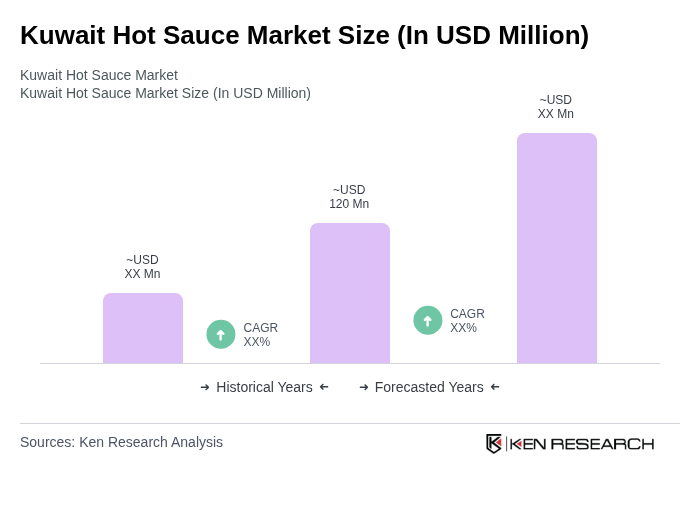
- The Kuwait Hot Sauce Market is valued at USD 120 million, based on a five-year historical analysis. This growth is primarily driven by the increasing popularity of spicy foods among consumers, coupled with a rise in the number of restaurants and food outlets offering diverse cuisines that incorporate hot sauces. The growing trend of culinary experimentation, influence of social media on food choices, rising adoption of ethnic cuisines, and demand for hybrid flavor profiles have further propelled the demand for hot sauces in the region.
- Kuwait City is the dominant market for hot sauce, primarily due to its status as the capital and largest city, where a significant portion of the population resides. The city's diverse culinary scene, influenced by various cultures, has led to a higher consumption of hot sauces. Additionally, other cities like Hawalli and Salmiya also contribute to the market, driven by their vibrant dining options and increasing consumer interest in spicy condiments.
- The Ministerial Resolution No. 389 of 2019 issued by the Public Authority for Food and Nutrition (PAFN) in Kuwait governs food safety and quality standards for hot sauce production. This binding instrument mandates comprehensive labeling requirements specifying ingredients, nutritional information, allergens, and production details, with compliance enforced through registration of food facilities, adherence to Good Manufacturing Practices (GMP), and maximum residue limits for contaminants applicable to all imported and locally produced condiments.
Kuwait Hot Sauce Market Segmentation
By Type:The hot sauce market can be segmented into various types, including Traditional Hot Sauce, Specialty Hot Sauce, Organic Hot Sauce, Gourmet Hot Sauce, and Others. Traditional Hot Sauce remains a staple due to its cultural significance and widespread use in local cuisines. Specialty Hot Sauce is gaining traction as consumers seek unique flavors and artisanal products. Organic Hot Sauce is appealing to health-conscious consumers, while Gourmet Hot Sauce caters to those looking for premium options. The "Others" category includes various niche products that do not fit into the primary classifications.

By End-User:The end-user segmentation includes Households, Restaurants, Food Processing Industry, Catering Services, and Others. Households represent a significant portion of the market as consumers increasingly use hot sauces in home cooking. Restaurants are also major contributors, utilizing hot sauces to enhance their menu offerings. The Food Processing Industry incorporates hot sauces into various products, while Catering Services use them to cater to diverse tastes. The "Others" category includes various commercial entities that utilize hot sauces in their operations.

Kuwait Hot Sauce Market Competitive Landscape
The Kuwait Hot Sauce Market is characterized by a dynamic mix of regional and international players. Leading participants such as Al Wazzan Food Industries, Kuwait Food Company (Americana), Al Kout Food Group, Al-Mansour Group, Al-Babtain Group, Al-Homaizi Foodstuff Company, Al-Qatami Global for Foodstuff, Al-Muhalab Food Company, Al-Salam International Food Company, Al-Fawaz Group, Al-Mansour Al-Hamadi Group, Al-Majed Group, Al-Shaab Group, Al-Mutawa Group, Al-Saeed Group contribute to innovation, geographic expansion, and service delivery in this space.
Kuwait Hot Sauce Market Industry Analysis
Growth Drivers
- Increasing Consumer Demand for Spicy Foods:The demand for spicy foods in Kuwait has surged, with a reported increase of 15% in hot sauce consumption from 2022 to 2023. This trend is driven by a growing preference for bold flavors among consumers, particularly among the younger demographic, which constitutes approximately 60% of the population. The World Bank projects that the food sector in Kuwait will grow by 4.5% in future, further supporting this demand for spicy condiments.
- Rising Popularity of International Cuisines:The influx of international cuisines in Kuwait has significantly influenced the hot sauce market. In future, the number of restaurants offering diverse culinary experiences increased by 20%, with many featuring spicy dishes. This trend is supported by the Kuwait Food and Nutrition Security Strategy, which aims to diversify food offerings. As a result, hot sauce sales have seen a corresponding rise, with an estimated increase of 10% in product variety available in local markets.
- Growth of the Food Service Industry:The food service industry in Kuwait is projected to reach a value of $3.5 billion by the end of future, reflecting a robust growth trajectory. This expansion is driven by increased dining out and a burgeoning café culture, which has led to a higher demand for hot sauces as essential condiments. The Kuwait Chamber of Commerce reports that food service establishments are increasingly incorporating local and international hot sauce brands into their menus, enhancing overall sales.
Market Challenges
- Intense Competition Among Local and International Brands:The Kuwait hot sauce market faces fierce competition, with over 50 brands vying for market share. Local brands account for approximately 40% of the market, while international brands are rapidly increasing their presence. This competitive landscape pressures pricing and marketing strategies, making it challenging for new entrants to establish themselves. The Kuwait Consumer Protection Agency emphasizes the need for differentiation to succeed in this saturated market.
- Fluctuating Raw Material Prices:The volatility in raw material prices, particularly chili peppers and vinegar, poses a significant challenge for hot sauce manufacturers. In future, the price of chili peppers rose by 25% due to supply chain disruptions and climate impacts. This fluctuation affects production costs and profit margins, compelling manufacturers to either absorb costs or pass them onto consumers. The Ministry of Commerce and Industry has noted that such price instability can hinder market growth and product availability.
Kuwait Hot Sauce Market Future Outlook
The future of the Kuwait hot sauce market appears promising, driven by evolving consumer preferences and a growing food service sector. As health consciousness rises, consumers are increasingly seeking out hot sauces with natural ingredients and health benefits. Additionally, the expansion of e-commerce platforms is expected to facilitate greater access to diverse hot sauce brands, enhancing market penetration. Collaborations with local chefs and restaurants will likely further stimulate innovation and product development, catering to the dynamic tastes of Kuwaiti consumers.
Market Opportunities
- Introduction of Innovative Flavors and Products:There is a significant opportunity for brands to introduce unique flavors that cater to local tastes, such as date-infused hot sauces. This innovation can attract health-conscious consumers and those seeking gourmet experiences, potentially increasing market share by 15% in future.
- Growth in E-commerce and Online Sales:The rise of e-commerce in Kuwait, projected to grow by 30% in future, presents a lucrative opportunity for hot sauce brands. By leveraging online platforms, companies can reach a broader audience, enhance brand visibility, and increase sales, particularly among younger consumers who prefer online shopping.
Scope of the Report
| Segment | Sub-Segments |
|---|---|
| By Type | Traditional Hot Sauce Specialty Hot Sauce Organic Hot Sauce Gourmet Hot Sauce Others |
| By End-User | Households Restaurants Food Processing Industry Catering Services Others |
| By Distribution Channel | Supermarkets/Hypermarkets Online Retail Convenience Stores Specialty Stores Others |
| By Packaging Type | Bottles Sachets Jars Pouches Others |
| By Flavor Profile | Mild Medium Hot Extra Hot Others |
| By Ingredient Type | Chili Peppers Vinegar Spices and Seasonings Preservatives Others |
| By Consumer Demographics | Age Group (18-25, 26-35, 36-50, 51+) Income Level (Low, Medium, High) Urban vs Rural Others |
Key Target Audience
Investors and Venture Capitalist Firms
Government and Regulatory Bodies (e.g., Kuwait Food and Drug Administration)
Manufacturers and Producers
Distributors and Retailers
Food Service Providers
Importers and Exporters
Industry Associations (e.g., Kuwait Chamber of Commerce)
Financial Institutions
Players Mentioned in the Report:
Al Wazzan Food Industries
Kuwait Food Company (Americana)
Al Kout Food Group
Al-Mansour Group
Al-Babtain Group
Al-Homaizi Foodstuff Company
Al-Qatami Global for Foodstuff
Al-Muhalab Food Company
Al-Salam International Food Company
Al-Fawaz Group
Al-Mansour Al-Hamadi Group
Al-Majed Group
Al-Shaab Group
Al-Mutawa Group
Al-Saeed Group
Table of Contents
Market Assessment Phase
1. Executive Summary and Approach
2. Kuwait Hot Sauce Market Overview
2.1 Key Insights and Strategic Recommendations
2.2 Kuwait Hot Sauce Market Overview
2.3 Definition and Scope
2.4 Evolution of Market Ecosystem
2.5 Timeline of Key Regulatory Milestones
2.6 Value Chain & Stakeholder Mapping
2.7 Business Cycle Analysis
2.8 Policy & Incentive Landscape
3. Kuwait Hot Sauce Market Analysis
3.1 Growth Drivers
3.1.1 Increasing consumer demand for spicy foods
3.1.2 Rising popularity of international cuisines
3.1.3 Growth of the food service industry
3.1.4 Expansion of retail distribution channels
3.2 Market Challenges
3.2.1 Intense competition among local and international brands
3.2.2 Fluctuating raw material prices
3.2.3 Regulatory compliance and labeling requirements
3.2.4 Limited consumer awareness of product varieties
3.3 Market Opportunities
3.3.1 Introduction of innovative flavors and products
3.3.2 Growth in e-commerce and online sales
3.3.3 Potential for export to neighboring markets
3.3.4 Collaborations with local restaurants and chefs
3.4 Market Trends
3.4.1 Increasing health consciousness among consumers
3.4.2 Rise of organic and natural hot sauce products
3.4.3 Popularity of gourmet and artisanal hot sauces
3.4.4 Social media influence on food trends
3.5 Government Regulation
3.5.1 Food safety standards and regulations
3.5.2 Labeling requirements for food products
3.5.3 Import regulations for food ingredients
3.5.4 Compliance with health and safety guidelines
4. SWOT Analysis
5. Stakeholder Analysis
6. Porter's Five Forces Analysis
7. Kuwait Hot Sauce Market Market Size, 2019-2024
7.1 By Value
7.2 By Volume
7.3 By Average Selling Price
8. Kuwait Hot Sauce Market Segmentation
8.1 By Type
8.1.1 Traditional Hot Sauce
8.1.2 Specialty Hot Sauce
8.1.3 Organic Hot Sauce
8.1.4 Gourmet Hot Sauce
8.1.5 Others
8.2 By End-User
8.2.1 Households
8.2.2 Restaurants
8.2.3 Food Processing Industry
8.2.4 Catering Services
8.2.5 Others
8.3 By Distribution Channel
8.3.1 Supermarkets/Hypermarkets
8.3.2 Online Retail
8.3.3 Convenience Stores
8.3.4 Specialty Stores
8.3.5 Others
8.4 By Packaging Type
8.4.1 Bottles
8.4.2 Sachets
8.4.3 Jars
8.4.4 Pouches
8.4.5 Others
8.5 By Flavor Profile
8.5.1 Mild
8.5.2 Medium
8.5.3 Hot
8.5.4 Extra Hot
8.5.5 Others
8.6 By Ingredient Type
8.6.1 Chili Peppers
8.6.2 Vinegar
8.6.3 Spices and Seasonings
8.6.4 Preservatives
8.6.5 Others
8.7 By Consumer Demographics
8.7.1 Age Group (18-25, 26-35, 36-50, 51+)
8.7.2 Income Level (Low, Medium, High)
8.7.3 Urban vs Rural
8.7.4 Others
9. Kuwait Hot Sauce Market Competitive Analysis
9.1 Market Share of Key Players
9.2 Cross Comparison of Key Players
9.2.1 Company Name.
9.2.2 Group Size (Large, Medium, or Small as per industry convention).
9.2.3 Revenue Growth Rate.
9.2.4 Market Penetration Rate.
9.2.5 Customer Retention Rate.
9.2.6 Pricing Strategy.
9.2.7 Product Diversification Index.
9.2.8 Brand Awareness Level.
9.2.9 Distribution Efficiency.
9.2.10 Customer Satisfaction Score.
9.3 SWOT Analysis of Top Players
9.4 Pricing Analysis
9.5 Detailed Profile of Major Companies
9.5.1 Al Wazzan Food Industries
9.5.2 Kuwait Food Company (Americana)
9.5.3 Al Kout Food Group
9.5.4 Al-Mansour Group
9.5.5 Al-Babtain Group
9.5.6 Al-Homaizi Foodstuff Company
9.5.7 Al-Qatami Global for Foodstuff
9.5.8 Al-Muhalab Food Company
9.5.9 Al-Salam International Food Company
9.5.10 Al-Fawaz Group
9.5.11 Al-Mansour Al-Hamadi Group
9.5.12 Al-Majed Group
9.5.13 Al-Shaab Group
9.5.14 Al-Mutawa Group
9.5.15 Al-Saeed Group
10. Kuwait Hot Sauce Market End-User Analysis
10.1 Procurement Behavior of Key Ministries
10.1.1 Ministry of Health
10.1.2 Ministry of Commerce and Industry
10.1.3 Ministry of Education
10.1.4 Ministry of Defense
10.2 Corporate Spend on Infrastructure & Energy
10.2.1 Food Service Sector Investments
10.2.2 Retail Sector Expenditures
10.2.3 Government Contracts for Food Supplies
10.3 Pain Point Analysis by End-User Category
10.3.1 Households
10.3.2 Restaurants
10.3.3 Food Manufacturers
10.4 User Readiness for Adoption
10.4.1 Awareness of Hot Sauce Varieties
10.4.2 Willingness to Experiment with New Flavors
10.5 Post-Deployment ROI and Use Case Expansion
10.5.1 Increased Sales from New Product Lines
10.5.2 Customer Feedback and Product Improvement
11. Kuwait Hot Sauce Market Future Size, 2025-2030
11.1 By Value
11.2 By Volume
11.3 By Average Selling Price
Go-To-Market Strategy Phase
1. Whitespace Analysis + Business Model Canvas
1.1 Market Gaps Identification
1.2 Business Model Development
2. Marketing and Positioning Recommendations
2.1 Branding Strategies
2.2 Product USPs
3. Distribution Plan
3.1 Urban Retail vs Rural NGO Tie-ups
4. Channel & Pricing Gaps
4.1 Underserved Routes
4.2 Pricing Bands
5. Unmet Demand & Latent Needs
5.1 Category Gaps
5.2 Consumer Segments
6. Customer Relationship
6.1 Loyalty Programs
6.2 After-sales Service
7. Value Proposition
7.1 Sustainability
7.2 Integrated Supply Chains
8. Key Activities
8.1 Regulatory Compliance
8.2 Branding
8.3 Distribution Setup
9. Entry Strategy Evaluation
9.1 Domestic Market Entry Strategy
9.1.1 Product Mix
9.1.2 Pricing Band
9.1.3 Packaging
9.2 Export Entry Strategy
9.2.1 Target Countries
9.2.2 Compliance Roadmap
10. Entry Mode Assessment
10.1 JV
10.2 Greenfield
10.3 M&A
10.4 Distributor Model
11. Capital and Timeline Estimation
11.1 Capital Requirements
11.2 Timelines
12. Control vs Risk Trade-Off
12.1 Ownership vs Partnerships
13. Profitability Outlook
13.1 Breakeven Analysis
13.2 Long-term Sustainability
14. Potential Partner List
14.1 Distributors
14.2 JVs
14.3 Acquisition Targets
15. Execution Roadmap
15.1 Phased Plan for Market Entry
15.1.1 Market Setup
15.1.2 Market Entry
15.1.3 Growth Acceleration
15.1.4 Scale & Stabilize
15.2 Key Activities and Milestones
15.2.1 Milestone Tracking
15.2.2 Activity Scheduling
Research Methodology
Phase 1: Approach1
Desk Research
- Analysis of market reports from local food and beverage authorities in Kuwait
- Review of trade publications and industry journals focusing on hot sauce trends
- Examination of import/export data related to hot sauce products in Kuwait
Primary Research
- Interviews with key stakeholders in the food distribution sector, including wholesalers and retailers
- Surveys targeting consumers to understand preferences and purchasing behavior regarding hot sauces
- Focus group discussions with culinary experts and chefs to gauge trends in hot sauce usage
Validation & Triangulation
- Cross-validation of findings with sales data from major retailers and distributors
- Triangulation of consumer insights with industry expert opinions
- Sanity checks through feedback from a panel of food industry analysts
Phase 2: Market Size Estimation1
Top-down Assessment
- Estimation of total market size based on national food expenditure statistics
- Segmentation of the market by product type, including different varieties of hot sauces
- Incorporation of demographic data to assess potential consumer base growth
Bottom-up Modeling
- Collection of sales data from leading hot sauce brands operating in Kuwait
- Estimation of average retail prices and volume sold across various distribution channels
- Analysis of consumer purchasing patterns to derive volume estimates for different segments
Forecasting & Scenario Analysis
- Utilization of historical sales data to project future growth rates for the hot sauce market
- Scenario analysis based on potential changes in consumer preferences and health trends
- Development of best-case, worst-case, and most-likely scenarios through 2030
Phase 3: CATI Sample Composition1
| Scope Item/Segment | Sample Size | Target Respondent Profiles |
|---|---|---|
| Retail Hot Sauce Sales | 150 | Store Managers, Category Buyers |
| Consumer Preferences Survey | 120 | General Consumers, Food Enthusiasts |
| Food Service Industry Insights | 100 | Restaurant Owners, Chefs |
| Distribution Channel Analysis | 80 | Distributors, Wholesalers |
| Market Trend Evaluation | 70 | Food Industry Analysts, Market Researchers |
Frequently Asked Questions
What is the current value of the Kuwait Hot Sauce Market?
The Kuwait Hot Sauce Market is valued at approximately USD 120 million, reflecting a growing consumer interest in spicy foods and diverse culinary offerings. This market growth is supported by an increase in restaurants and food outlets incorporating hot sauces into their menus.
What factors are driving the growth of the hot sauce market in Kuwait?
Which city in Kuwait has the highest demand for hot sauce?
What types of hot sauces are popular in Kuwait?
Other Regional/Country Reports
Other Adjacent Reports
Mexico Sauces and Dressings Market
Egypt Spices and Seasonings Market
South Korea Ethnic Foods Market
UAE Gourmet Foods Market
Organic Foods MarketIndia Food Processing Market Size, Share & Forecast, By Product Type, End-Use Industry & Distribution Channel, 2025-2032Brazil Restaurant Supplies Market
Saudi Arabia Catering Services Market Size, Share & Forecast, By Service Type, End-Use Industry & Delivery Model, 2026–2032Philippines Food Ingredients Market Size, Share & Forecast, By Ingredient Type, Source & Application, 2026-2031Why Buy From Us?

What makes us stand out is that our consultants follow Robust, Refine and Result (RRR) methodology. Robust for clear definitions, approaches and sanity checking, Refine for differentiating respondents' facts and opinions, and Result for presenting data with story.

We have set a benchmark in the industry by offering our clients with syndicated and customized market research reports featuring coverage of entire market as well as meticulous research and analyst insights.

While we don't replace traditional research, we flip the method upside down. Our dual approach of Top Bottom & Bottom Top ensures quality deliverable by not just verifying company fundamentals but also looking at the sector and macroeconomic factors.

With one step in the future, our research team constantly tries to show you the bigger picture. We help with some of the tough questions you may encounter along the way: How is the industry positioned? Best marketing channel? KPI's of competitors? By aligning every element, we help maximize success.

Our report gives you instant access to the answers and sources that other companies might choose to hide. We elaborate each steps of research methodology we have used and showcase you the sample size to earn your trust.

If you need any support, we are here! We pride ourselves on universe strength, data quality, and quick, friendly, and professional service.