Region:Middle East
Author(s):Rebecca
Product Code:KRAA9252
Pages:82
Published On:November 2025

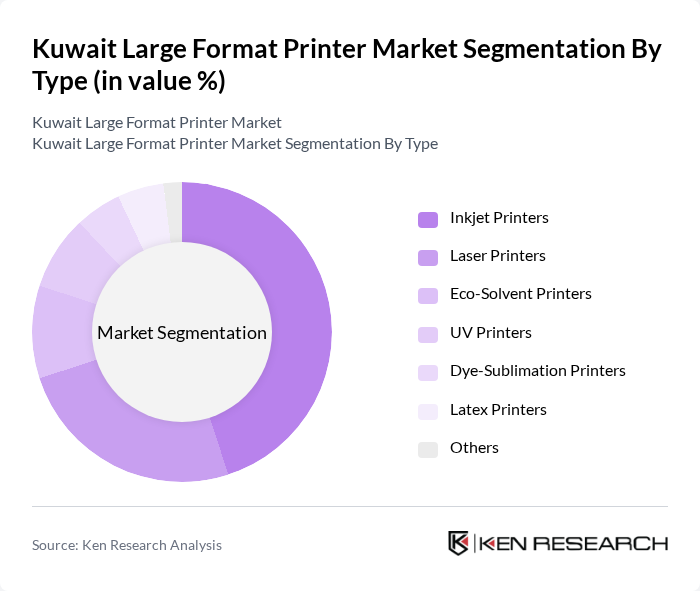
By Type:The large format printer market can be segmented into Inkjet Printers, Laser Printers, Eco-Solvent Printers, UV Printers, Dye-Sublimation Printers, Latex Printers, and Others. Inkjet Printers dominate the market due to their versatility, high-resolution output, and ability to print on a wide range of materials. The rising demand for personalized, vibrant advertising materials and the adoption of eco-friendly ink technologies further bolster the popularity of inkjet solutions. Laser Printers are also gaining traction, particularly in environments requiring fast, efficient, and high-volume printing .
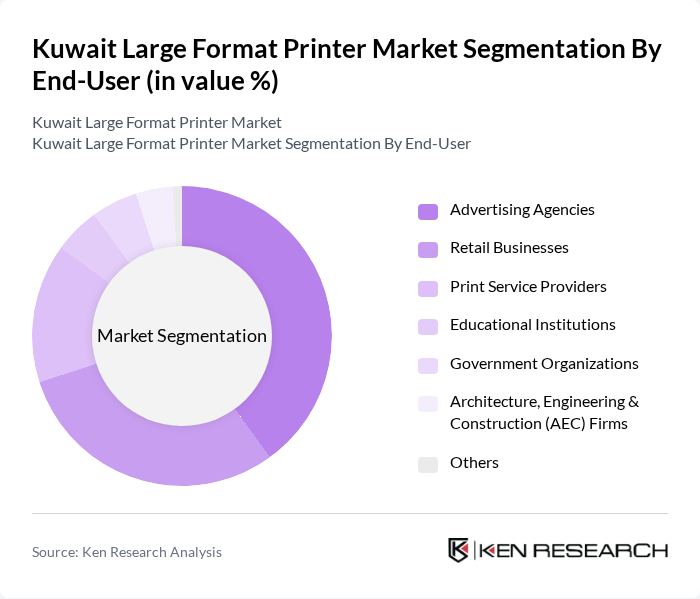
By End-User:The end-user segmentation includes Advertising Agencies, Retail Businesses, Print Service Providers, Educational Institutions, Government Organizations, Architecture, Engineering & Construction (AEC) Firms, and Others. Advertising Agencies are the leading end-users, driven by the need for high-quality promotional materials and signage. Retail businesses also significantly contribute to the market, as they require large format printing for in-store displays and marketing collateral. The increasing focus on branding, customer engagement, and the expansion of the retail and construction sectors further enhance the demand for large format printing solutions .
The Kuwait Large Format Printer Market is characterized by a dynamic mix of regional and international players. Leading participants such as Canon Inc., Epson Corporation, HP Inc., Roland DG Corporation, Mimaki Engineering Co., Ltd., Agfa-Gevaert Group, Xerox Corporation, Konica Minolta, Inc., Ricoh Company, Ltd., Durst Group AG, Mutoh Industries Ltd., Brother Industries, Ltd., Lexmark International, Inc., Seiko Instruments Inc., OKI Data Corporation, Gulf Commercial Group (GCG), Al Mulla Office Automation Solutions, Alghanim Electronics, United Business Group (UBG), Al-Yousifi contribute to innovation, geographic expansion, and service delivery in this space.
The future outlook for the Kuwait large format printer market appears promising, driven by ongoing technological advancements and increasing demand for customized printing solutions. As businesses continue to prioritize high-quality visual marketing, the market is expected to witness a shift towards on-demand printing services. Additionally, the integration of IoT technology in printing processes is anticipated to enhance operational efficiency, enabling companies to streamline production and reduce waste, ultimately fostering sustainable practices within the industry.
| Segment | Sub-Segments |
|---|---|
| By Type | Inkjet Printers Laser Printers Eco-Solvent Printers UV Printers Dye-Sublimation Printers Latex Printers Others |
| By End-User | Advertising Agencies Retail Businesses Print Service Providers Educational Institutions Government Organizations Architecture, Engineering & Construction (AEC) Firms Others |
| By Application | Signage and Banners Vehicle Wraps Exhibition Displays Interior Décor Textile Printing Packaging Prototypes Others |
| By Material | Vinyl Fabric Paper Canvas Plastic Films Others |
| By Distribution Channel | Direct Sales Online Sales Retail Outlets Distributors/Dealers Others |
| By Region | Kuwait City Hawalli Al Ahmadi Al Jahra Farwaniya Mubarak Al-Kabeer Others |
| By Technology | Digital Printing Inkjet Printing UV Printing Dye-Sublimation Printing Latex Printing Others |
| Scope Item/Segment | Sample Size | Target Respondent Profiles |
|---|---|---|
| Signage and Advertising Sector | 100 | Marketing Managers, Creative Directors |
| Textile Printing Industry | 60 | Production Managers, Textile Designers |
| Packaging and Labeling Sector | 50 | Packaging Engineers, Brand Managers |
| Commercial Print Service Providers | 70 | Operations Managers, Sales Directors |
| Educational and Institutional Users | 40 | IT Managers, Procurement Officers |
The Kuwait Large Format Printer Market is valued at approximately USD 120 million, reflecting a five-year historical analysis and normalization from regional market data. This growth is driven by increasing demand for high-quality printing solutions across various sectors.

What makes us stand out is that our consultants follow Robust, Refine and Result (RRR) methodology. Robust for clear definitions, approaches and sanity checking, Refine for differentiating respondents' facts and opinions, and Result for presenting data with story.

We have set a benchmark in the industry by offering our clients with syndicated and customized market research reports featuring coverage of entire market as well as meticulous research and analyst insights.

While we don't replace traditional research, we flip the method upside down. Our dual approach of Top Bottom & Bottom Top ensures quality deliverable by not just verifying company fundamentals but also looking at the sector and macroeconomic factors.

With one step in the future, our research team constantly tries to show you the bigger picture. We help with some of the tough questions you may encounter along the way: How is the industry positioned? Best marketing channel? KPI's of competitors? By aligning every element, we help maximize success.

Our report gives you instant access to the answers and sources that other companies might choose to hide. We elaborate each steps of research methodology we have used and showcase you the sample size to earn your trust.

If you need any support, we are here! We pride ourselves on universe strength, data quality, and quick, friendly, and professional service.













