Region:Middle East
Author(s):Rebecca
Product Code:KRAA9340
Pages:94
Published On:November 2025
By Type:The market is segmented into On-Premise Systems, Cloud-Based Systems, Hybrid Systems, Mobile Notification Systems, Integrated Public Alert & Warning Systems, and In-Building Notification Solutions. Each segment addresses distinct operational requirements: On-Premise Systems offer direct control and data residency; Cloud-Based Systems provide scalability and remote accessibility; Hybrid Systems combine both approaches for flexibility; Mobile Notification Systems enable real-time alerts via smartphones; Integrated Public Alert & Warning Systems support multi-channel public communication; and In-Building Notification Solutions focus on localized, facility-specific alerts.
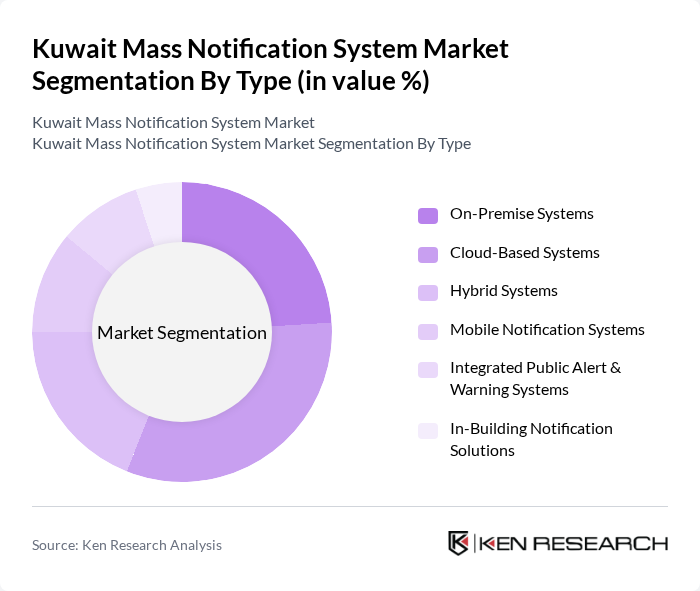
The Cloud-Based Systems sub-segment leads the market, driven by demand for scalable, cost-effective, and easily deployable solutions. Organizations increasingly favor cloud platforms for their rapid implementation and minimal maintenance needs, supporting business continuity and emergency readiness. The proliferation of mobile devices further accelerates the adoption of mobile notification systems, which are essential for delivering timely, location-based alerts to the public and employees.
By End-User:The end-user segmentation comprises Government Agencies (Ministry of Interior, Civil Defense, etc.), Educational Institutions (Universities, Schools), Healthcare Facilities (Hospitals, Clinics), Corporate Sector (Oil & Gas, Financial Services, Retail), Transportation & Infrastructure (Airports, Metro, Ports), Utilities (Water, Power), Hospitality & Tourism, and Others. Each sector has specific operational and compliance needs: Government Agencies require multi-channel alerting and coordination; Educational Institutions focus on campus safety; Healthcare Facilities prioritize patient and staff communication; Corporate Sector demands business continuity; Transportation & Infrastructure needs rapid incident response; Utilities ensure critical service continuity; and Hospitality & Tourism prioritize guest safety.
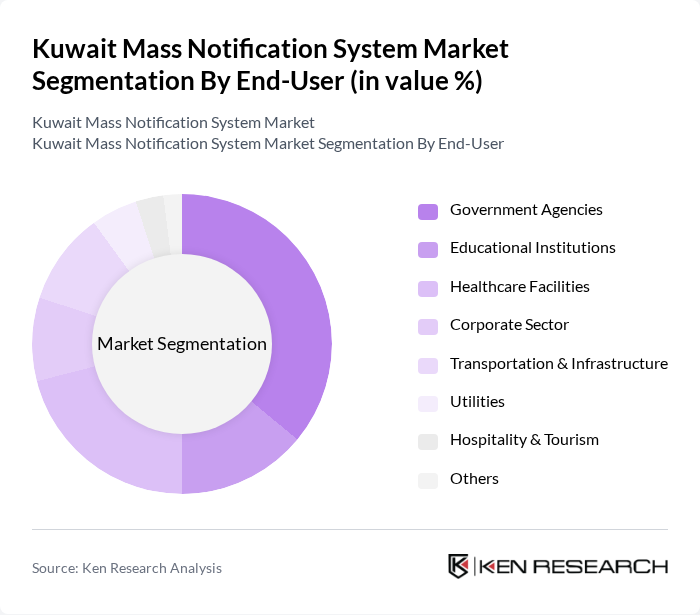
Government Agencies are the leading end-users of mass notification systems, driven by national public safety mandates and the need for coordinated emergency response. Healthcare Facilities represent a significant segment, as hospitals and clinics require robust systems to manage critical incidents and ensure patient safety. The educational sector is also expanding its adoption, reflecting increased focus on campus security and compliance with safety standards.
The Kuwait Mass Notification System Market is characterized by a dynamic mix of regional and international players. Leading participants such as Everbridge, Alertus Technologies, Rave Mobile Safety, Motorola Solutions, Siemens, Honeywell, Blackboard Inc., Omnilert, InformaCast (Singlewire Software), AtHoc (BlackBerry AtHoc), Nixle (Everbridge), CodeRED (OnSolve), Send Word Now (OnSolve), Regroup Mass Notification, AlertMedia, ATI Systems (Acoustic Technology, Inc.), Mircom Group, Johnson Controls, Eaton Corporation, Konexus contribute to innovation, geographic expansion, and service delivery in this space.
The future of the mass notification system market in Kuwait appears promising, driven by ongoing government investments and technological innovations. As urbanization continues, the demand for efficient communication solutions will likely increase, leading to enhanced public safety measures. Furthermore, the integration of AI and cloud-based technologies will facilitate more effective emergency responses. The focus on user-friendly interfaces and multi-channel communication will also shape the market, ensuring that systems are accessible and effective for all users.
| Segment | Sub-Segments |
|---|---|
| By Type | On-Premise Systems Cloud-Based Systems Hybrid Systems Mobile Notification Systems Integrated Public Alert & Warning Systems In-Building Notification Solutions |
| By End-User | Government Agencies (Ministry of Interior, Civil Defense, etc.) Educational Institutions (Universities, Schools) Healthcare Facilities (Hospitals, Clinics) Corporate Sector (Oil & Gas, Financial Services, Retail) Transportation & Infrastructure (Airports, Metro, Ports) Utilities (Water, Power) Hospitality & Tourism Others |
| By Deployment Mode | Public Cloud Private Cloud Hybrid Cloud On-Premise Others |
| By Communication Channel | SMS Alerts Email Notifications Social Media Alerts Voice Calls Mobile App Push Notifications Sirens & PA Systems Others |
| By Industry Vertical | Public Safety Transportation Utilities Oil & Gas Education Healthcare Hospitality Retail Others |
| By Geographic Coverage | Urban Areas Rural Areas Suburban Areas Industrial Zones Others |
| By Policy Support | Government Subsidies Tax Incentives Grants for Technology Adoption Regulatory Mandates Others |
| Scope Item/Segment | Sample Size | Target Respondent Profiles |
|---|---|---|
| Government Emergency Services | 100 | Emergency Management Officials, Public Safety Directors |
| Healthcare Institutions | 70 | Hospital Administrators, IT Managers |
| Educational Institutions | 60 | School Safety Coordinators, IT Directors |
| Corporate Sector | 80 | Facility Managers, Risk Management Officers |
| Technology Providers | 50 | Product Managers, Sales Directors |
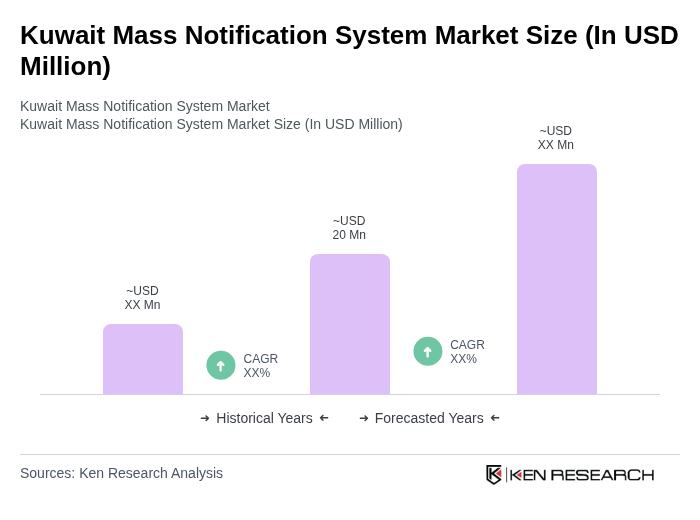
The Kuwait Mass Notification System market is valued at approximately USD 20 million, driven by urbanization, smart city investments, and increased public safety needs. This growth reflects the rising demand for effective emergency communication solutions across various sectors.

What makes us stand out is that our consultants follow Robust, Refine and Result (RRR) methodology. Robust for clear definitions, approaches and sanity checking, Refine for differentiating respondents' facts and opinions, and Result for presenting data with story.

We have set a benchmark in the industry by offering our clients with syndicated and customized market research reports featuring coverage of entire market as well as meticulous research and analyst insights.

While we don't replace traditional research, we flip the method upside down. Our dual approach of Top Bottom & Bottom Top ensures quality deliverable by not just verifying company fundamentals but also looking at the sector and macroeconomic factors.

With one step in the future, our research team constantly tries to show you the bigger picture. We help with some of the tough questions you may encounter along the way: How is the industry positioned? Best marketing channel? KPI's of competitors? By aligning every element, we help maximize success.

Our report gives you instant access to the answers and sources that other companies might choose to hide. We elaborate each steps of research methodology we have used and showcase you the sample size to earn your trust.

If you need any support, we are here! We pride ourselves on universe strength, data quality, and quick, friendly, and professional service.













