Region:Middle East
Author(s):Rebecca
Product Code:KRAD8242
Pages:88
Published On:December 2025

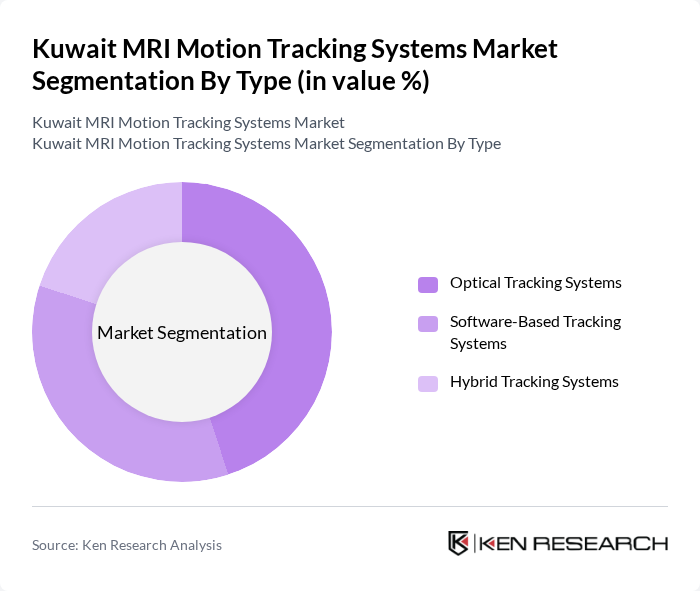
By Type:The market is segmented into Optical Tracking Systems, Software-Based Tracking Systems, and Hybrid Tracking Systems. Among these, Optical Tracking Systems are gaining traction due to their precision and reliability in motion tracking during MRI scans. Software-Based Tracking Systems are experiencing exponential growth, driven by increasing demand for advanced imaging technologies that enhance diagnostic accuracy. Medical facilities utilizing sophisticated motion tracking software have reduced retake rates, significantly improving overall workflow efficiency. Hybrid Tracking Systems combine the advantages of both optical and software-based solutions, catering to diverse clinical needs.
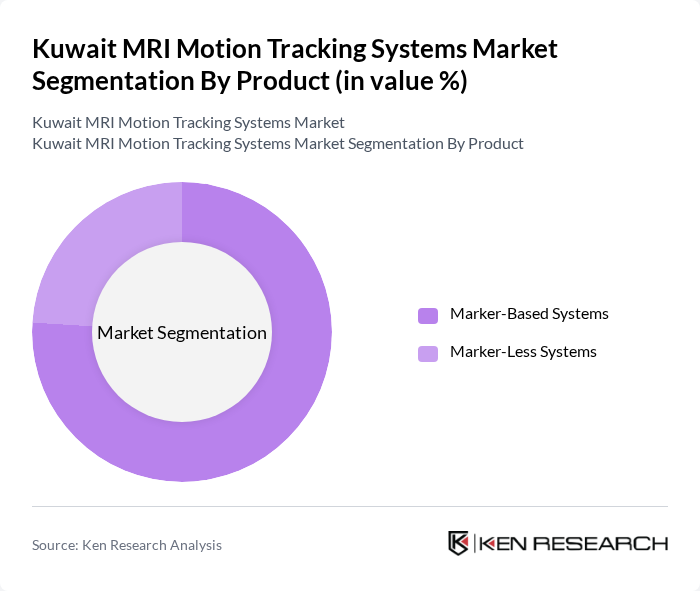
By Product:The product segmentation includes Marker-Based Systems and Marker-Less Systems. Marker-Based Systems are widely used due to their established efficacy in tracking patient movement during MRI scans, holding the largest revenue share at approximately 76% in 2024. Marker-based tracking achieves positional accuracy within 1 millimeter, significantly mitigating motion artifacts and enhancing image quality. Marker-Less Systems are emerging as the fastest-growing segment, driven by a shift towards non-invasive solutions that enhance operational efficiency. With an increasing focus on patient comfort and streamlined workflows, healthcare providers increasingly favor marker-less systems due to their ease of use and faster setup times.
The Kuwait MRI Motion Tracking Systems market is characterized by a dynamic mix of regional and international players. Leading participants such as Siemens Healthineers, GE Healthcare, Philips Healthcare, Canon Medical Systems, Hitachi Medical Corporation, Toshiba Medical Systems, Agfa HealthCare, Fujifilm Medical Systems, Mindray Medical International, Vicon Motion Systems, OptiTrack (NaturalPoint), Esaote S.p.A., Neusoft Medical Systems, Carestream Health, Shanghai Motion contribute to innovation, geographic expansion, and service delivery in this space.
The future of the MRI motion tracking systems market in Kuwait appears promising, driven by ongoing technological advancements and increasing healthcare investments. As the government continues to enhance healthcare infrastructure, the integration of AI and portable MRI devices is expected to gain traction. Additionally, the growing emphasis on patient-centric imaging solutions will likely lead to more personalized approaches in diagnostics, further propelling the adoption of these advanced systems in clinical settings.
| Segment | Sub-Segments |
|---|---|
| By Type | Optical Tracking Systems Software-Based Tracking Systems Hybrid Tracking Systems |
| By Product | Marker-Based Systems Marker-Less Systems |
| By End-User | Hospitals Diagnostic Imaging Centers Research Institutions Outpatient Facilities |
| By Application | Neurology Orthopedics Oncology Cardiology Abdominal & Pelvic Imaging |
| By Technology | T MRI Systems T MRI Systems T MRI Systems |
| By Region | Capital Governorate Hawalli Governorate Al Ahmadi Governorate Farwaniya Governorate Mubarak Al-Kabeer Governorate |
| By Patient Demographics | Pediatric Patients Adult Patients Geriatric Patients |
| Scope Item/Segment | Sample Size | Target Respondent Profiles |
|---|---|---|
| Hospital MRI Departments | 45 | Radiologists, MRI Technologists |
| Diagnostic Imaging Centers | 38 | Center Managers, Imaging Specialists |
| Healthcare Administrators | 32 | Procurement Officers, Operations Managers |
| Research Institutions | 22 | Research Scientists, Clinical Researchers |
| Medical Equipment Suppliers | 28 | Sales Managers, Product Specialists |
The Kuwait MRI Motion Tracking Systems market is valued at approximately USD 145 million, reflecting a steady growth driven by advancements in medical imaging technology and increasing demand for non-invasive diagnostic procedures.

What makes us stand out is that our consultants follow Robust, Refine and Result (RRR) methodology. Robust for clear definitions, approaches and sanity checking, Refine for differentiating respondents' facts and opinions, and Result for presenting data with story.

We have set a benchmark in the industry by offering our clients with syndicated and customized market research reports featuring coverage of entire market as well as meticulous research and analyst insights.

While we don't replace traditional research, we flip the method upside down. Our dual approach of Top Bottom & Bottom Top ensures quality deliverable by not just verifying company fundamentals but also looking at the sector and macroeconomic factors.

With one step in the future, our research team constantly tries to show you the bigger picture. We help with some of the tough questions you may encounter along the way: How is the industry positioned? Best marketing channel? KPI's of competitors? By aligning every element, we help maximize success.

Our report gives you instant access to the answers and sources that other companies might choose to hide. We elaborate each steps of research methodology we have used and showcase you the sample size to earn your trust.

If you need any support, we are here! We pride ourselves on universe strength, data quality, and quick, friendly, and professional service.













