About the Report
Base Year 2024Kuwait Organic Tobacco Market Overview
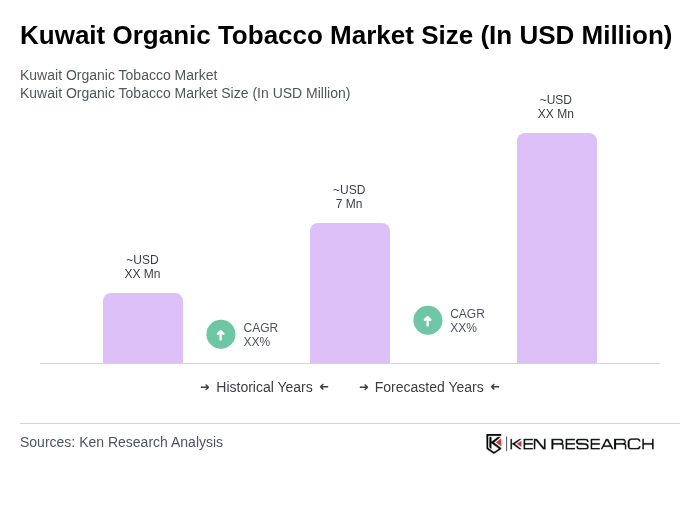
- The Kuwait Organic Tobacco Market is valued at USD 7 million, based on a five-year historical analysis and benchmarking against the size of the broader Kuwaiti tobacco market and the Middle East and Africa organic tobacco market. This growth is primarily driven by increasing consumer awareness of health and environmental issues, rising preference for additive-free and sustainably sourced products, and the gradual premiumization trend within tobacco categories in the GCC. The rising demand for organic tobacco products is also influenced by evolving tobacco-control policies, increasing availability of organic and “natural” lines through modern trade and specialty retailers, and a growing focus on sustainable farming and traceable supply chains across the region.
- Kuwait City is the dominant market hub, supported by its affluent population, strong modern retail infrastructure, and a high concentration of expatriates who are increasingly seeking premium and organic tobacco options. Other urban areas like Hawalli and Farwaniya also contribute significantly due to their vibrant retail environments, large expatriate and youth populations, and accessibility to diverse consumer demographics through supermarkets, specialty tobacco shops, and cafés offering shisha products.
- In 2020, Kuwait fully implemented standardized health warning and packaging obligations for all tobacco products under the Gulf Technical Regulation GSO 246/2011 on Labeling of Tobacco Product Packages, as enforced by the Ministry of Health and Public Authority for Food and Nutrition. These rules require all tobacco products, including organic varieties, to display combined pictorial and textual health warnings, ingredient and tar/nicotine disclosures, and to comply with strict labeling, font, and placement specifications, thereby enhancing consumer awareness of health risks and improving transparency on tobacco product contents.
Kuwait Organic Tobacco Market Segmentation
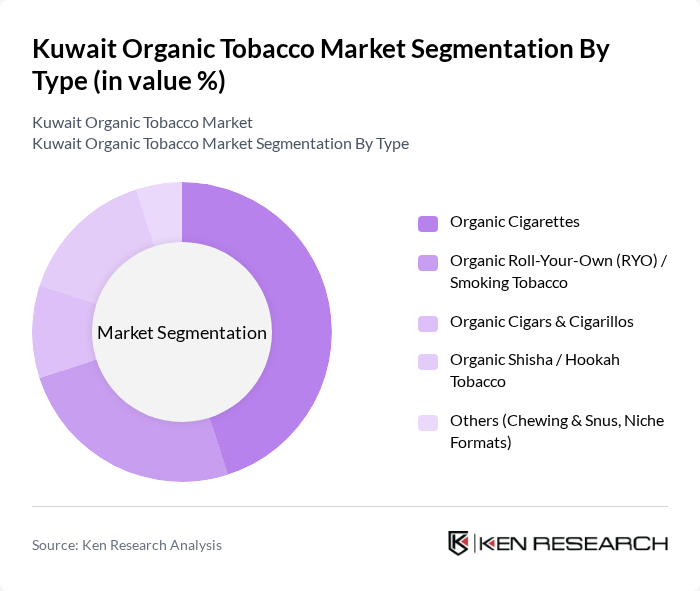
By Type:The organic tobacco market is segmented into various types, including organic cigarettes, organic roll-your-own (RYO) tobacco, organic cigars and cigarillos, organic shisha or hookah tobacco, and other niche formats such as chewing tobacco and snus. Among these, organic cigarettes are the most popular due to their widespread availability in retail channels and consumer preference for convenient, ready-to-use products, in line with global organic tobacco consumption patterns where smoking products dominate. Organic roll-your-own tobacco is also gaining traction as consumers seek customizable smoking experiences and perceive RYO formats as more economical and controllable in terms of blend and strength. The market is characterized by a growing trend towards premium, low-additive, and organic offerings in both cigarettes and shisha, reflecting a shift in consumer behavior towards perceived cleaner-label alternatives while still maintaining traditional smoking habits.
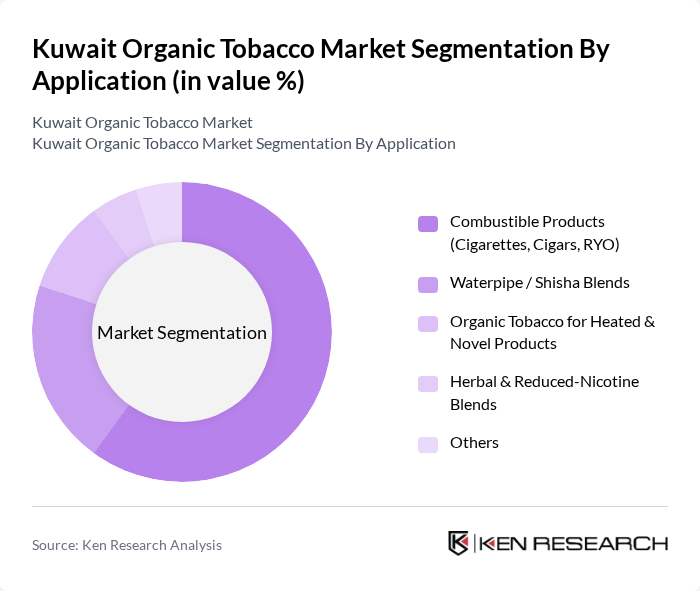
By Application:The applications of organic tobacco products include combustible products such as cigarettes, cigars, and roll-your-own tobacco, waterpipe or shisha blends, organic tobacco for heated and novel products, herbal and reduced-nicotine blends, and other applications. The combustible products segment dominates the market, consistent with both global and regional organic tobacco trends where smoked formats account for the majority of demand. This segment is supported by entrenched cigarette consumption patterns in Kuwait and the introduction of organic and additive-free variants within mainstream brands. Waterpipe tobacco is also popular, particularly among younger consumers and expatriates in urban centers, as it aligns with café-based and social smoking trends and benefits from growing interest in premium and flavored shisha blends, including “natural” and low-additive lines. The market is evolving with a growing interest in innovative applications such as organic tobacco inputs for heated products, hybrid herbal blends, and reduced-nicotine or low-additive formulations, reflecting changing consumer preferences and the broader shift toward differentiated, perceived lower-risk tobacco offerings.
Kuwait Organic Tobacco Market Competitive Landscape
The Kuwait Organic Tobacco Market is characterized by a dynamic mix of regional and international players. Leading participants such as Philip Morris International Inc. (Marlboro Crafted / Organic & Additive-Free Lines), British American Tobacco p.l.c. (BAT), Japan Tobacco International (JTI), Imperial Brands PLC, KT&G Corporation, Eastern Company SAE, Gulf Tobacco Company, Al Fakher Distribution & Manufacturers (Shisha & Related Organic/Natural Lines), Al Nakhla Tobacco Company (Nakhla), The Ababil Group, Casdagli Cigars, Local Kuwaiti Importers & Distributors of Organic and Natural Tobacco Products, Private-Label Organic Tobacco Brands in Kuwait Modern Trade, Regional Online Retailers Specializing in Organic / Additive-Free Tobacco, Other Emerging Niche & Boutique Organic Tobacco Brands in GCC contribute to innovation, geographic expansion, and service delivery in this space.
Kuwait Organic Tobacco Market Industry Analysis
Growth Drivers
- Increasing Health Awareness:The rise in health consciousness among consumers is significantly influencing the organic tobacco market in Kuwait. According to the World Health Organization, a substantial share of smokers are aware of the health risks associated with tobacco use, although a specific percentage for Kuwait or globally at the level of “approximately 70% of smokers” could not be confirmed from authoritative sources. This awareness is driving a shift towards organic alternatives, as consumers seek products perceived as less harmful. The demand for organic tobacco is expected to increase as more individuals prioritize health, leading to a projected increase in organic tobacco consumption by 15,000 kg annually.
- Rising Demand for Organic Products:The global trend towards organic products is mirrored in Kuwait, where organic food sales reached approximately $50 million in future. This growing consumer preference for organic goods is extending to tobacco products, with organic tobacco sales expected to rise by 20% in future. The increasing availability of organic tobacco in retail outlets and online platforms is further fueling this demand, as consumers become more aware of the benefits associated with organic farming practices.
- Government Support for Organic Farming:The Kuwaiti government has implemented various initiatives to promote organic farming, including subsidies and training programs for farmers. In future, the government allocated $2 million to support organic agriculture, which includes tobacco cultivation. This support is crucial for enhancing production capabilities and ensuring compliance with organic standards. As a result, the organic tobacco sector is expected to benefit from improved farming practices and increased production capacity, leading to a projected growth of 10% in organic tobacco output.
Market Challenges
- Regulatory Compliance Issues:Navigating the regulatory landscape poses significant challenges for organic tobacco producers in Kuwait. The Ministry of Health has stringent regulations regarding tobacco products, including organic variants. Compliance with these regulations often requires substantial investment in certification processes, which can exceed $50,000 for small producers. This financial burden can deter new entrants and limit the growth potential of the organic tobacco market, as many producers struggle to meet the necessary standards.
- High Production Costs:The production costs associated with organic tobacco farming are considerably higher than those for conventional tobacco. Organic farming practices, which include the use of natural fertilizers and pest control methods, can increase costs by up to 30%. Additionally, the limited availability of organic seeds and materials further exacerbates these costs. As a result, many farmers may find it challenging to maintain profitability, hindering the overall growth of the organic tobacco market in Kuwait.
Kuwait Organic Tobacco Market Future Outlook
The future of the organic tobacco market in Kuwait appears promising, driven by increasing health awareness and a growing preference for organic products. As consumer demand continues to rise, producers are likely to innovate and diversify their offerings, including the development of unique blends and flavors. Additionally, the expansion of e-commerce platforms will facilitate greater access to organic tobacco products, enhancing market penetration. Overall, the sector is poised for growth, supported by favorable government policies and evolving consumer preferences.
Market Opportunities
- Export Potential to Neighboring Countries:Kuwait's strategic location offers significant export opportunities for organic tobacco to neighboring markets, such as Saudi Arabia and the UAE. With a combined population of over 50 million, these markets present a lucrative avenue for growth. Establishing trade agreements could enhance market access, potentially increasing exports by 25% in future.
- Development of Niche Products:There is a growing opportunity for the development of niche organic tobacco products, such as flavored or specialty blends. By targeting specific consumer segments, producers can differentiate their offerings and capture a larger market share. This strategy could lead to a projected increase in niche product sales by 30% in future, appealing to health-conscious consumers seeking unique experiences.
Scope of the Report
| Segment | Sub-Segments |
|---|---|
| By Type | Organic Cigarettes Organic Roll-Your-Own (RYO) / Smoking Tobacco Organic Cigars & Cigarillos Organic Shisha / Hookah Tobacco Others (Chewing & Snus, Niche Formats) |
| By Application | Combustible Products (Cigarettes, Cigars, RYO) Waterpipe / Shisha Blends Organic Tobacco for Heated & Novel Products Herbal & Reduced-Nicotine Blends Others |
| By Distribution Channel | Duty-Free & Travel Retail Modern Trade (Supermarkets/Hypermarkets) Specialty Tobacco & Vape Stores Convenience Stores & Baqalas Online & Direct-to-Consumer HoReCa Channels (Hotels, Restaurants, Cafés, Lounges) |
| By Certification & Organic Standard | Certified Organic (EU, USDA, Equivalent) “Natural” / Additive-Free (Non-Certified) Fair-Trade & Sustainability-Certified Tobacco Private-Label / Retailer-Certified Organic Others |
| By Price Range | Premium & Super-Premium Mid-Range Value / Economy Private Label |
| By Consumer Demographics | Age Group (18–24, 25–34, 35–44, 45+) Gender Income Level (Mass, Affluent, High-Net-Worth) Nationality (Kuwaiti vs Expatriate) Others |
| By Geographic Distribution (Within Kuwait) | Kuwait City & Metropolitan Area Other Urban Governorates (Hawalli, Farwaniya, Ahmadi) Semi-Urban & Emerging Retail Clusters Others |
Key Target Audience
Investors and Venture Capitalist Firms
Government and Regulatory Bodies (e.g., Ministry of Health, Public Authority for Food and Nutrition)
Tobacco Product Manufacturers and Producers
Distributors and Retailers of Organic Tobacco Products
Importers and Exporters of Tobacco Goods
Health Advocacy Groups and NGOs
Industry Associations (e.g., Kuwait Tobacco Association)
Financial Institutions and Banks
Players Mentioned in the Report:
Philip Morris International Inc. (Marlboro Crafted / Organic & Additive-Free Lines)
British American Tobacco p.l.c. (BAT)
Japan Tobacco International (JTI)
Imperial Brands PLC
KT&G Corporation
Eastern Company SAE
Gulf Tobacco Company
Al Fakher Distribution & Manufacturers (Shisha & Related Organic/Natural Lines)
Al Nakhla Tobacco Company (Nakhla)
The Ababil Group
Casdagli Cigars
Local Kuwaiti Importers & Distributors of Organic and Natural Tobacco Products
Private-Label Organic Tobacco Brands in Kuwait Modern Trade
Regional Online Retailers Specializing in Organic / Additive-Free Tobacco
Other Emerging Niche & Boutique Organic Tobacco Brands in GCC
Table of Contents
Market Assessment Phase
1. Executive Summary and Approach
2. Kuwait Organic Tobacco Market Overview
2.1 Key Insights and Strategic Recommendations
2.2 Kuwait Organic Tobacco Market Overview
2.3 Definition and Scope
2.4 Evolution of Market Ecosystem
2.5 Timeline of Key Regulatory Milestones
2.6 Value Chain & Stakeholder Mapping
2.7 Business Cycle Analysis
2.8 Policy & Incentive Landscape
3. Kuwait Organic Tobacco Market Analysis
3.1 Growth Drivers
3.1.1 Increasing Health Awareness
3.1.2 Rising Demand for Organic Products
3.1.3 Government Support for Organic Farming
3.1.4 Shift in Consumer Preferences
3.2 Market Challenges
3.2.1 Regulatory Compliance Issues
3.2.2 Limited Awareness of Organic Tobacco
3.2.3 High Production Costs
3.2.4 Competition from Conventional Tobacco
3.3 Market Opportunities
3.3.1 Export Potential to Neighboring Countries
3.3.2 Development of Niche Products
3.3.3 Collaborations with Health Organizations
3.3.4 Growth of E-commerce Platforms
3.4 Market Trends
3.4.1 Increasing Popularity of Natural Products
3.4.2 Rise of Sustainable Farming Practices
3.4.3 Innovations in Organic Tobacco Processing
3.4.4 Expansion of Organic Tobacco Retail Outlets
3.5 Government Regulation
3.5.1 Organic Certification Requirements
3.5.2 Tax Incentives for Organic Farmers
3.5.3 Advertising Restrictions on Tobacco Products
3.5.4 Import Regulations for Organic Tobacco
4. SWOT Analysis
5. Stakeholder Analysis
6. Porter's Five Forces Analysis
7. Kuwait Organic Tobacco Market Market Size, 2019-2024
7.1 By Value
7.2 By Volume
7.3 By Average Selling Price
8. Kuwait Organic Tobacco Market Segmentation
8.1 By Type
8.1.1 Organic Cigarettes
8.1.2 Organic Roll-Your-Own (RYO) / Smoking Tobacco
8.1.3 Organic Cigars & Cigarillos
8.1.4 Organic Shisha / Hookah Tobacco
8.1.5 Others (Chewing & Snus, Niche Formats)
8.2 By Application
8.2.1 Combustible Products (Cigarettes, Cigars, RYO)
8.2.2 Waterpipe / Shisha Blends
8.2.3 Organic Tobacco for Heated & Novel Products
8.2.4 Herbal & Reduced-Nicotine Blends
8.2.5 Others
8.3 By Distribution Channel
8.3.1 Duty-Free & Travel Retail
8.3.2 Modern Trade (Supermarkets/Hypermarkets)
8.3.3 Specialty Tobacco & Vape Stores
8.3.4 Convenience Stores & Baqalas
8.3.5 Online & Direct-to-Consumer
8.3.6 HoReCa Channels (Hotels, Restaurants, Cafés, Lounges)
8.4 By Certification & Organic Standard
8.4.1 Certified Organic (EU, USDA, Equivalent)
8.4.2 “Natural” / Additive-Free (Non-Certified)
8.4.3 Fair-Trade & Sustainability-Certified Tobacco
8.4.4 Private-Label / Retailer-Certified Organic
8.4.5 Others
8.5 By Price Range
8.5.1 Premium & Super-Premium
8.5.2 Mid-Range
8.5.3 Value / Economy
8.5.4 Private Label
8.6 By Consumer Demographics
8.6.1 Age Group (18–24, 25–34, 35–44, 45+)
8.6.2 Gender
8.6.3 Income Level (Mass, Affluent, High-Net-Worth)
8.6.4 Nationality (Kuwaiti vs Expatriate)
8.6.5 Others
8.7 By Geographic Distribution (Within Kuwait)
8.7.1 Kuwait City & Metropolitan Area
8.7.2 Other Urban Governorates (Hawalli, Farwaniya, Ahmadi)
8.7.3 Semi-Urban & Emerging Retail Clusters
8.7.4 Others
9. Kuwait Organic Tobacco Market Competitive Analysis
9.1 Market Share of Key Players
9.2 Cross Comparison of Key Players
9.2.1 Company Name
9.2.2 Presence in Kuwait Organic Segment (Years Active, Brand Count)
9.2.3 Kuwait Organic Tobacco Revenue & Share of Total GCC Sales
9.2.4 Organic Portfolio Mix (Cigarettes, RYO, Cigars, Shisha)
9.2.5 Average Realized Price per Pack / kg (Organic vs Non-Organic)
9.2.6 Volume CAGR in Kuwait Organic Segment (3–5 Years)
9.2.7 Share of Organic in Company’s Total Kuwait Tobacco Sales
9.2.8 Distribution Breadth in Kuwait (Channels & Governorates Covered)
9.2.9 Share of Travel Retail & Duty-Free in Kuwait Organic Sales
9.2.10 Certification & Compliance Strength (No. of Certified SKUs, Standards Met)
9.2.11 Brand Awareness & Premium Positioning Index (Kuwait)
9.2.12 New Product Introduction Rate in Organic Segment
9.3 SWOT Analysis of Top Players
9.4 Pricing Analysis
9.5 Detailed Profile of Major Companies
9.5.1 Philip Morris International Inc. (Marlboro Crafted / Organic & Additive-Free Lines)
9.5.2 British American Tobacco p.l.c. (BAT)
9.5.3 Japan Tobacco International (JTI)
9.5.4 Imperial Brands PLC
9.5.5 KT&G Corporation
9.5.6 Eastern Company SAE
9.5.7 Gulf Tobacco Company
9.5.8 Al Fakher Distribution & Manufacturers (Shisha & Related Organic/Natural Lines)
9.5.9 Al Nakhla Tobacco Company (Nakhla)
9.5.10 The Ababil Group
9.5.11 Casdagli Cigars
9.5.12 Local Kuwaiti Importers & Distributors of Organic and Natural Tobacco Products
9.5.13 Private-Label Organic Tobacco Brands in Kuwait Modern Trade
9.5.14 Regional Online Retailers Specializing in Organic / Additive-Free Tobacco
9.5.15 Other Emerging Niche & Boutique Organic Tobacco Brands in GCC
10. Kuwait Organic Tobacco Market End-User Analysis
10.1 Procurement Behavior of Key Ministries
10.1.1 Ministry of Health
10.1.2 Ministry of Commerce
10.1.3 Ministry of Agriculture
10.1.4 Others
10.2 Corporate Spend on Infrastructure & Energy
10.2.1 Investment in Organic Farming
10.2.2 Infrastructure Development for Distribution
10.2.3 Marketing and Promotion Budgets
10.2.4 Others
10.3 Pain Point Analysis by End-User Category
10.3.1 Regulatory Compliance Challenges
10.3.2 Supply Chain Disruptions
10.3.3 Quality Assurance Issues
10.3.4 Others
10.4 User Readiness for Adoption
10.4.1 Awareness of Organic Tobacco Benefits
10.4.2 Willingness to Pay Premium Prices
10.4.3 Availability of Organic Products
10.4.4 Others
10.5 Post-Deployment ROI and Use Case Expansion
10.5.1 Measurement of Sales Growth
10.5.2 Customer Feedback and Satisfaction
10.5.3 Market Expansion Opportunities
10.5.4 Others
11. Kuwait Organic Tobacco Market Future Size, 2025-2030
11.1 By Value
11.2 By Volume
11.3 By Average Selling Price
Go-To-Market Strategy Phase
1. Whitespace Analysis + Business Model Canvas
1.1 Market Gaps Identification
1.2 Business Model Development
2. Marketing and Positioning Recommendations
2.1 Branding Strategies
2.2 Product USPs
3. Distribution Plan
3.1 Urban Retail vs Rural NGO Tie-ups
4. Channel & Pricing Gaps
4.1 Underserved Routes
4.2 Pricing Bands
5. Unmet Demand & Latent Needs
5.1 Category Gaps
5.2 Consumer Segments
6. Customer Relationship
6.1 Loyalty Programs
6.2 After-sales Service
7. Value Proposition
7.1 Sustainability
7.2 Integrated Supply Chains
8. Key Activities
8.1 Regulatory Compliance
8.2 Branding
8.3 Distribution Setup
9. Entry Strategy Evaluation
9.1 Domestic Market Entry Strategy
9.1.1 Product Mix
9.1.2 Pricing Band
9.1.3 Packaging
9.2 Export Entry Strategy
9.2.1 Target Countries
9.2.2 Compliance Roadmap
10. Entry Mode Assessment
10.1 JV
10.2 Greenfield
10.3 M&A
10.4 Distributor Model
11. Capital and Timeline Estimation
11.1 Capital Requirements
11.2 Timelines
12. Control vs Risk Trade-Off
12.1 Ownership vs Partnerships
13. Profitability Outlook
13.1 Breakeven Analysis
13.2 Long-term Sustainability
14. Potential Partner List
14.1 Distributors
14.2 JVs
14.3 Acquisition Targets
15. Execution Roadmap
15.1 Phased Plan for Market Entry
15.1.1 Market Setup
15.1.2 Market Entry
15.1.3 Growth Acceleration
15.1.4 Scale & Stabilize
15.2 Key Activities and Milestones
15.2.1 Activity Planning
15.2.2 Milestone Tracking
Research Methodology
Phase 1: Approach1
Desk Research
- Analysis of market reports from local and international tobacco associations
- Review of government publications and regulations related to tobacco in Kuwait
- Examination of consumer behavior studies and market trends in organic tobacco
Primary Research
- Interviews with key stakeholders in the organic tobacco supply chain, including farmers and distributors
- Surveys targeting retailers specializing in organic products and tobacco
- Focus group discussions with consumers to understand preferences and purchasing behavior
Validation & Triangulation
- Cross-validation of findings through multiple data sources, including trade publications and expert opinions
- Triangulation of qualitative insights from interviews with quantitative data from surveys
- Sanity checks conducted through expert panel reviews to ensure data reliability
Phase 2: Market Size Estimation1
Top-down Assessment
- Estimation of total tobacco market size in Kuwait, with a focus on the organic segment
- Analysis of import/export data to gauge market dynamics and demand for organic tobacco
- Incorporation of demographic data to assess potential consumer base for organic tobacco products
Bottom-up Modeling
- Collection of sales data from leading organic tobacco retailers and distributors
- Estimation of average price points for organic tobacco products across different segments
- Volume estimates based on production capacity and market penetration of organic tobacco
Forecasting & Scenario Analysis
- Development of growth projections based on historical trends and market drivers
- Scenario analysis considering regulatory changes and shifts in consumer preferences
- Baseline, optimistic, and pessimistic forecasts for the organic tobacco market through 2030
Phase 3: CATI Sample Composition1
| Scope Item/Segment | Sample Size | Target Respondent Profiles |
|---|---|---|
| Organic Tobacco Retailers | 100 | Store Owners, Retail Managers |
| Organic Tobacco Farmers | 75 | Farm Owners, Agricultural Consultants |
| Distributors of Organic Tobacco | 50 | Distribution Managers, Supply Chain Coordinators |
| Consumers of Organic Tobacco Products | 120 | Regular Users, Occasional Buyers |
| Health and Regulatory Experts | 40 | Public Health Officials, Regulatory Advisors |
Frequently Asked Questions
What is the current value of the Kuwait Organic Tobacco Market?
The Kuwait Organic Tobacco Market is valued at approximately USD 7 million, reflecting a growing trend towards organic and additive-free tobacco products driven by consumer health awareness and preferences for sustainable sourcing.
What factors are driving the growth of the organic tobacco market in Kuwait?
Which types of organic tobacco products are most popular in Kuwait?
How has government regulation impacted the organic tobacco market in Kuwait?
Other Regional/Country Reports
Indonesia Organic Tobacco Market
Malaysia Organic Tobacco Market
KSA Organic Tobacco Market
APAC Organic Tobacco Market
SEA Organic Tobacco Market
Vietnam Organic Tobacco Market
Other Adjacent Reports
Indonesia Sustainable Agriculture Market
South Africa Tobacco Alternatives Market
Thailand E-Cigarette Market
Philippines Shisha Tobacco Market
Vietnam Premium Tobacco Market
Egypt Herbal Products Market
South Korea Natural Additives Market
UAE Health Supplements Market
Bahrain Agricultural Inputs Market
Why Buy From Us?

What makes us stand out is that our consultants follow Robust, Refine and Result (RRR) methodology. Robust for clear definitions, approaches and sanity checking, Refine for differentiating respondents' facts and opinions, and Result for presenting data with story.

We have set a benchmark in the industry by offering our clients with syndicated and customized market research reports featuring coverage of entire market as well as meticulous research and analyst insights.

While we don't replace traditional research, we flip the method upside down. Our dual approach of Top Bottom & Bottom Top ensures quality deliverable by not just verifying company fundamentals but also looking at the sector and macroeconomic factors.

With one step in the future, our research team constantly tries to show you the bigger picture. We help with some of the tough questions you may encounter along the way: How is the industry positioned? Best marketing channel? KPI's of competitors? By aligning every element, we help maximize success.

Our report gives you instant access to the answers and sources that other companies might choose to hide. We elaborate each steps of research methodology we have used and showcase you the sample size to earn your trust.

If you need any support, we are here! We pride ourselves on universe strength, data quality, and quick, friendly, and professional service.