About the Report
Base Year 2024Kuwait Refrigerated Trailer Market Overview
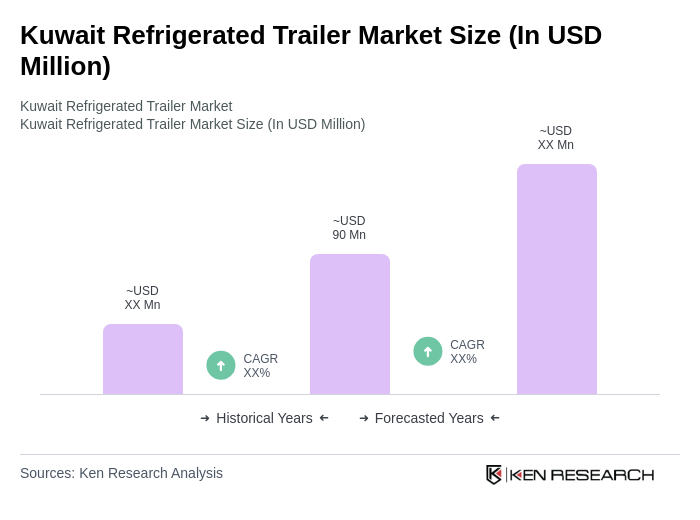
- The Kuwait Refrigerated Trailer Market is valued at USD 90 million, based on a five-year historical analysis and regional share of the Middle East refrigerated truck and trailer market. This growth is primarily driven by the rising demand for cold chain logistics, especially in the food and pharmaceutical sectors, and the rapid expansion of e-commerce platforms requiring reliable temperature-controlled transportation solutions. Recent trends include the adoption of advanced cooling technologies, telematics for fleet management, and a shift toward energy-efficient and eco-friendly refrigeration systems.
- Kuwait City remains the dominant region in the market due to its role as the capital and principal commercial hub. Significant industrial zones such as Ahmadi and Mubarak Al-Kabeer also contribute substantially, given their concentration of food processing, distribution facilities, and logistics infrastructure, which drive demand for refrigerated trailers.
- In 2023, the Kuwaiti government enforced the “Ministerial Resolution No. 87 of 2023 Concerning Food Transport Vehicle Standards,” issued by the Public Authority for Food and Nutrition. This regulation mandates that all vehicles transporting food must comply with specific temperature control standards, periodic inspections, and licensing requirements, directly enhancing food safety and reducing waste, thereby increasing demand for advanced refrigerated trailers.
Kuwait Refrigerated Trailer Market Segmentation
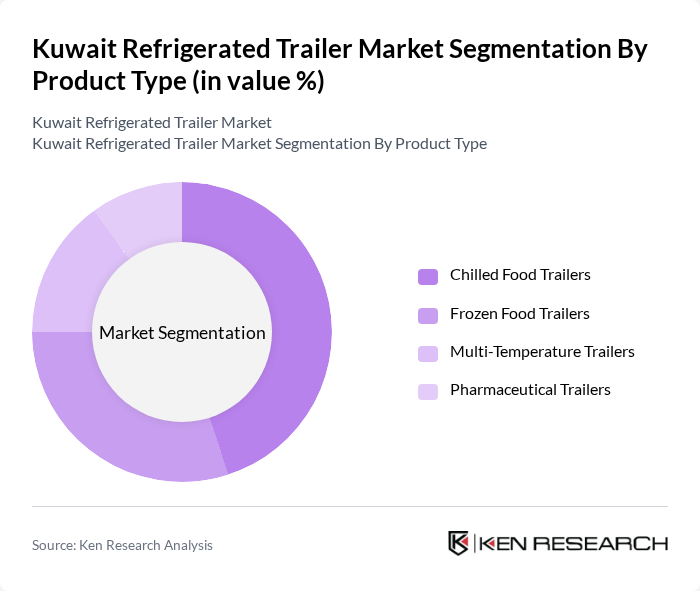
By Product Type:The product type segmentation includes Chilled Food Trailers, Frozen Food Trailers, Multi-Temperature Trailers, and Pharmaceutical Trailers. Chilled Food Trailers lead the market, supported by strong demand for fresh produce, dairy, and perishable goods. The shift toward healthier eating habits and the need for efficient transportation of chilled products make this sub-segment particularly significant. Frozen Food Trailers also hold a substantial share, driven by the popularity of frozen meals and convenience foods, and the requirement for consistent low-temperature transport solutions.
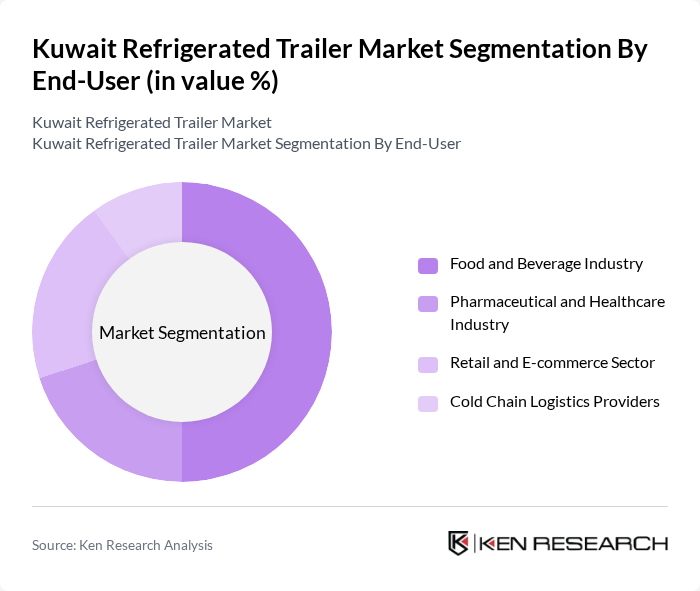
By End-User:The end-user segmentation includes the Food and Beverage Industry, Pharmaceutical and Healthcare Industry, Retail and E-commerce Sector, and Cold Chain Logistics Providers. The Food and Beverage Industry is the leading segment, driven by high consumption of perishable goods and the need for robust distribution channels. The rapid growth of e-commerce has significantly impacted the Retail and E-commerce Sector, as consumer demand for home delivery of fresh and frozen products continues to rise, further boosting refrigerated trailer demand.
Kuwait Refrigerated Trailer Market Competitive Landscape
The Kuwait Refrigerated Trailer Market is characterized by a dynamic mix of regional and international players. Leading participants such as Thermo King (Ingersoll Rand), Daikin Industries, Carrier Transicold, Zanotti Refrigerated Systems, ISUZU Motors, Al-Futtaim Group, Al-Sayer Group, Al-Mansour Automotive, Frigoblock, TSSC (Harwal Group), Al-Bahar Group, and Al-Khaldiya Group contribute to innovation, geographic expansion, and service delivery in this space.
Kuwait Refrigerated Trailer Market Industry Analysis
Growth Drivers
- Increasing Demand for Perishable Goods Transportation:The demand for refrigerated trailers in Kuwait is significantly driven by the rising consumption of perishable goods, which reached approximately 1.3 million tons in future. This growth is fueled by a population increase of 1.6% annually, leading to higher food consumption rates. Additionally, the food and beverage sector's contribution to Kuwait's GDP is projected to be around 5.5% in future, further emphasizing the need for efficient cold chain logistics to maintain product quality and safety.
- Expansion of the Food and Beverage Industry:The food and beverage industry in Kuwait is expected to grow at a rate of 4.8% annually, reaching a market value of approximately USD 5.5 billion in future. This expansion is driven by increasing consumer preferences for diverse food options and the growth of local food production. Consequently, the demand for refrigerated trailers is anticipated to rise, as businesses seek reliable transportation solutions to ensure the freshness and safety of their products during distribution.
- Rising E-commerce and Online Grocery Shopping:The e-commerce sector in Kuwait is projected to grow by 22% in future, with online grocery shopping becoming increasingly popular. This shift is expected to drive the demand for refrigerated trailers, as companies require efficient logistics solutions to deliver temperature-sensitive products. In future, online grocery sales accounted for approximately 17% of total grocery sales, highlighting the need for enhanced cold chain capabilities to meet consumer expectations for quality and timely delivery.
Market Challenges
- High Initial Investment Costs:The entry barrier for refrigerated trailer operators in Kuwait is significantly impacted by high initial investment costs, which can exceed USD 120,000 per unit. This financial burden limits the ability of small and medium-sized enterprises to enter the market. Additionally, the need for advanced refrigeration technology and compliance with safety standards further escalates these costs, making it challenging for new players to establish a foothold in the competitive landscape.
- Stringent Regulatory Compliance Requirements:The refrigerated transport sector in Kuwait faces stringent regulatory compliance requirements, including adherence to food safety standards and environmental regulations. Companies must invest in training and certification programs to ensure compliance, which can cost upwards of USD 25,000 annually. These regulations, while essential for maintaining safety and quality, can pose significant challenges for operators, particularly smaller firms with limited resources to navigate the complex regulatory landscape.
Kuwait Refrigerated Trailer Market Future Outlook
The future of the refrigerated trailer market in Kuwait appears promising, driven by technological advancements and increasing consumer demand for quality food products. The integration of IoT technology is expected to enhance operational efficiency, allowing for real-time monitoring of temperature and conditions during transport. Additionally, the growing emphasis on sustainability will likely lead to the adoption of eco-friendly refrigerants, aligning with global environmental standards and consumer preferences for greener solutions in logistics and transportation.
Market Opportunities
- Adoption of Advanced Refrigeration Technologies:The market presents opportunities for the adoption of advanced refrigeration technologies, such as energy-efficient systems and smart temperature controls. These innovations can reduce operational costs and improve service reliability, appealing to businesses seeking competitive advantages in the logistics sector.
- Growth in Cold Chain Logistics:The increasing focus on cold chain logistics offers significant opportunities for refrigerated trailer operators. As the demand for temperature-controlled transportation rises, businesses can capitalize on this trend by expanding their fleets and enhancing service offerings to meet the evolving needs of the food and beverage industry.
Scope of the Report
| Segment | Sub-Segments |
|---|---|
| By Product Type | Chilled Food Trailers Frozen Food Trailers Multi-Temperature Trailers Pharmaceutical Trailers |
| By End-User | Food and Beverage Industry Pharmaceutical and Healthcare Industry Retail and E-commerce Sector Cold Chain Logistics Providers |
| By Application | Meat and Seafood Transportation Fruits and Vegetables Transportation Dairy Products Transportation Pharmaceutical and Medical Supplies Transportation |
| By Payload Capacity | Light Duty Trailers (Up to 5 tons) Medium Duty Trailers (5-15 tons) Heavy Duty Trailers (Above 15 tons) |
| By Distribution Channel | Direct Sales from Manufacturers Authorized Distributors and Dealers Online and Digital Platforms |
| By Price Range | Budget Trailers (Entry-level) Mid-Range Trailers (Standard) Premium Trailers (Advanced Technology) |
| By Region | Central Kuwait (Kuwait City and Surroundings) Southern Kuwait (Ahmadi, Mubarak Al-Kabeer) Northern Kuwait (Jahra, Subiya) Western Kuwait (Kabd, Wafra) |
Key Target Audience
Investors and Venture Capitalist Firms
Government and Regulatory Bodies (e.g., Kuwait Public Authority for Industry)
Manufacturers and Producers of Refrigerated Trailers
Logistics and Transportation Companies
Cold Chain Service Providers
Retail Chains and Supermarkets
Food and Beverage Distributors
Financial Institutions and Banks
Players Mentioned in the Report:
Thermo King (Ingersoll Rand)
Daikin Industries
Carrier Transicold
Zanotti Refrigerated Systems
ISUZU Motors
Al-Futtaim Group
Al-Sayer Group
Al-Mansour Automotive
Frigoblock
TSSC (Harwal Group)
Al-Bahar Group
Al-Khaldiya Group
Table of Contents
Market Assessment Phase
1. Executive Summary and Approach
2. Kuwait Refrigerated Trailer Market Overview
2.1 Key Insights and Strategic Recommendations
2.2 Kuwait Refrigerated Trailer Market Overview
2.3 Definition and Scope
2.4 Evolution of Market Ecosystem
2.5 Timeline of Key Regulatory Milestones
2.6 Value Chain & Stakeholder Mapping
2.7 Business Cycle Analysis
2.8 Policy & Incentive Landscape
3. Kuwait Refrigerated Trailer Market Analysis
3.1 Growth Drivers
3.1.1 Increasing demand for perishable goods transportation
3.1.2 Expansion of the food and beverage industry
3.1.3 Rising e-commerce and online grocery shopping
3.1.4 Government initiatives to improve logistics infrastructure
3.2 Market Challenges
3.2.1 High initial investment costs
3.2.2 Stringent regulatory compliance requirements
3.2.3 Limited availability of skilled workforce
3.2.4 Fluctuating fuel prices impacting operational costs
3.3 Market Opportunities
3.3.1 Adoption of advanced refrigeration technologies
3.3.2 Growth in cold chain logistics
3.3.3 Increasing demand for temperature-controlled transportation
3.3.4 Potential for expansion into neighboring markets
3.4 Market Trends
3.4.1 Shift towards eco-friendly refrigerants
3.4.2 Integration of IoT in refrigerated trailers
3.4.3 Customization of trailers for specific industries
3.4.4 Rise in demand for multi-temperature trailers
3.5 Government Regulation
3.5.1 Compliance with food safety standards
3.5.2 Regulations on emissions and environmental impact
3.5.3 Licensing requirements for refrigerated transport
3.5.4 Safety regulations for transportation of hazardous materials
4. SWOT Analysis
5. Stakeholder Analysis
6. Porter's Five Forces Analysis
7. Kuwait Refrigerated Trailer Market Market Size, 2019-2024
7.1 By Value
7.2 By Volume
7.3 By Average Selling Price
8. Kuwait Refrigerated Trailer Market Segmentation
8.1 By Product Type
8.1.1 Chilled Food Trailers
8.1.2 Frozen Food Trailers
8.1.3 Multi-Temperature Trailers
8.1.4 Pharmaceutical Trailers
8.2 By End-User
8.2.1 Food and Beverage Industry
8.2.2 Pharmaceutical and Healthcare Industry
8.2.3 Retail and E-commerce Sector
8.2.4 Cold Chain Logistics Providers
8.3 By Application
8.3.1 Meat and Seafood Transportation
8.3.2 Fruits and Vegetables Transportation
8.3.3 Dairy Products Transportation
8.3.4 Pharmaceutical and Medical Supplies Transportation
8.4 By Payload Capacity
8.4.1 Light Duty Trailers (Up to 5 tons)
8.4.2 Medium Duty Trailers (5-15 tons)
8.4.3 Heavy Duty Trailers (Above 15 tons)
8.5 By Distribution Channel
8.5.1 Direct Sales from Manufacturers
8.5.2 Authorized Distributors and Dealers
8.5.3 Online and Digital Platforms
8.6 By Price Range
8.6.1 Budget Trailers (Entry-level)
8.6.2 Mid-Range Trailers (Standard)
8.6.3 Premium Trailers (Advanced Technology)
8.7 By Region
8.7.1 Central Kuwait (Kuwait City and Surroundings)
8.7.2 Southern Kuwait (Ahmadi, Mubarak Al-Kabeer)
8.7.3 Northern Kuwait (Jahra, Subiya)
8.7.4 Western Kuwait (Kabd, Wafra)
9. Kuwait Refrigerated Trailer Market Competitive Analysis
9.1 Market Share of Key Players
9.2 Cross Comparison of Key Players
9.2.1 Company Name
9.2.2 Company Size Classification (Large, Medium, or Small)
9.2.3 Year-on-Year Revenue Growth Rate (%)
9.2.4 Market Penetration Rate in Kuwait (%)
9.2.5 Customer Retention Rate (%)
9.2.6 Pricing Strategy (Premium, Mid-market, Budget)
9.2.7 Operational Efficiency Index (Fleet Utilization Rate)
9.2.8 Product Portfolio Diversification (Number of Product Lines)
9.2.9 Supply Chain Lead Time (Days)
9.2.10 Net Promoter Score (NPS) / Customer Satisfaction Index
9.3 SWOT Analysis of Top Players
9.4 Pricing Analysis
9.5 Detailed Profile of Major Companies
9.5.1 Thermo King (Ingersoll Rand)
9.5.2 Daikin Industries
9.5.3 Carrier Transicold
9.5.4 Zanotti Refrigerated Systems
9.5.5 ISUZU Motors
9.5.6 Al-Futtaim Group
9.5.7 Al-Sayer Group
9.5.8 Al-Mansour Automotive
9.5.9 Frigoblock
9.5.10 TSSC (Harwal Group)
9.5.11 Al-Bahar Group
9.5.12 Al-Khaldiya Group
10. Kuwait Refrigerated Trailer Market End-User Analysis
10.1 Procurement Behavior of Key Ministries
10.1.1 Ministry of Health
10.1.2 Ministry of Commerce and Industry
10.1.3 Ministry of Public Works
10.2 Corporate Spend on Infrastructure & Energy
10.2.1 Investment in Cold Chain Infrastructure
10.2.2 Budget Allocation for Transportation
10.2.3 Expenditure on Refrigeration Technologies
10.3 Pain Point Analysis by End-User Category
10.3.1 Food Industry Challenges
10.3.2 Pharmaceutical Supply Chain Issues
10.3.3 Logistics and Distribution Hurdles
10.4 User Readiness for Adoption
10.4.1 Awareness of Refrigerated Solutions
10.4.2 Training and Skill Development Needs
10.4.3 Financial Readiness for Investment
10.5 Post-Deployment ROI and Use Case Expansion
10.5.1 Measurement of Cost Savings
10.5.2 Expansion into New Markets
10.5.3 Long-term Sustainability Assessments
11. Kuwait Refrigerated Trailer Market Future Size, 2025-2030
11.1 By Value
11.2 By Volume
11.3 By Average Selling Price
Go-To-Market Strategy Phase
1. Whitespace Analysis + Business Model Canvas
1.1 Identification of Market Gaps
1.2 Business Model Framework
2. Marketing and Positioning Recommendations
2.1 Branding Strategies
2.2 Product USPs
3. Distribution Plan
3.1 Urban Retail Strategies
3.2 Rural NGO Tie-ups
4. Channel & Pricing Gaps
4.1 Underserved Routes
4.2 Pricing Bands
5. Unmet Demand & Latent Needs
5.1 Category Gaps
5.2 Consumer Segments
6. Customer Relationship
6.1 Loyalty Programs
6.2 After-sales Service
7. Value Proposition
7.1 Sustainability Initiatives
7.2 Integrated Supply Chains
8. Key Activities
8.1 Regulatory Compliance
8.2 Branding Efforts
8.3 Distribution Setup
9. Entry Strategy Evaluation
9.1 Domestic Market Entry Strategy
9.1.1 Product Mix Considerations
9.1.2 Pricing Band Analysis
9.1.3 Packaging Strategies
9.2 Export Entry Strategy
9.2.1 Target Countries
9.2.2 Compliance Roadmap
10. Entry Mode Assessment
10.1 Joint Ventures
10.2 Greenfield Investments
10.3 Mergers & Acquisitions
10.4 Distributor Model
11. Capital and Timeline Estimation
11.1 Capital Requirements
11.2 Timelines for Implementation
12. Control vs Risk Trade-Off
12.1 Ownership vs Partnerships
13. Profitability Outlook
13.1 Breakeven Analysis
13.2 Long-term Sustainability
14. Potential Partner List
14.1 Distributors
14.2 Joint Ventures
14.3 Acquisition Targets
15. Execution Roadmap
15.1 Phased Plan for Market Entry
15.1.1 Market Setup
15.1.2 Market Entry
15.1.3 Growth Acceleration
15.1.4 Scale & Stabilize
15.2 Key Activities and Milestones
15.2.1 Milestone Planning
15.2.2 Activity Tracking
Research Methodology
Phase 1: Approach1
Desk Research
- Analysis of industry reports from local and regional logistics associations
- Review of government publications on transportation and refrigerated logistics
- Examination of market studies and white papers from relevant trade organizations
Primary Research
- Interviews with fleet managers and logistics coordinators in the refrigerated transport sector
- Surveys targeting cold chain service providers and distributors in Kuwait
- Field interviews with operators of refrigerated trailer fleets and maintenance personnel
Validation & Triangulation
- Cross-validation of findings through multiple data sources including trade publications and expert insights
- Triangulation of data from primary interviews and secondary research findings
- Sanity checks conducted through expert panel discussions and feedback sessions
Phase 2: Market Size Estimation1
Top-down Assessment
- Estimation of total market size based on national logistics expenditure and cold chain investments
- Segmentation of the market by end-user industries such as food and pharmaceuticals
- Incorporation of trends in consumer demand for temperature-sensitive goods
Bottom-up Modeling
- Collection of operational data from leading refrigerated trailer operators in Kuwait
- Estimation of average rental rates and operational costs for refrigerated trailers
- Volume calculations based on fleet size and average utilization rates
Forecasting & Scenario Analysis
- Development of forecasting models based on historical growth rates and market trends
- Scenario analysis considering regulatory changes and technological advancements in refrigeration
- Projections for market growth under various economic conditions through 2030
Phase 3: CATI Sample Composition1
| Scope Item/Segment | Sample Size | Target Respondent Profiles |
|---|---|---|
| Food Distribution Sector | 50 | Logistics Managers, Supply Chain Coordinators |
| Pharmaceutical Cold Chain | 40 | Operations Managers, Quality Assurance Heads |
| Retail Refrigerated Logistics | 45 | Procurement Officers, Store Managers |
| Transport Service Providers | 60 | Fleet Managers, Business Development Executives |
| Refrigerated Trailer Manufacturers | 50 | Product Development Managers, Sales Directors |
Frequently Asked Questions
What is the current value of the Kuwait Refrigerated Trailer Market?
The Kuwait Refrigerated Trailer Market is valued at approximately USD 90 million, driven by the increasing demand for cold chain logistics, particularly in the food and pharmaceutical sectors, as well as the growth of e-commerce platforms requiring temperature-controlled transportation.
What factors are driving the growth of the refrigerated trailer market in Kuwait?
Which regions in Kuwait dominate the refrigerated trailer market?
What are the recent regulatory changes affecting the refrigerated trailer market in Kuwait?
Other Regional/Country Reports
Indonesia Refrigerated Trailer Market
Malaysia Refrigerated Trailer Market
APAC Refrigerated Trailer Market
Other Adjacent Reports
South Korea Cold Chain Logistics Market
South Africa Refrigerated Truck Market
KSA Food Transportation Market
Germany Pharmaceutical Logistics Market
Germany E-commerce Logistics Market
Egypt Temperature-Controlled Packaging Market
Indonesia Fleet Management Software Market
Indonesia Refrigeration Equipment Market
Malaysia Supply Chain Management Market
Vietnam Perishable Goods Distribution Market
Why Buy From Us?

What makes us stand out is that our consultants follow Robust, Refine and Result (RRR) methodology. Robust for clear definitions, approaches and sanity checking, Refine for differentiating respondents' facts and opinions, and Result for presenting data with story.

We have set a benchmark in the industry by offering our clients with syndicated and customized market research reports featuring coverage of entire market as well as meticulous research and analyst insights.

While we don't replace traditional research, we flip the method upside down. Our dual approach of Top Bottom & Bottom Top ensures quality deliverable by not just verifying company fundamentals but also looking at the sector and macroeconomic factors.

With one step in the future, our research team constantly tries to show you the bigger picture. We help with some of the tough questions you may encounter along the way: How is the industry positioned? Best marketing channel? KPI's of competitors? By aligning every element, we help maximize success.

Our report gives you instant access to the answers and sources that other companies might choose to hide. We elaborate each steps of research methodology we have used and showcase you the sample size to earn your trust.

If you need any support, we are here! We pride ourselves on universe strength, data quality, and quick, friendly, and professional service.