About the Report
Base Year 2024Kuwait Seafood Processing Equipment Market Overview
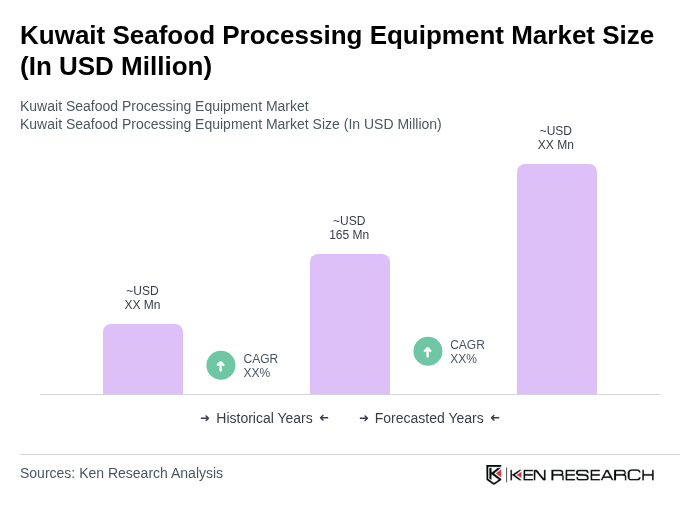
- The Kuwait Seafood Processing Equipment Market is valued at approximately USD 165 million, based on a five-year historical analysis. This growth is primarily driven by the increasing demand for processed seafood products, rising consumer awareness regarding food safety, and advancements in processing technologies. The market has seen a significant uptick in investments aimed at enhancing production efficiency and quality control in seafood processing, supported by robust government initiatives in aquaculture infrastructure and technology adoption.
- Kuwait City is the dominant hub for the seafood processing equipment market due to its strategic location, robust infrastructure, and proximity to major fishing grounds. Additionally, the presence of key players and a growing consumer base in urban areas contribute to the market's strength. Other notable regions include Al Ahmadi and Hawalli, which support the seafood supply chain and processing activities.
- The Kuwaiti government has implemented comprehensive food safety regulations aligned with international standards for the seafood processing industry. This includes mandatory compliance with international hygiene and quality standards, requiring processors to invest in advanced equipment and training for staff. Such regulatory frameworks are designed to ensure the safety and quality of seafood products, thereby boosting consumer confidence and market growth.
Kuwait Seafood Processing Equipment Market Segmentation
By Product Type:The product type segmentation includes various equipment essential for seafood processing. The subsegments are Filleting and Skinning Equipment, De-heading and Gutting Equipment, Grading Equipment, Scaling Equipment, Freezing Equipment, Packaging Machines, and Others. The demand for these products is driven by the need for efficiency and quality in seafood processing. Filleting equipment dominates the global market and maintains strong demand in Kuwait due to its essential role in initial processing stages.
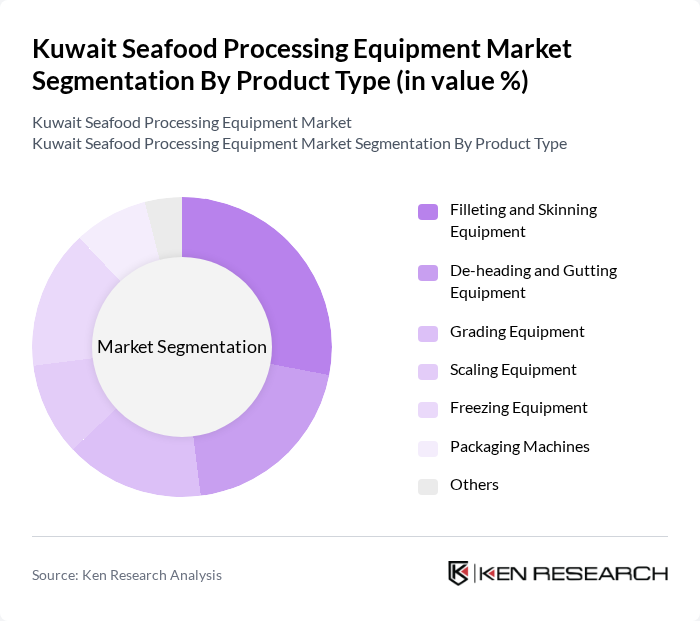
The Filleting and Skinning Equipment segment is currently dominating the market due to its essential role in the initial stages of seafood processing. This equipment is crucial for ensuring the quality and presentation of seafood products, which is increasingly important to consumers. The growing trend towards ready-to-cook seafood products has further fueled demand for efficient filleting and skinning solutions. Additionally, advancements in technology have led to the development of more automated and efficient machines, making them a preferred choice among processors.
By Seafood Type:The seafood type segmentation includes Fresh and Chilled Fish, Frozen Fish, Dried Fish, Canned Fish, Crustaceans and Mollusks, and Others. Each type has unique processing requirements, influencing the demand for specific equipment. Fresh and Chilled Fish represents the leading segment, driven by consumer preferences for fresh products and the growing trend of healthy eating.
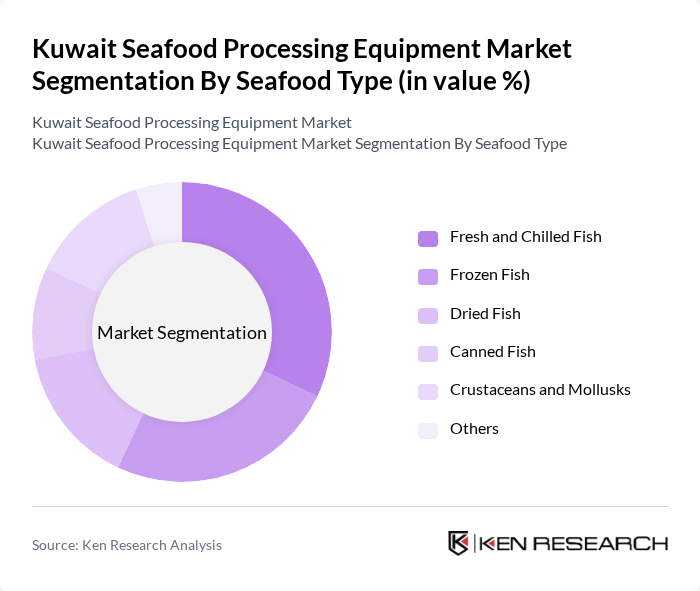
Among the seafood types, Fresh and Chilled Fish is the leading segment, driven by consumer preferences for fresh products and the growing trend of healthy eating. The demand for fresh seafood has led to increased investments in processing technologies that maintain quality and extend shelf life. Additionally, the rise of online grocery shopping has further boosted the market for fresh and chilled fish, as consumers seek convenient access to high-quality seafood. Rising per-capita seafood intake among Kuwaitis continues to support this segment's growth trajectory.
Kuwait Seafood Processing Equipment Market Competitive Landscape
The Kuwait Seafood Processing Equipment Market is characterized by a dynamic mix of regional and international players. Leading participants such as Al Khor Seafood, Kuwait Fisheries Company, Al-Manshar Group, Al-Bahar Group, Gulf Fish Company, Al-Muhalab Group, Al-Qurain Group, Al-Masah Group, Al-Hamra Group, Al-Safwa Group, Al-Mutawa Group, Al-Mansour Group, Al-Jazeera Fish Company, Al-Fahad Group, and Nestle S.A. contribute to innovation, geographic expansion, and service delivery in this space.
Kuwait Seafood Processing Equipment Market Industry Analysis
Growth Drivers
- Increasing Demand for Processed Seafood:The demand for processed seafood in Kuwait is projected to reach 55,000 tons in future, driven by a growing population and rising disposable incomes. The seafood consumption per capita in Kuwait is approximately 22 kg annually, which is higher than the global average of 20 kg. This trend is further supported by the increasing preference for convenient and ready-to-eat seafood products, leading to a surge in processing activities and equipment requirements.
- Technological Advancements in Processing Equipment:The Kuwait seafood processing sector is witnessing significant technological advancements, with investments in modern processing equipment expected to exceed $18 million in future. Innovations such as automated filleting machines and advanced freezing technologies enhance efficiency and product quality. These advancements not only reduce labor costs but also improve yield rates, making the processing of seafood more economically viable and appealing to local businesses.
- Government Initiatives to Boost the Fishing Industry:The Kuwaiti government has allocated approximately $12 million for initiatives aimed at enhancing the fishing industry in future. These initiatives include subsidies for modern processing equipment and training programs for local fishermen. By promoting sustainable fishing practices and improving infrastructure, the government aims to increase local seafood production, thereby driving demand for processing equipment and supporting industry growth.
Market Challenges
- High Initial Investment Costs:The seafood processing equipment market in Kuwait faces challenges due to high initial investment costs, which can range from $120,000 to $550,000 for advanced processing lines. Many small to medium-sized enterprises struggle to secure financing for such investments, limiting their ability to upgrade equipment and compete effectively. This financial barrier can hinder overall market growth and innovation within the sector.
- Stringent Regulatory Requirements:Compliance with stringent regulatory requirements poses a significant challenge for seafood processors in Kuwait. The Ministry of Health mandates rigorous food safety standards, which require processors to invest in quality control systems and certifications. Non-compliance can lead to fines and operational shutdowns, creating an environment of uncertainty that may deter new entrants and stifle growth in the processing equipment market.
Kuwait Seafood Processing Equipment Market Future Outlook
The future of the Kuwait seafood processing equipment market appears promising, driven by increasing consumer demand for high-quality seafood products and advancements in processing technologies. As the market evolves, companies are likely to adopt automation and digital solutions to enhance operational efficiency. Additionally, the focus on sustainability and environmental responsibility will shape investment decisions, encouraging the development of eco-friendly processing methods and equipment that align with global trends in food production.
Market Opportunities
- Expansion of Export Markets:Kuwait's seafood processing industry has the potential to expand into international markets, particularly in the Gulf Cooperation Council (GCC) region. With a projected export value of $6 million in future, local processors can leverage their geographical advantage and quality products to meet the growing demand for seafood in neighboring countries, enhancing profitability and market reach.
- Adoption of Sustainable Practices:There is a growing opportunity for seafood processors in Kuwait to adopt sustainable practices, which can lead to increased consumer trust and market differentiation. By investing in eco-friendly processing technologies and sustainable sourcing, companies can tap into the rising demand for responsibly sourced seafood, potentially increasing their market share and attracting environmentally conscious consumers.
Scope of the Report
| Segment | Sub-Segments |
|---|---|
| By Product Type | Filleting and Skinning Equipment De-heading and Gutting Equipment Grading Equipment Scaling Equipment Freezing Equipment Packaging Machines Others |
| By Seafood Type | Fresh and Chilled Fish Frozen Fish Dried Fish Canned Fish Crustaceans and Mollusks Others |
| By End-User | Food and Beverage Manufacturers Meat, Fish & Poultry Processors Retailers Wholesalers Food Service Providers Exporters Others |
| By Technology | Automated Processing Systems Semi-Automated Processing Systems Manual Processing Systems Others |
| By Distribution Channel | Direct Sales Distributors Online Sales Others |
| By Region | Capital Governorate Hawalli Governorate Al Ahmadi Governorate Others |
Key Target Audience
Investors and Venture Capitalist Firms
Government and Regulatory Bodies (e.g., Kuwait Public Authority for Food and Nutrition)
Manufacturers and Producers of Seafood Processing Equipment
Distributors and Retailers of Seafood Products
Seafood Processing Plant Operators
Technology Providers for Seafood Processing Solutions
Industry Associations (e.g., Kuwait Fisheries Association)
Financial Institutions and Banks
Players Mentioned in the Report:
Al Khor Seafood
Kuwait Fisheries Company
Al-Manshar Group
Al-Bahar Group
Gulf Fish Company
Al-Muhalab Group
Al-Qurain Group
Al-Masah Group
Al-Hamra Group
Al-Safwa Group
Al-Mutawa Group
Al-Mansour Group
Al-Jazeera Fish Company
Al-Fahad Group
Nestle S.A.
Table of Contents
Market Assessment Phase
1. Executive Summary and Approach
2. Kuwait Seafood Processing Equipment Market Overview
2.1 Key Insights and Strategic Recommendations
2.2 Kuwait Seafood Processing Equipment Market Overview
2.3 Definition and Scope
2.4 Evolution of Market Ecosystem
2.5 Timeline of Key Regulatory Milestones
2.6 Value Chain & Stakeholder Mapping
2.7 Business Cycle Analysis
2.8 Policy & Incentive Landscape
3. Kuwait Seafood Processing Equipment Market Analysis
3.1 Growth Drivers
3.1.1 Increasing demand for processed seafood
3.1.2 Technological advancements in processing equipment
3.1.3 Government initiatives to boost the fishing industry
3.1.4 Rising health consciousness among consumers
3.2 Market Challenges
3.2.1 High initial investment costs
3.2.2 Stringent regulatory requirements
3.2.3 Fluctuating raw material prices
3.2.4 Limited skilled labor availability
3.3 Market Opportunities
3.3.1 Expansion of export markets
3.3.2 Adoption of sustainable practices
3.3.3 Development of value-added products
3.3.4 Collaboration with technology providers
3.4 Market Trends
3.4.1 Shift towards automation in processing
3.4.2 Growing popularity of organic seafood
3.4.3 Increasing focus on food safety and quality
3.4.4 Rise in online seafood sales
3.5 Government Regulation
3.5.1 Compliance with food safety standards
3.5.2 Licensing requirements for processing facilities
3.5.3 Environmental regulations on waste disposal
3.5.4 Import/export regulations for seafood products
4. SWOT Analysis
5. Stakeholder Analysis
6. Porter's Five Forces Analysis
7. Kuwait Seafood Processing Equipment Market Market Size, 2019-2024
7.1 By Value
7.2 By Volume
7.3 By Average Selling Price
8. Kuwait Seafood Processing Equipment Market Segmentation
8.1 By Product Type
8.1.1 Filleting and Skinning Equipment
8.1.2 De-heading and Gutting Equipment
8.1.3 Grading Equipment
8.1.4 Scaling Equipment
8.1.5 Freezing Equipment
8.1.6 Packaging Machines
8.1.7 Others
8.2 By Seafood Type
8.2.1 Fresh and Chilled Fish
8.2.2 Frozen Fish
8.2.3 Dried Fish
8.2.4 Canned Fish
8.2.5 Crustaceans and Mollusks
8.2.6 Others
8.3 By End-User
8.3.1 Food and Beverage Manufacturers
8.3.2 Meat, Fish & Poultry Processors
8.3.3 Retailers
8.3.4 Wholesalers
8.3.5 Food Service Providers
8.3.6 Exporters
8.3.7 Others
8.4 By Technology
8.4.1 Automated Processing Systems
8.4.2 Semi-Automated Processing Systems
8.4.3 Manual Processing Systems
8.4.4 Others
8.5 By Distribution Channel
8.5.1 Direct Sales
8.5.2 Distributors
8.5.3 Online Sales
8.5.4 Others
8.6 By Region
8.6.1 Capital Governorate
8.6.2 Hawalli Governorate
8.6.3 Al Ahmadi Governorate
8.6.4 Others
9. Kuwait Seafood Processing Equipment Market Competitive Analysis
9.1 Market Share of Key Players
9.2 Cross Comparison of Key Players
9.2.1 Company Name
9.2.2 Company Size Classification (Large, Medium, Small)
9.2.3 Annual Revenue (USD Million)
9.2.4 Year-over-Year Revenue Growth Rate (%)
9.2.5 Market Share (%)
9.2.6 Customer Retention Rate (%)
9.2.7 Production Capacity Utilization (%)
9.2.8 Installed Equipment Base (Units)
9.2.9 Product Portfolio Breadth (Number of Equipment Types)
9.2.10 Geographic Presence (Number of Markets Served)
9.3 SWOT Analysis of Top Players
9.4 Pricing Analysis
9.5 Detailed Profile of Major Companies
9.5.1 Al Khor Seafood
9.5.2 Kuwait Fisheries Company
9.5.3 Al-Manshar Group
9.5.4 Al-Bahar Group
9.5.5 Gulf Fish Company
9.5.6 Al-Muhalab Group
9.5.7 Al-Qurain Group
9.5.8 Al-Masah Group
9.5.9 Al-Hamra Group
9.5.10 Al-Safwa Group
9.5.11 Al-Mutawa Group
9.5.12 Al-Mansour Group
9.5.13 Al-Jazeera Fish Company
9.5.14 Al-Fahad Group
9.5.15 Nestle S.A.
10. Kuwait Seafood Processing Equipment Market End-User Analysis
10.1 Procurement Behavior of Key Ministries
10.1.1 Ministry of Commerce and Industry
10.1.2 Ministry of Health
10.1.3 Ministry of Agriculture
10.1.4 Others
10.2 Corporate Spend on Infrastructure & Energy
10.2.1 Investment in Processing Facilities
10.2.2 Budget Allocation for Equipment Upgrades
10.2.3 Expenditure on Sustainability Initiatives
10.2.4 Others
10.3 Pain Point Analysis by End-User Category
10.3.1 Retail Sector Challenges
10.3.2 Food Service Sector Challenges
10.3.3 Export Sector Challenges
10.3.4 Others
10.4 User Readiness for Adoption
10.4.1 Awareness of New Technologies
10.4.2 Training and Skill Development Needs
10.4.3 Financial Readiness for Investment
10.4.4 Others
10.5 Post-Deployment ROI and Use Case Expansion
10.5.1 Measurement of ROI Metrics
10.5.2 Case Studies of Successful Implementations
10.5.3 Opportunities for Scaling Operations
10.5.4 Others
11. Kuwait Seafood Processing Equipment Market Future Size, 2025-2030
11.1 By Value
11.2 By Volume
11.3 By Average Selling Price
Go-To-Market Strategy Phase
1. Whitespace Analysis + Business Model Canvas
1.1 Market Gaps Identification
1.2 Business Model Development
2. Marketing and Positioning Recommendations
2.1 Branding Strategies
2.2 Product USPs
3. Distribution Plan
3.1 Urban Retail vs Rural NGO Tie-ups
4. Channel & Pricing Gaps
4.1 Underserved Routes
4.2 Pricing Bands
5. Unmet Demand & Latent Needs
5.1 Category Gaps
5.2 Consumer Segments
6. Customer Relationship
6.1 Loyalty Programs
6.2 After-sales Service
7. Value Proposition
7.1 Sustainability
7.2 Integrated Supply Chains
8. Key Activities
8.1 Regulatory Compliance
8.2 Branding
8.3 Distribution Setup
9. Entry Strategy Evaluation
9.1 Domestic Market Entry Strategy
9.1.1 Product Mix
9.1.2 Pricing Band
9.1.3 Packaging
9.2 Export Entry Strategy
9.2.1 Target Countries
9.2.2 Compliance Roadmap
10. Entry Mode Assessment
10.1 JV
10.2 Greenfield
10.3 M&A
10.4 Distributor Model
11. Capital and Timeline Estimation
11.1 Capital Requirements
11.2 Timelines
12. Control vs Risk Trade-Off
12.1 Ownership vs Partnerships
13. Profitability Outlook
13.1 Breakeven Analysis
13.2 Long-term Sustainability
14. Potential Partner List
14.1 Distributors
14.2 JVs
14.3 Acquisition Targets
15. Execution Roadmap
15.1 Phased Plan for Market Entry
15.1.1 Market Setup
15.1.2 Market Entry
15.1.3 Growth Acceleration
15.1.4 Scale & Stabilize
15.2 Key Activities and Milestones
15.2.1 Milestone Planning
15.2.2 Activity Tracking
Research Methodology
Phase 1: Approach1
Desk Research
- Industry reports from the Kuwait Chamber of Commerce and Industry
- Market analysis publications from seafood processing associations
- Government publications on seafood import/export statistics and regulations
Primary Research
- Interviews with key stakeholders in seafood processing companies
- Surveys conducted with equipment suppliers and distributors in Kuwait
- Field visits to processing plants to gather firsthand insights
Validation & Triangulation
- Cross-validation of data from multiple industry sources and reports
- Triangulation of findings from primary interviews and desk research
- Sanity checks through expert panels comprising industry veterans
Phase 2: Market Size Estimation1
Top-down Assessment
- Analysis of national seafood consumption trends and processing capacity
- Estimation of market size based on historical growth rates and forecasts
- Incorporation of government initiatives promoting local seafood processing
Bottom-up Modeling
- Data collection on equipment sales from major suppliers in the region
- Operational cost analysis based on equipment types and processing volumes
- Volume x cost calculations to derive market potential for each equipment category
Forecasting & Scenario Analysis
- Multi-factor regression analysis considering population growth and dietary shifts
- Scenario modeling based on regulatory changes and sustainability trends
- Baseline, optimistic, and pessimistic forecasts through 2030
Phase 3: CATI Sample Composition1
| Scope Item/Segment | Sample Size | Target Respondent Profiles |
|---|---|---|
| Seafood Processing Equipment Suppliers | 75 | Sales Managers, Product Development Heads |
| Processing Plant Operators | 65 | Plant Managers, Operations Supervisors |
| Regulatory Bodies and Associations | 40 | Policy Makers, Compliance Officers |
| End-users in Retail Seafood Markets | 50 | Store Managers, Procurement Officers |
| Logistics and Supply Chain Experts | 45 | Logistics Managers, Supply Chain Analysts |
Frequently Asked Questions
What is the current value of the Kuwait Seafood Processing Equipment Market?
The Kuwait Seafood Processing Equipment Market is valued at approximately USD 165 million, reflecting a significant growth driven by increasing demand for processed seafood products and advancements in processing technologies.
What factors are driving the growth of the Kuwait Seafood Processing Equipment Market?
Which region in Kuwait is the primary hub for seafood processing equipment?
What are the main product types in the Kuwait Seafood Processing Equipment Market?
Other Regional/Country Reports
Other Adjacent Reports
Qatar Aquaculture Equipment Market
Asia Pacific Food Processing Machinery Market Outlook to 2030: Size, Share, Growth and TrendsGermany Refrigeration Equipment Market
Global Packaging Machinery Market Size, Share & Forecast, By Machine Type, End-Use Industry & Technology, 2025-2032Thailand Food Safety Testing Market
Germany Fishery Equipment Market
Japan Meat Processing Equipment Market
Japan Poultry Processing Equipment Market
Egypt Frozen Food Processing Market
Singapore Industrial Automation Equipment Market
Why Buy From Us?

What makes us stand out is that our consultants follow Robust, Refine and Result (RRR) methodology. Robust for clear definitions, approaches and sanity checking, Refine for differentiating respondents' facts and opinions, and Result for presenting data with story.

We have set a benchmark in the industry by offering our clients with syndicated and customized market research reports featuring coverage of entire market as well as meticulous research and analyst insights.

While we don't replace traditional research, we flip the method upside down. Our dual approach of Top Bottom & Bottom Top ensures quality deliverable by not just verifying company fundamentals but also looking at the sector and macroeconomic factors.

With one step in the future, our research team constantly tries to show you the bigger picture. We help with some of the tough questions you may encounter along the way: How is the industry positioned? Best marketing channel? KPI's of competitors? By aligning every element, we help maximize success.

Our report gives you instant access to the answers and sources that other companies might choose to hide. We elaborate each steps of research methodology we have used and showcase you the sample size to earn your trust.

If you need any support, we are here! We pride ourselves on universe strength, data quality, and quick, friendly, and professional service.