About the Report
Base Year 2024Kuwait Tomato Ketchup Market Overview
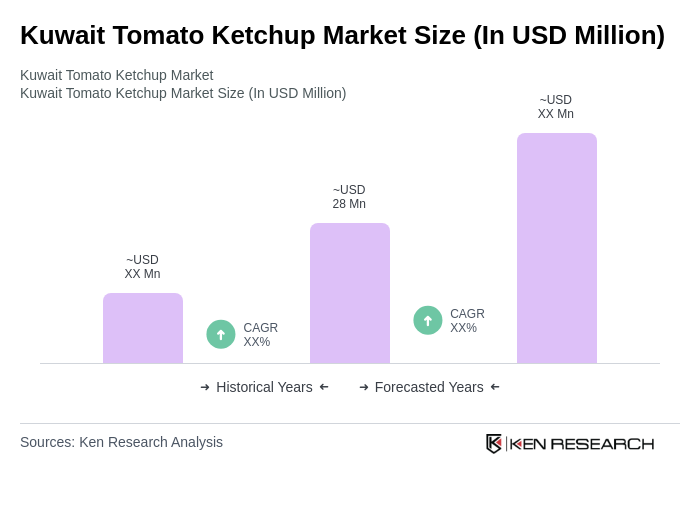
- The Kuwait Tomato Ketchup Market is valued at USD 28 million, based on a five-year historical analysis. This market has experienced moderate fluctuations, with recent contraction attributed to market saturation and the availability of alternative sauces and spices. Growth drivers include increasing consumer demand for convenience foods, the popularity of fast food and casual dining, and a shift toward ready-to-use condiments, although overall expansion is limited by slow growth in consumer awareness and demand for tomato ketchup products .
- Kuwait City remains the dominant region in the market, driven by its high population density and urban lifestyle, which supports greater demand for processed food products. Hawalli and Farwaniya also contribute significantly, with a concentration of restaurants and food outlets fueling ketchup consumption. Urbanization in these areas continues to underpin market growth, particularly through the expansion of foodservice channels .
- Regulatory oversight is provided under the “Kuwait Food Safety Law No. 62 of 2007,” issued by the Ministry of Health, which mandates that all food products, including tomato ketchup, comply with specific labeling, traceability, and quality assurance protocols. These requirements cover ingredient disclosure, expiration dates, and batch tracking, ensuring consumers receive safe and high-quality products and reinforcing confidence in local and imported brands .
Kuwait Tomato Ketchup Market Segmentation
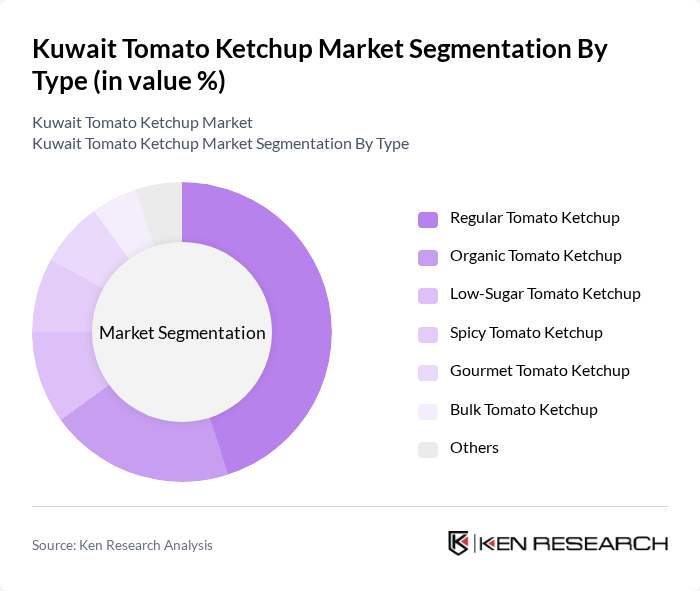
By Type:The market is segmented into Regular Tomato Ketchup, Organic Tomato Ketchup, Low-Sugar Tomato Ketchup, Spicy Tomato Ketchup, Gourmet Tomato Ketchup, Bulk Tomato Ketchup, and Others. Regular Tomato Ketchup maintains its leading position due to broad acceptance in households and restaurants, favored for its traditional flavor and versatility. Health-conscious consumers are increasingly driving demand for organic and low-sugar variants, reflecting a shift toward clean-label and natural ingredient products. Spicy and gourmet options are gaining popularity among younger demographics seeking novel flavors, while bulk ketchup is preferred by foodservice and catering segments .
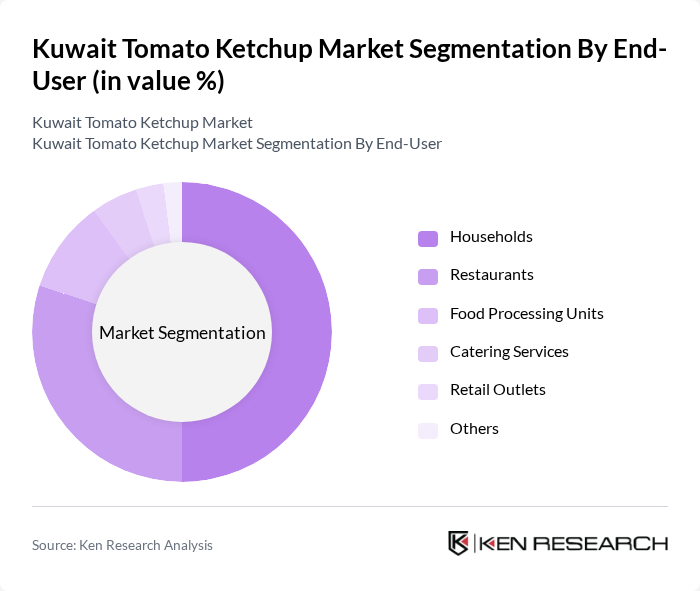
By End-User:The end-user segmentation comprises Households, Restaurants, Food Processing Units, Catering Services, Retail Outlets, and Others. Households represent the largest segment, driven by home cooking trends and demand for convenient meal solutions. Restaurants are the second-largest segment, with ketchup as a staple condiment in fast food and casual dining. Food processing units and catering services utilize bulk ketchup for large-scale meal preparation, while retail outlets serve both individual and institutional buyers. The growing foodservice industry and rising health consciousness among consumers continue to shape end-user preferences .
Kuwait Tomato Ketchup Market Competitive Landscape
The Kuwait Tomato Ketchup Market is characterized by a dynamic mix of regional and international players. Leading participants such as Americana Group (Kuwait Food Company), Al Wazzan Foodstuff Industries, Heinz (Kraft Heinz Company), Del Monte Foods, Unilever (Hellmann's, Knorr), Almarai, Al Kabeer Group, Al Jazeera Foodstuff Company, Al Safat Dairy & Foodstuff Company, Al Ain Food & Beverages, Al Babtain Group, Al-Mansour Group, Al-Muhaidib Group, Al-Faisal Group, Al-Safi Danone contribute to innovation, geographic expansion, and service delivery in this space.
Kuwait Tomato Ketchup Market Industry Analysis
Growth Drivers
- Increasing Demand for Convenience Foods:The convenience food sector in Kuwait is projected to reach a value of approximately $1.5 billion in future, driven by busy lifestyles and a growing preference for ready-to-eat meals. This trend is significantly boosting the demand for tomato ketchup, a staple condiment that complements various fast and convenient food options. The rise in urbanization, with over 98% of the population living in urban areas, further supports this growth, as consumers seek quick meal solutions.
- Rising Popularity of Fast Food Chains:The fast food industry in Kuwait is expected to grow to around $1.2 billion in future, with major chains expanding their presence. This growth is directly influencing the demand for tomato ketchup, as it is a key ingredient in many fast food offerings. The increasing number of outlets, which has risen by 15% over the past three years, indicates a robust market for ketchup as a complementary product, enhancing the overall consumption rates in the region.
- Health Consciousness Leading to Organic Options:The organic food market in Kuwait is anticipated to grow to $300 million in future, reflecting a shift towards healthier eating habits. This trend is prompting ketchup manufacturers to introduce organic variants, catering to health-conscious consumers. With 60% of Kuwaiti consumers expressing a preference for organic products, the demand for organic tomato ketchup is expected to rise, providing a significant growth avenue for brands willing to adapt to these changing preferences.
Market Challenges
- Intense Competition from Local and International Brands:The Kuwait tomato ketchup market is characterized by fierce competition, with over 30 brands vying for market share. Local brands account for approximately 40% of the market, while international brands like Heinz and Del Monte dominate the remaining share. This competitive landscape pressures pricing and innovation, making it challenging for new entrants to establish a foothold and for existing brands to maintain profitability amidst aggressive marketing strategies.
- Fluctuating Raw Material Prices:The cost of tomatoes, a primary ingredient in ketchup, has seen significant volatility, with prices fluctuating between $200 to $300 per ton in recent years. This instability is largely due to climate change impacts and supply chain disruptions. Such fluctuations can severely affect production costs and profit margins for manufacturers, forcing them to either absorb costs or pass them onto consumers, which could impact overall sales and market stability.
Kuwait Tomato Ketchup Market Future Outlook
The future of the Kuwait tomato ketchup market appears promising, driven by evolving consumer preferences and market dynamics. As health consciousness continues to rise, brands are likely to innovate with organic and natural ingredient options. Additionally, the growth of e-commerce platforms is expected to facilitate direct sales, enhancing market reach. Collaborations with food service providers will also play a crucial role in expanding distribution channels, ensuring that ketchup remains a staple condiment in both homes and restaurants across Kuwait.
Market Opportunities
- Expansion into Health-Conscious Product Lines:With the organic food market growing rapidly, there is a significant opportunity for ketchup brands to develop health-focused product lines. By introducing organic and low-sugar variants, companies can cater to the increasing demand for healthier options, potentially capturing a larger market share and appealing to health-conscious consumers.
- E-commerce Growth for Direct Sales:The rise of e-commerce in Kuwait, projected to reach $1 billion in future, presents a valuable opportunity for ketchup brands. By leveraging online platforms for direct sales, companies can enhance their market presence, reach a broader audience, and streamline distribution, ultimately driving sales growth in a competitive landscape.
Scope of the Report
| Segment | Sub-Segments |
|---|---|
| By Type | Regular Tomato Ketchup Organic Tomato Ketchup Low-Sugar Tomato Ketchup Spicy Tomato Ketchup Gourmet Tomato Ketchup Bulk Tomato Ketchup Others |
| By End-User | Households Restaurants Food Processing Units Catering Services Retail Outlets Others |
| By Distribution Channel | Supermarkets/Hypermarkets Online Retail Convenience Stores Wholesale Distributors Direct Sales Others |
| By Packaging Type | Glass Bottles Plastic Bottles Pouches Tetra Packs Others |
| By Price Range | Economy Mid-Range Premium Others |
| By Flavor Profile | Classic Sweet Savory Others |
| By Region | Capital Governorate (Kuwait City) Hawalli Governorate Farwaniya Governorate Ahmadi Governorate Mubarak Al-Kabeer Governorate Jahra Governorate Others |
Key Target Audience
Investors and Venture Capitalist Firms
Government and Regulatory Bodies (e.g., Ministry of Commerce and Industry, Kuwait Municipality)
Manufacturers and Producers
Distributors and Retailers
Food Service Providers (e.g., Restaurants, Cafes)
Importers and Exporters
Packaging Suppliers
Market Analysts and Industry Experts
Players Mentioned in the Report:
Americana Group (Kuwait Food Company)
Al Wazzan Foodstuff Industries
Heinz (Kraft Heinz Company)
Del Monte Foods
Unilever (Hellmann's, Knorr)
Almarai
Al Kabeer Group
Al Jazeera Foodstuff Company
Al Safat Dairy & Foodstuff Company
Al Ain Food & Beverages
Al Babtain Group
Al-Mansour Group
Al-Muhaidib Group
Al-Faisal Group
Al-Safi Danone
Table of Contents
Market Assessment Phase
1. Executive Summary and Approach
2. Kuwait Tomato Ketchup Market Overview
2.1 Key Insights and Strategic Recommendations
2.2 Kuwait Tomato Ketchup Market Overview
2.3 Definition and Scope
2.4 Evolution of Market Ecosystem
2.5 Timeline of Key Regulatory Milestones
2.6 Value Chain & Stakeholder Mapping
2.7 Business Cycle Analysis
2.8 Policy & Incentive Landscape
3. Kuwait Tomato Ketchup Market Analysis
3.1 Growth Drivers
3.1.1 Increasing Demand for Convenience Foods
3.1.2 Rising Popularity of Fast Food Chains
3.1.3 Growth in Food Service Sector
3.1.4 Health Consciousness Leading to Organic Options
3.2 Market Challenges
3.2.1 Intense Competition from Local and International Brands
3.2.2 Fluctuating Raw Material Prices
3.2.3 Regulatory Compliance and Quality Standards
3.2.4 Changing Consumer Preferences
3.3 Market Opportunities
3.3.1 Expansion into Health-Conscious Product Lines
3.3.2 E-commerce Growth for Direct Sales
3.3.3 Export Potential to Neighboring Markets
3.3.4 Collaborations with Food Service Providers
3.4 Market Trends
3.4.1 Increasing Use of Natural Ingredients
3.4.2 Rise of Private Label Brands
3.4.3 Innovative Packaging Solutions
3.4.4 Focus on Sustainability and Eco-Friendly Practices
3.5 Government Regulation
3.5.1 Food Safety Standards and Regulations
3.5.2 Labeling Requirements for Nutritional Information
3.5.3 Import Tariffs on Tomato Products
3.5.4 Environmental Regulations on Packaging Waste
4. SWOT Analysis
5. Stakeholder Analysis
6. Porter's Five Forces Analysis
7. Kuwait Tomato Ketchup Market Market Size, 2019-2024
7.1 By Value
7.2 By Volume
7.3 By Average Selling Price
8. Kuwait Tomato Ketchup Market Segmentation
8.1 By Type
8.1.1 Regular Tomato Ketchup
8.1.2 Organic Tomato Ketchup
8.1.3 Low-Sugar Tomato Ketchup
8.1.4 Spicy Tomato Ketchup
8.1.5 Gourmet Tomato Ketchup
8.1.6 Bulk Tomato Ketchup
8.1.7 Others
8.2 By End-User
8.2.1 Households
8.2.2 Restaurants
8.2.3 Food Processing Units
8.2.4 Catering Services
8.2.5 Retail Outlets
8.2.6 Others
8.3 By Distribution Channel
8.3.1 Supermarkets/Hypermarkets
8.3.2 Online Retail
8.3.3 Convenience Stores
8.3.4 Wholesale Distributors
8.3.5 Direct Sales
8.3.6 Others
8.4 By Packaging Type
8.4.1 Glass Bottles
8.4.2 Plastic Bottles
8.4.3 Pouches
8.4.4 Tetra Packs
8.4.5 Others
8.5 By Price Range
8.5.1 Economy
8.5.2 Mid-Range
8.5.3 Premium
8.5.4 Others
8.6 By Flavor Profile
8.6.1 Classic
8.6.2 Sweet
8.6.3 Savory
8.6.4 Others
8.7 By Region
8.7.1 Capital Governorate (Kuwait City)
8.7.2 Hawalli Governorate
8.7.3 Farwaniya Governorate
8.7.4 Ahmadi Governorate
8.7.5 Mubarak Al-Kabeer Governorate
8.7.6 Jahra Governorate
8.7.7 Others
9. Kuwait Tomato Ketchup Market Competitive Analysis
9.1 Market Share of Key Players
9.2 Cross Comparison of Key Players
9.2.1 Company Name
9.2.2 Group Size (Large, Medium, or Small as per industry convention)
9.2.3 Revenue Growth Rate (YoY %)
9.2.4 Market Share (%)
9.2.5 Distribution Coverage (number of retail and foodservice outlets)
9.2.6 Product Portfolio Breadth (number of SKUs/variants)
9.2.7 Pricing Strategy (Economy, Mid-Range, Premium)
9.2.8 Brand Recognition Index (survey-based or digital metrics)
9.2.9 Innovation Score (new launches, packaging, formulation)
9.2.10 Customer Retention Rate (%)
9.2.11 Digital Engagement Metrics (social media followers, online reviews)
9.3 SWOT Analysis of Top Players
9.4 Pricing Analysis
9.5 Detailed Profile of Major Companies
9.5.1 Americana Group (Kuwait Food Company)
9.5.2 Al Wazzan Foodstuff Industries
9.5.3 Heinz (Kraft Heinz Company)
9.5.4 Del Monte Foods
9.5.5 Unilever (Hellmann's, Knorr)
9.5.6 Almarai
9.5.7 Al Kabeer Group
9.5.8 Al Jazeera Foodstuff Company
9.5.9 Al Safat Dairy & Foodstuff Company
9.5.10 Al Ain Food & Beverages
9.5.11 Al Babtain Group
9.5.12 Al-Mansour Group
9.5.13 Al-Muhaidib Group
9.5.14 Al-Faisal Group
9.5.15 Al-Safi Danone
10. Kuwait Tomato Ketchup Market End-User Analysis
10.1 Procurement Behavior of Key Ministries
10.1.1 Ministry of Health
10.1.2 Ministry of Commerce and Industry
10.1.3 Ministry of Education
10.1.4 Ministry of Defense
10.2 Corporate Spend on Infrastructure & Energy
10.2.1 Food Service Infrastructure
10.2.2 Retail Infrastructure
10.2.3 Logistics and Distribution
10.3 Pain Point Analysis by End-User Category
10.3.1 Quality Consistency
10.3.2 Supply Chain Reliability
10.3.3 Pricing Fluctuations
10.4 User Readiness for Adoption
10.4.1 Awareness of Product Benefits
10.4.2 Availability of Alternatives
10.5 Post-Deployment ROI and Use Case Expansion
10.5.1 Customer Satisfaction Metrics
10.5.2 Repeat Purchase Rates
10.5.3 Market Expansion Opportunities
11. Kuwait Tomato Ketchup Market Future Size, 2025-2030
11.1 By Value
11.2 By Volume
11.3 By Average Selling Price
Go-To-Market Strategy Phase
1. Whitespace Analysis + Business Model Canvas
1.1 Market Gaps Identification
1.2 Business Model Framework
2. Marketing and Positioning Recommendations
2.1 Branding Strategies
2.2 Product USPs
3. Distribution Plan
3.1 Urban Retail Strategies
3.2 Rural NGO Tie-Ups
4. Channel & Pricing Gaps
4.1 Underserved Routes
4.2 Pricing Bands
5. Unmet Demand & Latent Needs
5.1 Category Gaps
5.2 Consumer Segments
6. Customer Relationship
6.1 Loyalty Programs
6.2 After-Sales Service
7. Value Proposition
7.1 Sustainability Initiatives
7.2 Integrated Supply Chains
8. Key Activities
8.1 Regulatory Compliance
8.2 Branding Efforts
8.3 Distribution Setup
9. Entry Strategy Evaluation
9.1 Domestic Market Entry Strategy
9.1.1 Product Mix Considerations
9.1.2 Pricing Band Strategy
9.1.3 Packaging Innovations
9.2 Export Entry Strategy
9.2.1 Target Countries
9.2.2 Compliance Roadmap
10. Entry Mode Assessment
10.1 Joint Ventures
10.2 Greenfield Investments
10.3 Mergers & Acquisitions
10.4 Distributor Model
11. Capital and Timeline Estimation
11.1 Capital Requirements
11.2 Timelines for Implementation
12. Control vs Risk Trade-Off
12.1 Ownership Considerations
12.2 Partnerships Evaluation
13. Profitability Outlook
13.1 Breakeven Analysis
13.2 Long-Term Sustainability
14. Potential Partner List
14.1 Distributors
14.2 Joint Ventures
14.3 Acquisition Targets
15. Execution Roadmap
15.1 Phased Plan for Market Entry
15.1.1 Market Setup
15.1.2 Market Entry
15.1.3 Growth Acceleration
15.1.4 Scale & Stabilize
15.2 Key Activities and Milestones
15.2.1 Activity Timeline
15.2.2 Milestone Tracking
Research Methodology
Phase 1: Approach1
Desk Research
- Analysis of market reports from local food industry associations and trade publications
- Review of government publications on food safety regulations and import/export data
- Examination of consumer behavior studies and market trends in the condiment sector
Primary Research
- Interviews with key stakeholders in the food processing industry, including manufacturers and distributors
- Surveys targeting retail managers and grocery store owners to understand consumer preferences
- Focus group discussions with consumers to gauge brand loyalty and product attributes
Validation & Triangulation
- Cross-validation of findings through comparison with historical sales data and market growth rates
- Triangulation of insights from primary interviews with secondary data sources
- Sanity checks conducted through expert reviews from industry analysts and market specialists
Phase 2: Market Size Estimation1
Top-down Assessment
- Estimation of total market size based on national consumption statistics for tomato-based products
- Segmentation of the market by distribution channels, including supermarkets, hypermarkets, and online platforms
- Incorporation of demographic data to assess potential growth in urban versus rural areas
Bottom-up Modeling
- Collection of sales data from leading ketchup brands and local producers
- Estimation of average retail prices and volume sold across different market segments
- Analysis of production capacity and supply chain logistics to determine market feasibility
Forecasting & Scenario Analysis
- Utilization of time-series analysis to project future market trends based on historical data
- Scenario modeling based on economic indicators, such as GDP growth and consumer spending patterns
- Development of best-case, worst-case, and most-likely scenarios for market growth through 2030
Phase 3: CATI Sample Composition1
| Scope Item/Segment | Sample Size | Target Respondent Profiles |
|---|---|---|
| Retail Sector Insights | 100 | Store Managers, Category Buyers |
| Consumer Preferences | 120 | Household Decision Makers, Food Enthusiasts |
| Food Service Industry | 80 | Restaurant Owners, Chefs |
| Distribution Channel Analysis | 60 | Logistics Coordinators, Supply Chain Managers |
| Market Trend Evaluation | 40 | Food Industry Analysts, Market Researchers |
Frequently Asked Questions
What is the current value of the Kuwait Tomato Ketchup Market?
The Kuwait Tomato Ketchup Market is valued at approximately USD 28 million, reflecting a five-year historical analysis. This market has seen moderate fluctuations due to factors like market saturation and the availability of alternative sauces.
What factors are driving the growth of the Kuwait Tomato Ketchup Market?
Which regions in Kuwait have the highest demand for tomato ketchup?
What types of tomato ketchup are available in the Kuwait market?
Other Regional/Country Reports
Malaysia Tomato Ketchup Market
KSA Tomato Ketchup Market
APAC Tomato Ketchup Market
SEA Tomato Ketchup Market
Vietnam Tomato Ketchup Market
Other Adjacent Reports
Vietnam Sauces and Condiments Market
Middle East and Africa Fast Food Market Outlook to 2030: Size, Share, Growth and TrendsBrazil Convenience Foods Market
Qatar Organic Condiments Market
India Food Processing Market Outlook to 2030Thailand Tomato Products Market
Japan Bottled Sauces Market
Kuwait Catering Services Market Outlook to 2030: Size, Share, Growth and TrendsMalaysia Retail Food Market
Brazil E-Commerce Grocery Market
Why Buy From Us?

What makes us stand out is that our consultants follow Robust, Refine and Result (RRR) methodology. Robust for clear definitions, approaches and sanity checking, Refine for differentiating respondents' facts and opinions, and Result for presenting data with story.

We have set a benchmark in the industry by offering our clients with syndicated and customized market research reports featuring coverage of entire market as well as meticulous research and analyst insights.

While we don't replace traditional research, we flip the method upside down. Our dual approach of Top Bottom & Bottom Top ensures quality deliverable by not just verifying company fundamentals but also looking at the sector and macroeconomic factors.

With one step in the future, our research team constantly tries to show you the bigger picture. We help with some of the tough questions you may encounter along the way: How is the industry positioned? Best marketing channel? KPI's of competitors? By aligning every element, we help maximize success.

Our report gives you instant access to the answers and sources that other companies might choose to hide. We elaborate each steps of research methodology we have used and showcase you the sample size to earn your trust.

If you need any support, we are here! We pride ourselves on universe strength, data quality, and quick, friendly, and professional service.