About the Report
Base Year 2024Malaysia Artificial Intelligence Ai Data Center Market Overview
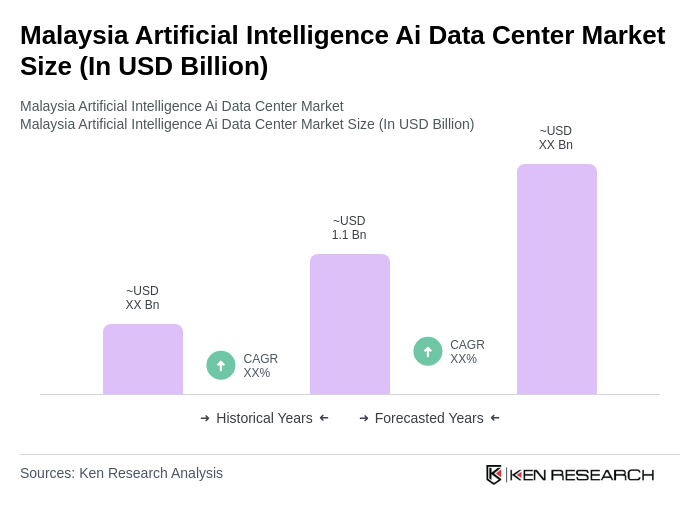
- The Malaysia Artificial Intelligence Ai Data Center Market is valued at USD 1.1 billion, based on a five-year historical analysis. This reflects the rapid build-out of AI-ready and hyperscale facilities in Malaysia, underpinned by strong overall data center investment momentum and the emergence of AI-optimized capacity in the country .
- Key cities dominating the market include Kuala Lumpur, Cyberjaya, and Penang. Kuala Lumpur functions as the country’s economic and digital hub and hosts major colocation and cloud nodes; Cyberjaya is a mature data center cluster favored for power, fiber, and zoning suitable for hyperscale campuses; Penang’s expanding tech and electronics ecosystem and connectivity are drawing new data infrastructure investments .
- In 2023, the Malaysian government advanced national digital and AI initiatives that enhance data infrastructure readiness, including the continuation of the National AI Roadmap under the National AI Office and pro-investment policies for hyperscale regions, alongside a focus on sustainable power and regulatory readiness that benefit data center investments .
Malaysia Artificial Intelligence Ai Data Center Market Segmentation
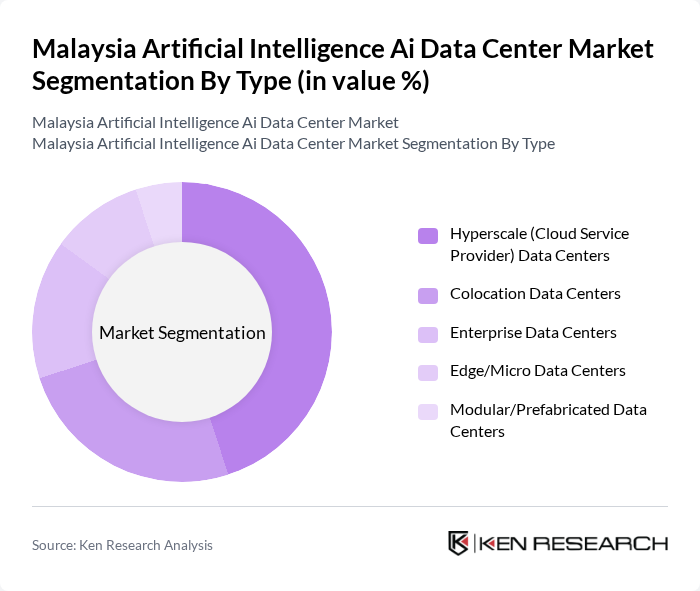
By Type:The market is segmented into various types of data centers, including Hyperscale (Cloud Service Provider) Data Centers, Colocation Data Centers, Enterprise Data Centers, Edge/Micro Data Centers, and Modular/Prefabricated Data Centers. Among these, Hyperscale Data Centers are leading due to the increasing demand for cloud services and the need for scalable infrastructure to support AI workloads. The trend towards digital transformation across industries is driving enterprises to adopt hyperscale solutions for enhanced efficiency and performance.
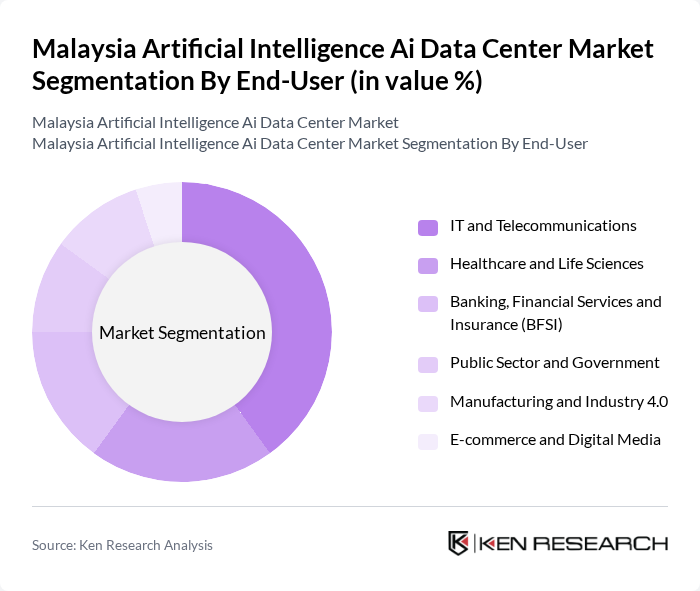
By End-User:The end-user segmentation includes IT and Telecommunications, Healthcare and Life Sciences, Banking, Financial Services and Insurance (BFSI), Public Sector and Government, Manufacturing and Industry 4.0, and E-commerce and Digital Media. The IT and Telecommunications sector is the dominant end-user, driven by the increasing reliance on cloud services and data analytics. The rapid digitalization of businesses and the growing need for data storage and processing capabilities are propelling this sector's growth.
Malaysia Artificial Intelligence Ai Data Center Market Competitive Landscape
The Malaysia Artificial Intelligence Ai Data Center Market is characterized by a dynamic mix of regional and international players. Leading participants such as AIMS Data Centre (AIMS DC, a DigitalBridge company), NTT Global Data Centers (Malaysia), Keppel Data Centres (Malaysia), Bridge Data Centres (BDx Indonesia/Bridge, Malaysia), YTL Power Data Center (YTL Green Data Center Park, Kulai, Johor), GDS Holdings (Malaysia), Equinix (Malaysia), Digital Realty (Malaysia), TM One (Telekom Malaysia Berhad), TIME dotCom Berhad (AIMS partner, network and DC), Khazna Data Centers (Malaysia), Princeton Digital Group (PDG) Malaysia, EdgeConneX (Malaysia), Google Cloud (Malaysia cloud region and infrastructure), Amazon Web Services (AWS) Malaysia contribute to innovation, geographic expansion, and service delivery in this space.
Malaysia Artificial Intelligence Ai Data Center Market Industry Analysis
Growth Drivers
- Increasing Demand for AI Applications:The demand for AI applications in Malaysia is projected to reach RM 3 billion by the future, driven by sectors such as finance, healthcare, and manufacturing. This surge is fueled by the need for enhanced data analytics and automation, which are critical for improving operational efficiency. The Malaysian government’s push for digital transformation further supports this trend, as organizations increasingly adopt AI technologies to remain competitive in a rapidly evolving market.
- Government Initiatives and Support:The Malaysian government has allocated RM 1.5 billion for the National Artificial Intelligence Framework, aiming to position the country as a regional AI hub by the future. This initiative includes funding for research and development, infrastructure improvements, and incentives for businesses adopting AI technologies. Such support is crucial for fostering innovation and attracting foreign investments, which are essential for the growth of the AI data center market in Malaysia.
- Rise in Data Generation and Consumption:Malaysia's data generation is expected to exceed 3 zettabytes by the future, driven by the proliferation of IoT devices and digital services. This exponential growth in data consumption necessitates robust data center capabilities to manage, store, and process vast amounts of information. As businesses increasingly rely on data-driven decision-making, the demand for AI-powered data centers that can efficiently handle this data surge will continue to rise significantly.
Market Challenges
- High Initial Investment Costs:Establishing AI data centers in Malaysia requires substantial initial investments, often exceeding RM 60 million per facility. This high cost can deter smaller enterprises from entering the market, limiting competition and innovation. Additionally, ongoing operational expenses, including energy consumption and maintenance, further complicate financial feasibility, particularly for startups and SMEs looking to leverage AI technologies.
- Data Privacy and Security Concerns:With the increasing volume of data processed, concerns regarding data privacy and security are paramount. Malaysia's Data Protection Act mandates strict compliance, which can impose additional operational burdens on data center operators. The potential for data breaches and cyberattacks poses significant risks, leading to hesitance among businesses to fully embrace AI solutions, thereby hindering market growth.
Malaysia Artificial Intelligence Ai Data Center Market Future Outlook
The future of the AI data center market in Malaysia appears promising, driven by technological advancements and increasing digitalization across various sectors. As organizations prioritize data-driven strategies, the integration of AI into data management processes will become more prevalent. Furthermore, the government's commitment to enhancing digital infrastructure will likely facilitate the growth of innovative solutions, positioning Malaysia as a competitive player in the regional AI landscape. Continued investment in talent development will also be crucial for sustaining this momentum.
Market Opportunities
- Growth in Edge Computing:The rise of edge computing presents a significant opportunity for AI data centers in Malaysia. By processing data closer to the source, businesses can reduce latency and improve response times. This trend is expected to drive investments in localized data centers, enhancing service delivery and operational efficiency across various industries, particularly in manufacturing and logistics.
- Development of Green Data Centers:The increasing focus on sustainability is driving the development of green data centers in Malaysia. By adopting energy-efficient technologies and renewable energy sources, these facilities can significantly reduce their carbon footprint. This shift not only aligns with global sustainability goals but also attracts environmentally conscious investors and clients, creating a competitive advantage in the market.
Scope of the Report
| Segment | Sub-Segments |
|---|---|
| By Type | Hyperscale (Cloud Service Provider) Data Centers Colocation Data Centers Enterprise Data Centers Edge/Micro Data Centers Modular/Prefabricated Data Centers |
| By End-User | IT and Telecommunications Healthcare and Life Sciences Banking, Financial Services and Insurance (BFSI) Public Sector and Government Manufacturing and Industry 4.0 E-commerce and Digital Media |
| By Application (AI Workload) | AI Training (GPU/Accelerator High-Density Racks) AI Inference Big Data Analytics Cloud-Native/Hybrid Cloud Workloads IoT/Edge Analytics |
| By Investment Source | Domestic Investment Foreign Direct Investment (FDI) Public-Private Partnerships (PPP) Government Grants and Incentives |
| By Policy Support | Tax Incentives and Pioneer Status Renewable and Low-Carbon Energy Incentives Data Sovereignty and PDPA Compliance Green Building and Energy Efficiency Standards |
| By Location Cluster | Cyberjaya (Selangor) Johor (Sedenak/Kulaiso/Tebrau) Greater Kuala Lumpur/Klang Valley Penang and Northern Corridor |
| By Service Model | Infrastructure as a Service (IaaS) Platform as a Service (PaaS) Software as a Service (SaaS) Managed and Professional Services |
| By Power and Cooling Density | Standard Density Racks (?10 kW/rack) High Density Racks (10–30 kW/rack) Extreme Density/AI Racks (?30 kW/rack, incl. liquid cooling) |
Key Target Audience
Investors and Venture Capitalist Firms
Government and Regulatory Bodies (e.g., Malaysian Communications and Multimedia Commission, Ministry of Science, Technology and Innovation)
Data Center Operators
Cloud Service Providers
Telecommunications Companies
Energy Providers
Technology Infrastructure Providers
Cybersecurity Firms
Players Mentioned in the Report:
AIMS Data Centre (AIMS DC, a DigitalBridge company)
NTT Global Data Centers (Malaysia)
Keppel Data Centres (Malaysia)
Bridge Data Centres (BDx Indonesia/Bridge, Malaysia)
YTL Power Data Center (YTL Green Data Center Park, Kulai, Johor)
GDS Holdings (Malaysia)
Equinix (Malaysia)
Digital Realty (Malaysia)
TM One (Telekom Malaysia Berhad)
TIME dotCom Berhad (AIMS partner, network and DC)
Khazna Data Centers (Malaysia)
Princeton Digital Group (PDG) Malaysia
EdgeConneX (Malaysia)
Google Cloud (Malaysia cloud region and infrastructure)
Amazon Web Services (AWS) Malaysia
Table of Contents
Market Assessment Phase
1. Executive Summary and Approach
2. Malaysia Artificial Intelligence Ai Data Center Market Overview
2.1 Key Insights and Strategic Recommendations
2.2 Malaysia Artificial Intelligence Ai Data Center Market Overview
2.3 Definition and Scope
2.4 Evolution of Market Ecosystem
2.5 Timeline of Key Regulatory Milestones
2.6 Value Chain & Stakeholder Mapping
2.7 Business Cycle Analysis
2.8 Policy & Incentive Landscape
3. Malaysia Artificial Intelligence Ai Data Center Market Analysis
3.1 Growth Drivers
3.1.1 Increasing Demand for AI Applications
3.1.2 Government Initiatives and Support
3.1.3 Rise in Data Generation and Consumption
3.1.4 Expansion of Cloud Services
3.2 Market Challenges
3.2.1 High Initial Investment Costs
3.2.2 Data Privacy and Security Concerns
3.2.3 Limited Skilled Workforce
3.2.4 Infrastructure Limitations
3.3 Market Opportunities
3.3.1 Growth in Edge Computing
3.3.2 Partnerships with Tech Giants
3.3.3 Development of Green Data Centers
3.3.4 Increasing Adoption of IoT
3.4 Market Trends
3.4.1 Shift Towards Hybrid Cloud Solutions
3.4.2 Focus on Energy Efficiency
3.4.3 Adoption of AI for Data Management
3.4.4 Growth of Colocation Services
3.5 Government Regulation
3.5.1 Data Protection Act Compliance
3.5.2 Incentives for Renewable Energy Use
3.5.3 Regulations on Data Sovereignty
3.5.4 Licensing Requirements for Data Centers
4. SWOT Analysis
5. Stakeholder Analysis
6. Porter's Five Forces Analysis
7. Malaysia Artificial Intelligence Ai Data Center Market Market Size, 2019-2024
7.1 By Value
7.2 By Volume
7.3 By Average Selling Price
8. Malaysia Artificial Intelligence Ai Data Center Market Segmentation
8.1 By Type
8.1.1 Hyperscale (Cloud Service Provider) Data Centers
8.1.2 Colocation Data Centers
8.1.3 Enterprise Data Centers
8.1.4 Edge/Micro Data Centers
8.1.5 Modular/Prefabricated Data Centers
8.2 By End-User
8.2.1 IT and Telecommunications
8.2.2 Healthcare and Life Sciences
8.2.3 Banking, Financial Services and Insurance (BFSI)
8.2.4 Public Sector and Government
8.2.5 Manufacturing and Industry 4.0
8.2.6 E-commerce and Digital Media
8.3 By Application (AI Workload)
8.3.1 AI Training (GPU/Accelerator High-Density Racks)
8.3.2 AI Inference
8.3.3 Big Data Analytics
8.3.4 Cloud-Native/Hybrid Cloud Workloads
8.3.5 IoT/Edge Analytics
8.4 By Investment Source
8.4.1 Domestic Investment
8.4.2 Foreign Direct Investment (FDI)
8.4.3 Public-Private Partnerships (PPP)
8.4.4 Government Grants and Incentives
8.5 By Policy Support
8.5.1 Tax Incentives and Pioneer Status
8.5.2 Renewable and Low-Carbon Energy Incentives
8.5.3 Data Sovereignty and PDPA Compliance
8.5.4 Green Building and Energy Efficiency Standards
8.6 By Location Cluster
8.6.1 Cyberjaya (Selangor)
8.6.2 Johor (Sedenak/Kulaiso/Tebrau)
8.6.3 Greater Kuala Lumpur/Klang Valley
8.6.4 Penang and Northern Corridor
8.7 By Service Model
8.7.1 Infrastructure as a Service (IaaS)
8.7.2 Platform as a Service (PaaS)
8.7.3 Software as a Service (SaaS)
8.7.4 Managed and Professional Services
8.8 By Power and Cooling Density
8.8.1 Standard Density Racks (?10 kW/rack)
8.8.2 High Density Racks (10–30 kW/rack)
8.8.3 Extreme Density/AI Racks (?30 kW/rack, incl. liquid cooling)
9. Malaysia Artificial Intelligence Ai Data Center Market Competitive Analysis
9.1 Market Share of Key Players
9.2 Cross Comparison of Key Players
9.2.1 Company Name
9.2.2 Installed IT Capacity (MW) in Malaysia
9.2.3 GPU/AI-Optimized Capacity (MW) and High-Density Rack Share (%)
9.2.4 Number of Operational Campuses/Sites in Malaysia
9.2.5 Expansion Pipeline (Announced/Under Construction MW)
9.2.6 Average PUE and Liquid-Cooling Readiness
9.2.7 Interconnection Ecosystem (Carriers, IXs, Cloud On-ramps)
9.2.8 SLA Uptime (Tier/Availability) and Compliance Certifications
9.2.9 Land/Power Secured (MVA) and Renewable/Energy Contracts
9.2.10 Revenue Mix (Colocation vs. Hyperscale/CSP) in Malaysia
9.2.11 Customer Concentration (Top-3 share %) and Churn
9.2.12 Average Price per kW (Retail/Wholesale) in Malaysia
9.3 SWOT Analysis of Top Players
9.4 Pricing Analysis
9.5 Detailed Profile of Major Companies
9.5.1 AIMS Data Centre (AIMS DC, a DigitalBridge company)
9.5.2 NTT Global Data Centers (Malaysia)
9.5.3 Keppel Data Centres (Malaysia)
9.5.4 Bridge Data Centres (BDx Indonesia/Bridge, Malaysia)
9.5.5 YTL Power Data Center (YTL Green Data Center Park, Kulai, Johor)
9.5.6 GDS Holdings (Malaysia)
9.5.7 Equinix (Malaysia)
9.5.8 Digital Realty (Malaysia)
9.5.9 TM One (Telekom Malaysia Berhad)
9.5.10 TIME dotCom Berhad (AIMS partner, network and DC)
9.5.11 Khazna Data Centers (Malaysia)
9.5.12 Princeton Digital Group (PDG) Malaysia
9.5.13 EdgeConneX (Malaysia)
9.5.14 Google Cloud (Malaysia cloud region and infrastructure)
9.5.15 Amazon Web Services (AWS) Malaysia
10. Malaysia Artificial Intelligence Ai Data Center Market End-User Analysis
10.1 Procurement Behavior of Key Ministries
10.1.1 Budget Allocation Trends
10.1.2 Decision-Making Processes
10.1.3 Preferred Vendors
10.1.4 Compliance Requirements
10.2 Corporate Spend on Infrastructure & Energy
10.2.1 Investment Trends
10.2.2 Budget Prioritization
10.2.3 Cost Management Strategies
10.3 Pain Point Analysis by End-User Category
10.3.1 Data Security Concerns
10.3.2 Scalability Issues
10.3.3 High Operational Costs
10.4 User Readiness for Adoption
10.4.1 Training and Skill Development Needs
10.4.2 Technology Adoption Barriers
10.5 Post-Deployment ROI and Use Case Expansion
10.5.1 Performance Metrics
10.5.2 Use Case Diversification
10.5.3 Long-term Value Assessment
11. Malaysia Artificial Intelligence Ai Data Center Market Future Size, 2025-2030
11.1 By Value
11.2 By Volume
11.3 By Average Selling Price
Go-To-Market Strategy Phase
1. Whitespace Analysis + Business Model Canvas
1.1 Market Gaps Identification
1.2 Business Model Development
2. Marketing and Positioning Recommendations
2.1 Branding Strategies
2.2 Product USPs
3. Distribution Plan
3.1 Urban Retail Strategies
3.2 Rural NGO Tie-ups
4. Channel & Pricing Gaps
4.1 Underserved Routes
4.2 Pricing Bands
5. Unmet Demand & Latent Needs
5.1 Category Gaps
5.2 Consumer Segments
6. Customer Relationship
6.1 Loyalty Programs
6.2 After-sales Service
7. Value Proposition
7.1 Sustainability Initiatives
7.2 Integrated Supply Chains
8. Key Activities
8.1 Regulatory Compliance
8.2 Branding Efforts
8.3 Distribution Setup
9. Entry Strategy Evaluation
9.1 Domestic Market Entry Strategy
9.1.1 Product Mix Considerations
9.1.2 Pricing Band Strategy
9.1.3 Packaging Options
9.2 Export Entry Strategy
9.2.1 Target Countries
9.2.2 Compliance Roadmap
10. Entry Mode Assessment
10.1 Joint Ventures
10.2 Greenfield Investments
10.3 Mergers & Acquisitions
10.4 Distributor Model
11. Capital and Timeline Estimation
11.1 Capital Requirements
11.2 Timelines for Implementation
12. Control vs Risk Trade-Off
12.1 Ownership Considerations
12.2 Partnerships Evaluation
13. Profitability Outlook
13.1 Breakeven Analysis
13.2 Long-term Sustainability
14. Potential Partner List
14.1 Distributors
14.2 Joint Ventures
14.3 Acquisition Targets
15. Execution Roadmap
15.1 Phased Plan for Market Entry
15.1.1 Market Setup
15.1.2 Market Entry
15.1.3 Growth Acceleration
15.1.4 Scale & Stabilize
15.2 Key Activities and Milestones
15.2.1 Milestone Planning
15.2.2 Activity Tracking
Research Methodology
Phase 1: Approach1
Desk Research
- Analysis of government publications and reports on AI and data center initiatives in Malaysia
- Review of industry white papers and market analysis reports from relevant technology associations
- Examination of academic journals and conference proceedings focusing on AI applications and data center technologies
Primary Research
- Interviews with key stakeholders in the AI and data center sectors, including executives and technical leads
- Surveys targeting IT managers and data center operators to gather insights on operational challenges and trends
- Focus group discussions with industry experts to explore future trends and market dynamics
Validation & Triangulation
- Cross-validation of findings through multiple data sources, including market reports and expert opinions
- Triangulation of qualitative insights from interviews with quantitative data from surveys
- Sanity checks conducted through expert panel reviews to ensure data accuracy and relevance
Phase 2: Market Size Estimation1
Top-down Assessment
- Estimation of the overall AI market size in Malaysia and its contribution to the data center sector
- Segmentation of the market by application areas such as cloud computing, big data analytics, and machine learning
- Incorporation of government initiatives and funding aimed at boosting AI and data center infrastructure
Bottom-up Modeling
- Collection of firm-level data from leading data center operators regarding capacity and utilization rates
- Operational cost analysis based on service offerings and pricing models in the AI data center market
- Volume and revenue projections based on historical growth rates and emerging trends in AI adoption
Forecasting & Scenario Analysis
- Development of forecasting models using historical data and projected growth rates for AI technologies
- Scenario analysis based on varying levels of investment in AI and data center infrastructure
- Creation of baseline, optimistic, and pessimistic forecasts through 2030, considering market volatility
Phase 3: CATI Sample Composition1
| Scope Item/Segment | Sample Size | Target Respondent Profiles |
|---|---|---|
| AI Data Center Operations | 110 | Data Center Managers, IT Infrastructure Directors |
| Cloud Computing Services | 85 | Cloud Architects, Service Delivery Managers |
| Big Data Analytics | 75 | Data Scientists, Business Intelligence Analysts |
| Machine Learning Applications | 65 | AI Researchers, Product Development Leads |
| Regulatory Compliance in AI | 55 | Compliance Officers, Legal Advisors in Tech |
Frequently Asked Questions
What is the current value of the Malaysia Artificial Intelligence Ai Data Center Market?
The Malaysia Artificial Intelligence Ai Data Center Market is valued at approximately USD 1.1 billion, reflecting significant growth driven by the establishment of AI-ready and hyperscale facilities across the country.
Which cities are key players in the Malaysia AI Data Center Market?
What government initiatives support the AI Data Center Market in Malaysia?
What types of data centers are prevalent in Malaysia?
Other Regional/Country Reports
Indonesia Artificial Intelligence Ai Data Center Market
KSA Artificial Intelligence Ai Data Center Market
APAC Artificial Intelligence Ai Data Center Market
SEA Artificial Intelligence Ai Data Center Market
Vietnam Artificial Intelligence Ai Data Center Market
Why Buy From Us?

What makes us stand out is that our consultants follow Robust, Refine and Result (RRR) methodology. Robust for clear definitions, approaches and sanity checking, Refine for differentiating respondents' facts and opinions, and Result for presenting data with story.

We have set a benchmark in the industry by offering our clients with syndicated and customized market research reports featuring coverage of entire market as well as meticulous research and analyst insights.

While we don't replace traditional research, we flip the method upside down. Our dual approach of Top Bottom & Bottom Top ensures quality deliverable by not just verifying company fundamentals but also looking at the sector and macroeconomic factors.

With one step in the future, our research team constantly tries to show you the bigger picture. We help with some of the tough questions you may encounter along the way: How is the industry positioned? Best marketing channel? KPI's of competitors? By aligning every element, we help maximize success.

Our report gives you instant access to the answers and sources that other companies might choose to hide. We elaborate each steps of research methodology we have used and showcase you the sample size to earn your trust.

If you need any support, we are here! We pride ourselves on universe strength, data quality, and quick, friendly, and professional service.