















MEA Argon Market Outlook to 2030
Region:Global
Author(s):Shreya Garg
Product Code:KROD7898
December 2024
90
About the Report
MEA Argon Market Overview
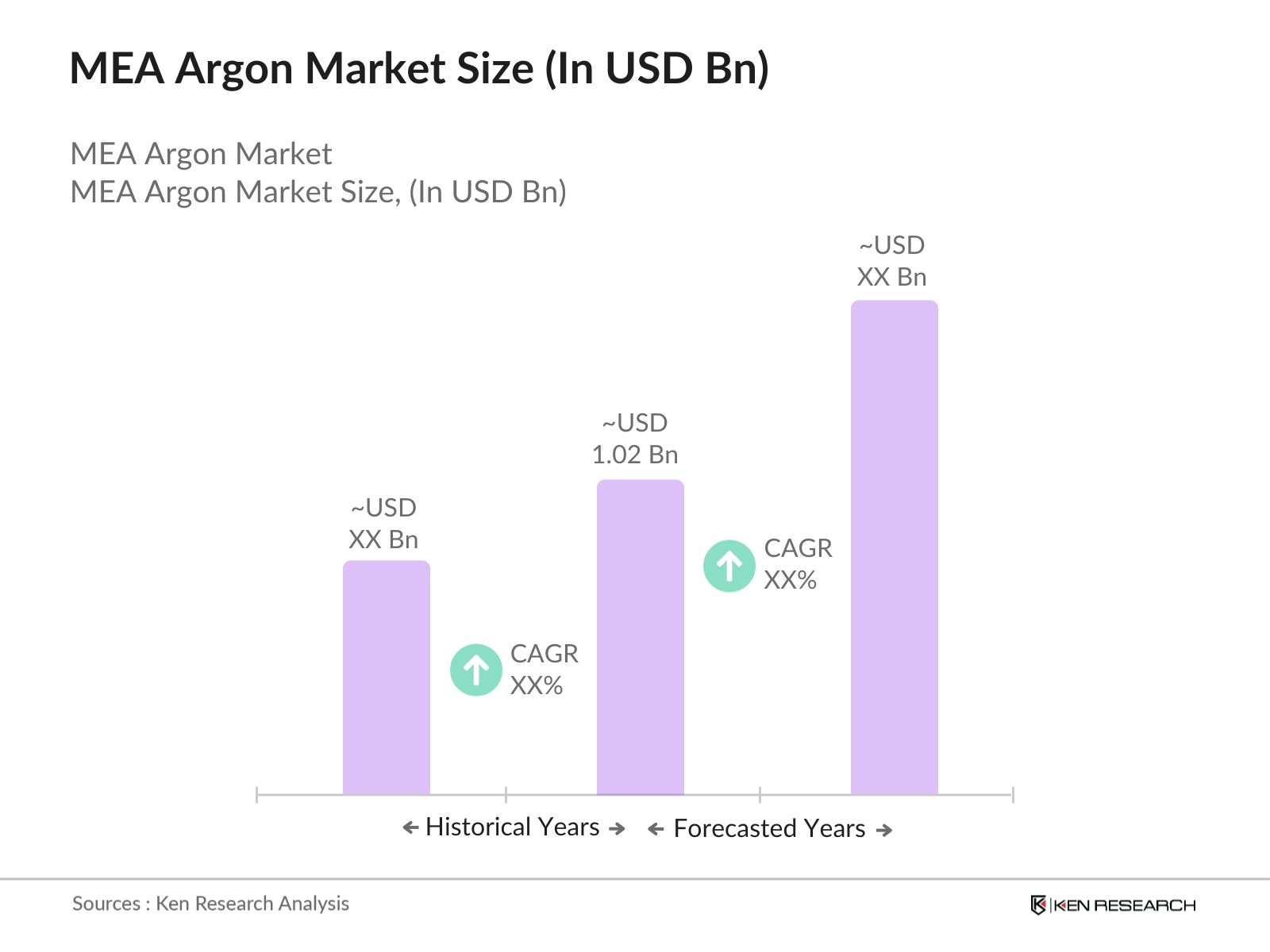
- The MEA Argon market has shown stable growth and is valued at around USD 1.02 billion based on historical analysis. This growth is primarily driven by the expanding demand from sectors such as welding and metal fabrication, electronics, healthcare, and food preservation, where argons inert properties are crucial. The markets expansion is also bolstered by investments in industrial gases within the region to meet rising industry needs, particularly in oil-rich economies focused on diversifying their industrial output.
- Key countries in the MEA region that dominate the Argon market include the UAE and Saudi Arabia, due to their substantial industrial and petrochemical activities. These nations have well-developed infrastructure for industrial gases, including argon production, which serves the significant local demand in metal processing, electronics, and healthcare applications. Additionally, the presence of major industrial gas players and investments in high-tech manufacturing makes these countries pivotal in regional argon distribution.
- MEAs governments are enforcing stringent environmental standards on industrial gases, including argon. The UAEs environmental regulations mandate specific emission limits for industrial gas plants, implemented through real-time monitoring systems to track carbon outputs. In 2023, Saudi Arabia enhanced its regulations under the National Industrial Development and Logistics Program (NIDLP), which introduced tighter limits on industrial emissions and higher penalties for non-compliance. This regulatory focus on emissions controls aims to lower the environmental impact of argon production across MEA.
MEA Argon Market Segmentation
By Phase: The market is segmented by phase into Liquid Argon and Gaseous Argon. Liquid Argon currently leads due to its widespread industrial applications, particularly in manufacturing and metal fabrication. Industries favor liquid argon because of its stable supply chain logistics and ease of storage. In addition, its use in healthcare and research facilities for cryogenic processes further supports its dominance. 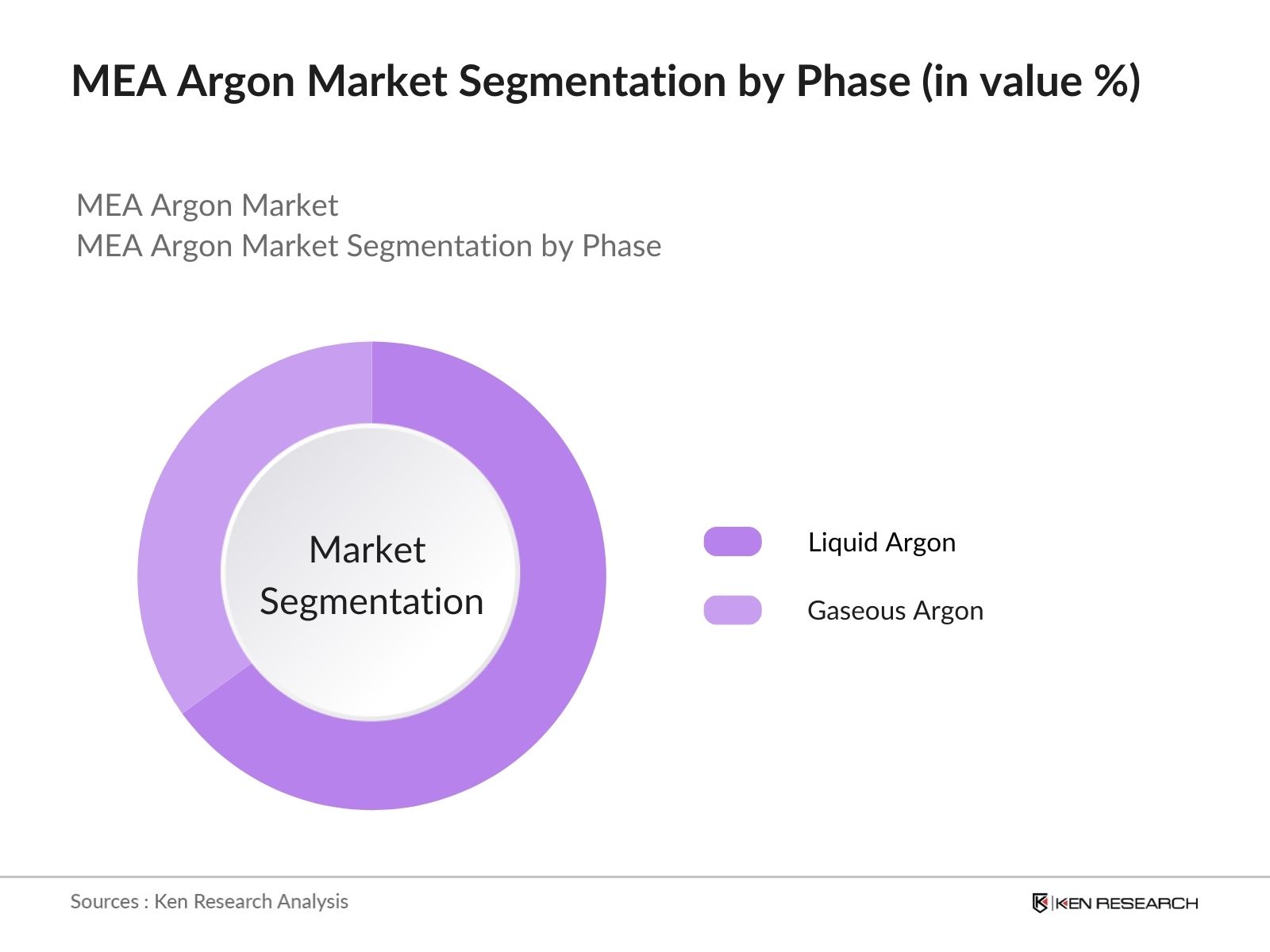
By Application: The market by application is segmented into Welding & Metal Manufacturing, Healthcare, Food and Beverage Preservation, and Electronics. The Welding & Metal Manufacturing segment holds a dominant position, as argons inert nature is ideal for shielding during welding processes. The segments leadership is also due to the regions robust construction and infrastructure projects, which extensively utilize argon-shielded welding, especially in major cities within GCC countries. 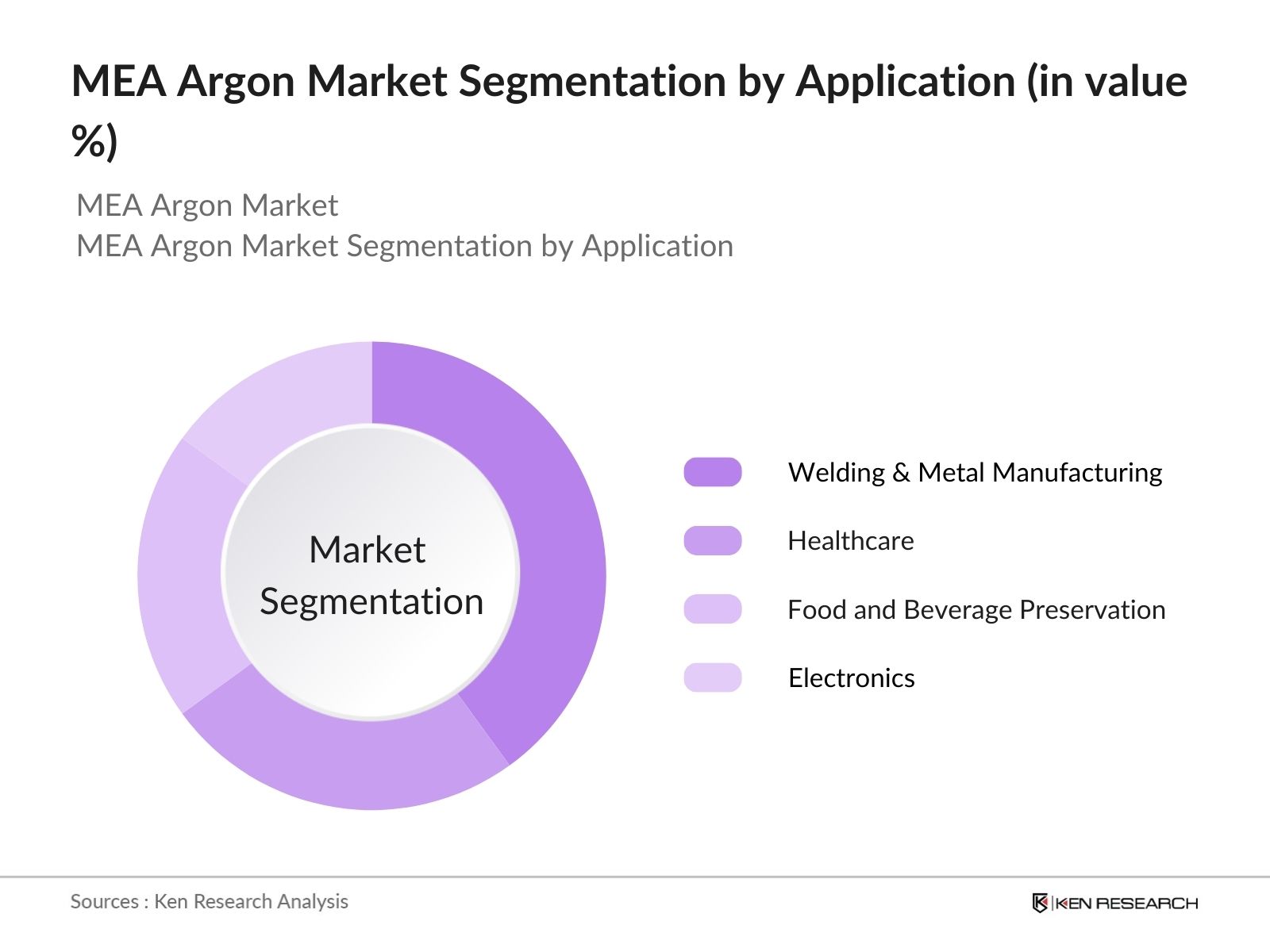
MEA Argon Market Competitive Landscape
The MEA Argon market is dominated by major global and regional players. These companies focus on expanding production capacities and strategic partnerships to strengthen their market positions.
The market is marked by the presence of industry giants such as Air Liquide and Linde Group, which leverage extensive distribution networks and production facilities to meet regional demand. Additionally, domestic players such as Gulf Cryo Holding K.S.C.C. play a significant role in supporting local markets with tailored solutions and agile supply chains.
|
Company |
Established |
Headquarters |
Production Capacity |
Key Markets |
Technology Investments |
Strategic Partnerships |
Regional Offices |
|
Air Liquide |
1902 |
France |
|||||
|
Linde Group |
1879 |
Germany |
|||||
|
Gulf Cryo Holding K.S.C.C. |
1953 |
Kuwait |
|||||
|
Air Products and Chemicals |
1940 |
USA |
|||||
|
Taiyo Nippon Sanso |
1910 |
Japan |
MEA Argon Industry Analysis
Growth Drivers
- Industrial Demand: In 2024, argon gas is integral to the MEA region's industrial sector, specifically in metal manufacturing and electronics. The metalworking sector, particularly in aluminum and steel production, has increased its demand for argon due to its role as an inert gas that prevents oxidation during welding and other high-temperature processes. For instance, aluminum production in the MEA region, concentrated heavily in the UAE, exceeded 2.6 million metric tons in 2023, all of which utilized argon for efficient smelting and welding processes. Electronics manufacturing also uses argon extensively in component assembly for microelectronics. With ongoing investments in electronics infrastructure, notably in Saudi Arabias industrial cities, this demand has strengthened, positioning argon as a critical industrial asset.
- Increased Usage in Healthcare and Food Packaging: Healthcare and food packaging sectors in the MEA are leveraging argon for its preservative properties. In the healthcare field, argon-based cryotherapy is increasingly utilized for cancer treatments, especially in oncology centers across the UAE and Saudi Arabia, which reported increased oncology treatment admissions in 2023. Argon is also essential in food packaging due to its ability to extend the shelf life of packaged foods by displacing oxygen, slowing down oxidation. This need is mirrored in Saudi Arabias food production sector, which recorded over 5 billion packaging units in 2023, requiring preservation for longer shelf life, especially in dairy and meat products.
- Adoption in Energy and Lighting Solutions: The adoption of argon in energy and lighting applications has seen significant growth in the MEA region. As the renewable energy market expands, energy-efficient lighting solutions have become essential, with argon used in fluorescent tubes and incandescent bulbs. Egypt, for instance, has one of the largest lighting markets in the region, with demand for incandescent and CFL lights reaching nearly 500 million units in 2022, much of which requires argon for efficient operation. Argon is also utilized in energy-efficient windows and insulations, critical for green building certifications in rapidly developing urban areas.
Market Challenges
- High Energy Costs: Argon production in the MEA is highly energy-intensive, with a reliance on air separation units that consume considerable electricity. High energy costs impact production expenses; for example, electricity prices in Saudi Arabia, a primary argon producer, have increased by over 20% between 2022 and 2024, adding significant costs to argon generation. This expense is further compounded in countries like Egypt, where fluctuating energy prices and a volatile energy supply network strain production operation, affecting pricing and accessibility for smaller industrial consumers.
- Supply Chain Volatility: The argon market in MEA faces ongoing supply chain issues due to geopolitical tensions and regional infrastructure challenges. These have led to disruptions in the transportation of compressed gases and challenges in maintaining steady supply lines. For instance, Egypt and Saudi Arabia, both key players in gas production, have seen transportation costs increase by up to 15% in the last two years. This escalation impacts the logistics of delivering argon to industrial and healthcare clients, adding operational risk and increasing final costs.
MEA Argon Market Future Outlook
The MEA Argon market is poised for continued growth as industrialization and infrastructure projects accelerate in the region. With increased adoption in healthcare for cryosurgery and in food preservation, demand for argon is likely to rise. Companies are expected to invest in advanced technologies, including enhanced storage solutions and distribution capabilities, to cater to regional requirements effectively.
Future Market Opportunities
- Expansion in Additive Manufacturing Applications: Additive manufacturing, which heavily relies on argon to create inert atmospheres for metal powder handling, is expanding rapidly across MEA. In 2023, the UAE reported a 30% increase in 3D printing applications within the automotive and aerospace sectors, both of which depend on argon for stable metal printing environments. Argon use in this sector is growing in tandem with government-led initiatives to bolster advanced manufacturing capabilities, making it a promising area for growth.
- Growing Demand in Electronics and Optics: The electronics and optics sectors in MEA continue to expand, with argon gas playing a critical role in producing high-purity atmospheres for semiconductor manufacturing and laser technologies. In 2023, Saudi Arabias electronics manufacturing base grew substantially, with substantial investments into semiconductor plants which require argon for laser diodes and other components. Argon is essential in optical fiber production, with Saudi Arabia and the UAE showing growth in telecom infrastructure, increasing argon demand in optical manufacturing.
Scope of the Report
|
By Phase |
Liquid Gas |
|
By Application |
Welding and Metal Manufacturing Healthcare Food and Beverage Packaging Electronics and Lighting |
|
By End-User |
Industrial Manufacturing Energy Sector Medical and Healthcare |
|
By Distribution Channel |
Direct Sales Distributors |
|
By Region |
GCC North Africa South Africa Rest of MEA |
Products
Key Target Audience
Industrial Manufacturing Firms
Healthcare Facilities and Medical Research Labs
Electronics Manufacturers
Food and Beverage Processing Plants
Construction and Infrastructure Companies
Investor and Venture Capitalist Firms
Government and Regulatory Bodies (e.g., Ministry of Industry and Mineral Resources, UAE; Ministry of Energy, Saudi Arabia)
Chemical Production Companies
Companies
Major Players
Air Liquide
Linde Group
Gulf Cryo Holding K.S.C.C.
Air Products and Chemicals
Taiyo Nippon Sanso
Messer Group GmbH
BOC Group
Nippon Steel Sumitomo Metal
BASF SE
Dubai Industrial Gases
Southern Industrial Gas Berhad
Coregas Pty Ltd
Iwatani Corporation
nexAir
American Gas Products
Table of Contents
MEA Argon Market Overview
1.1 Definition and Scope
1.2 Market Taxonomy
1.3 Market Dynamics
MEA Argon Market Size
2.1 Historical Market Size Analysis
2.2 Value Chain Milestones
2.3 Demand Drivers in the Market
MEA Argon Market Analysis
3.1 Key Growth Drivers (Energy Sector Demand, Technological Advancements, Supply Chain Developments)
3.2 Challenges (High Production Costs, Regulatory Compliance)
3.3 Opportunities (Industrial Innovations, Expansion of Medical and Specialty Gases)
3.4 Trends (Green Manufacturing, Digital Transformation in Production, Cost-Reduction Technologies)
3.5 Regulatory Environment (Environmental Compliance Standards, Regional Export/Import Policies)
3.6 Market Stakeholders
3.7 Porters Five Forces Analysis
3.8 Competitive Ecosystem
MEA Argon Market Segmentation
4.1 By Phase (In Value %)
4.1.1 Liquid
4.1.2 Gas
4.2 By Application (In Value %)
4.2.1 Welding and Metal Manufacturing
4.2.2 Healthcare
4.2.3 Food and Beverage Packaging
4.2.4 Electronics and Lighting
4.3 By End-User (In Value %)
4.3.1 Industrial Manufacturing
4.3.2 Energy Sector
4.3.3 Medical and Healthcare
4.4 By Distribution Channel (In Value %)
4.4.1 Direct Sales
4.4.2 Distributors
4.5 By Region (In Value %)
4.5.1 GCC
4.5.2 North Africa
4.5.3 South Africa
4.5.4 Rest of MEA
MEA Argon Market Competitive Analysis
5.1 Detailed Profiles of Major Competitors
5.1.1 Air Liquide
5.1.2 Linde plc
5.1.3 Air Products and Chemicals Inc.
5.1.4 Messer Group
5.1.5 Praxair, Inc.
5.1.6 Gulf Cryo
5.1.7 Taiyo Nippon Sanso Corporation
5.1.8 Emirates Industrial Gases Co.
5.1.9 Matheson Tri-Gas, Inc.
5.1.10 Southern Gas
5.1.11 Saudi Industrial Gas Co. Ltd (SIGAS)
5.1.12 Yateem Oxygen
5.1.13 National Industrial Gas Plants (NIGP)
5.1.14 BASF SE
5.1.15 Gasco
5.2 Cross Comparison Parameters (Product Portfolio, Market Presence, R&D Investment, Key Distribution Channels, Environmental Sustainability, Production Capacity, Regional Coverage, Strategic Partnerships)
5.3 Market Share Analysis
5.4 Strategic Initiatives by Key Players
5.5 Mergers and Acquisitions
5.6 Capital Investments in the Region
5.7 Government and Private Equity Funding
MEA Argon Market Regulatory Framework
6.1 Industry Standards and Certification Requirements
6.2 Environmental Regulations Affecting Argon Production
6.3 Safety and Handling Regulations
MEA Argon Future Market Size
7.1 Projected Demand and Key Influencing Factors
7.2 Strategic Developments Supporting Market Growth
MEA Argon Future Market Segmentation
8.1 By Production Process
8.2 By End-Use Industry
8.3 By Purity Level
8.4 By Application
8.5 By Distribution Channel
MEA Argon Market Analysts Recommendations
9.1 Customer and Industry-Specific Market Strategies
9.2 Key Growth Opportunities by Segment
9.3 Market Entry Strategies
9.4 White Space Analysis in Regional Markets
Disclaimer
Contact Us
Research Methodology
Step 1: Identification of Key Variables
The initial phase focuses on mapping the MEA Argon Markets primary stakeholders and market dynamics. This involved extensive research using secondary databases and proprietary information to define the critical factors influencing the market.
Step 2: Market Analysis and Data Collection
This phase includes historical data analysis for argon demand, supply chain structures, and industrial applications in MEA. Data validation is performed through comprehensive reviews of market penetration rates, revenue trends, and technological adoption.
Step 3: Expert Consultations and Validation
Market hypotheses were tested through interviews with industry professionals from leading Argon suppliers and end-users in various sectors. These insights helped confirm and refine the market data collected.
Step 4: Data Synthesis and Final Review
The final phase includes data synthesis through direct consultations with industrial gas companies. This ensures an accurate representation of current trends, production methods, and market segmentation analysis for the MEA Argon market.
Frequently Asked Questions
01. How big is the MEA Argon Market?
The MEA Argon Market is valued at USD 1.02 billion, primarily driven by demand from the welding, healthcare, and electronics sectors, backed by industrial expansion across key regions.
02. What are the challenges in the MEA Argon Market?
Challenges in the MEA Argon market include high energy costs, logistical complexities due to supply chain disruptions, and strict environmental regulations that affect production processes.
03. Who are the major players in the MEA Argon Market?
Key players in the MEA Argon Market include Air Liquide, Linde Group, Gulf Cryo Holding, Air Products, and Taiyo Nippon Sanso, which dominate due to their expansive distribution networks and technological advancements.
04. What are the growth drivers of the MEA Argon Market?
Growth in the MEA Argon Market is driven by industrial demand in manufacturing and healthcare applications, as well as the increased need for high-purity argon in electronics and food preservation.
05. What regions are dominant in the MEA Argon Market?
The UAE and Saudi Arabia lead the MEA Argon Market due to their well-established industrial infrastructure and significant investments in sectors that heavily use argon.
Why Buy From Us?

What makes us stand out is that our consultants follows Robust, Refine and Result (RRR) methodology. i.e. Robust for clear definitions, approaches and sanity checking, Refine for differentiating respondents facts and opinions and Result for presenting data with story

We have set a benchmark in the industry by offering our clients with syndicated and customized market research reports featuring coverage of entire market as well as meticulous research and analyst insights.

While we don't replace traditional research, we flip the method upside down. Our dual approach of Top Bottom & Bottom Top ensures quality deliverable by not just verifying company fundamentals but also looking at the sector and macroeconomic factors.

With one step in the future, our research team constantly tries to show you the bigger picture. We help with some of the tough questions you may encounter along the way: How is the industry positioned? Best marketing channel? KPI's of competitors? By aligning every element, we help maximize success.

Our report gives you instant access to the answers and sources that other companies might choose to hide. We elaborate each steps of research methodology we have used and showcase you the sample size to earn your trust.

If you need any support, we are here! We pride ourselves on universe strength, data quality, and quick, friendly, and professional service.