Ken Research Logo

MEA Identity Verification Market Outlook to 2030

Region:Global

Author(s):Shambhavi

Product Code:KROD2202

Published On

December 2024

Total pages

91

About the Report

MEA Identity verification Market Overview

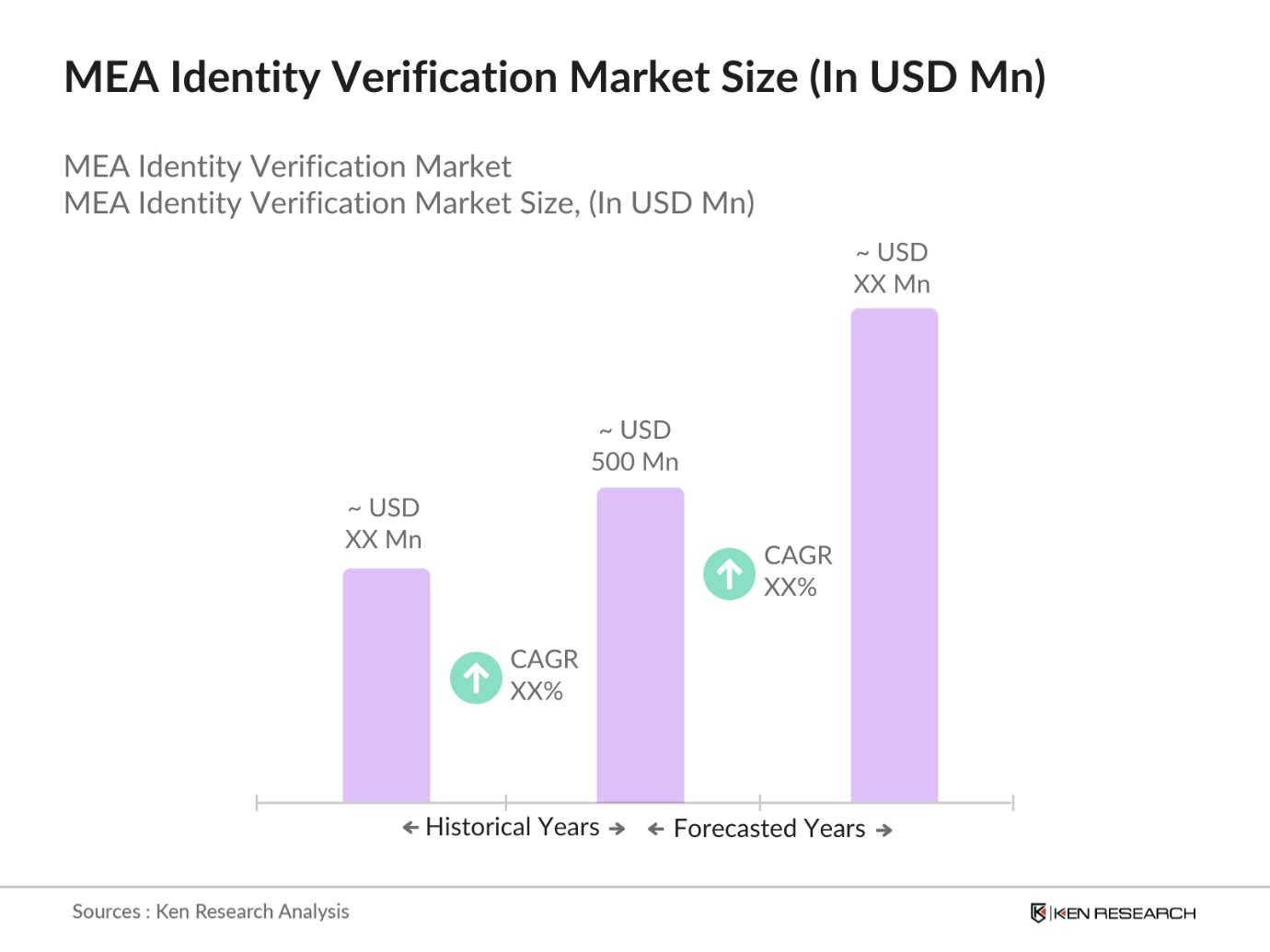
  • The Middle East and Africa (MEA) identity verification market has seen significant growth over the past few years, driven by the increasing adoption of biometric technologies and identity verification solutions across various sectors, including government, finance, healthcare, and telecom. The market size for identity verification in MEA in 2023 stood at USD 500 million. This growth is supported by increased governmental efforts to strengthen digital identity infrastructure and the rising demand for secure authentication methods.
  • MEA Identity verification Market Size
  • Key players in the MEA identity verification market include Thales Group, IDEMIA, HID Global, NEC Corporation, and Gemalto. These companies dominate the market by offering advanced identity verification and biometric solutions tailored to the needs of governments, financial institutions, and enterprises. Thales, for example, provides secure ID solutions for national programs, while HID Global specializes in digital credentials and access management.
  • A major recent development in the MEA identity verification market was the announcement of the Emirates Digital Identity System by the UAE in early 2023. The initiative seeks to establish a unified digital identity framework across federal and local levels, enhancing the security of e-government services. By mid-2023, over 500,000 UAE residents had registered for the system.
  • The cities leading the identity verification market in MEA include Dubai, Riyadh, and Johannesburg. Dubai dominates due to its advanced technological infrastructure, government support for digital transformation, and widespread use of e-government services. Riyadh follows, driven by Saudi Arabias Vision 2030 initiatives, which emphasize digital innovation across multiple sectors.

MEA Identity verification Market Segmentation

By Technology Type: The MEA identity verification market is segmented by technology type into biometric identification, smart card technology, and digital identity platforms. In 2023, biometric identification had a dominant market share due to its extensive use across various sectors such as banking, healthcare, and government services. The growing emphasis on security and the increasing prevalence of identity theft have spurred the demand for biometric technologies, particularly facial recognition and fingerprint scanning, which are seen as more secure alternatives to traditional methods of identification.
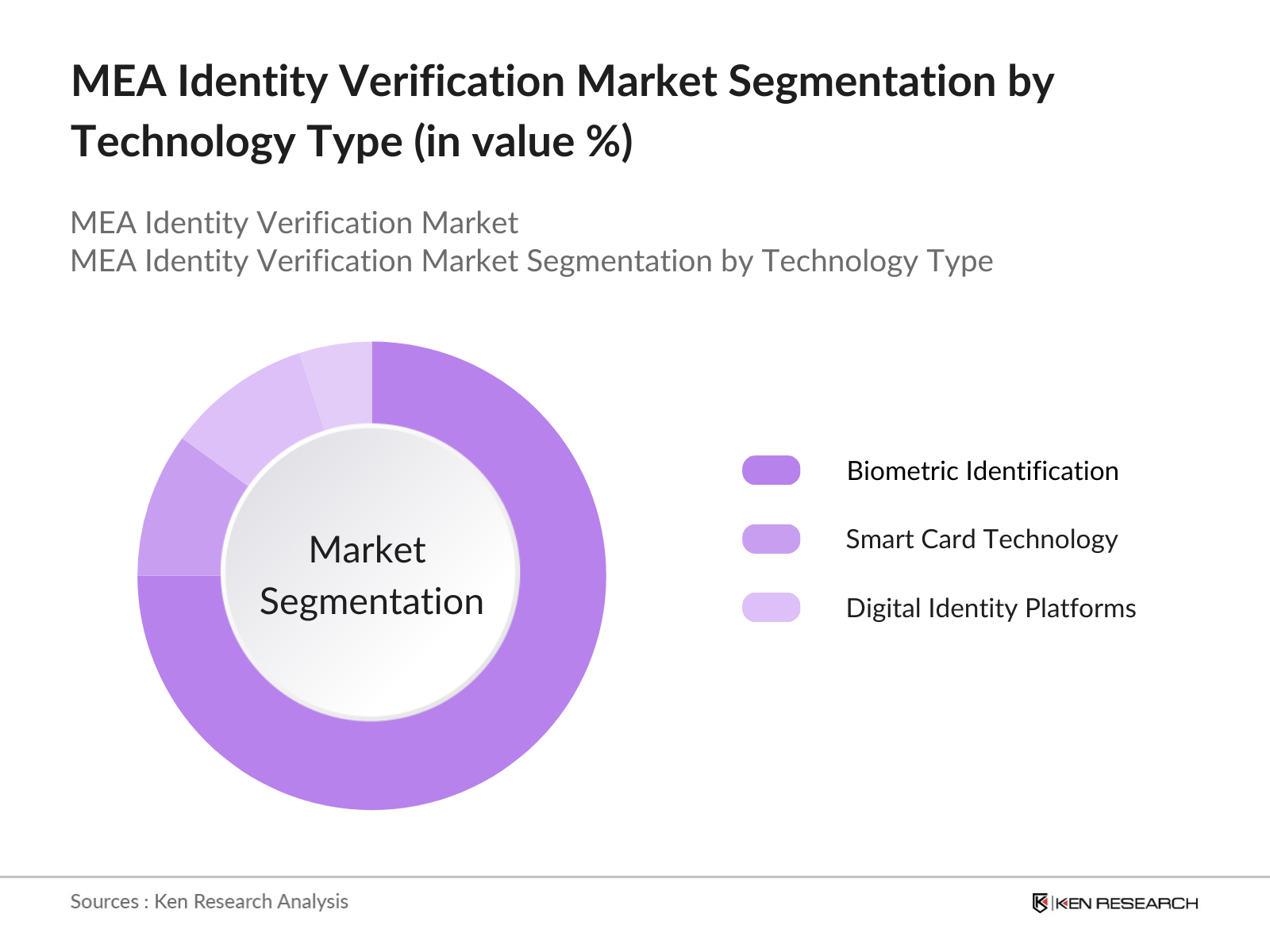
MEA Identity verification Market Segmentation By Technology Type

By End-User Industry: By end-user industry, the market is segmented into government, financial services, healthcare, and telecom. In 2023, the financial services industry held the largest share of the identity verification market in MEA. This is driven by the growing need for secure, seamless digital banking solutions, coupled with an increasing shift towards online and mobile banking services. Financial institutions are integrating digital identity verification systems to ensure security, streamline processes, and comply with stringent regulatory requirements. Additionally, biometric solutions are being employed for fraud prevention and customer onboarding.
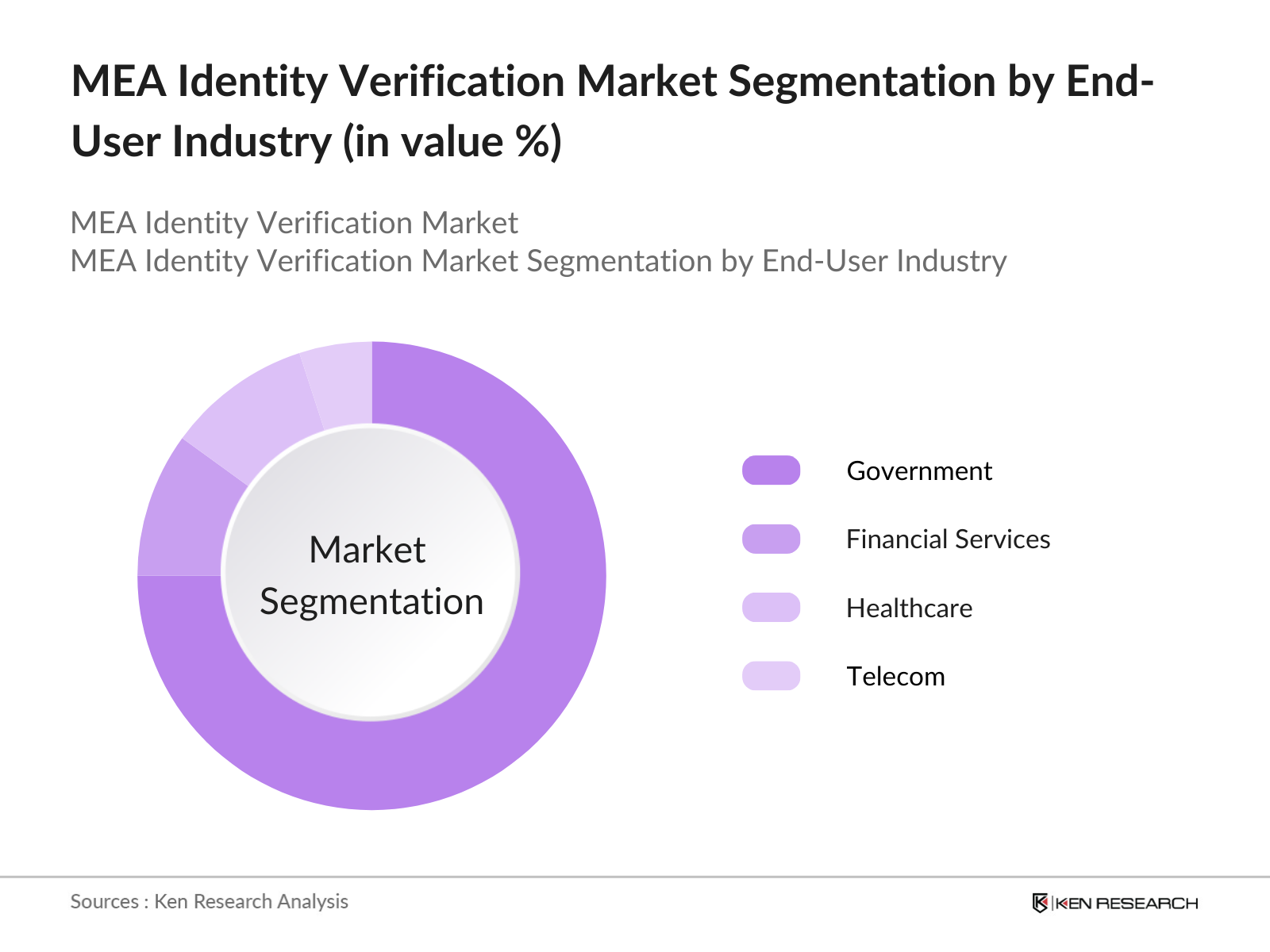
MEA Identity verification Market Segmentation By End-User Industry

By Region: The MEA identity verification market is also segmented by regions, including Israel, United Arab Emirates, Jordan, Morocco, South Africa, and the rest of MEA. In 2023, the United Arab Emirates held the dominant market share due to its advanced digital infrastructure and government initiatives aimed at improving identity verification services. The UAE government has made significant investments in digital identity systems, including the Emirates Digital Identity System, which simplifies access to e-government services and ensures secure digital transactions.

MEA Identity verification Market Competitive Landscape

Company

Establishment Year

Headquarters

Thales Group

2000

Paris, France

IDEMIA

2007

Courbevoie, France

HID Global

1991

Austin, Texas, USA

NEC Corporation

1899

Tokyo, Japan

Gemalto

2006

Meudon, France

  • Thales Group: In 2023, Thales Group secured a contract with the South African government to provide its digital ID solutions for the nations e-governance initiatives. The companys biometric authentication systems will be integrated into public services, ensuring secure access to digital platforms. In 2024, Thales has a long-standing presence in South Africa, having supported local initiatives and employed 175 people in the region, reflecting its commitment to local development and corporate social responsibility.
  • IDEMIA: IDEMIA launched its new biometric-based identity verification system for banking applications in early 2023. By mid-2024, it had partnered with several major banks in the UAE and Saudi Arabia to implement these systems, focusing on enhancing security in mobile and online banking platforms. IDEMIAs technology has been instrumental in reducing fraud and improving customer experience in digital financial services.

MEA Identity verification Market Analysis

Growth Drivers

  • Increased Demand for Biometric Solutions in Financial Services
    The financial services sector in the MEA region has seen a surge in demand for biometric authentication solutions. In 2023, over 2 million customers in Saudi Arabia alone registered for biometric-based digital banking services, according to the Saudi Arabian Monetary Authority (SAMA). The rise in mobile banking users, which stood at 18 million in 2024, is fueling the demand for secure authentication methods like fingerprint and facial recognition. As digital transactions increase across the region, financial institutions are turning to these solutions to mitigate fraud, thereby driving the market for identity verification systems.
  • National Digital Identity Initiatives
    Countries such as the UAE and South Africa are investing heavily in national digital identity programs, which have become a major driver of market growth. In 2024, the UAE's federal government announced that over 1.5 million users were now registered under the Emirates Digital Identity System. Similarly, South Africa's Department of Home Affairs has enrolled 20 million citizens in its national biometric system as of mid-2024. These initiatives are enhancing access to e-government services and streamlining interactions between citizens and the state, significantly driving the demand for advanced identity verification technologies.
  • Rising E-Commerce Activity and Digital Transactions
    The rapid growth of e-commerce platforms in MEA, driven by a large, young, and tech-savvy population, is a significant driver of identity verification adoption. In 2024, it was reported that e-commerce transactions in the region surpassed USD 100 billion, according to the UAE Ministry of Economy. As online retail and digital payments become more widespread, businesses are increasingly relying on secure digital identity systems to authenticate users and prevent fraud. This trend is particularly strong in the UAE, Saudi Arabia, and Egypt, where digital payment systems are becoming the norm in e-commerce.

Challenges

  • Data Privacy Concerns
    As governments and private entities implement large-scale biometric databases, there are growing concerns about data privacy and the misuse of personal information. In 2024, South Africas Protection of Personal Information Act (POPIA) led to a nationwide debate on the security of biometric data collected under national ID programs. Citizens have raised concerns about how this data could be misused, particularly after a high-profile data breach in 2023 that exposed the personal information of over 500,000 users. This has prompted governments and companies to invest in advanced encryption and security protocols, but data privacy concerns remain a significant challenge.
  • High Implementation Costs
    Despite the clear benefits of identity verification systems, the initial implementation costs are prohibitively high, particularly for smaller businesses and government agencies in less economically developed countries within the MEA region. In 2023, it was estimated that the rollout of the Emirates Digital Identity System cost the UAE government USD 800 million. The hardware and software costs associated with biometric technologies, such as facial recognition and fingerprint scanning, are substantial, making it difficult for some organizations to adopt these systems at scale. This remains a barrier to wider market penetration, particularly in countries with tighter budgets.

Government Initiatives

  • UAE Emirates Digital Identity System (2023)
    Launched in 2023, the Emirates Digital Identity System is a flagship initiative by the UAE government aimed at creating a unified digital identity for all residents. As of early 2024, the system has over 1.5 million registered users, allowing citizens to access various government services securely and seamlessly. The initiative is part of the UAEs broader efforts to modernize its public sector through digital transformation, supporting e-governance and enhancing public trust in digital services.
  • Saudi Arabias National Digital Transformation Program (2023)
    As part of Saudi Arabias Vision 2030, the National Digital Transformation Program was launched in 2023 to improve the countrys digital infrastructure, with a particular focus on digital identity systems. By mid-2024, the government reported that more than 2 million citizens had registered for the new biometric-based identity platform, which allows for secure access to both public and private sector services. The programs goal is to create a more efficient, transparent, and accessible public administration system through advanced digital technologies.

MEA Identity verification Market Future Outlook

The MEA identity verification market is set to experience rapid expansion over the next five years, driven by a combination of government initiatives, the proliferation of biometric technologies, and rising demand for secure digital transactions. Governments in the region, particularly in the UAE and Saudi Arabia, are leading the charge with large-scale national identity programs that aim to bring digital services to their populations, improving public sector efficiency and security. Additionally, the growing need for identity verification in sectors such as financial services, healthcare, and e-commerce is expected to continue propelling the market forward.

Future Trends

  • Expansion of Biometric Technologies in Public Services
    Over the next five years, governments in the MEA region will increasingly integrate biometric technologies into their public services. Countries like the UAE and Saudi Arabia are expected to expand their national ID programs to include more advanced biometric verification systems such as iris scanning and facial recognition, which will improve both security and access to public services.
  • Growth in Mobile Identity Solutions
    Mobile identity solutions will gain significant traction in the MEA region by 2028, driven by the widespread adoption of smartphones and mobile networks. As more citizens engage in digital transactions through mobile devices, telecom operators and financial institutions will increasingly offer mobile-based identity verification systems to ensure security and user convenience.

Scope of the Report

By Technology Type

Biometric Identification

Smart Card Technology

Digital Identity Platforms

By End User

Government

Financial Services

Healthcare

Telecom

By Region

Israel

United Arab Emirates

Jordan

Morocco

South Africa

Rest of MEA

Products

Key Target Audience Organizations and Entities Who Can Benefit by Subscribing This Report:

  • Financial institutions

  • Telecom companies

  • Healthcare providers

  • Biometric solution providers

  • National identification authorities

  • Tech infrastructure providers

  • E-commerce platforms

  • Insurance companies

  • Investors and venture capitalist firms

  • Government and regulatory bodies (UAE Digital Authority, Saudi Arabian Ministry of Communications and Information Technology)

Time Period Captured in the Report:

  • Historical Period: 2018-2023

  • Base Year: 2023

  • Forecast Period: 2023-2028

Companies

Players Mentioned in the Report:

  • Thales Group

  • IDEMIA

  • HID Global

  • NEC Corporation

  • Gemalto

  • Accenture

  • Cognitec Systems

  • Suprema Inc.

  • Veridos

  • BioID

  • FaceTec

  • Innovatrics

  • Iris ID Systems

  • Smartmatic

Table of Contents

1. MEA Identity Verification Market Overview

1.1. Definition and Scope
1.2. Market Taxonomy
1.3. Market Dynamics Overview
1.4. MEA Identity Verification Market Ecosystem

2. MEA Identity Verification Market Size (in USD)

2.1. Historical Market Size
2.2. Year-on-Year Growth Analysis
2.3. Key Market Developments and Milestones

3. MEA Identity Verification Market Analysis

3.1. Growth Drivers
3.1.1. Increasing demand for biometric verification in banking and financial services
3.1.2. Government-led national identity programs
3.1.3. Rise of e-commerce and digital payments requiring secure identity verification
3.2. Market Challenges
3.2.1. High implementation costs
3.2.2. Data privacy concerns
3.2.3. Lack of digital infrastructure in rural areas
3.3. Market Opportunities
3.3.1. Expansion to small and medium-sized enterprises
3.3.2. Adoption of biometric technologies in healthcare and e-government services
3.3.3. Potential for international collaborations
3.4. Market Trends
3.4.1. AI integration in biometric verification
3.4.2. Mobile-based identity verification solutions
3.4.3. Blockchain for enhanced security
3.5. Government Regulations
3.5.1. UAEs Emirates Digital Identity System (2023)
3.5.2. Saudi Arabias National Digital Transformation Program (2023)
3.5.3. South Africas Biometric National ID Program (2022)
3.6. SWOT Analysis
3.7. Stakeholder Ecosystem

4. MEA Identity Verification Market Segmentation

4.1. By Technology Type (in value %)
4.1.1. Biometric Identification
4.1.2. Smart Card Technology
4.1.3. Digital Identity Platforms
4.2. By End-User Industry (in value %)
4.2.1. Government
4.2.2. Financial Services
4.2.3. Healthcare
4.2.4. Telecom
4.3. By Solution Type (in value %)
4.3.1. Identity Verification Solutions
4.3.2. Authentication and Access Management
4.3.3. Biometric Data Capture Solutions
4.4. By Deployment Type (in value %)
4.4.1. On-premise
4.4.2. Cloud-based
4.5. By Region (in value %)
4.5.1. Israel
4.5.2. United Arab Emirates
4.5.3. Jordan
4.5.4. Morocco
4.5.5. South Africa
4.5.6. Rest of MEA

5. MEA Identity Verification Market Cross-Comparison

5.1. Detailed Profiles of Major Companies
5.1.1. Thales Group
5.1.2. IDEMIA
5.1.3. HID Global
5.1.4. NEC Corporation
5.1.5. Gemalto
5.1.6. Accenture
5.1.7. Cognitec Systems
5.1.8. Suprema Inc.
5.1.9. Veridos
5.1.10. BioID
5.1.11. FaceTec
5.1.12. Innovatrics
5.1.13. Iris ID Systems
5.1.14. Smartmatic
5.1.15. ZKTeco
5.2. Cross-Comparison Parameters (number of employees, headquarters, inception year, revenue)

6. MEA Identity Verification Market Competitive Landscape

6.1. Market Share Analysis
6.2. Strategic Initiatives
6.3. Mergers and Acquisitions
6.4. Investment Analysis
6.4.1. Venture Capital Funding
6.4.2. Government Grants and Investments
6.4.3. Private Equity Investments

7. MEA Identity Verification Market Regulatory Framework

7.1. Identity Verification Standards
7.2. Compliance Requirements
7.3. Certification Processes

8. MEA Identity Verification Future Market Size (in USD)

8.1. Future Market Size Projections
8.2. Key Factors Driving Future Market Growth

9. MEA Identity Verification Future Market Segmentation

9.1. By Technology Type (in value %)
9.2. By End-User Industry (in value %)
9.3. By Solution Type (in value %)
9.4. By Deployment Type (in value %)
9.5. By Region (in value %)

10. MEA Identity Verification Market Analysts' Recommendations

10.1. TAM/SAM/SOM Analysis
10.2. Customer Cohort Analysis
10.3. Marketing Initiatives
10.4. White Space Opportunity Analysis

Disclaimer Contact Us

Research Methodology

Step 1: Identifying Key Variables

Ecosystem creation for all major entities and referring to multiple secondary and proprietary databases to perform desk research around the market to collate market-level information.

Step 2: Market Building

Collating statistics on the MEA Identity Verification Market over the years, analyzing the penetration of MEA Identity Verification technologies, and computing the revenue generated for the market. This step also involves reviewing technology adoption rates and application effectiveness to ensure accuracy behind the data points shared.

Step 3: Validating and Finalizing

Building market hypotheses and conducting CATIs with market experts belonging to different companies to validate statistics and seek operational and financial information from company representatives.

Step 4: Research Output

Our team will approach multiple MEA Identity Verification companies to understand the nature of technology segments, consumer preferences, and other parameters. This supports validating statistics derived through a bottom-to-top approach from these MEA Identity Verification companies, ensuring accuracy and reliability in the report.

Frequently Asked Questions

01 How big is the MEA Identity verification Market?

The MEA identity verification market was valued at USD 500 million in 2023, driven by increasing government-led initiatives for digital transformation, the proliferation of biometric technologies, and growing demand for secure digital transactions across various sectors.

02 What are the challenges in the MEA Identity verification Market?

Key challenges include data privacy concerns, high implementation costs, and the lack of digital infrastructure in rural areas. Additionally, regulatory hurdles and the high cost of biometric technologies pose significant barriers to market expansion, especially in less economically developed regions.

03 Who are the major players in the MEA Identity verification Market?

Major players in the MEA identity verification market include Thales Group, IDEMIA, HID Global, NEC Corporation, and Gemalto. These companies lead the market due to their advanced biometric solutions, strong government partnerships, and extensive technological expertise.

04 What are the growth drivers of the MEA Identity verification Market?

Growth is driven by the increasing adoption of biometric authentication in financial services, national digital identity programs in countries like the UAE and Saudi Arabia, and the rise in e-commerce activities that require secure digital verification systems. These factors contribute to the growing demand for advanced identity solutions.

Why Buy From Us?

RRR
Refine Robust Result (RRR) Framework

What makes us stand out is that our consultants follows Robust, Refine and Result (RRR) methodology. i.e. Robust for clear definitions, approaches and sanity checking, Refine for differentiating respondents facts and opinions and Result for presenting data with story

Our Reach Is Unmatched

We have set a benchmark in the industry by offering our clients with syndicated and customized market research reports featuring coverage of entire market as well as meticulous research and analyst insights.

Research
Shifting the Research Paradigm

While we don't replace traditional research, we flip the method upside down. Our dual approach of Top Bottom & Bottom Top ensures quality deliverable by not just verifying company fundamentals but also looking at the sector and macroeconomic factors.

Insite
More Insights-Better Decisions

With one step in the future, our research team constantly tries to show you the bigger picture. We help with some of the tough questions you may encounter along the way: How is the industry positioned? Best marketing channel? KPI's of competitors? By aligning every element, we help maximize success.

Trust
Transparency and Trust

Our report gives you instant access to the answers and sources that other companies might choose to hide. We elaborate each steps of research methodology we have used and showcase you the sample size to earn your trust.

support
Round the Clock Support

If you need any support, we are here! We pride ourselves on universe strength, data quality, and quick, friendly, and professional service.

Why Client Choose Us?

400000+ Reports in repository
150+ Consulting project a year
100+ Analysts
8000+ Client Queries in 2022