About the Report
Base Year 2024Listen to the audio summary
Mexico Drone Crop Monitoring Market Overview
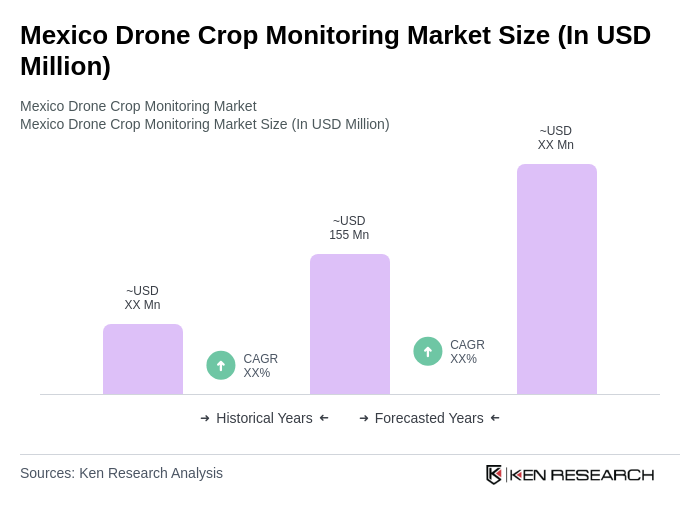
- The Mexico Drone Crop Monitoring Market is valued at USD 155 million, based on a five-year historical analysis. This growth is primarily driven by the increasing adoption of precision agriculture techniques, which enhance crop yield and reduce resource wastage. The integration of advanced technologies such as AI and machine learning in drone operations has further propelled market expansion, enabling farmers to make data-driven decisions. The market is also benefiting from the rising demand for crop health monitoring and surveillance, as drones equipped with multispectral and thermal sensors allow for early detection of pests, diseases, and nutrient deficiencies, improving farm productivity and sustainability .
- Key regions dominating the market includeJalisco, Guanajuato, and Michoacán. These areas are characterized by a high concentration of agricultural activities and a growing number of tech-savvy farmers who are eager to adopt innovative solutions. The presence of agricultural research institutions and government support initiatives in these regions also contributes to their market leadership. In Michoacán, for example, drones are widely used for orchard health monitoring in avocado production, while in arid regions such as Sonora, drones help optimize irrigation schedules .
- The regulatory framework for drone use in Mexican agriculture is governed by theReglamento de la Ley de Aviación Civil en Materia de Aeronaves Pilotadas a Distancia (RPAS), issued by the Agencia Federal de Aviación Civil (AFAC) in 2020. This regulation requires all commercial drone operators to obtain a special permit, comply with operational safety standards, and register their drones with the AFAC. The regulation covers operational limits, pilot certification, and airspace management, fostering a more organized and efficient drone operation environment in the agricultural sector .
Mexico Drone Crop Monitoring Market Segmentation
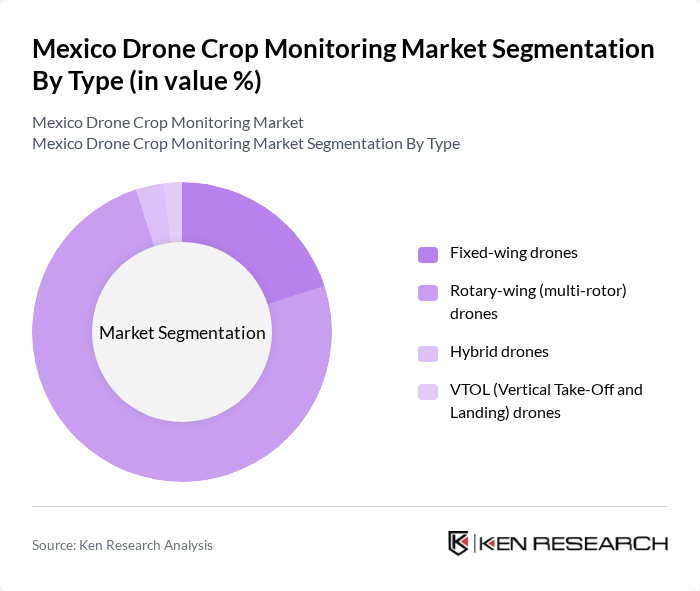
By Type:The market is segmented into four types of drones: Fixed-wing drones, Rotary-wing (multi-rotor) drones, Hybrid drones, and VTOL (Vertical Take-Off and Landing) drones. Each type serves different agricultural needs, with fixed-wing drones being preferred for large area coverage, while rotary-wing drones are favored for their maneuverability and ease of use in smaller fields. Hybrid and VTOL drones combine the advantages of both types, catering to diverse farming requirements. In recent years, rotary-wing drones have accounted for the largest market share due to their versatility and cost-effectiveness, while fixed-wing drones are gaining traction for large-scale commercial applications .
By End-User:The end-user segmentation includes Large-scale commercial farms, Smallholder farms, Agricultural service providers, and Research and academic institutions. Large-scale commercial farms dominate the market due to their significant investment in technology and the need for efficient crop management. Smallholder farms are increasingly adopting drone technology to enhance productivity, while agricultural service providers offer drone services to various clients, including research institutions. The trend toward digital agriculture and government modernization programs is accelerating adoption across all segments .

Mexico Drone Crop Monitoring Market Competitive Landscape
The Mexico Drone Crop Monitoring Market is characterized by a dynamic mix of regional and international players. Leading participants such as DJI Technology Co., Ltd., Parrot Drones S.A.S., senseFly SA (an AgEagle company), AgEagle Aerial Systems Inc., PrecisionHawk Inc., Delair SAS, Skydio, Inc., AeroVironment, Inc., Quantum Systems GmbH, Wingtra AG, MicaSense, Inc., Sentera, Inc., DroneDeploy, Inc., Raptor Maps, Inc., Trimble Inc., Draganfly Inc., Autel Robotics Co., Ltd., Pix4D S.A., Sky-Drones Technologies Ltd., and Agrasolutions S.A.P.I. de C.V. contribute to innovation, geographic expansion, and service delivery in this space.
Mexico Drone Crop Monitoring Market Industry Analysis
Growth Drivers
- Increasing Demand for Precision Agriculture:The Mexican agricultural sector is increasingly adopting precision agriculture techniques, with an estimated 35% of farmers utilizing advanced technologies in future. This shift is driven by the need to enhance crop yields and optimize resource use. The World Bank reports that precision agriculture can increase productivity by up to 20%, making drone crop monitoring essential for farmers aiming to meet rising food demands while minimizing environmental impact.
- Technological Advancements in Drone Capabilities:The drone technology landscape is evolving rapidly, with advancements in sensors and imaging technologies. The average cost of high-resolution multispectral cameras is projected to decrease by 10%, making them more accessible to farmers. This technological evolution allows for more accurate crop health assessments, enabling farmers to make data-driven decisions that can lead to a 12% increase in overall crop productivity.
- Government Support and Subsidies for Agricultural Technology:The Mexican government has allocated approximately $250 million in subsidies for agricultural technology initiatives in future. This funding aims to promote the adoption of innovative solutions, including drone technology. Such support is crucial for smallholder farmers, who represent 80% of the agricultural sector, as it helps reduce the financial burden associated with acquiring advanced monitoring tools, thereby fostering growth in the drone crop monitoring market.
Market Challenges
- High Initial Investment Costs:The initial investment required for drone technology can be a significant barrier for many farmers. The average cost of a commercial drone setup, including hardware and software, is around $18,000. This high upfront cost can deter adoption, especially among smallholder farmers, who often operate on tight budgets. As a result, only 12% of farmers in rural areas have adopted drone technology, limiting market growth potential.
- Regulatory Hurdles and Compliance Issues:Navigating the regulatory landscape for drone operations in Mexico poses challenges for farmers. The Mexican government has established stringent regulations, requiring drone operators to obtain licenses and comply with safety standards. As of future, only 30% of drone operators are fully compliant with these regulations, creating uncertainty and hindering the widespread adoption of drone crop monitoring solutions in the agricultural sector.
Mexico Drone Crop Monitoring Market Future Outlook
The future of the Mexico drone crop monitoring market appears promising, driven by technological advancements and increasing awareness of sustainable farming practices. As farmers seek to enhance productivity and reduce environmental impact, the integration of drones with IoT and AI technologies is expected to gain traction. Additionally, the expansion of drone services into underserved rural areas will likely facilitate greater adoption, enabling farmers to leverage data analytics for improved decision-making and resource management.
Market Opportunities
- Expansion into Underserved Rural Areas:There is a significant opportunity to expand drone crop monitoring services into rural areas, where only 20% of farmers currently utilize such technology. By targeting these regions, companies can tap into a largely untapped market, potentially increasing their customer base by 60% over the next few years, thereby driving overall market growth.
- Integration with IoT and AI Technologies:The integration of drone technology with IoT and AI can enhance data collection and analysis capabilities. The market for IoT in agriculture is expected to reach $12 billion in Mexico in future. This convergence will enable farmers to receive real-time insights, improving crop management and potentially increasing yields by 18%, creating a lucrative opportunity for technology providers.
Scope of the Report
| Segment | Sub-Segments |
|---|---|
| By Type | Fixed-wing drones Rotary-wing (multi-rotor) drones Hybrid drones VTOL (Vertical Take-Off and Landing) drones |
| By End-User | Large-scale commercial farms Smallholder farms Agricultural service providers Research and academic institutions |
| By Application | Crop health monitoring & surveillance Soil and field analysis Irrigation & water management Pest and disease detection Precision spraying & fertilization |
| By Distribution Channel | Direct sales (OEMs) Online platforms Distributors and resellers System integrators |
| By Region | Northern Mexico Central Mexico Southern Mexico Baja California and Pacific Coast |
| By Investment Source | Private investments Government funding International grants Venture capital & agri-tech funds |
| By Policy Support | Subsidies for drone purchases Tax incentives for agricultural technology Research and development grants Pilot programs and demonstration projects |
Key Target Audience
Investors and Venture Capitalist Firms
Government and Regulatory Bodies (e.g., Secretaría de Agricultura y Desarrollo Rural, Comisión Nacional de Agricultura)
Agricultural Producers and Cooperatives
Drone Manufacturers and Suppliers
Agricultural Technology Startups
Agri-tech Industry Associations
Financial Institutions and Banks
Insurance Companies specializing in Agriculture
Players Mentioned in the Report:
DJI Technology Co., Ltd.
Parrot Drones S.A.S.
senseFly SA (an AgEagle company)
AgEagle Aerial Systems Inc.
PrecisionHawk Inc.
Delair SAS
Skydio, Inc.
AeroVironment, Inc.
Quantum Systems GmbH
Wingtra AG
MicaSense, Inc.
Sentera, Inc.
DroneDeploy, Inc.
Raptor Maps, Inc.
Trimble Inc.
Draganfly Inc.
Autel Robotics Co., Ltd.
Pix4D S.A.
Sky-Drones Technologies Ltd.
Agrasolutions S.A.P.I. de C.V.
Table of Contents
Market Assessment Phase
1. Executive Summary and Approach
2. Mexico Drone Crop Monitoring Market Overview
2.1 Key Insights and Strategic Recommendations
2.2 Mexico Drone Crop Monitoring Market Overview
2.3 Definition and Scope
2.4 Evolution of Market Ecosystem
2.5 Timeline of Key Regulatory Milestones
2.6 Value Chain & Stakeholder Mapping
2.7 Business Cycle Analysis
2.8 Policy & Incentive Landscape
3. Mexico Drone Crop Monitoring Market Analysis
3.1 Growth Drivers
3.1.1 Increasing demand for precision agriculture
3.1.2 Technological advancements in drone capabilities
3.1.3 Government support and subsidies for agricultural technology
3.1.4 Rising awareness of sustainable farming practices
3.2 Market Challenges
3.2.1 High initial investment costs
3.2.2 Regulatory hurdles and compliance issues
3.2.3 Limited technical expertise among farmers
3.2.4 Data privacy and security concerns
3.3 Market Opportunities
3.3.1 Expansion into underserved rural areas
3.3.2 Integration with IoT and AI technologies
3.3.3 Development of customized drone solutions
3.3.4 Partnerships with agricultural cooperatives
3.4 Market Trends
3.4.1 Increasing adoption of UAVs for crop health monitoring
3.4.2 Growth in data analytics for agricultural insights
3.4.3 Shift towards eco-friendly farming solutions
3.4.4 Rise of subscription-based service models
3.5 Government Regulation
3.5.1 Drone operation regulations by the Mexican government
3.5.2 Environmental impact assessments for drone usage
3.5.3 Licensing requirements for drone operators
3.5.4 Compliance with agricultural standards and practices
4. SWOT Analysis
5. Stakeholder Analysis
6. Porter's Five Forces Analysis
7. Mexico Drone Crop Monitoring Market Market Size, 2019-2024
7.1 By Value
7.2 By Volume
7.3 By Average Selling Price
8. Mexico Drone Crop Monitoring Market Segmentation
8.1 By Type
8.1.1 Fixed-wing drones
8.1.2 Rotary-wing (multi-rotor) drones
8.1.3 Hybrid drones
8.1.4 VTOL (Vertical Take-Off and Landing) drones
8.2 By End-User
8.2.1 Large-scale commercial farms
8.2.2 Smallholder farms
8.2.3 Agricultural service providers
8.2.4 Research and academic institutions
8.3 By Application
8.3.1 Crop health monitoring & surveillance
8.3.2 Soil and field analysis
8.3.3 Irrigation & water management
8.3.4 Pest and disease detection
8.3.5 Precision spraying & fertilization
8.4 By Distribution Channel
8.4.1 Direct sales (OEMs)
8.4.2 Online platforms
8.4.3 Distributors and resellers
8.4.4 System integrators
8.5 By Region
8.5.1 Northern Mexico
8.5.2 Central Mexico
8.5.3 Southern Mexico
8.5.4 Baja California and Pacific Coast
8.6 By Investment Source
8.6.1 Private investments
8.6.2 Government funding
8.6.3 International grants
8.6.4 Venture capital & agri-tech funds
8.7 By Policy Support
8.7.1 Subsidies for drone purchases
8.7.2 Tax incentives for agricultural technology
8.7.3 Research and development grants
8.7.4 Pilot programs and demonstration projects
9. Mexico Drone Crop Monitoring Market Competitive Analysis
9.1 Market Share of Key Players
9.2 Cross Comparison of Key Players
9.2.1 Company Name
9.2.2 Company Size (Large, Medium, Small)
9.2.3 Revenue from Mexico Drone Crop Monitoring (USD, latest year)
9.2.4 Market Share in Mexico (%)
9.2.5 Number of Drones Deployed in Mexico
9.2.6 Average Acreage Monitored per Drone
9.2.7 Customer Segments Served (e.g., large farms, cooperatives)
9.2.8 Product Portfolio Breadth (hardware, software, services)
9.2.9 R&D Investment as % of Revenue
9.2.10 Local Partnerships and Distribution Network Strength
9.2.11 Customer Satisfaction/Net Promoter Score (NPS)
9.2.12 After-Sales Service Coverage in Mexico
9.3 SWOT Analysis of Top Players
9.4 Pricing Analysis
9.5 Detailed Profile of Major Companies
9.5.1 DJI Technology Co., Ltd.
9.5.2 Parrot Drones S.A.S.
9.5.3 senseFly SA (an AgEagle company)
9.5.4 AgEagle Aerial Systems Inc.
9.5.5 PrecisionHawk Inc.
9.5.6 Delair SAS
9.5.7 Skydio, Inc.
9.5.8 AeroVironment, Inc.
9.5.9 Quantum Systems GmbH
9.5.10 Wingtra AG
9.5.11 MicaSense, Inc.
9.5.12 Sentera, Inc.
9.5.13 DroneDeploy, Inc.
9.5.14 Raptor Maps, Inc.
9.5.15 Trimble Inc.
9.5.16 Draganfly Inc.
9.5.17 Autel Robotics Co., Ltd.
9.5.18 Pix4D S.A.
9.5.19 Sky-Drones Technologies Ltd.
9.5.20 Agrasolutions S.A.P.I. de C.V.
10. Mexico Drone Crop Monitoring Market End-User Analysis
10.1 Procurement Behavior of Key Ministries
10.1.1 Ministry of Agriculture and Rural Development
10.1.2 Ministry of Environment and Natural Resources
10.1.3 Ministry of Economy
10.2 Corporate Spend on Infrastructure & Energy
10.2.1 Investment in agricultural technology
10.2.2 Budget allocation for research and development
10.2.3 Funding for sustainable practices
10.3 Pain Point Analysis by End-User Category
10.3.1 Large-scale farms
10.3.2 Smallholder farms
10.3.3 Agricultural cooperatives
10.4 User Readiness for Adoption
10.4.1 Awareness of drone technology benefits
10.4.2 Training and support needs
10.4.3 Financial readiness for investment
10.5 Post-Deployment ROI and Use Case Expansion
10.5.1 Measurement of cost savings
10.5.2 Evaluation of yield improvements
10.5.3 Identification of new use cases
11. Mexico Drone Crop Monitoring Market Future Size, 2025-2030
11.1 By Value
11.2 By Volume
11.3 By Average Selling Price
Go-To-Market Strategy Phase
1. Whitespace Analysis + Business Model Canvas
1.1 Market Gaps Identification
1.2 Business Model Development
2. Marketing and Positioning Recommendations
2.1 Branding strategies
2.2 Product USPs
3. Distribution Plan
3.1 Urban retail vs rural NGO tie-ups
4. Channel & Pricing Gaps
4.1 Underserved routes
4.2 Pricing bands
5. Unmet Demand & Latent Needs
5.1 Category gaps
5.2 Consumer segments
6. Customer Relationship
6.1 Loyalty programs
6.2 After-sales service
7. Value Proposition
7.1 Sustainability
7.2 Integrated supply chains
8. Key Activities
8.1 Regulatory compliance
8.2 Branding
8.3 Distribution setup
9. Entry Strategy Evaluation
9.1 Domestic Market Entry Strategy
9.1.1 Product mix
9.1.2 Pricing band
9.1.3 Packaging
9.2 Export Entry Strategy
9.2.1 Target countries
9.2.2 Compliance roadmap
10. Entry Mode Assessment
10.1 JV
10.2 Greenfield
10.3 M&A
10.4 Distributor Model
11. Capital and Timeline Estimation
11.1 Capital requirements
11.2 Timelines
12. Control vs Risk Trade-Off
12.1 Ownership vs Partnerships
13. Profitability Outlook
13.1 Breakeven analysis
13.2 Long-term sustainability
14. Potential Partner List
14.1 Distributors
14.2 JVs
14.3 Acquisition targets
15. Execution Roadmap
15.1 Phased Plan for Market Entry
15.1.1 Market Setup
15.1.2 Market Entry
15.1.3 Growth Acceleration
15.1.4 Scale & Stabilize
15.2 Key Activities and Milestones
15.2.1 Activity Planning
15.2.2 Milestone Tracking
Research Methodology
Phase 1: Approach1
Desk Research
- Analysis of agricultural production statistics from the Mexican government and agricultural agencies
- Review of industry reports and white papers on drone technology applications in agriculture
- Examination of market trends and forecasts from agricultural technology journals and publications
Primary Research
- Interviews with agronomists and agricultural technology experts to understand market needs
- Surveys with farmers and agricultural cooperatives regarding their adoption of drone technology
- Field visits to farms utilizing drone crop monitoring for firsthand insights
Validation & Triangulation
- Cross-validation of findings through multiple data sources, including government reports and industry insights
- Triangulation of qualitative data from interviews with quantitative data from surveys
- Sanity checks through expert panel reviews to ensure data accuracy and relevance
Phase 2: Market Size Estimation1
Top-down Assessment
- Estimation of total agricultural output in Mexico to gauge potential drone market size
- Segmentation of the market by crop type and region to identify high-demand areas
- Incorporation of government initiatives promoting precision agriculture and technology adoption
Bottom-up Modeling
- Collection of data on drone sales and service contracts from leading drone manufacturers
- Estimation of operational costs associated with drone monitoring services
- Volume and pricing analysis based on service offerings and market penetration rates
Forecasting & Scenario Analysis
- Multi-factor regression analysis considering factors such as crop yield improvements and technology costs
- Scenario modeling based on varying levels of technology adoption and regulatory impacts
- Development of baseline, optimistic, and pessimistic forecasts through 2030
Phase 3: CATI Sample Composition1
| Scope Item/Segment | Sample Size | Target Respondent Profiles |
|---|---|---|
| Drone Adoption in Crop Monitoring | 100 | Farm Owners, Agricultural Technologists |
| Precision Agriculture Practices | 80 | Agronomists, Crop Consultants |
| Government Agricultural Initiatives | 60 | Policy Makers, Agricultural Extension Officers |
| Drone Service Providers | 50 | Business Owners, Operations Managers |
| Research Institutions Focused on Agriculture | 40 | Researchers, Academic Professors |
Frequently Asked Questions
What is the current value of the Mexico Drone Crop Monitoring Market?
The Mexico Drone Crop Monitoring Market is valued at approximately USD 155 million, reflecting a significant growth trend driven by the adoption of precision agriculture techniques and advanced technologies like AI and machine learning in farming practices.
Which regions in Mexico are leading in drone crop monitoring?
What types of drones are used in the Mexico Drone Crop Monitoring Market?
What are the main applications of drones in agriculture?
Other Regional/Country Reports
Indonesia Drone Crop Monitoring Market
Malaysia Drone Crop Monitoring Market
KSA Drone Crop Monitoring Market
APAC Drone Crop Monitoring Market
SEA Drone Crop Monitoring Market
Vietnam Drone Crop Monitoring Market
Other Adjacent Reports
Belgium Agricultural Drone Services Market
South Korea Crop Analytics Software Market
Egypt Farm Management Systems Market
Brazil Agricultural IoT Devices Market
GCC Remote Sensing Technology Market Report Size Share Growth Drivers Trends Opportunities & Forecast 2025–2030India AI in Agriculture Market Size, Share & Forecast, By Solution Type, Application & Customer Type, 2026-2031Egypt Sustainable Farming Technologies Market
South Africa Pest Detection Solutions Market
Germany Irrigation Management Market
Why Buy From Us?

What makes us stand out is that our consultants follow Robust, Refine and Result (RRR) methodology. Robust for clear definitions, approaches and sanity checking, Refine for differentiating respondents' facts and opinions, and Result for presenting data with story.

We have set a benchmark in the industry by offering our clients with syndicated and customized market research reports featuring coverage of entire market as well as meticulous research and analyst insights.

While we don't replace traditional research, we flip the method upside down. Our dual approach of Top Bottom & Bottom Top ensures quality deliverable by not just verifying company fundamentals but also looking at the sector and macroeconomic factors.

With one step in the future, our research team constantly tries to show you the bigger picture. We help with some of the tough questions you may encounter along the way: How is the industry positioned? Best marketing channel? KPI's of competitors? By aligning every element, we help maximize success.

Our report gives you instant access to the answers and sources that other companies might choose to hide. We elaborate each steps of research methodology we have used and showcase you the sample size to earn your trust.

If you need any support, we are here! We pride ourselves on universe strength, data quality, and quick, friendly, and professional service.