Mexico Fruits and Vegetables Sector Market

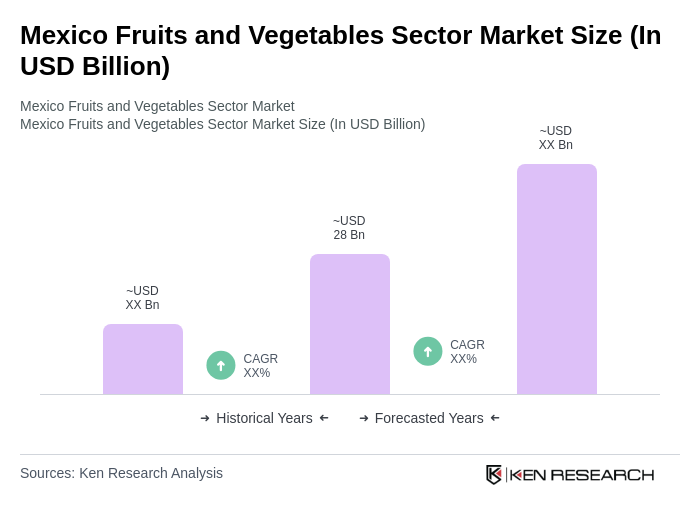
The Mexico fruits and vegetables market, valued at USD 28 billion, is growing due to rising health awareness, organic produce demand, and export opportunities, supported by government initiatives.

Region:Central and South America

Author(s):Shubham

Product Code:KRAC0893

Pages:98

Published On:August 2025
About the Report

Base Year 2024

Mexico Fruits and Vegetables Sector Market Overview

  • The Mexico Fruits and Vegetables Sector Market is valued at USD 28 billion, based on a five-year historical analysis. This growth is primarily driven by increasing consumer demand for fresh produce, rising health consciousness, and the expansion of export markets. The sector has seen a significant rise in both domestic consumption and international trade, particularly with the United States and Canada, which remain major importers of Mexican fruits and vegetables. Additional growth drivers include the adoption of hybrid seeds, technological advancements in precision farming, and government initiatives supporting food security and sustainable agriculture .
  • Key players in this market includeMexico City, Guadalajara, and Monterrey, which dominate due to their strategic locations, robust infrastructure, and access to both local and international markets. These cities serve as major distribution hubs, facilitating efficient movement of goods and supporting the growth of the agricultural sector. Regional performance is also influenced by climatic conditions and agricultural specialization, with strong export activity centered in these urban areas .
  • In 2023, the Mexican government implemented theSustainable Agriculture Program, aimed at promoting environmentally friendly farming practices. This initiative includes financial incentives for farmers adopting sustainable methods, enhancing productivity while minimizing environmental impact. The program operates under the framework of the "Ley de Desarrollo Rural Sustentable" (Sustainable Rural Development Law), issued by the Secretaría de Agricultura y Desarrollo Rural (SADER) in 2023. Key operational requirements include compliance with sustainable land use standards, adoption of water-efficient irrigation technologies, and participation in certified training on integrated pest management. The program is expected to bolster sector growth and sustainability .
Mexico Fruits and Vegetables Sector Market Size

Mexico Fruits and Vegetables Sector Market Segmentation

By Type:The market is segmented into various types of fruits and vegetables, each catering to different consumer preferences and market demands.Fresh fruits and vegetablesdominate the market due to high consumption rates and recognized health benefits.Processed fruits and vegetablesare gaining traction as convenience and longer shelf life become priorities for consumers.Organic produceis also on the rise, reflecting a growing trend towards healthier eating habits and increased demand for sustainably produced foods. The market also includes exotic fruits and other specialty categories, driven by diversification in consumer preferences and export opportunities .
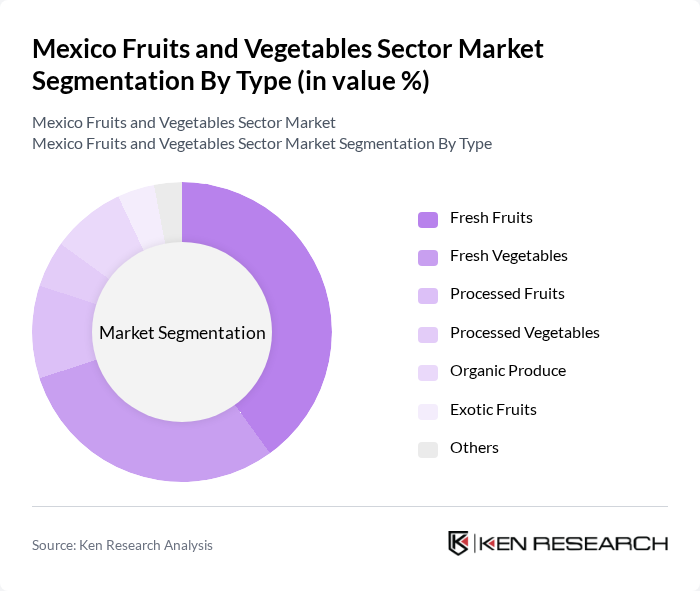
Mexico Fruits and Vegetables Sector Market segmentation by Type.

By End-User:The end-user segmentation includes various categories such as retail consumers, the food service industry, food processing companies, and export markets.Retail consumersrepresent the largest segment, driven by increasing health awareness and demand for fresh produce. Thefood service industryis also significant, as restaurants and catering services seek high-quality fruits and vegetables to meet evolving consumer preferences.Food processing companiesandexport marketscontinue to expand, supported by technological innovation and improved supply chain logistics .
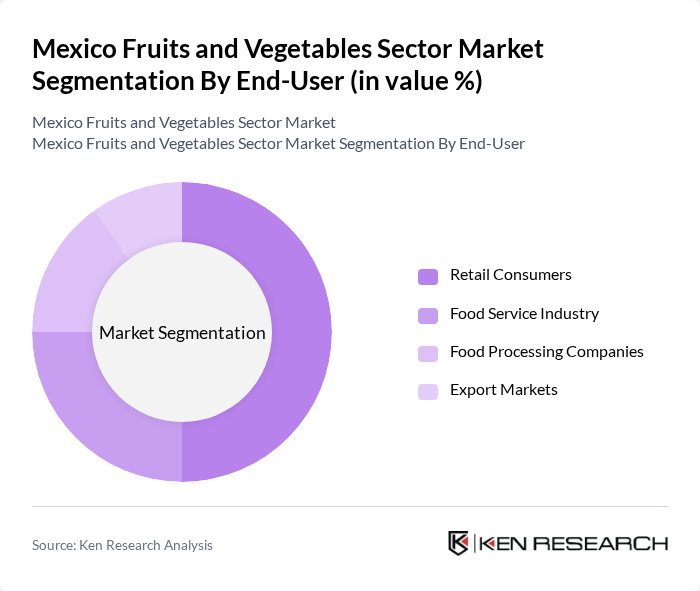
Mexico Fruits and Vegetables Sector Market segmentation by End-User.

Mexico Fruits and Vegetables Sector Market Competitive Landscape

The Mexico Fruits and Vegetables Sector Market is characterized by a dynamic mix of regional and international players. Leading participants such as Grupo Bimbo, Del Monte Foods, Inc., Fresh Del Monte Produce Inc., Grupo Lala, Chedraui, Walmart de México y Centroamérica, Sigma Alimentos, Grupo Herdez, La Huerta Congelados, Naturalia, Organics Unlimited, Grupo Agropecuario Valle Verde, Agricola El Rosal, Frutas y Verduras de México, Productos del Campo S.A. de C.V. contribute to innovation, geographic expansion, and service delivery in this space.

Grupo Bimbo

1945

Mexico City, Mexico

Del Monte Foods, Inc.

1886

San Francisco, California, USA

Fresh Del Monte Produce Inc.

1886

Coral Gables, Florida, USA

Grupo Lala

1949

Gomez Palacio, Durango, Mexico

Chedraui

1920

Xalapa, Veracruz, Mexico

Company

Establishment Year

Headquarters

Group Size (Large, Medium, or Small as per industry convention)

Revenue Growth Rate (annual % change in sales)

Market Penetration Rate (share of domestic and export markets)

Export Volume (tons/year or % of total output exported)

Customer Retention Rate (repeat business %)

Pricing Strategy (premium, value, discount, etc.)

Mexico Fruits and Vegetables Sector Market Industry Analysis

Growth Drivers

  • Increasing Health Consciousness:The Mexican population is increasingly prioritizing health, with 70% of consumers actively seeking healthier food options. This trend is supported by a report from the National Institute of Statistics and Geography (INEGI), which indicates that the demand for fresh fruits and vegetables has surged by 15% over the past two years. As consumers become more aware of the benefits of a balanced diet, the fruits and vegetables sector is poised for significant growth, driven by this health-centric shift.
  • Rising Demand for Organic Produce:The organic produce market in Mexico has expanded rapidly, with sales reaching approximately $1.5 billion, according to the Mexican Ministry of Agriculture. This growth is fueled by a 25% increase in consumer interest in organic products over the last three years. As more consumers prioritize sustainability and health, the demand for organic fruits and vegetables is expected to continue rising, creating new opportunities for producers and retailers alike.
  • Export Opportunities to North America:Mexico's fruits and vegetables sector benefits significantly from export opportunities, particularly to the United States and Canada. In future, exports reached $4 billion, with a 20% increase in shipments of avocados and tomatoes. The United States-Mexico-Canada Agreement (USMCA) facilitates trade, allowing Mexican producers to capitalize on the growing North American market. This trend is expected to bolster the sector's growth as demand for fresh produce continues to rise in these regions.

Market Challenges

  • Climate Change Impact:Climate change poses a significant threat to Mexico's agricultural sector, with projections indicating a potential 30% reduction in crop yields in future due to extreme weather events. The National Meteorological Service reported that unprecedented drought conditions affected key growing regions. This environmental challenge not only jeopardizes food security but also increases production costs, making it difficult for farmers to maintain profitability in the fruits and vegetables sector.
  • Supply Chain Disruptions:The fruits and vegetables sector in Mexico faces ongoing supply chain disruptions, exacerbated by global events such as the COVID-19 pandemic. In future, logistics costs increased by 15%, impacting the timely delivery of fresh produce. Additionally, transportation bottlenecks have led to a 10% increase in spoilage rates, further straining the sector. These challenges hinder market efficiency and threaten the competitiveness of Mexican produce in both domestic and international markets.

Mexico Fruits and Vegetables Sector Market Future Outlook

The future of Mexico's fruits and vegetables sector appears promising, driven by increasing health consciousness and a growing preference for organic produce. As consumers continue to prioritize fresh and sustainable options, producers are likely to adapt by enhancing their offerings. Additionally, advancements in agricultural technology and e-commerce platforms will facilitate better distribution and access to fresh produce. However, addressing climate change and supply chain challenges will be crucial for sustaining growth and ensuring food security in the coming years.

Market Opportunities

  • Expansion of E-commerce Platforms:The rise of e-commerce presents a significant opportunity for the fruits and vegetables sector, with online grocery sales projected to reach $2.5 billion in future. This shift allows producers to reach a broader customer base, enhancing convenience and accessibility for consumers. By leveraging digital platforms, businesses can streamline operations and improve customer engagement, ultimately driving sales growth in the sector.
  • Development of Sustainable Farming Practices:There is a growing emphasis on sustainable farming practices, with investments in eco-friendly technologies expected to exceed $600 million in future. This trend not only addresses environmental concerns but also meets consumer demand for responsibly sourced products. By adopting sustainable methods, producers can enhance their market appeal and potentially increase profitability through premium pricing for organic and sustainably grown produce.

Scope of the Report

SegmentSub-Segments
By Type

Fresh Fruits (e.g., mangoes, bananas, pineapples, avocados, strawberries, grapes, apples)

Fresh Vegetables (e.g., tomatoes, bell peppers, onions, chilis, lettuce, cucumbers, carrots)

Processed Fruits (including frozen, canned, dried, and packaged)

Processed Vegetables (including frozen, canned, dried, and packaged)

Organic Produce (fruits and vegetables certified organic)

Exotic Fruits (e.g., dragon fruit, rambutan, lychee)

Others (specialty/niche crops, herbs)

By End-User

Retail Consumers

Food Service Industry (restaurants, hotels, catering)

Food Processing Companies

Export Markets (United States, Canada, Europe)

By Distribution Channel

Supermarkets and Hypermarkets

Online Retail / E-commerce Platforms

Farmers' Markets

Wholesale Distributors

By Packaging Type

Bulk Packaging

Retail Packaging

Eco-friendly Packaging

By Quality

Premium Quality

Standard Quality

Economy Quality

By Seasonality

Seasonal Products

Year-round Products

By Price Range

Low Price

Mid Price

High Price

Key Target Audience

Investors and Venture Capitalist Firms

Government and Regulatory Bodies (e.g., Secretaría de Agricultura y Desarrollo Rural, Servicio Nacional de Sanidad, Inocuidad y Calidad Agroalimentaria)

Manufacturers and Producers

Distributors and Retailers

Exporters and Importers

Food Processing Companies

Logistics and Supply Chain Companies

Industry Associations (e.g., Asociación Nacional de Exportadores de Productos de México)

Players Mentioned in the Report:

Grupo Bimbo

Del Monte Foods, Inc.

Fresh Del Monte Produce Inc.

Grupo Lala

Chedraui

Walmart de Mexico y Centroamerica

Sigma Alimentos

Grupo Herdez

La Huerta Congelados

Naturalia

Organics Unlimited

Grupo Agropecuario Valle Verde

Agricola El Rosal

Frutas y Verduras de Mexico

Productos del Campo S.A. de C.V.

Table of Contents

Market Assessment Phase

1. Executive Summary and Approach


2. Mexico Fruits and Vegetables Sector Market Overview

2.1 Key Insights and Strategic Recommendations

2.2 Mexico Fruits and Vegetables Sector Market Overview

2.3 Definition and Scope

2.4 Evolution of Market Ecosystem

2.5 Timeline of Key Regulatory Milestones

2.6 Value Chain & Stakeholder Mapping

2.7 Business Cycle Analysis

2.8 Policy & Incentive Landscape


3. Mexico Fruits and Vegetables Sector Market Analysis

3.1 Growth Drivers

3.1.1 Increasing Health Consciousness
3.1.2 Rising Demand for Organic Produce
3.1.3 Export Opportunities to North America
3.1.4 Technological Advancements in Agriculture

3.2 Market Challenges

3.2.1 Climate Change Impact
3.2.2 Supply Chain Disruptions
3.2.3 Regulatory Compliance Issues
3.2.4 Competition from Imported Products

3.3 Market Opportunities

3.3.1 Expansion of E-commerce Platforms
3.3.2 Development of Sustainable Farming Practices
3.3.3 Increasing Investment in Agri-tech
3.3.4 Growing Demand for Processed Fruits and Vegetables

3.4 Market Trends

3.4.1 Shift Towards Local Sourcing
3.4.2 Rise of Plant-Based Diets
3.4.3 Innovations in Packaging Solutions
3.4.4 Increased Focus on Food Safety Standards

3.5 Government Regulation

3.5.1 New Agricultural Policies
3.5.2 Import Tariffs on Fruits and Vegetables
3.5.3 Organic Certification Requirements
3.5.4 Environmental Regulations for Farming Practices

4. SWOT Analysis


5. Stakeholder Analysis


6. Porter's Five Forces Analysis


7. Mexico Fruits and Vegetables Sector Market Market Size, 2019-2024

7.1 By Value

7.2 By Volume

7.3 By Average Selling Price


8. Mexico Fruits and Vegetables Sector Market Segmentation

8.1 By Type

8.1.1 Fresh Fruits (e.g., mangoes, bananas, pineapples, avocados, strawberries, grapes, apples)
8.1.2 Fresh Vegetables (e.g., tomatoes, bell peppers, onions, chilis, lettuce, cucumbers, carrots)
8.1.3 Processed Fruits (including frozen, canned, dried, and packaged)
8.1.4 Processed Vegetables (including frozen, canned, dried, and packaged)
8.1.5 Organic Produce (fruits and vegetables certified organic)
8.1.6 Exotic Fruits (e.g., dragon fruit, rambutan, lychee)
8.1.7 Others (specialty/niche crops, herbs)

8.2 By End-User

8.2.1 Retail Consumers
8.2.2 Food Service Industry (restaurants, hotels, catering)
8.2.3 Food Processing Companies
8.2.4 Export Markets (United States, Canada, Europe)

8.3 By Distribution Channel

8.3.1 Supermarkets and Hypermarkets
8.3.2 Online Retail / E-commerce Platforms
8.3.3 Farmers' Markets
8.3.4 Wholesale Distributors

8.4 By Packaging Type

8.4.1 Bulk Packaging
8.4.2 Retail Packaging
8.4.3 Eco-friendly Packaging

8.5 By Quality

8.5.1 Premium Quality
8.5.2 Standard Quality
8.5.3 Economy Quality

8.6 By Seasonality

8.6.1 Seasonal Products
8.6.2 Year-round Products

8.7 By Price Range

8.7.1 Low Price
8.7.2 Mid Price
8.7.3 High Price

9. Mexico Fruits and Vegetables Sector Market Competitive Analysis

9.1 Market Share of Key Players

9.2 Cross Comparison of Key Players

9.2.1 Company Name
9.2.2 Group Size (Large, Medium, or Small as per industry convention)
9.2.3 Revenue Growth Rate (annual % change in sales)
9.2.4 Market Penetration Rate (share of domestic and export markets)
9.2.5 Export Volume (tons/year or % of total output exported)
9.2.6 Customer Retention Rate (repeat business %)
9.2.7 Pricing Strategy (premium, value, discount, etc.)
9.2.8 Product Diversification Index (number of product categories/segments served)
9.2.9 Supply Chain Efficiency (lead time, post-harvest loss %)
9.2.10 Brand Recognition Score (survey-based or market share proxy)
9.2.11 Distribution Network Coverage (number of regions/countries served)

9.3 SWOT Analysis of Top Players

9.4 Pricing Analysis

9.5 Detailed Profile of Major Companies

9.5.1 Grupo Bimbo
9.5.2 Del Monte Foods, Inc.
9.5.3 Fresh Del Monte Produce Inc.
9.5.4 Grupo Lala
9.5.5 Chedraui
9.5.6 Walmart de México y Centroamérica
9.5.7 Sigma Alimentos
9.5.8 Grupo Herdez
9.5.9 La Huerta Congelados
9.5.10 Naturalia
9.5.11 Organics Unlimited
9.5.12 Grupo Agropecuario Valle Verde
9.5.13 Agricola El Rosal
9.5.14 Frutas y Verduras de México
9.5.15 Productos del Campo S.A. de C.V.

10. Mexico Fruits and Vegetables Sector Market End-User Analysis

10.1 Procurement Behavior of Key Ministries

10.1.1 Ministry of Agriculture
10.1.2 Ministry of Health
10.1.3 Ministry of Economy

10.2 Corporate Spend on Infrastructure & Energy

10.2.1 Investment in Cold Storage Facilities
10.2.2 Funding for Transportation Logistics

10.3 Pain Point Analysis by End-User Category

10.3.1 Supply Chain Inefficiencies
10.3.2 Quality Control Issues

10.4 User Readiness for Adoption

10.4.1 Adoption of Technology in Farming
10.4.2 Readiness for Organic Certification

10.5 Post-Deployment ROI and Use Case Expansion

10.5.1 ROI from Sustainable Practices
10.5.2 Expansion into New Markets

11. Mexico Fruits and Vegetables Sector Market Future Size, 2025-2030

11.1 By Value

11.2 By Volume

11.3 By Average Selling Price


Go-To-Market Strategy Phase

1. Whitespace Analysis + Business Model Canvas

1.1 Market Gaps Identification

1.2 Business Model Development


2. Marketing and Positioning Recommendations

2.1 Branding Strategies

2.2 Product USPs


3. Distribution Plan

3.1 Urban Retail Strategies

3.2 Rural NGO Tie-ups


4. Channel & Pricing Gaps

4.1 Underserved Routes

4.2 Pricing Bands


5. Unmet Demand & Latent Needs

5.1 Category Gaps

5.2 Consumer Segments


6. Customer Relationship

6.1 Loyalty Programs

6.2 After-sales Service


7. Value Proposition

7.1 Sustainability Initiatives

7.2 Integrated Supply Chains


8. Key Activities

8.1 Regulatory Compliance

8.2 Branding Efforts

8.3 Distribution Setup


9. Entry Strategy Evaluation

9.1 Domestic Market Entry Strategy

9.1.1 Product Mix
9.1.2 Pricing Band
9.1.3 Packaging Considerations

9.2 Export Entry Strategy

9.2.1 Target Countries
9.2.2 Compliance Roadmap

10. Entry Mode Assessment

10.1 Joint Ventures

10.2 Greenfield Investments

10.3 Mergers & Acquisitions

10.4 Distributor Model


11. Capital and Timeline Estimation

11.1 Capital Requirements

11.2 Timelines


12. Control vs Risk Trade-Off

12.1 Ownership vs Partnerships


13. Profitability Outlook

13.1 Breakeven Analysis

13.2 Long-term Sustainability


14. Potential Partner List

14.1 Distributors

14.2 Joint Ventures

14.3 Acquisition Targets


15. Execution Roadmap

15.1 Phased Plan for Market Entry

15.1.1 Market Setup
15.1.2 Market Entry
15.1.3 Growth Acceleration
15.1.4 Scale & Stabilize

15.2 Key Activities and Milestones

15.2.1 Milestone Planning
15.2.2 Activity Tracking

Research Methodology

ApproachModellingSample

Phase 1: Approach1

Desk Research

  • Analysis of agricultural production statistics from the Mexican Ministry of Agriculture
  • Review of market reports from industry associations such as the National Association of Fruit and Vegetable Producers
  • Examination of trade publications and journals focusing on the Mexican agricultural sector

Primary Research

  • Interviews with key stakeholders including farmers, distributors, and retailers in the fruits and vegetables sector
  • Surveys targeting agricultural experts and market analysts to gather insights on market trends
  • Field visits to farms and distribution centers to observe operational practices and gather qualitative data

Validation & Triangulation

  • Cross-validation of data from multiple sources including government reports and industry surveys
  • Triangulation of findings through expert consultations and stakeholder feedback
  • Sanity checks using historical data trends and current market dynamics

Phase 2: Market Size Estimation1

Top-down Assessment

  • Estimation of total market size based on national agricultural output and export statistics
  • Segmentation of the market by product type, including fruits and vegetables, and their respective market shares
  • Incorporation of growth rates derived from historical data and future projections from agricultural forecasts

Bottom-up Modeling

  • Collection of sales data from major distributors and retailers in the fruits and vegetables market
  • Estimation of average prices and volumes sold across different product categories
  • Calculation of market size based on aggregated data from individual firms and market segments

Forecasting & Scenario Analysis

  • Development of forecasting models using historical growth rates and market drivers such as population growth and urbanization
  • Scenario analysis based on potential impacts of climate change and trade policies on agricultural output
  • Creation of baseline, optimistic, and pessimistic scenarios to project market evolution through 2030

Phase 3: CATI Sample Composition1

Scope Item/SegmentSample SizeTarget Respondent Profiles
Fruit Producers60Farm Owners, Agricultural Managers
Vegetable Distributors50Supply Chain Managers, Distribution Coordinators
Retail Sector Buyers40Procurement Officers, Category Managers
Export Market Analysts45Market Analysts, Trade Specialists
Consumer Insights70End Consumers, Market Research Participants

Frequently Asked Questions

What is the current value of the Mexico Fruits and Vegetables Sector Market?

The Mexico Fruits and Vegetables Sector Market is valued at approximately USD 28 billion, reflecting significant growth driven by increasing consumer demand for fresh produce, health consciousness, and expanding export markets, particularly to the United States and Canada.

What are the main growth drivers for the Mexico Fruits and Vegetables Sector?

Which cities are the major hubs for the Mexico Fruits and Vegetables Sector?

What is the impact of the Sustainable Agriculture Program in Mexico?

Other Regional/Country Reports

Indonesia Fruits and Vegetables Sector Market

Malaysia Fruits and Vegetables Sector Market

KSA Fruits and Vegetables Sector Market

APAC Fruits and Vegetables Sector Market

SEA Fruits and Vegetables Sector Market

Vietnam Fruits and Vegetables Sector Market

Why Buy From Us?

Refine Robust Result (RRR) Framework

What makes us stand out is that our consultants follow Robust, Refine and Result (RRR) methodology. Robust for clear definitions, approaches and sanity checking, Refine for differentiating respondents' facts and opinions, and Result for presenting data with story.

Our Reach Is Unmatched

We have set a benchmark in the industry by offering our clients with syndicated and customized market research reports featuring coverage of entire market as well as meticulous research and analyst insights.

Shifting the Research Paradigm

While we don't replace traditional research, we flip the method upside down. Our dual approach of Top Bottom & Bottom Top ensures quality deliverable by not just verifying company fundamentals but also looking at the sector and macroeconomic factors.

More Insights-Better Decisions

With one step in the future, our research team constantly tries to show you the bigger picture. We help with some of the tough questions you may encounter along the way: How is the industry positioned? Best marketing channel? KPI's of competitors? By aligning every element, we help maximize success.

Transparency and Trust

Our report gives you instant access to the answers and sources that other companies might choose to hide. We elaborate each steps of research methodology we have used and showcase you the sample size to earn your trust.

Round the Clock Support

If you need any support, we are here! We pride ourselves on universe strength, data quality, and quick, friendly, and professional service.

Why Clients Choose Us?

400000+
Reports in repository
150+
Consulting projects a year
100+
Analysts
8000+
Client Queries in 2022








