About the Report
Base Year 2024Middle East 3D Printing Constructions Market Overview
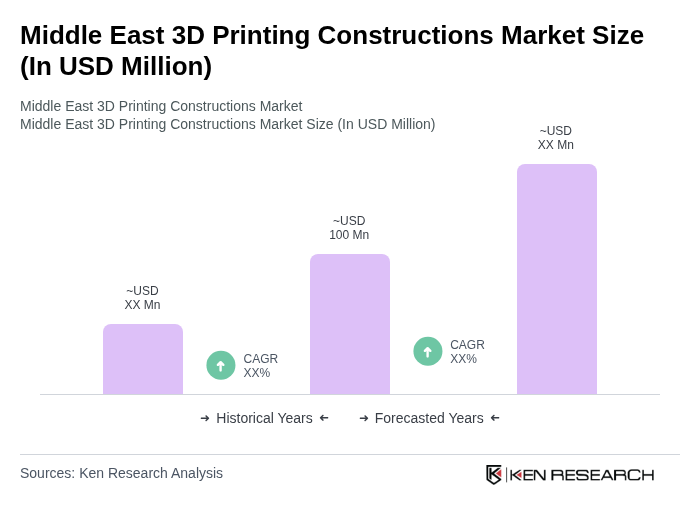
- The Middle East 3D Printing Constructions Market is valued at USD 100 million, based on a five-year historical analysis of regional revenues within the broader Middle East and Africa 3D printing in construction market. This growth is primarily driven by rapid urbanization, large-scale infrastructure pipelines, government initiatives promoting sustainable and industrialized construction, and advancements in 3D printing technologies (notably concrete extrusion systems) that enhance efficiency, shorten project timelines, and reduce material waste in the construction sector.
- Key players in this market include the United Arab Emirates, Saudi Arabia, and Qatar, which lead regional deployment of 3D printed buildings and infrastructure pilots. These countries dominate due to significant investments in smart city and giga-projects (such as Dubai’s smart city agenda and Saudi Arabia’s NEOM and related programs), ambitious housing and infrastructure plans under national visions, and policy support that encourages the adoption of digital and additive construction technologies.
- In 2016, the UAE launched the Dubai 3D Printing Strategy, and in 2018 the Dubai Municipality issued the Dubai 3D Printing Strategy for Construction initiative, under which the government set a target that 25% of new buildings in Dubai will be constructed using 3D printing technologies by 2030, with phased adoption starting from 2025. This initiative is part of the UAE's broader vision to enhance sustainability, reduce construction costs and labor intensity, and integrate advanced manufacturing into building and infrastructure development.
Middle East 3D Printing Constructions Market Segmentation
By Construction Type:
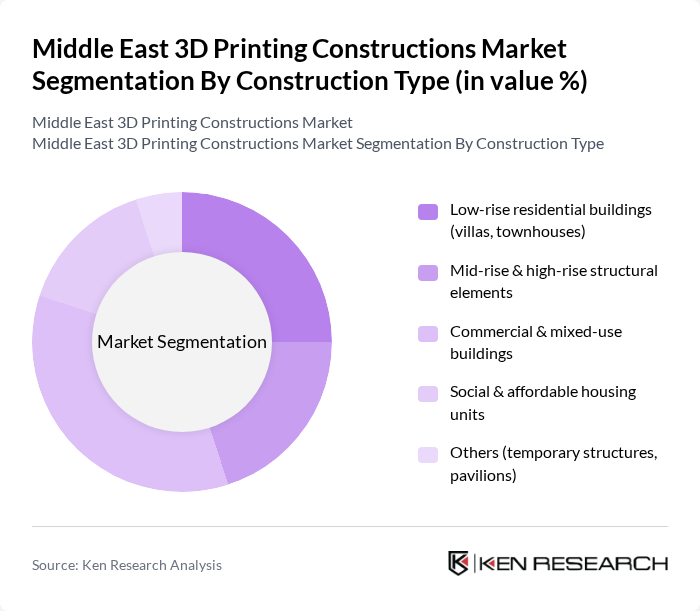
The construction type segmentation includes various subsegments such as low-rise residential buildings (villas, townhouses), mid-rise & high-rise structural elements, commercial & mixed-use buildings, social & affordable housing units, and others (temporary structures, pavilions). This aligns with industry practice where 3D printing is applied across residential, commercial, and infrastructure/building categories, with concrete-based extrusion being the dominant method. Among these, the commercial & mixed-use buildings segment is currently leading the market in the region in terms of demonstration and flagship projects, driven by high-visibility smart city districts, hospitality, offices, and mixed-use developments that seek innovative, sustainable designs. This trend is driven by urbanization, tourism and service-led economies, and the need for multifunctional spaces in rapidly growing cities. The low-rise residential buildings segment also shows significant growth, fueled by national housing programs, affordable housing initiatives, and the suitability of 3D printing for single- and multi-family low-rise units.
By End-User / Client Type:
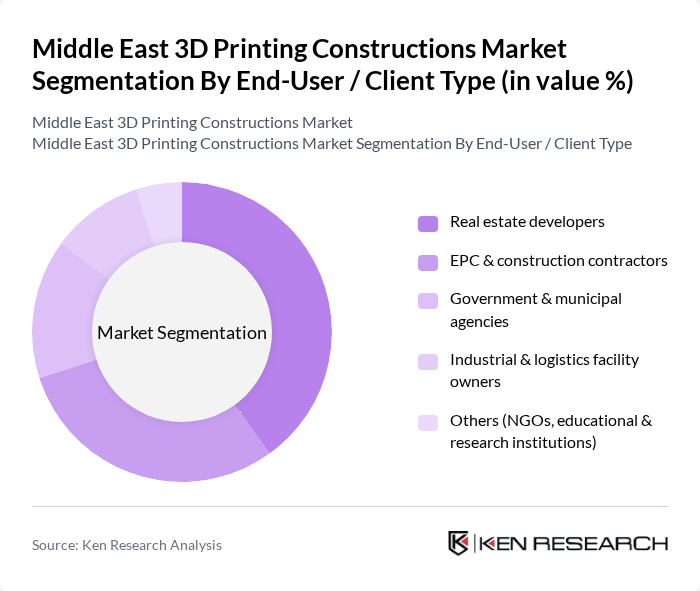
This segmentation includes real estate developers, EPC & construction contractors, government & municipal agencies, industrial & logistics facility owners, and others (NGOs, educational & research institutions). This structure is consistent with broader MEA 3D printing construction end-use patterns, where building (residential, commercial, industrial) and infrastructure clients are the primary adopters. The real estate developers segment is currently the most dominant, driven by the increasing number of mixed-use, residential, and hospitality projects that seek differentiation through innovative, sustainable construction solutions. Additionally, EPC contractors are also significant players, as they are increasingly adopting 3D printing technologies to optimize project delivery timelines, reduce labor dependency, and integrate digital construction workflows such as BIM with additive manufacturing. The government & municipal agencies segment is gaining traction due to national visions and urban development strategies that explicitly promote innovative construction methods, including 3D printing, for public housing, social infrastructure, and smart city projects.
Middle East 3D Printing Constructions Market Competitive Landscape
The Middle East 3D Printing Constructions Market is characterized by a dynamic mix of regional and international players. Leading participants such as COBOD International A/S, CyBe Construction B.V., Apis Cor Inc., ICON Technology, Inc., XtreeE SAS, WASP S.r.l. (World’s Advanced Saving Project), 3DXB Group (UAE), Dar Al Arkan Real Estate Development Company, Saudi Arabian Ministry of Municipal, Rural Affairs and Housing (MOMRAH) – Housing Program Partners, Dubai Municipality – 3D Printing in Construction Initiative, NEOM Company, Sika AG, MX3D B.V., Contour Crafting Corporation, CyBe Middle East & regional implementation partners contribute to innovation, geographic expansion, and service delivery in this space.
Middle East 3D Printing Constructions Market Industry Analysis
Growth Drivers
- Increasing Demand for Affordable Housing:The Middle East faces a significant housing deficit, with an estimated 3 million units needed in future. This demand is driven by a growing population, projected to reach around 500 million in future. 3D printing technology offers a cost-effective solution, potentially reducing construction costs by up to 30%. As governments prioritize affordable housing, the adoption of 3D printing in construction is expected to accelerate, addressing both supply and affordability challenges.
- Technological Advancements in 3D Printing:The 3D printing construction sector is witnessing rapid technological advancements, with innovations such as concrete 3D printers capable of producing structures in days rather than months. For instance, the introduction of robotic arms has improved precision and efficiency, reducing labor costs by approximately 20%. As these technologies become more accessible, their integration into construction practices is anticipated to enhance productivity and lower overall project timelines significantly.
- Government Initiatives Promoting Sustainable Construction:Governments in the Middle East are increasingly focusing on sustainability, with initiatives like Saudi Arabia's Vision 2030 aiming to diversify the economy and promote green building practices. The UAE has committed to reducing carbon emissions by about 31 percent relative to a business-as-usual scenario in future. These policies encourage the adoption of 3D printing technologies, which can utilize eco-friendly materials and reduce waste, aligning with national sustainability goals and attracting investment in innovative construction methods.
Market Challenges
- High Initial Investment Costs:The initial capital required for 3D printing technology in construction can be prohibitive, often exceeding USD 1 million for advanced, large-scale construction printers supplied by leading global manufacturers. This financial barrier limits entry for smaller construction firms and startups. Additionally, the need for skilled labor to operate these machines adds to the overall costs. As a result, many companies may hesitate to invest in 3D printing, slowing down market adoption despite its long-term cost benefits.
- Regulatory Hurdles and Compliance Issues:The regulatory landscape for 3D printing in construction is still evolving, with many countries lacking clear guidelines. For example, Dubai in the UAE has issued a 3D Printing Strategy and some related regulations, but comprehensive, fully adapted building codes for all types of 3D printed structures are still under development, creating uncertainty among developers. Compliance with existing regulations can delay project timelines and increase costs, creating a significant challenge for companies looking to innovate within the construction sector.
Middle East 3D Printing Constructions Market Future Outlook
The future of the Middle East 3D printing constructions market appears promising, driven by technological advancements and increasing government support for sustainable practices. As urbanization accelerates, the demand for innovative construction solutions will rise, prompting further investment in 3D printing technologies. Additionally, collaboration between construction firms and tech companies is expected to foster innovation, leading to more efficient and eco-friendly building methods that align with regional sustainability goals and economic diversification efforts.
Market Opportunities
- Expansion into Emerging Markets:Emerging markets in the Middle East, such as Iraq and Yemen, present significant opportunities for 3D printing in construction. With a combined population of over 40 million and a pressing need for infrastructure development, these regions can benefit from the cost-effective and rapid construction capabilities of 3D printing, potentially transforming their housing landscapes and attracting foreign investment.
- Development of Eco-Friendly Materials:The growing emphasis on sustainability opens avenues for the development of eco-friendly materials suitable for 3D printing. Innovations in bio-based and recycled materials can reduce environmental impact while meeting construction needs. Companies investing in research and development of these materials can position themselves as leaders in the sustainable construction market, appealing to environmentally conscious consumers and governments alike.
Scope of the Report
| Segment | Sub-Segments |
|---|---|
| By Construction Type | Low-rise residential buildings (villas, townhouses) Mid-rise & high-rise structural elements Commercial & mixed-use buildings Social & affordable housing units Others (temporary structures, pavilions) |
| By End-User / Client Type | Real estate developers EPC & construction contractors Government & municipal agencies Industrial & logistics facility owners Others (NGOs, educational & research institutions) |
| By Country | United Arab Emirates Saudi Arabia Qatar Kuwait Rest of GCC Egypt Rest of Middle East & North Africa |
| By Printing Technology | Extrusion-based concrete 3D printing Powder bonding / binder jetting Additive welding & metal-based construction printing Hybrid & other emerging technologies |
| By Application | Structural walls & load-bearing elements Façades, cladding & architectural features Infrastructure (bridges, street furniture, utilities) Onsite vs offsite (prefabricated) components Others (demonstration projects, prototypes) |
| By Business Model / Revenue Stream | Equipment sales (printers & robotics) Contract 3D printing (as-a-service) Design, engineering & BIM integration services Material supply (inks, mortars, additives) Turnkey 3D printed projects (EPC) |
| By Material Type | Cementitious & concrete-based mixes Geopolymer & low-carbon binders Composite materials & fiber-reinforced mortars Others (polymers, metals for construction parts) |
Key Target Audience
Investors and Venture Capitalist Firms
Government and Regulatory Bodies (e.g., Ministry of Housing, Ministry of Municipal and Rural Affairs)
Construction Companies and Contractors
Architectural Firms and Design Studios
Real Estate Developers
Material Suppliers and Manufacturers
Technology Providers and Software Developers
Industry Associations and Trade Organizations
Players Mentioned in the Report:
COBOD International A/S
CyBe Construction B.V.
Apis Cor Inc.
ICON Technology, Inc.
XtreeE SAS
WASP S.r.l. (Worlds Advanced Saving Project)
3DXB Group (UAE)
Dar Al Arkan Real Estate Development Company
Saudi Arabian Ministry of Municipal, Rural Affairs and Housing (MOMRAH) Housing Program Partners
Dubai Municipality 3D Printing in Construction Initiative
NEOM Company
Sika AG
MX3D B.V.
Contour Crafting Corporation
CyBe Middle East & regional implementation partners
Table of Contents
Market Assessment Phase
1. Executive Summary and Approach
2. Middle East 3D Printing Constructions Market Overview
2.1 Key Insights and Strategic Recommendations
2.2 Middle East 3D Printing Constructions Market Overview
2.3 Definition and Scope
2.4 Evolution of Market Ecosystem
2.5 Timeline of Key Regulatory Milestones
2.6 Value Chain & Stakeholder Mapping
2.7 Business Cycle Analysis
2.8 Policy & Incentive Landscape
3. Middle East 3D Printing Constructions Market Analysis
3.1 Growth Drivers
3.1.1 Increasing demand for affordable housing
3.1.2 Technological advancements in 3D printing
3.1.3 Government initiatives promoting sustainable construction
3.1.4 Rising urbanization and population growth
3.2 Market Challenges
3.2.1 High initial investment costs
3.2.2 Limited awareness and understanding of technology
3.2.3 Regulatory hurdles and compliance issues
3.2.4 Supply chain disruptions
3.3 Market Opportunities
3.3.1 Expansion into emerging markets
3.3.2 Collaboration with tech companies for innovation
3.3.3 Development of eco-friendly materials
3.3.4 Customization and personalization of construction projects
3.4 Market Trends
3.4.1 Adoption of automation in construction processes
3.4.2 Integration of AI and machine learning
3.4.3 Focus on sustainability and green building practices
3.4.4 Growth of modular and prefabricated construction
3.5 Government Regulation
3.5.1 Building codes and standards for 3D printed structures
3.5.2 Incentives for sustainable construction practices
3.5.3 Environmental impact assessments
3.5.4 Licensing requirements for 3D printing technology
4. SWOT Analysis
5. Stakeholder Analysis
6. Porter's Five Forces Analysis
7. Middle East 3D Printing Constructions Market Market Size, 2019-2024
7.1 By Value
7.2 By Volume
7.3 By Average Selling Price
8. Middle East 3D Printing Constructions Market Segmentation
8.1 By Construction Type
8.1.1 Low-rise residential buildings (villas, townhouses)
8.1.2 Mid-rise & high-rise structural elements
8.1.3 Commercial & mixed-use buildings
8.1.4 Social & affordable housing units
8.1.5 Others (temporary structures, pavilions)
8.2 By End-User / Client Type
8.2.1 Real estate developers
8.2.2 EPC & construction contractors
8.2.3 Government & municipal agencies
8.2.4 Industrial & logistics facility owners
8.2.5 Others (NGOs, educational & research institutions)
8.3 By Country
8.3.1 United Arab Emirates
8.3.2 Saudi Arabia
8.3.3 Qatar
8.3.4 Kuwait
8.3.5 Rest of GCC
8.3.6 Egypt
8.3.7 Rest of Middle East & North Africa
8.4 By Printing Technology
8.4.1 Extrusion-based concrete 3D printing
8.4.2 Powder bonding / binder jetting
8.4.3 Additive welding & metal-based construction printing
8.4.4 Hybrid & other emerging technologies
8.5 By Application
8.5.1 Structural walls & load-bearing elements
8.5.2 Façades, cladding & architectural features
8.5.3 Infrastructure (bridges, street furniture, utilities)
8.5.4 Onsite vs offsite (prefabricated) components
8.5.5 Others (demonstration projects, prototypes)
8.6 By Business Model / Revenue Stream
8.6.1 Equipment sales (printers & robotics)
8.6.2 Contract 3D printing (as-a-service)
8.6.3 Design, engineering & BIM integration services
8.6.4 Material supply (inks, mortars, additives)
8.6.5 Turnkey 3D printed projects (EPC)
8.7 By Material Type
8.7.1 Cementitious & concrete-based mixes
8.7.2 Geopolymer & low-carbon binders
8.7.3 Composite materials & fiber-reinforced mortars
8.7.4 Others (polymers, metals for construction parts)
9. Middle East 3D Printing Constructions Market Competitive Analysis
9.1 Market Share of Key Players
9.2 Cross Comparison of Key Players
9.2.1 Company name
9.2.2 Regional footprint (no. of Middle East countries served)
9.2.3 Installed printer base in the region (number of systems)
9.2.4 3D printed built-up area delivered in ME (m², cumulative)
9.2.5 Revenue from Middle East 3D printing construction projects (USD)
9.2.6 Order backlog / pipeline of announced projects (USD or m²)
9.2.7 Share of revenue from recurring services (O&M, software, AMC)
9.2.8 Average project execution time vs conventional construction (%)
9.2.9 Average cost saving vs traditional methods (%)
9.2.10 R&D intensity (R&D spend as % of revenue)
9.2.11 Number of strategic partnerships in ME (developers, EPCs, gov.)
9.2.12 Compliance & certification coverage (local building codes, ESG)
9.3 SWOT Analysis of Top Players
9.4 Pricing Analysis
9.5 Detailed Profile of Major Companies
9.5.1 COBOD International A/S
9.5.2 CyBe Construction B.V.
9.5.3 Apis Cor Inc.
9.5.4 ICON Technology, Inc.
9.5.5 XtreeE SAS
9.5.6 WASP S.r.l. (World’s Advanced Saving Project)
9.5.7 3DXB Group (UAE)
9.5.8 Dar Al Arkan Real Estate Development Company
9.5.9 Saudi Arabian Ministry of Municipal, Rural Affairs and Housing (MOMRAH) – Housing Program Partners
9.5.10 Dubai Municipality – 3D Printing in Construction Initiative
9.5.11 NEOM Company
9.5.12 Sika AG
9.5.13 MX3D B.V.
9.5.14 Contour Crafting Corporation
9.5.15 CyBe Middle East & regional implementation partners
10. Middle East 3D Printing Constructions Market End-User Analysis
10.1 Procurement Behavior of Key Ministries
10.1.1 Ministry of Housing
10.1.2 Ministry of Infrastructure
10.1.3 Ministry of Urban Development
10.1.4 Others
10.2 Corporate Spend on Infrastructure & Energy
10.2.1 Investment Trends
10.2.2 Budget Allocations
10.2.3 Project Prioritization
10.2.4 Others
10.3 Pain Point Analysis by End-User Category
10.3.1 Cost Overruns
10.3.2 Delays in Project Completion
10.3.3 Quality Assurance Issues
10.3.4 Others
10.4 User Readiness for Adoption
10.4.1 Awareness Levels
10.4.2 Training Needs
10.4.3 Technology Acceptance
10.4.4 Others
10.5 Post-Deployment ROI and Use Case Expansion
10.5.1 Performance Metrics
10.5.2 Case Studies
10.5.3 Scalability Potential
10.5.4 Others
11. Middle East 3D Printing Constructions Market Future Size, 2025-2030
11.1 By Value
11.2 By Volume
11.3 By Average Selling Price
Go-To-Market Strategy Phase
1. Whitespace Analysis + Business Model Canvas
1.1 Market Gaps Identification
1.2 Value Proposition Development
1.3 Revenue Streams
1.4 Cost Structure Analysis
1.5 Key Partnerships
1.6 Customer Segments
1.7 Channels
2. Marketing and Positioning Recommendations
2.1 Branding Strategies
2.2 Product USPs
3. Distribution Plan
3.1 Urban Retail Strategies
3.2 Rural NGO Tie-ups
4. Channel & Pricing Gaps
4.1 Underserved Routes
4.2 Pricing Bands
5. Unmet Demand & Latent Needs
5.1 Category Gaps
5.2 Consumer Segments
6. Customer Relationship
6.1 Loyalty Programs
6.2 After-sales Service
7. Value Proposition
7.1 Sustainability Initiatives
7.2 Integrated Supply Chains
8. Key Activities
8.1 Regulatory Compliance
8.2 Branding Efforts
8.3 Distribution Setup
9. Entry Strategy Evaluation
9.1 Domestic Market Entry Strategy
9.1.1 Product Mix
9.1.2 Pricing Band
9.1.3 Packaging
9.2 Export Entry Strategy
9.2.1 Target Countries
9.2.2 Compliance Roadmap
10. Entry Mode Assessment
10.1 Joint Ventures
10.2 Greenfield Investments
10.3 Mergers & Acquisitions
10.4 Distributor Model
11. Capital and Timeline Estimation
11.1 Capital Requirements
11.2 Timelines
12. Control vs Risk Trade-Off
12.1 Ownership vs Partnerships
13. Profitability Outlook
13.1 Breakeven Analysis
13.2 Long-term Sustainability
14. Potential Partner List
14.1 Distributors
14.2 Joint Ventures
14.3 Acquisition Targets
15. Execution Roadmap
15.1 Phased Plan for Market Entry
15.1.1 Market Setup
15.1.2 Market Entry
15.1.3 Growth Acceleration
15.1.4 Scale & Stabilize
15.2 Key Activities and Milestones
15.2.1 Milestone Planning
15.2.2 Activity Tracking
Research Methodology
Phase 1: Approach1
Desk Research
- Industry reports from regional construction and 3D printing associations
- Market analysis from government publications and trade organizations
- Academic journals and white papers on 3D printing technologies in construction
Primary Research
- Interviews with architects and construction project managers utilizing 3D printing
- Surveys with material suppliers and technology providers in the 3D printing sector
- Field interviews with regulatory bodies overseeing construction standards
Validation & Triangulation
- Cross-validation of data through multiple industry reports and expert opinions
- Triangulation of findings from primary interviews and secondary data sources
- Sanity checks through feedback from a panel of industry experts
Phase 2: Market Size Estimation1
Top-down Assessment
- Analysis of national construction spending trends and their impact on 3D printing adoption
- Segmentation of the market by application areas such as residential, commercial, and infrastructure
- Incorporation of government initiatives promoting sustainable construction practices
Bottom-up Modeling
- Volume estimates based on the number of 3D printing projects completed in the region
- Cost analysis of materials and technologies used in 3D printing for construction
- Revenue projections based on average project size and frequency of 3D printing applications
Forecasting & Scenario Analysis
- Multi-variable regression analysis considering economic growth and technological advancements
- Scenario modeling based on regulatory changes and market adoption rates
- Baseline, optimistic, and pessimistic forecasts through 2030
Phase 3: CATI Sample Composition1
| Scope Item/Segment | Sample Size | Target Respondent Profiles |
|---|---|---|
| Residential 3D Printing Projects | 120 | Architects, Home Builders |
| Commercial Construction Applications | 90 | Project Managers, Construction Executives |
| Infrastructure Development Initiatives | 80 | Urban Planners, Civil Engineers |
| Material Suppliers for 3D Printing | 70 | Supply Chain Managers, Product Development Leads |
| Regulatory Compliance in 3D Printing | 60 | Regulatory Officials, Compliance Officers |
Frequently Asked Questions
What is the current value of the Middle East 3D Printing Constructions Market?
The Middle East 3D Printing Constructions Market is valued at approximately USD 100 million, reflecting a five-year historical analysis of regional revenues within the broader Middle East and Africa 3D printing in construction market.
What are the main drivers of growth in the Middle East 3D Printing Constructions Market?
Which countries are leading in the Middle East 3D Printing Constructions Market?
What is the Dubai 3D Printing Strategy?
Other Regional/Country Reports
Indonesia 3D Printing Constructions Market
Malaysia 3D Printing Constructions Market
KSA 3D Printing Constructions Market
APAC 3D Printing Constructions Market
SEA 3D Printing Constructions Market
Vietnam 3D Printing Constructions Market
Other Adjacent Reports
Indonesia Additive Manufacturing Materials Market
Mexico Construction Robotics Market
Belgium Modular Construction Market
Qatar Sustainable Building Materials Market
Brazil Digital Construction Technology Market
Brazil Green Building Market
Egypt Prefabricated Housing Market
UAE Smart City Infrastructure Market
Kuwait Concrete Extrusion Technology Market
Vietnam Building Information Modeling Market
Why Buy From Us?

What makes us stand out is that our consultants follow Robust, Refine and Result (RRR) methodology. Robust for clear definitions, approaches and sanity checking, Refine for differentiating respondents' facts and opinions, and Result for presenting data with story.

We have set a benchmark in the industry by offering our clients with syndicated and customized market research reports featuring coverage of entire market as well as meticulous research and analyst insights.

While we don't replace traditional research, we flip the method upside down. Our dual approach of Top Bottom & Bottom Top ensures quality deliverable by not just verifying company fundamentals but also looking at the sector and macroeconomic factors.

With one step in the future, our research team constantly tries to show you the bigger picture. We help with some of the tough questions you may encounter along the way: How is the industry positioned? Best marketing channel? KPI's of competitors? By aligning every element, we help maximize success.

Our report gives you instant access to the answers and sources that other companies might choose to hide. We elaborate each steps of research methodology we have used and showcase you the sample size to earn your trust.

If you need any support, we are here! We pride ourselves on universe strength, data quality, and quick, friendly, and professional service.