Middle East Activated Carbon Pharma Healthcare Market Report Size, Share, Growth Drivers, Trends, Opportunities & Forecast 2025–2030

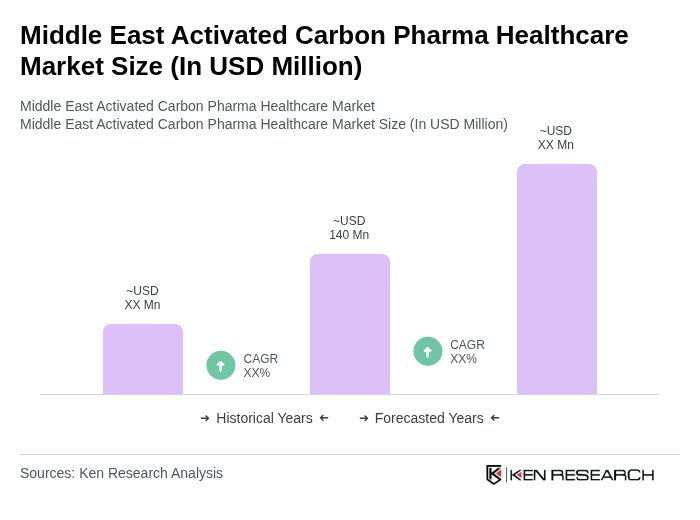
The Middle East Activated Carbon Pharma Healthcare Market, worth USD 140 Mn, is expanding due to rising demand in drug purification, environmental sustainability, and healthcare infrastructure.

Region:Middle East

Author(s):Rebecca

Product Code:KRAD4937

Pages:82

Published On:December 2025
About the Report

Base Year 2024

Middle East Activated Carbon Pharma Healthcare Market Overview

  • The Middle East Activated Carbon Pharma Healthcare Market is valued at USD 140 million, based on a five-year historical analysis of the broader regional activated carbon market and the share accounted for by pharmaceutical and healthcare applications. This growth is primarily driven by the increasing demand for high-quality activated carbon in pharmaceutical applications, including drug purification, decolorization, and wastewater treatment. The rising awareness of environmental sustainability, stricter effluent discharge norms, and tighter quality requirements for excipients and process aids in pharma manufacturing further propel the market's expansion.
  • Key country-level demand centers for activated carbon in this market include Saudi Arabia, the United Arab Emirates, and Egypt. Saudi Arabia holds the largest share of the Middle East activated carbon market, supported by rapid industrialization, growing water treatment needs, and a significant presence of pharmaceutical and medical sectors. The United Arab Emirates is a fast-growing importer and consumer of activated carbon, driven by investments in healthcare infrastructure, stringent water and air purification requirements in hospitals, and broader industrial applications. Egypt is emerging as a promising market, supported by expansion in water and wastewater treatment and a developing pharmaceutical industry that increasingly relies on advanced purification media.
  • The Saudi Food and Drug Authority (SFDA) regulates excipients and processing aids, including activated carbon used in pharmaceutical manufacturing, through instruments such as the SFDA “Drug Registration Guidance” and related quality standards issued under the Saudi Food and Drug Authority Law and the Executive Regulations of the Law of Pharmaceutical Establishments and Preparations, which reference compliance with pharmacopoeial standards (e.g., USP, Ph. Eur.) and good manufacturing practice requirements for materials used in drug production. These rules require that materials like pharmaceutical-grade activated carbon used in drug manufacturing meet specified quality, purity, and documentation standards but do not specify a standalone 2023 mandate exclusively for activated carbon; rather, they integrate activated carbon within the broader framework of excipient and manufacturing quality control.
Middle East Activated Carbon Pharma Healthcare Market Size

Middle East Activated Carbon Pharma Healthcare Market Segmentation

By Type:The market is segmented into various types of activated carbon, each serving distinct applications in the pharmaceutical and healthcare sectors. The primary types include Granular Activated Carbon, Powdered Activated Carbon, Extruded/Pelletized Activated Carbon, Impregnated Activated Carbon, and Spherical/Bead Activated Carbon. Granular Activated Carbon is widely used in fixed-bed filters for bulk water treatment and air purification in healthcare facilities, while Powdered Activated Carbon is increasingly adopted for batch purification, decolorization, and polishing steps in pharmaceutical and biopharmaceutical processes due to its high surface area and rapid adsorption kinetics. Extruded/Pelletized and Impregnated Activated Carbon types are applied in gas-phase filtration, odor control, and removal of specific contaminants (such as volatile organic compounds) in cleanroom and HVAC systems, whereas Spherical/Bead Activated Carbon is used in specialized applications including chromatographic separation and high-purity liquid treatment in pharma and medical device settings.
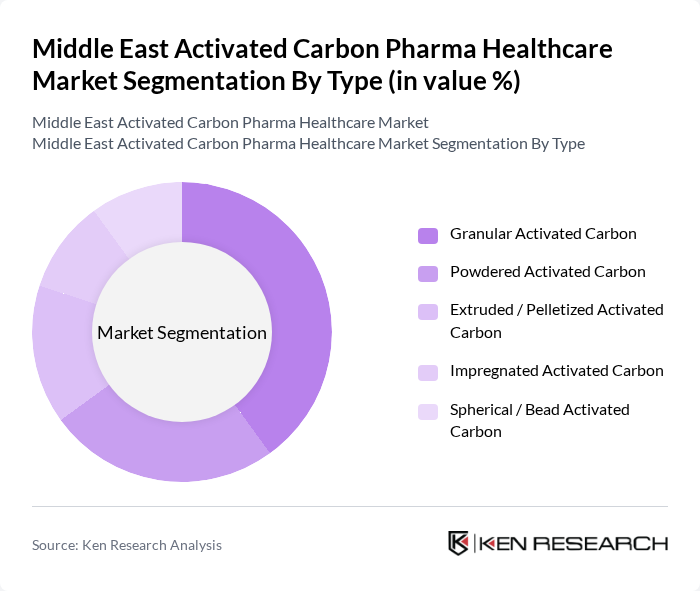
Middle East Activated Carbon Pharma Healthcare Market segmentation by Type.

By End-User:The activated carbon market is segmented by end-users, which include Hospitals & Clinics, Pharmaceutical & Biopharmaceutical Manufacturers, Contract Development & Manufacturing Organizations (CDMOs/CMOs), Dialysis Centers & Renal Care Facilities, and Research & Academic Laboratories. Hospitals & Clinics represent a major segment due to their high demand for activated carbon in point-of-use and centralized water purification systems, air and gas filtration units, and odor control solutions that are essential for maintaining sterile environments and patient safety. Pharmaceutical & Biopharmaceutical Manufacturers and CDMOs/CMOs use pharmaceutical-grade activated carbon extensively for impurity removal, API and intermediate purification, solvent recovery, and process polishing, while Dialysis Centers and Renal Care Facilities rely on activated carbon as part of multi-stage water treatment systems for hemodialysis. Research & Academic Laboratories deploy high-purity activated carbon in analytical sample preparation, separation processes, and pilot-scale purification studies supporting drug development.
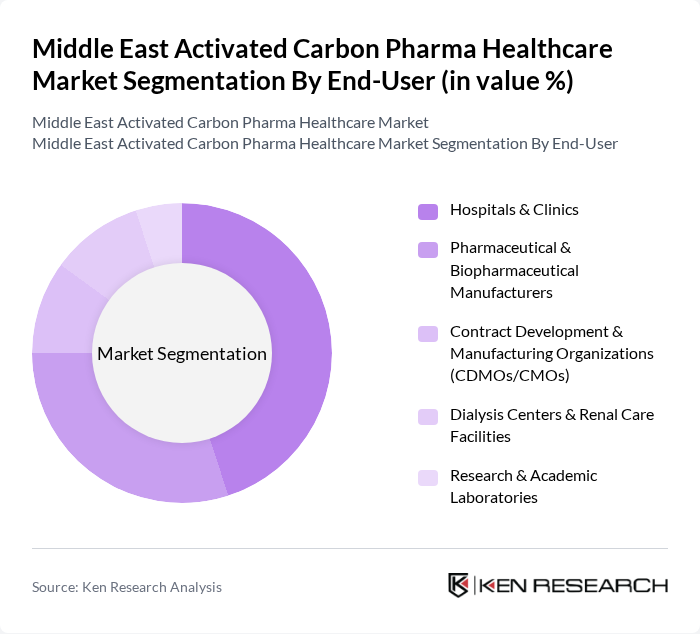
Middle East Activated Carbon Pharma Healthcare Market segmentation by End-User.

Middle East Activated Carbon Pharma Healthcare Market Competitive Landscape

The Middle East Activated Carbon Pharma Healthcare Market is characterized by a dynamic mix of regional and international players. Leading participants such as Cabot Corporation, Calgon Carbon Corporation (A Kuraray Company), Kuraray Co., Ltd., Haycarb PLC, Osaka Gas Chemicals Co., Ltd., Ingevity Corporation, Kureha Corporation, Donau Carbon GmbH, DESOTEC NV, Silcarbon Aktivkohle GmbH, Jacobi Carbons Group (Osaka Gas Chemicals), Eurocarb Products Ltd (Haycarb Group), PURAGEN Activated Carbons, Fujian Yuanli Active Carbon Co., Ltd., Activated Carbon Technologies FZE (UAE) contribute to innovation, geographic expansion, and service delivery in this space.

Cabot Corporation

1882

Boston, USA

Calgon Carbon Corporation

1942

Pittsburgh, USA

Kuraray Co., Ltd.

1926

Tokyo, Japan

Haycarb PLC

1973

Colombo, Sri Lanka

Osaka Gas Chemicals Co., Ltd.

1941

Osaka, Japan

Company

Establishment Year

Headquarters

Regional Footprint in the Middle East & North Africa (Number of Countries Served)

Pharma & Healthcare Revenue (USD Million, Middle East)

CAGR in Pharma / Healthcare Segment (Last 3–5 Years)

Installed Production / Processing Capacity for Pharma-Grade Activated Carbon (Tons/Year)

Share of Pharma & Healthcare in Total Activated Carbon Sales (%)

Number of Pharma-Grade SKUs / Product Lines

Middle East Activated Carbon Pharma Healthcare Market Industry Analysis

Growth Drivers

  • Increasing Demand for Pharmaceutical Applications:The Middle East pharmaceutical sector is projected to reach $70 billion, driven by a growing population and rising healthcare needs. Activated carbon is essential in drug purification and production processes, enhancing product quality. The region's focus on improving healthcare outcomes is further supported by government initiatives, which allocated $15 billion for healthcare infrastructure, thereby increasing the demand for activated carbon in pharmaceutical applications.
  • Rising Awareness of Environmental Sustainability:The Middle East is witnessing a significant shift towards sustainable practices, with the region investing approximately $30 billion in renewable energy projects in future. This trend is influencing the healthcare sector, where activated carbon is recognized for its eco-friendly properties. The increasing emphasis on reducing carbon footprints and waste management in healthcare facilities is driving the demand for activated carbon solutions, aligning with global sustainability goals.
  • Technological Advancements in Activated Carbon Production:Innovations in activated carbon production technologies are enhancing efficiency and reducing costs. In future, the introduction of advanced manufacturing techniques is expected to lower production costs by 20%, making activated carbon more accessible to healthcare providers. Additionally, the integration of automation and smart technologies in production processes is expected to improve product quality and consistency, further driving market growth in the region.

Market Challenges

  • High Production Costs:The production of activated carbon involves significant costs, primarily due to raw material prices and energy consumption. In future, the average cost of activated carbon production is estimated to be around $3,000 per ton, which poses a challenge for manufacturers. This high cost can limit market entry for smaller companies and restrict the overall growth of the activated carbon market in the healthcare sector.
  • Regulatory Compliance Issues:The activated carbon industry faces stringent regulatory requirements, particularly in the pharmaceutical sector. Compliance with local and international standards can be complex and costly. In future, companies may incur up to $1.5 million in compliance-related expenses, which can hinder innovation and market expansion. Navigating these regulations effectively is crucial for companies aiming to succeed in the Middle East activated carbon market.

Middle East Activated Carbon Pharma Healthcare Market Future Outlook

The future of the Middle East activated carbon pharma healthcare market appears promising, driven by increasing investments in healthcare infrastructure and a growing emphasis on sustainable practices. As the biopharmaceutical sector expands, the demand for high-quality activated carbon will likely rise. Additionally, advancements in production technologies will enhance efficiency and reduce costs, making activated carbon solutions more accessible. The collaboration between healthcare and environmental sectors will further foster innovation and market growth, positioning the region as a leader in activated carbon applications.

Market Opportunities

  • Growth in the Biopharmaceutical Sector:The biopharmaceutical market in the Middle East is expected to reach $20 billion, creating significant opportunities for activated carbon applications in drug development and purification processes. This growth will drive demand for high-quality activated carbon, positioning manufacturers to capitalize on this expanding market segment.
  • Expansion of Water Treatment Facilities:With an investment of $10 billion in water treatment infrastructure planned in future, the demand for activated carbon in water purification processes is set to increase. This expansion presents a lucrative opportunity for activated carbon producers to supply effective filtration solutions, addressing both healthcare and environmental needs in the region.

Scope of the Report

SegmentSub-Segments
By Type

Granular Activated Carbon

Powdered Activated Carbon

Extruded / Pelletized Activated Carbon

Impregnated Activated Carbon

Spherical / Bead Activated Carbon

By End-User

Hospitals & Clinics

Pharmaceutical & Biopharmaceutical Manufacturers

Contract Development & Manufacturing Organizations (CDMOs/CMOs)

Dialysis Centers & Renal Care Facilities

Research & Academic Laboratories

By Application

API Purification & Decolorization

Excipients and Oral Solid Dosage Formulations

Hemoperfusion & Hemodialysis (Detoxification)

Pharmaceutical Wastewater & Effluent Treatment

Air & Gas Purification in Healthcare Facilities

By Distribution Channel

Direct Sales to Pharma / Healthcare End-Users

Specialty Chemical Distributors

OEM Supply to Medical Device & Filter Manufacturers

Online Technical Procurement Platforms

Local Traders & Agents

By Geography

GCC Countries (Saudi Arabia, UAE, Qatar, Kuwait, Oman, Bahrain)

Levant (Turkey, Israel, Jordan, Lebanon, Others)

North Africa (Egypt, Morocco, Algeria, Others)

Rest of Middle East & Africa

By Regulatory Compliance

USP / Ph. Eur. / JP Pharmaceutical-Grade Standards

cGMP-Compliant Manufacturing

Local Health Authority Approvals (SFDA, MOHAP, etc.)

Environmental & ESG Compliance

By Product Formulation

Bulk Activated Carbon for Processing

Finished Medicinal Activated Carbon (Tablets, Capsules, Sachets)

Cartridge, Filter Media & Device-Integrated Forms

Key Target Audience

Investors and Venture Capitalist Firms

Government and Regulatory Bodies (e.g., Ministry of Health, Food and Drug Administration)

Manufacturers and Producers of Activated Carbon

Pharmaceutical Companies

Healthcare Providers and Hospitals

Distributors and Wholesalers of Healthcare Products

Industry Associations and Trade Organizations

Financial Institutions and Investment Banks

Players Mentioned in the Report:

Cabot Corporation

Calgon Carbon Corporation (A Kuraray Company)

Kuraray Co., Ltd.

Haycarb PLC

Osaka Gas Chemicals Co., Ltd.

Ingevity Corporation

Kureha Corporation

Donau Carbon GmbH

DESOTEC NV

Silcarbon Aktivkohle GmbH

Jacobi Carbons Group (Osaka Gas Chemicals)

Eurocarb Products Ltd (Haycarb Group)

PURAGEN Activated Carbons

Fujian Yuanli Active Carbon Co., Ltd.

Activated Carbon Technologies FZE (UAE)

Table of Contents

Market Assessment Phase

1. Executive Summary and Approach


2. Middle East Activated Carbon Pharma Healthcare Market Overview

2.1 Key Insights and Strategic Recommendations

2.2 Middle East Activated Carbon Pharma Healthcare Market Overview

2.3 Definition and Scope

2.4 Evolution of Market Ecosystem

2.5 Timeline of Key Regulatory Milestones

2.6 Value Chain & Stakeholder Mapping

2.7 Business Cycle Analysis

2.8 Policy & Incentive Landscape


3. Middle East Activated Carbon Pharma Healthcare Market Analysis

3.1 Growth Drivers

3.1.1 Increasing Demand for Pharmaceutical Applications
3.1.2 Rising Awareness of Environmental Sustainability
3.1.3 Technological Advancements in Activated Carbon Production
3.1.4 Expanding Healthcare Infrastructure in the Region

3.2 Market Challenges

3.2.1 High Production Costs
3.2.2 Regulatory Compliance Issues
3.2.3 Limited Awareness Among End-Users
3.2.4 Competition from Alternative Filtration Technologies

3.3 Market Opportunities

3.3.1 Growth in the Biopharmaceutical Sector
3.3.2 Expansion of Water Treatment Facilities
3.3.3 Increasing Investment in Research and Development
3.3.4 Potential for Exporting Activated Carbon Products

3.4 Market Trends

3.4.1 Shift Towards Sustainable and Eco-Friendly Products
3.4.2 Integration of Smart Technologies in Healthcare
3.4.3 Customization of Activated Carbon Solutions
3.4.4 Collaborations Between Healthcare and Environmental Sectors

3.5 Government Regulation

3.5.1 Stricter Environmental Regulations
3.5.2 Guidelines for Pharmaceutical Waste Management
3.5.3 Standards for Activated Carbon Quality
3.5.4 Incentives for Sustainable Practices in Healthcare

4. SWOT Analysis


5. Stakeholder Analysis


6. Porter's Five Forces Analysis


7. Middle East Activated Carbon Pharma Healthcare Market Market Size, 2019-2024

7.1 By Value

7.2 By Volume

7.3 By Average Selling Price


8. Middle East Activated Carbon Pharma Healthcare Market Segmentation

8.1 By Type

8.1.1 Granular Activated Carbon
8.1.2 Powdered Activated Carbon
8.1.3 Extruded / Pelletized Activated Carbon
8.1.4 Impregnated Activated Carbon
8.1.5 Spherical / Bead Activated Carbon

8.2 By End-User

8.2.1 Hospitals & Clinics
8.2.2 Pharmaceutical & Biopharmaceutical Manufacturers
8.2.3 Contract Development & Manufacturing Organizations (CDMOs/CMOs)
8.2.4 Dialysis Centers & Renal Care Facilities
8.2.5 Research & Academic Laboratories

8.3 By Application

8.3.1 API Purification & Decolorization
8.3.2 Excipients and Oral Solid Dosage Formulations
8.3.3 Hemoperfusion & Hemodialysis (Detoxification)
8.3.4 Pharmaceutical Wastewater & Effluent Treatment
8.3.5 Air & Gas Purification in Healthcare Facilities

8.4 By Distribution Channel

8.4.1 Direct Sales to Pharma / Healthcare End-Users
8.4.2 Specialty Chemical Distributors
8.4.3 OEM Supply to Medical Device & Filter Manufacturers
8.4.4 Online Technical Procurement Platforms
8.4.5 Local Traders & Agents

8.5 By Geography

8.5.1 GCC Countries (Saudi Arabia, UAE, Qatar, Kuwait, Oman, Bahrain)
8.5.2 Levant (Turkey, Israel, Jordan, Lebanon, Others)
8.5.3 North Africa (Egypt, Morocco, Algeria, Others)
8.5.4 Rest of Middle East & Africa

8.6 By Regulatory Compliance

8.6.1 USP / Ph. Eur. / JP Pharmaceutical-Grade Standards
8.6.2 cGMP-Compliant Manufacturing
8.6.3 Local Health Authority Approvals (SFDA, MOHAP, etc.)
8.6.4 Environmental & ESG Compliance

8.7 By Product Formulation

8.7.1 Bulk Activated Carbon for Processing
8.7.2 Finished Medicinal Activated Carbon (Tablets, Capsules, Sachets)
8.7.3 Cartridge, Filter Media & Device-Integrated Forms

9. Middle East Activated Carbon Pharma Healthcare Market Competitive Analysis

9.1 Market Share of Key Players

9.2 Cross Comparison of Key Players

9.2.1 Company Name
9.2.2 Regional Footprint in the Middle East & North Africa (Number of Countries Served)
9.2.3 Pharma & Healthcare Revenue (USD Million, Middle East)
9.2.4 CAGR in Pharma / Healthcare Segment (Last 3–5 Years)
9.2.5 Installed Production / Processing Capacity for Pharma-Grade Activated Carbon (Tons/Year)
9.2.6 Share of Pharma & Healthcare in Total Activated Carbon Sales (%)
9.2.7 Number of Pharma-Grade SKUs / Product Lines
9.2.8 Compliance Portfolio (No. of USP/Ph. Eur./JP Grades, cGMP Sites, Certifications)
9.2.9 Key Middle East Partnerships (Distributors, CMOs, OEMs)
9.2.10 Average Realization per Kg for Pharma-Grade Activated Carbon (USD/Kg)
9.2.11 R&D Intensity (% of Revenue Spent on Pharma / Healthcare Applications)
9.2.12 On-Time Delivery & Supply Reliability in the Region (%)

9.3 SWOT Analysis of Top Players

9.4 Pricing Analysis

9.5 Detailed Profile of Major Companies

9.5.1 Cabot Corporation
9.5.2 Calgon Carbon Corporation (A Kuraray Company)
9.5.3 Kuraray Co., Ltd.
9.5.4 Haycarb PLC
9.5.5 Osaka Gas Chemicals Co., Ltd.
9.5.6 Ingevity Corporation
9.5.7 Kureha Corporation
9.5.8 Donau Carbon GmbH
9.5.9 DESOTEC NV
9.5.10 Silcarbon Aktivkohle GmbH
9.5.11 Jacobi Carbons Group (Osaka Gas Chemicals)
9.5.12 Eurocarb Products Ltd (Haycarb Group)
9.5.13 PURAGEN Activated Carbons
9.5.14 Fujian Yuanli Active Carbon Co., Ltd.
9.5.15 Activated Carbon Technologies FZE (UAE)

10. Middle East Activated Carbon Pharma Healthcare Market End-User Analysis

10.1 Procurement Behavior of Key Ministries

10.1.1 Budget Allocation Trends
10.1.2 Procurement Processes
10.1.3 Supplier Selection Criteria
10.1.4 Contract Management Practices

10.2 Corporate Spend on Infrastructure & Energy

10.2.1 Investment Trends in Healthcare Infrastructure
10.2.2 Energy Consumption Patterns
10.2.3 Budgeting for Activated Carbon Solutions
10.2.4 Cost-Benefit Analysis of Activated Carbon Use

10.3 Pain Point Analysis by End-User Category

10.3.1 Quality Assurance Issues
10.3.2 Supply Chain Disruptions
10.3.3 Regulatory Compliance Challenges
10.3.4 Cost Management Concerns

10.4 User Readiness for Adoption

10.4.1 Awareness Levels
10.4.2 Training and Support Needs
10.4.3 Technology Adoption Rates
10.4.4 Feedback Mechanisms

10.5 Post-Deployment ROI and Use Case Expansion

10.5.1 Measurement of ROI
10.5.2 Case Studies of Successful Implementations
10.5.3 Future Use Case Opportunities
10.5.4 Long-term Sustainability Considerations

11. Middle East Activated Carbon Pharma Healthcare Market Future Size, 2025-2030

11.1 By Value

11.2 By Volume

11.3 By Average Selling Price


Go-To-Market Strategy Phase

1. Whitespace Analysis + Business Model Canvas

1.1 Market Gaps Identification

1.2 Value Proposition Development

1.3 Revenue Streams Analysis

1.4 Cost Structure Evaluation

1.5 Key Partnerships Exploration

1.6 Customer Segmentation

1.7 Channels of Distribution


2. Marketing and Positioning Recommendations

2.1 Branding Strategies

2.2 Product USPs

2.3 Target Market Identification

2.4 Communication Strategies

2.5 Digital Marketing Approaches


3. Distribution Plan

3.1 Urban Retail Strategies

3.2 Rural NGO Tie-ups

3.3 E-commerce Integration

3.4 Logistics and Supply Chain Management


4. Channel & Pricing Gaps

4.1 Underserved Routes

4.2 Pricing Bands Analysis

4.3 Competitor Pricing Strategies


5. Unmet Demand & Latent Needs

5.1 Category Gaps Identification

5.2 Consumer Segments Analysis

5.3 Product Development Opportunities


6. Customer Relationship

6.1 Loyalty Programs

6.2 After-sales Service Enhancements

6.3 Customer Feedback Mechanisms


7. Value Proposition

7.1 Sustainability Initiatives

7.2 Integrated Supply Chains

7.3 Competitive Advantages


8. Key Activities

8.1 Regulatory Compliance

8.2 Branding Initiatives

8.3 Distribution Setup


9. Entry Strategy Evaluation

9.1 Domestic Market Entry Strategy

9.1.1 Product Mix Considerations
9.1.2 Pricing Band Strategy
9.1.3 Packaging Innovations

9.2 Export Entry Strategy

9.2.1 Target Countries Identification
9.2.2 Compliance Roadmap Development

10. Entry Mode Assessment

10.1 Joint Ventures

10.2 Greenfield Investments

10.3 Mergers & Acquisitions

10.4 Distributor Model Evaluation


11. Capital and Timeline Estimation

11.1 Capital Requirements Analysis

11.2 Timelines for Market Entry


12. Control vs Risk Trade-Off

12.1 Ownership vs Partnerships

12.2 Risk Mitigation Strategies


13. Profitability Outlook

13.1 Breakeven Analysis

13.2 Long-term Sustainability Strategies


14. Potential Partner List

14.1 Distributors

14.2 Joint Ventures

14.3 Acquisition Targets


15. Execution Roadmap

15.1 Phased Plan for Market Entry

15.1.1 Market Setup
15.1.2 Market Entry
15.1.3 Growth Acceleration
15.1.4 Scale & Stabilize

15.2 Key Activities and Milestones

15.2.1 Milestone Planning
15.2.2 Activity Tracking

Research Methodology

ApproachModellingSample

Phase 1: Approach1

Desk Research

  • Analysis of industry reports from healthcare and pharmaceutical associations in the Middle East
  • Review of market studies and white papers published by research institutions and consultancy firms
  • Examination of regulatory frameworks and guidelines from health ministries across the region

Primary Research

  • Interviews with key opinion leaders in the activated carbon and pharmaceutical sectors
  • Surveys targeting healthcare professionals and procurement managers in hospitals and clinics
  • Field interviews with manufacturers and suppliers of activated carbon products

Validation & Triangulation

  • Cross-validation of findings through multiple data sources, including trade publications and market reports
  • Triangulation of insights from primary interviews with secondary data trends
  • Sanity checks conducted through expert panel discussions and feedback sessions

Phase 2: Market Size Estimation1

Top-down Assessment

  • Estimation of market size based on healthcare expenditure trends in the Middle East
  • Segmentation of the market by application areas such as pharmaceuticals, water treatment, and air purification
  • Incorporation of growth rates from related sectors, including environmental and healthcare technologies

Bottom-up Modeling

  • Collection of sales data from leading activated carbon manufacturers in the region
  • Estimation of market share based on production capacities and sales volumes
  • Analysis of pricing strategies and cost structures of activated carbon products

Forecasting & Scenario Analysis

  • Development of forecasts using historical data and market growth indicators
  • Scenario analysis based on potential regulatory changes and healthcare trends
  • Creation of baseline, optimistic, and pessimistic market projections through 2030

Phase 3: CATI Sample Composition1

Scope Item/SegmentSample SizeTarget Respondent Profiles
Pharmaceutical Manufacturers110Production Managers, Quality Control Officers
Healthcare Providers90Hospital Administrators, Procurement Officers
Environmental Agencies60Regulatory Affairs Specialists, Environmental Scientists
Activated Carbon Suppliers70Sales Managers, Product Development Engineers
Research Institutions50Research Analysts, Academic Professors

Frequently Asked Questions

What is the current value of the Middle East Activated Carbon Pharma Healthcare Market?

The Middle East Activated Carbon Pharma Healthcare Market is valued at approximately USD 140 million, reflecting the significant role of activated carbon in pharmaceutical applications such as drug purification and wastewater treatment.

What factors are driving the growth of the activated carbon market in the Middle East?

Which countries are the major demand centers for activated carbon in the Middle East?

How does the Saudi Food and Drug Authority regulate activated carbon in pharmaceuticals?

Other Regional/Country Reports

Indonesia Activated Carbon Pharma Healthcare Market

Malaysia Activated Carbon Pharma Healthcare Market

KSA Activated Carbon Pharma Healthcare Market

APAC Activated Carbon Pharma Healthcare Market

SEA Activated Carbon Pharma Healthcare Market

Vietnam Activated Carbon Pharma Healthcare Market

Other Adjacent Reports

Belgium Pharmaceutical Excipients Market

Qatar Water Treatment Chemicals Market

KSA Air Purification Systems Market

Malaysia Biopharmaceutical Manufacturing Market

Bahrain Wastewater Treatment Equipment Market

Vietnam Drug Purification Technologies Market

South Africa Medical Filtration Devices Market

Bahrain Hospital Air Quality Management Market

UAE Renal Dialysis Supplies Market

Brazil Environmental Remediation Services Market

Why Buy From Us?

Refine Robust Result (RRR) Framework

What makes us stand out is that our consultants follow Robust, Refine and Result (RRR) methodology. Robust for clear definitions, approaches and sanity checking, Refine for differentiating respondents' facts and opinions, and Result for presenting data with story.

Our Reach Is Unmatched

We have set a benchmark in the industry by offering our clients with syndicated and customized market research reports featuring coverage of entire market as well as meticulous research and analyst insights.

Shifting the Research Paradigm

While we don't replace traditional research, we flip the method upside down. Our dual approach of Top Bottom & Bottom Top ensures quality deliverable by not just verifying company fundamentals but also looking at the sector and macroeconomic factors.

More Insights-Better Decisions

With one step in the future, our research team constantly tries to show you the bigger picture. We help with some of the tough questions you may encounter along the way: How is the industry positioned? Best marketing channel? KPI's of competitors? By aligning every element, we help maximize success.

Transparency and Trust

Our report gives you instant access to the answers and sources that other companies might choose to hide. We elaborate each steps of research methodology we have used and showcase you the sample size to earn your trust.

Round the Clock Support

If you need any support, we are here! We pride ourselves on universe strength, data quality, and quick, friendly, and professional service.

Why Clients Choose Us?

400000+
Reports in repository
150+
Consulting projects a year
100+
Analysts
8000+
Client Queries in 2022








