About the Report
Base Year 2024Middle East And Africa Armored Vehicles Market Overview
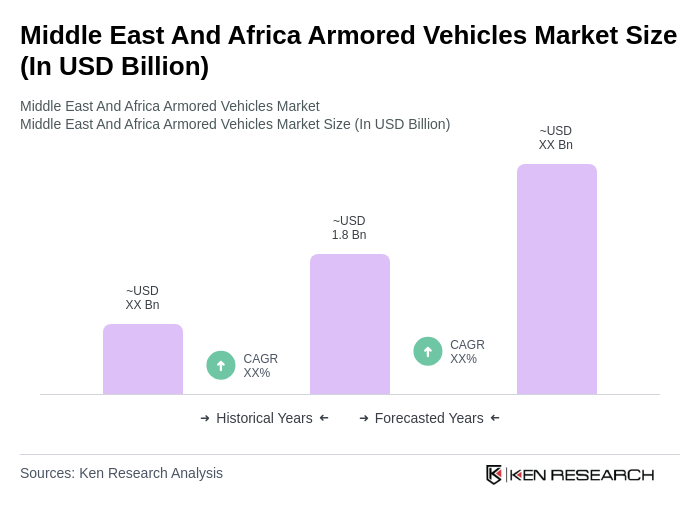
- The Middle East and Africa Armored Vehicles Market is valued at USD 1.8 billion, based on a five-year historical analysis. This demand is primarily driven by increasing defense budgets, persistent geopolitical tensions, and the need to modernize land forces for enhanced survivability and mobility.
- Key regional demand centers include Saudi Arabia, the United Arab Emirates, and South Africa. Saudi Arabia’s elevated defense spending and ongoing localization initiatives, the UAE’s strong industrial base via EDGE/NIMR and strategic procurement, and South Africa’s established armored vehicle manufacturing ecosystem (Paramount, Denel) underpin their prominent roles in the market.
- In 2023, the UAE advanced policies to deepen defense industrial participation and local content, supporting domestic armored vehicle production through EDGE Group programs and offsets, although no official mandate requires 50% of all defense contracts to be awarded to local manufacturers; UAE policy frameworks emphasize localization and in?country value rather than a fixed statutory quota.
Middle East And Africa Armored Vehicles Market Segmentation
By Type:
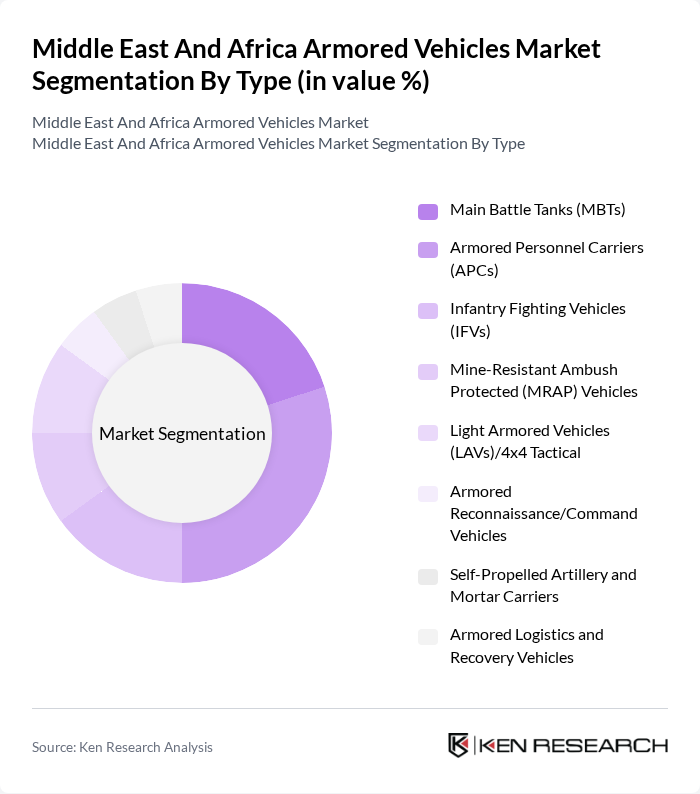
The armored vehicles market is segmented into various types, including Main Battle Tanks (MBTs), Armored Personnel Carriers (APCs), Infantry Fighting Vehicles (IFVs), Mine-Resistant Ambush Protected (MRAP) Vehicles, Light Armored Vehicles (LAVs)/4x4 Tactical, Armored Reconnaissance/Command Vehicles, Self-Propelled Artillery and Mortar Carriers, and Armored Logistics and Recovery Vehicles. Among these, Armored Personnel Carriers (APCs) and MBTs account for significant demand in the region, supported by fleet recapitalization and border security missions; APCs remain a mainstay for protected troop transport and modular mission roles, while MRAPs continue to see uptake for counter-insurgency and internal security tasks.
By End-User:
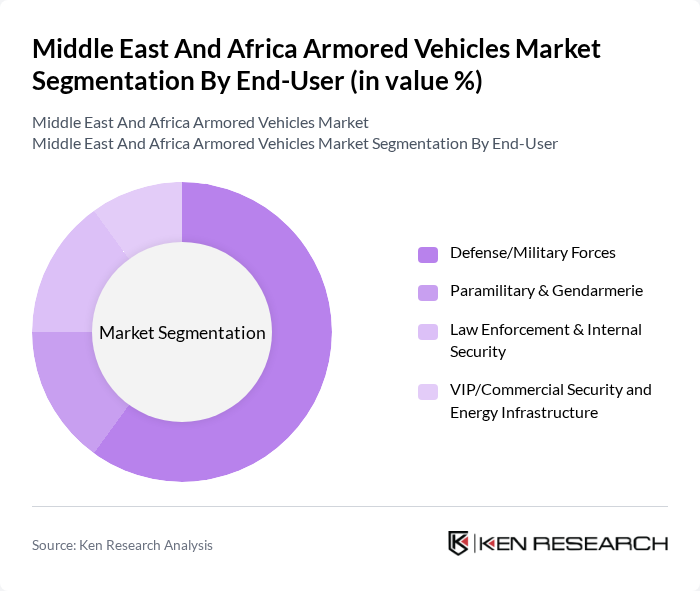
The end-user segmentation includes Defense/Military Forces, Paramilitary & Gendarmerie, Law Enforcement & Internal Security, and VIP/Commercial Security and Energy Infrastructure. The Defense/Military Forces segment leads the market, underpinned by ongoing force modernization, localization partnerships (e.g., Saudi industrialization initiatives with regional OEMs), and rising land systems procurement for border security and counter-terror operations; internal security agencies continue to procure MRAPs and 4x4 tactical platforms for urban and asymmetric environments.
Middle East And Africa Armored Vehicles Market Competitive Landscape
The Middle East And Africa Armored Vehicles Market is characterized by a dynamic mix of regional and international players. Leading participants such as NIMR (EDGE Group, UAE), Saudi Arabian Military Industries (SAMI), KSA, STREIT Group, UAE, Paramount Group, South Africa, Denel Vehicle Systems, South Africa, Otokar, Türkiye, FNSS Savunma Sistemleri, Türkiye, Plasan, Israel, Elbit Systems, Israel, Israel Aerospace Industries (IAI), Israel, Rafael Advanced Defense Systems, Israel, Iveco Defence Vehicles, Italy, BAE Systems (incl. BAE Systems Land UK & BAE Systems Hägglunds), General Dynamics Land Systems (GDLS), Rheinmetall AG, KNDS (Krauss?Maffei Wegmann + Nexter), Oshkosh Defense, AM General, Textron Systems, Arquus (Volvo Group), France, Mahindra Defence Systems, India, Ashok Leyland (Defence), India, FFG Flensburger Fahrzeugbau Gesellschaft, Germany, PT Pindad, Indonesia, Nimda & Carmor, Israel contribute to innovation, geographic expansion, and service delivery in this space.
Middle East And Africa Armored Vehicles Market Industry Analysis
Growth Drivers
- Increasing Defense Budgets:The Middle East and Africa region has seen a significant increase in defense budgets, with countries like Saudi Arabia allocating approximately $66 billion. This surge is driven by geopolitical tensions and the need for enhanced military capabilities. The UAE and Egypt are also increasing their defense spending, with budgets of around $30 billion and $13 billion, respectively. This financial commitment directly supports the procurement of advanced armored vehicles, fueling market growth.
- Rising Security Concerns:Heightened security threats, including terrorism and regional conflicts, have prompted nations in the Middle East and Africa to prioritize military readiness. For instance, the African Union reported a 35% increase in terrorist activities, leading to urgent calls for improved defense mechanisms. Countries are investing in armored vehicles to enhance troop protection and operational efficiency, thereby driving demand in the armored vehicles market significantly.
- Technological Advancements in Armored Vehicles:The armored vehicles market is experiencing rapid technological advancements, with innovations such as enhanced armor materials and integrated communication systems. In future, the global defense technology market is projected to reach $1.9 trillion, with a significant portion allocated to armored vehicle upgrades. These advancements not only improve vehicle performance but also attract investments from governments seeking to modernize their military fleets, thus propelling market growth.
Market Challenges
- High Initial Investment Costs:The acquisition of armored vehicles involves substantial initial investment, often exceeding $1.2 million per unit for advanced models. This financial barrier can deter smaller nations or those with limited budgets from upgrading their fleets. For example, many African nations face budget constraints, with average defense spending around $6 billion, making it challenging to allocate sufficient funds for armored vehicle procurement.
- Regulatory Compliance Issues:Navigating the complex regulatory landscape poses significant challenges for manufacturers and buyers in the armored vehicles market. Compliance with export control regulations, such as the Arms Trade Treaty, can delay procurement processes. In future, the compliance costs are estimated to rise by 20%, impacting the overall market dynamics. This regulatory burden can hinder timely acquisitions and limit the availability of advanced armored vehicles in the region.
Middle East And Africa Armored Vehicles Market Future Outlook
The future of the Middle East and Africa armored vehicles market appears promising, driven by ongoing modernization efforts and increasing defense budgets. As nations prioritize military readiness, the demand for advanced armored vehicles is expected to rise. Additionally, the integration of cutting-edge technologies, such as AI and autonomous systems, will enhance operational capabilities. However, addressing challenges like high costs and regulatory compliance will be crucial for sustained growth in this sector, ensuring that countries can effectively modernize their armed forces.
Market Opportunities
- Growing Demand for Modernization of Armed Forces:As regional conflicts escalate, there is a pressing need for modernization among armed forces. Countries are increasingly seeking to upgrade their fleets with state-of-the-art armored vehicles, presenting a lucrative opportunity for manufacturers. The modernization efforts are expected to attract investments exceeding $12 billion, significantly impacting the market landscape.
- Development of Hybrid and Electric Armored Vehicles:The shift towards sustainability is creating opportunities for the development of hybrid and electric armored vehicles. With global trends indicating a 25% increase in demand for eco-friendly military solutions, manufacturers can capitalize on this trend. In future, investments in green technologies are projected to reach $2.5 billion, fostering innovation and expanding market potential in the region.
Scope of the Report
| Segment | Sub-Segments |
|---|---|
| By Type | Main Battle Tanks (MBTs) Armored Personnel Carriers (APCs) Infantry Fighting Vehicles (IFVs) Mine-Resistant Ambush Protected (MRAP) Vehicles Light Armored Vehicles (LAVs)/4x4 Tactical Armored Reconnaissance/Command Vehicles Self-Propelled Artillery and Mortar Carriers Armored Logistics and Recovery Vehicles |
| By End-User | Defense/Military Forces Paramilitary & Gendarmerie Law Enforcement & Internal Security VIP/Commercial Security and Energy Infrastructure |
| By Application | Combat and Fire Support Reconnaissance, C2/C4ISR, and Patrol Border Security and Counter?Insurgency Peacekeeping & Humanitarian Missions EOD/Route Clearance and Convoy Protection |
| By Procurement Channel | New Build/OEM Procurement Upgrades, Retrofit, and Life?Extension Surplus/Foreign Military Sales (FMS/G2G) |
| By Geography | Gulf Cooperation Council (Saudi Arabia, UAE, Qatar, Kuwait, Bahrain, Oman) Levant & Iraq (Israel, Jordan, Lebanon, Iraq) North Africa (Egypt, Algeria, Morocco, Tunisia) Sub?Saharan Africa (South Africa, Nigeria, Angola, Kenya, Others) |
| By Protection Level (STANAG/Armor Class) | Light (STANAG Level 1–2) Medium (STANAG Level 3–4) Heavy (STANAG Level 5–6+) |
| By Component/Subsystem | Hull/Chassis Armor Systems (Composite/Reactive/Add?on) Weapon Stations (Turrets, RWS) Powertrain & Mobility (Engine, Transmission, Suspension) Electronics & Vetronics (Sensors, BMS, EW, Comms) Active Protection & Counter?IED Systems Life Support & Survivability (CBRN, Fire Suppression) |
Key Target Audience
Investors and Venture Capitalist Firms
Government and Regulatory Bodies (e.g., Ministry of Defense, Ministry of Interior)
Military and Defense Procurement Agencies
Armored Vehicle Manufacturers and Producers
Defense Contractors and Suppliers
Security and Defense Consultants
Industry Associations (e.g., International Armored Vehicles Association)
Financial Institutions and Investment Banks
Players Mentioned in the Report:
NIMR (EDGE Group, UAE)
Saudi Arabian Military Industries (SAMI), KSA
STREIT Group, UAE
Paramount Group, South Africa
Denel Vehicle Systems, South Africa
Otokar, Turkiye
FNSS Savunma Sistemleri, Turkiye
Plasan, Israel
Elbit Systems, Israel
Israel Aerospace Industries (IAI), Israel
Rafael Advanced Defense Systems, Israel
Iveco Defence Vehicles, Italy
BAE Systems (incl. BAE Systems Land UK & BAE Systems Hagglunds)
General Dynamics Land Systems (GDLS)
Rheinmetall AG
KNDS (KraussMaffei Wegmann + Nexter)
Oshkosh Defense
AM General
Textron Systems
Arquus (Volvo Group), France
Mahindra Defence Systems, India
Ashok Leyland (Defence), India
FFG Flensburger Fahrzeugbau Gesellschaft, Germany
PT Pindad, Indonesia
Nimda & Carmor, Israel
Table of Contents
Market Assessment Phase
1. Executive Summary and Approach
2. Middle East And Africa Armored Vehicles Market Overview
2.1 Key Insights and Strategic Recommendations
2.2 Middle East And Africa Armored Vehicles Market Overview
2.3 Definition and Scope
2.4 Evolution of Market Ecosystem
2.5 Timeline of Key Regulatory Milestones
2.6 Value Chain & Stakeholder Mapping
2.7 Business Cycle Analysis
2.8 Policy & Incentive Landscape
3. Middle East And Africa Armored Vehicles Market Analysis
3.1 Growth Drivers
3.1.1 Increasing Defense Budgets
3.1.2 Rising Security Concerns
3.1.3 Technological Advancements in Armored Vehicles
3.1.4 Strategic Partnerships and Collaborations
3.2 Market Challenges
3.2.1 High Initial Investment Costs
3.2.2 Regulatory Compliance Issues
3.2.3 Supply Chain Disruptions
3.2.4 Limited Local Manufacturing Capabilities
3.3 Market Opportunities
3.3.1 Growing Demand for Modernization of Armed Forces
3.3.2 Expansion into Emerging Markets
3.3.3 Development of Hybrid and Electric Armored Vehicles
3.3.4 Increased Focus on Cybersecurity in Defense
3.4 Market Trends
3.4.1 Shift Towards Lightweight Armored Vehicles
3.4.2 Integration of AI and Autonomous Systems
3.4.3 Enhanced Focus on Soldier Protection Systems
3.4.4 Growing Importance of Logistics and Support Vehicles
3.5 Government Regulation
3.5.1 Export Control Regulations
3.5.2 Defense Procurement Policies
3.5.3 Environmental Regulations for Manufacturing
3.5.4 Standards for Vehicle Safety and Performance
4. SWOT Analysis
5. Stakeholder Analysis
6. Porter's Five Forces Analysis
7. Middle East And Africa Armored Vehicles Market Market Size, 2019-2024
7.1 By Value
7.2 By Volume
7.3 By Average Selling Price
8. Middle East And Africa Armored Vehicles Market Segmentation
8.1 By Type
8.1.1 Main Battle Tanks (MBTs)
8.1.2 Armored Personnel Carriers (APCs)
8.1.3 Infantry Fighting Vehicles (IFVs)
8.1.4 Mine-Resistant Ambush Protected (MRAP) Vehicles
8.1.5 Light Armored Vehicles (LAVs)/4x4 Tactical
8.1.6 Armored Reconnaissance/Command Vehicles
8.1.7 Self-Propelled Artillery and Mortar Carriers
8.1.8 Armored Logistics and Recovery Vehicles
8.2 By End-User
8.2.1 Defense/Military Forces
8.2.2 Paramilitary & Gendarmerie
8.2.3 Law Enforcement & Internal Security
8.2.4 VIP/Commercial Security and Energy Infrastructure
8.3 By Application
8.3.1 Combat and Fire Support
8.3.2 Reconnaissance, C2/C4ISR, and Patrol
8.3.3 Border Security and Counter?Insurgency
8.3.4 Peacekeeping & Humanitarian Missions
8.3.5 EOD/Route Clearance and Convoy Protection
8.4 By Procurement Channel
8.4.1 New Build/OEM Procurement
8.4.2 Upgrades, Retrofit, and Life?Extension
8.4.3 Surplus/Foreign Military Sales (FMS/G2G)
8.5 By Geography
8.5.1 Gulf Cooperation Council (Saudi Arabia, UAE, Qatar, Kuwait, Bahrain, Oman)
8.5.2 Levant & Iraq (Israel, Jordan, Lebanon, Iraq)
8.5.3 North Africa (Egypt, Algeria, Morocco, Tunisia)
8.5.4 Sub?Saharan Africa (South Africa, Nigeria, Angola, Kenya, Others)
8.6 By Protection Level (STANAG/Armor Class)
8.6.1 Light (STANAG Level 1–2)
8.6.2 Medium (STANAG Level 3–4)
8.6.3 Heavy (STANAG Level 5–6+)
8.7 By Component/Subsystem
8.7.1 Hull/Chassis
8.7.2 Armor Systems (Composite/Reactive/Add?on)
8.7.3 Weapon Stations (Turrets, RWS)
8.7.4 Powertrain & Mobility (Engine, Transmission, Suspension)
8.7.5 Electronics & Vetronics (Sensors, BMS, EW, Comms)
8.7.6 Active Protection & Counter?IED Systems
8.7.7 Life Support & Survivability (CBRN, Fire Suppression)
9. Middle East And Africa Armored Vehicles Market Competitive Analysis
9.1 Market Share of Key Players
9.2 Cross Comparison of Key Players
9.2.1 Company Name
9.2.2 Regional Footprint (Installed Base in MEA)
9.2.3 Backlog/Order Book in MEA (USD, units)
9.2.4 Revenue from MEA Armored Vehicles (USD, % of total defense)
9.2.5 Program Participation (e.g., JAIS, Mbombe, Eitan, Rabdan, Badger)
9.2.6 Deliveries and Local Assembly Presence (CKD/SKD, JV)
9.2.7 Product Portfolio Breadth (MBT/APC/IFV/MRAP/LAV)
9.2.8 Technology Edge (APS, RWS, hybrid power, BMS)
9.2.9 Offset/Localization Compliance (% local content)
9.2.10 Aftermarket & MRO Capacity in MEA (depots, service hubs)
9.2.11 Win Rate in MEA Tenders (%)
9.2.12 Average Delivery Lead Time (months)
9.2.13 Unit Pricing Range in MEA (indicative, by type)
9.2.14 Strategic Partnerships and Technology Transfer (MoUs, ToT)
9.3 SWOT Analysis of Top Players
9.4 Pricing Analysis
9.5 Detailed Profile of Major Companies
9.5.1 NIMR (EDGE Group, UAE)
9.5.2 Saudi Arabian Military Industries (SAMI), KSA
9.5.3 STREIT Group, UAE
9.5.4 Paramount Group, South Africa
9.5.5 Denel Vehicle Systems, South Africa
9.5.6 Otokar, Türkiye
9.5.7 FNSS Savunma Sistemleri, Türkiye
9.5.8 Plasan, Israel
9.5.9 Elbit Systems, Israel
9.5.10 Israel Aerospace Industries (IAI), Israel
9.5.11 Rafael Advanced Defense Systems, Israel
9.5.12 Iveco Defence Vehicles, Italy
9.5.13 BAE Systems (incl. BAE Systems Land UK & BAE Systems Hägglunds)
9.5.14 General Dynamics Land Systems (GDLS)
9.5.15 Rheinmetall AG
9.5.16 KNDS (Krauss?Maffei Wegmann + Nexter)
9.5.17 Oshkosh Defense
9.5.18 AM General
9.5.19 Textron Systems
9.5.20 Arquus (Volvo Group), France
9.5.21 Mahindra Defence Systems, India
9.5.22 Ashok Leyland (Defence), India
9.5.23 FFG Flensburger Fahrzeugbau Gesellschaft, Germany
9.5.24 PT Pindad, Indonesia
9.5.25 Nimda & Carmor, Israel
10. Middle East And Africa Armored Vehicles Market End-User Analysis
10.1 Procurement Behavior of Key Ministries
10.1.1 Defense Ministries
10.1.2 Interior Ministries
10.1.3 Emergency Services
10.2 Corporate Spend on Infrastructure & Energy
10.2.1 Government Contracts
10.2.2 Private Sector Investments
10.3 Pain Point Analysis by End-User Category
10.3.1 Budget Constraints
10.3.2 Technology Gaps
10.3.3 Maintenance Challenges
10.4 User Readiness for Adoption
10.4.1 Training Requirements
10.4.2 Infrastructure Readiness
10.5 Post-Deployment ROI and Use Case Expansion
10.5.1 Performance Metrics
10.5.2 Future Procurement Plans
11. Middle East And Africa Armored Vehicles Market Future Size, 2025-2030
11.1 By Value
11.2 By Volume
11.3 By Average Selling Price
Go-To-Market Strategy Phase
1. Whitespace Analysis + Business Model Canvas
1.1 Market Gaps Identification
1.2 Business Model Framework
2. Marketing and Positioning Recommendations
2.1 Branding Strategies
2.2 Product USPs
3. Distribution Plan
3.1 Urban Retail Strategies
3.2 Rural NGO Tie-Ups
4. Channel & Pricing Gaps
4.1 Underserved Routes
4.2 Pricing Bands
5. Unmet Demand & Latent Needs
5.1 Category Gaps
5.2 Consumer Segments
6. Customer Relationship
6.1 Loyalty Programs
6.2 After-Sales Service
7. Value Proposition
7.1 Sustainability Initiatives
7.2 Integrated Supply Chains
8. Key Activities
8.1 Regulatory Compliance
8.2 Branding Efforts
8.3 Distribution Setup
9. Entry Strategy Evaluation
9.1 Domestic Market Entry Strategy
9.1.1 Product Mix
9.1.2 Pricing Band
9.1.3 Packaging
9.2 Export Entry Strategy
9.2.1 Target Countries
9.2.2 Compliance Roadmap
10. Entry Mode Assessment
10.1 Joint Ventures
10.2 Greenfield Investments
10.3 Mergers & Acquisitions
10.4 Distributor Model
11. Capital and Timeline Estimation
11.1 Capital Requirements
11.2 Timelines
12. Control vs Risk Trade-Off
12.1 Ownership vs Partnerships
13. Profitability Outlook
13.1 Breakeven Analysis
13.2 Long-Term Sustainability
14. Potential Partner List
14.1 Distributors
14.2 Joint Ventures
14.3 Acquisition Targets
15. Execution Roadmap
15.1 Phased Plan for Market Entry
15.1.1 Market Setup
15.1.2 Market Entry
15.1.3 Growth Acceleration
15.1.4 Scale & Stabilize
15.2 Key Activities and Milestones
15.2.1 Activity Timeline
15.2.2 Milestone Tracking
Research Methodology
Phase 1: Approach1
Desk Research
- Analysis of market reports from defense and security agencies in the Middle East and Africa
- Review of industry publications and white papers on armored vehicle technology and trends
- Examination of government defense budgets and procurement plans across key countries
Primary Research
- Interviews with military procurement officers and defense analysts in the region
- Surveys with manufacturers and suppliers of armored vehicles and components
- Field interviews with military personnel regarding operational requirements and vehicle performance
Validation & Triangulation
- Cross-validation of findings through multiple data sources including trade publications and government reports
- Triangulation of market data with insights from industry experts and stakeholders
- Sanity checks through expert panel reviews to ensure data accuracy and relevance
Phase 2: Market Size Estimation1
Top-down Assessment
- Estimation of total market size based on regional defense spending and armored vehicle allocations
- Segmentation of the market by vehicle type, including light, medium, and heavy armored vehicles
- Incorporation of geopolitical factors influencing defense budgets and procurement strategies
Bottom-up Modeling
- Collection of sales data from leading armored vehicle manufacturers in the region
- Estimation of production capacities and operational costs for various vehicle types
- Volume x cost analysis to derive revenue projections for each segment
Forecasting & Scenario Analysis
- Multi-factor regression analysis incorporating defense spending trends and regional security dynamics
- Scenario modeling based on potential changes in government policies and international relations
- Baseline, optimistic, and pessimistic forecasts through 2030 to account for market volatility
Phase 3: CATI Sample Composition1
| Scope Item/Segment | Sample Size | Target Respondent Profiles |
|---|---|---|
| Military Procurement Departments | 100 | Procurement Officers, Defense Analysts |
| Armored Vehicle Manufacturers | 80 | Product Managers, Sales Directors |
| Defense Contractors | 70 | Project Managers, Business Development Executives |
| Military End-Users | 90 | Field Commanders, Technical Officers |
| Government Defense Agencies | 60 | Policy Makers, Strategic Planners |
Frequently Asked Questions
What is the current value of the Middle East and Africa Armored Vehicles Market?
The Middle East and Africa Armored Vehicles Market is valued at approximately USD 1.8 billion, driven by increasing defense budgets, geopolitical tensions, and the need for modernization of land forces to enhance survivability and mobility.
Which countries are the key demand centers for armored vehicles in the Middle East and Africa?
What factors are driving the growth of the armored vehicles market in the Middle East and Africa?
What are the main types of armored vehicles in the market?
Other Regional/Country Reports
Indonesia Armored Vehicles Market
Malaysia Armored Vehicles Market
KSA Armored Vehicles Market
APAC Armored Vehicles Market
SEA Armored Vehicles Market
Why Buy From Us?

What makes us stand out is that our consultants follow Robust, Refine and Result (RRR) methodology. Robust for clear definitions, approaches and sanity checking, Refine for differentiating respondents' facts and opinions, and Result for presenting data with story.

We have set a benchmark in the industry by offering our clients with syndicated and customized market research reports featuring coverage of entire market as well as meticulous research and analyst insights.

While we don't replace traditional research, we flip the method upside down. Our dual approach of Top Bottom & Bottom Top ensures quality deliverable by not just verifying company fundamentals but also looking at the sector and macroeconomic factors.

With one step in the future, our research team constantly tries to show you the bigger picture. We help with some of the tough questions you may encounter along the way: How is the industry positioned? Best marketing channel? KPI's of competitors? By aligning every element, we help maximize success.

Our report gives you instant access to the answers and sources that other companies might choose to hide. We elaborate each steps of research methodology we have used and showcase you the sample size to earn your trust.

If you need any support, we are here! We pride ourselves on universe strength, data quality, and quick, friendly, and professional service.