About the Report
Base Year 2024Middle East And Africa Aviation Fuel Market Overview
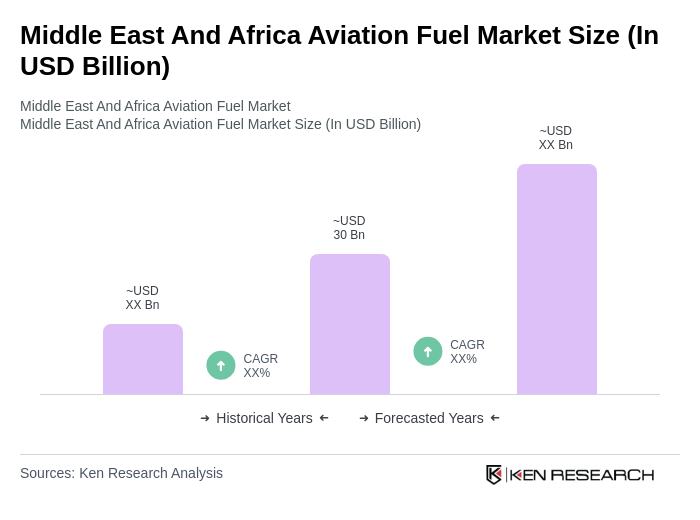
- The Middle East and Africa Aviation Fuel Market is valued at USD 30 billion, based on a five-year historical analysis. This growth is primarily driven by increasing air travel demand, expansion of airport infrastructure, and rising cargo transportation needs across key hubs such as the UAE and Saudi Arabia, alongside a broad post-pandemic recovery in commercial flight activity and jet fuel uplift in MEA.
- Key players in this market include the United Arab Emirates, Saudi Arabia, and South Africa. The UAE is a major hub for international air travel, with Dubai International Airport consistently among the world’s busiest by international passengers, supporting high jet fuel throughput. Saudi Arabia’s sustained investments in aviation (airport expansions and national carriers) and South Africa’s strategic role in regional air cargo and long-haul connectivity underpin their prominence in regional fuel demand.
- In 2023, the South African government did not mandate a minimum blend of sustainable aviation fuel (SAF) in all aviation fuel sold. Policy activity on SAF in MEA is growing, but binding blend mandates in South Africa have not been enacted; SAF adoption in MEA remains at an early stage with modest 2024 regional revenues reported for SAF.
Middle East And Africa Aviation Fuel Market Segmentation
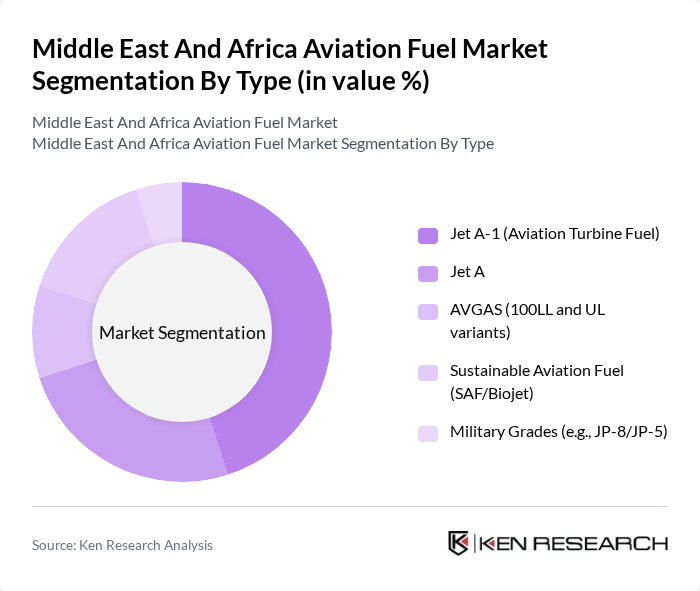
By Type:The aviation fuel market is segmented into various types, including Jet A-1 (Aviation Turbine Fuel), Jet A, AVGAS (100LL and UL variants), Sustainable Aviation Fuel (SAF/Biojet), and Military Grades (e.g., JP-8/JP-5). Among these, Jet A-1 is the most widely used fuel type due to its compatibility with commercial jet engines and its availability at most airports. The increasing focus on sustainability has also led to a rise in the adoption of SAF, which is gaining traction among airlines looking to reduce their carbon footprint.
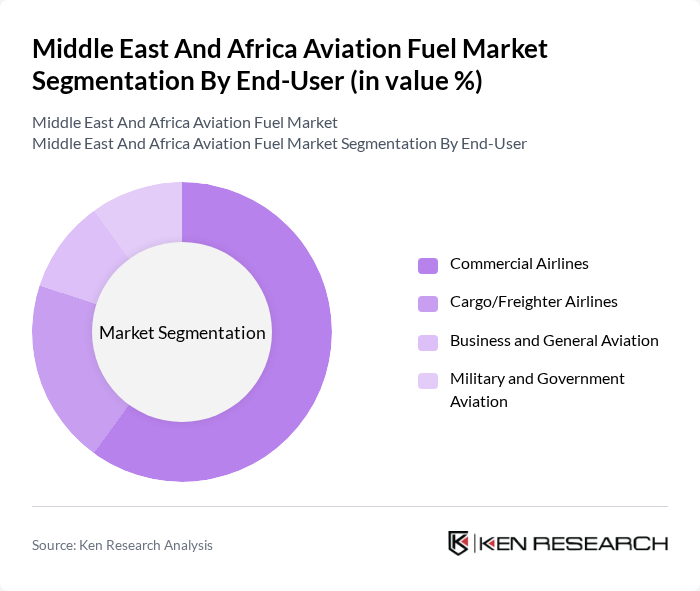
By End-User:The aviation fuel market is categorized by end-users, including Commercial Airlines, Cargo/Freighter Airlines, Business and General Aviation, and Military and Government Aviation. The Commercial Airlines segment dominates the market due to the high volume of passenger flights and the growing demand for air travel. Cargo airlines are also significant contributors, driven by the increasing need for air freight services in the region.
Middle East And Africa Aviation Fuel Market Competitive Landscape
The Middle East And Africa Aviation Fuel Market is characterized by a dynamic mix of regional and international players. Leading participants such as TotalEnergies SE, BP p.l.c. (Air bp), Shell plc (Shell Aviation), ExxonMobil Corporation, Chevron Corporation, World Fuel Services Corporation, Vitol Aviation, QatarEnergy, Abu Dhabi National Oil Company (ADNOC), Saudi Aramco (Saudi Arabian Oil Company), OQ (formerly Oman Oil Company), Emirates National Oil Company (ENOC), Engen Petroleum, Kuwait Petroleum Corporation (Q8 Aviation), Sonangol E.P. contribute to innovation, geographic expansion, and service delivery in this space.
Middle East And Africa Aviation Fuel Market Industry Analysis
Growth Drivers
- Increasing Air Travel Demand:The Middle East and Africa region is witnessing a significant surge in air travel, with passenger numbers projected to reach 300 million in future, according to the International Air Transport Association (IATA). This growth is driven by rising disposable incomes and a burgeoning middle class, particularly in countries like Nigeria and Kenya. The expansion of low-cost carriers is also contributing to this demand, making air travel more accessible to a larger population, thereby increasing aviation fuel consumption.
- Expansion of Airport Infrastructure:The region is investing heavily in airport infrastructure, with over $30 billion allocated for airport development projects in future. Major projects include the expansion of Dubai International Airport and the construction of new terminals in Addis Ababa and Nairobi. This infrastructure growth is expected to enhance capacity and efficiency, facilitating increased air traffic and subsequently driving demand for aviation fuel, which is projected to rise in tandem with passenger and cargo volumes.
- Rising Cargo Transportation Needs:The demand for air cargo services in the Middle East and Africa is expected to grow significantly, with the air freight market projected to reach $10 billion in future. This growth is fueled by the region's strategic location as a global logistics hub and the increasing need for rapid delivery of goods. The rise in e-commerce and trade activities is further propelling the demand for aviation fuel, as airlines expand their cargo operations to meet these needs.
Market Challenges
- Fluctuating Crude Oil Prices:The aviation fuel market in the Middle East and Africa is highly sensitive to crude oil price volatility. In future, crude oil prices are projected to fluctuate between $70 and $90 per barrel, according to the U.S. Energy Information Administration. This volatility can significantly impact fuel costs for airlines, leading to increased operational expenses and potential fare hikes, which may deter air travel demand and affect overall market growth.
- Regulatory Compliance Issues:The aviation sector faces stringent regulatory compliance challenges, particularly regarding fuel quality and emissions standards. In future, the International Civil Aviation Organization (ICAO) is expected to enforce stricter emission reduction targets, compelling airlines to invest in cleaner fuels. Compliance with these regulations may lead to increased operational costs and necessitate significant investments in technology and infrastructure, posing a challenge for market players.
Middle East And Africa Aviation Fuel Market Future Outlook
The future of the aviation fuel market in the Middle East and Africa appears promising, driven by increasing air travel and infrastructure investments. However, challenges such as fluctuating oil prices and regulatory compliance will require strategic adaptations. The adoption of sustainable aviation fuels and advancements in fuel efficiency technologies are expected to play crucial roles in shaping the market landscape. As airlines and fuel suppliers navigate these dynamics, the focus will be on enhancing operational efficiency and sustainability to meet evolving consumer and regulatory demands.
Market Opportunities
- Adoption of Sustainable Aviation Fuels:The shift towards sustainable aviation fuels (SAFs) presents a significant opportunity for the market. With global investments in SAF technology projected to exceed $1 billion in future, the Middle East and Africa can leverage this trend to enhance fuel sustainability and reduce carbon footprints, aligning with international emission reduction goals.
- Technological Advancements in Fuel Efficiency:Innovations in fuel efficiency technologies are set to transform the aviation fuel landscape. By future, advancements such as improved engine designs and alternative fuel sources could reduce fuel consumption by up to 20%. This presents an opportunity for airlines to lower operational costs while meeting regulatory requirements, enhancing their competitive edge in the market.
Scope of the Report
| Segment | Sub-Segments |
|---|---|
| By Type | Jet A-1 (Aviation Turbine Fuel) Jet A AVGAS (100LL and UL variants) Sustainable Aviation Fuel (SAF/Biojet) Military Grades (e.g., JP-8/JP-5) |
| By End-User | Commercial Airlines Cargo/Freighter Airlines Business and General Aviation Military and Government Aviation |
| By Distribution Channel | Direct Supply (Into-plane at Airports) Resellers/Distributors and Fuel Traders Hydrant System/Depot Supply |
| By Region | Gulf Cooperation Council (GCC) North Africa Sub-Saharan Africa |
| By Application | Scheduled Commercial Flights Air Cargo and Logistics Military and Peacekeeping Operations |
| By Pricing/Contract Structure | Spot Purchases (Platts/MOPS-linked) Term Contracts (Formula Pricing) Hedged/Indexed Agreements |
| By Policy & Sustainability | Government Incentives/Subsidies for SAF Tax and Duty Regimes on Jet Fuel SAF Mandates/Voluntary Offtake Agreements |
Key Target Audience
Investors and Venture Capitalist Firms
Government and Regulatory Bodies (e.g., Civil Aviation Authority, Ministry of Energy)
Airline Operators
Fuel Suppliers and Distributors
Airport Authorities
Energy and Fuel Industry Associations
Logistics and Transportation Companies
Financial Institutions and Banks
Players Mentioned in the Report:
TotalEnergies SE
BP p.l.c. (Air bp)
Shell plc (Shell Aviation)
ExxonMobil Corporation
Chevron Corporation
World Fuel Services Corporation
Vitol Aviation
QatarEnergy
Abu Dhabi National Oil Company (ADNOC)
Saudi Aramco (Saudi Arabian Oil Company)
OQ (formerly Oman Oil Company)
Emirates National Oil Company (ENOC)
Engen Petroleum
Kuwait Petroleum Corporation (Q8 Aviation)
Sonangol E.P.
Table of Contents
Market Assessment Phase
1. Executive Summary and Approach
2. Middle East And Africa Aviation Fuel Market Overview
2.1 Key Insights and Strategic Recommendations
2.2 Middle East And Africa Aviation Fuel Market Overview
2.3 Definition and Scope
2.4 Evolution of Market Ecosystem
2.5 Timeline of Key Regulatory Milestones
2.6 Value Chain & Stakeholder Mapping
2.7 Business Cycle Analysis
2.8 Policy & Incentive Landscape
3. Middle East And Africa Aviation Fuel Market Analysis
3.1 Growth Drivers
3.1.1 Increasing Air Travel Demand
3.1.2 Expansion of Airport Infrastructure
3.1.3 Rising Cargo Transportation Needs
3.1.4 Government Investments in Aviation Sector
3.2 Market Challenges
3.2.1 Fluctuating Crude Oil Prices
3.2.2 Regulatory Compliance Issues
3.2.3 Environmental Concerns and Emission Regulations
3.2.4 Geopolitical Instability in the Region
3.3 Market Opportunities
3.3.1 Adoption of Sustainable Aviation Fuels
3.3.2 Technological Advancements in Fuel Efficiency
3.3.3 Strategic Partnerships with Airlines
3.3.4 Growth of Low-Cost Carriers
3.4 Market Trends
3.4.1 Shift Towards Biofuels
3.4.2 Digitalization in Fuel Management
3.4.3 Increased Focus on Supply Chain Resilience
3.4.4 Emergence of Alternative Fuel Sources
3.5 Government Regulation
3.5.1 Fuel Quality Standards
3.5.2 Emission Reduction Targets
3.5.3 Subsidies for Sustainable Fuels
3.5.4 Safety and Security Regulations
4. SWOT Analysis
5. Stakeholder Analysis
6. Porter's Five Forces Analysis
7. Middle East And Africa Aviation Fuel Market Market Size, 2019-2024
7.1 By Value
7.2 By Volume
7.3 By Average Selling Price
8. Middle East And Africa Aviation Fuel Market Segmentation
8.1 By Type
8.1.1 Jet A-1 (Aviation Turbine Fuel)
8.1.2 Jet A
8.1.3 AVGAS (100LL and UL variants)
8.1.4 Sustainable Aviation Fuel (SAF/Biojet)
8.1.5 Military Grades (e.g., JP-8/JP-5)
8.2 By End-User
8.2.1 Commercial Airlines
8.2.2 Cargo/Freighter Airlines
8.2.3 Business and General Aviation
8.2.4 Military and Government Aviation
8.3 By Distribution Channel
8.3.1 Direct Supply (Into-plane at Airports)
8.3.2 Resellers/Distributors and Fuel Traders
8.3.3 Hydrant System/Depot Supply
8.4 By Region
8.4.1 Gulf Cooperation Council (GCC)
8.4.2 North Africa
8.4.3 Sub-Saharan Africa
8.5 By Application
8.5.1 Scheduled Commercial Flights
8.5.2 Air Cargo and Logistics
8.5.3 Military and Peacekeeping Operations
8.6 By Pricing/Contract Structure
8.6.1 Spot Purchases (Platts/MOPS-linked)
8.6.2 Term Contracts (Formula Pricing)
8.6.3 Hedged/Indexed Agreements
8.7 By Policy & Sustainability
8.7.1 Government Incentives/Subsidies for SAF
8.7.2 Tax and Duty Regimes on Jet Fuel
8.7.3 SAF Mandates/Voluntary Offtake Agreements
9. Middle East And Africa Aviation Fuel Market Competitive Analysis
9.1 Market Share of Key Players
9.2 Cross Comparison of Key Players
9.2.1 Company Name
9.2.2 Regional Footprint (MEA airports served/into-plane locations)
9.2.3 Aviation Fuel Sales Volume (ML/y) in MEA
9.2.4 Market Share (%) in MEA Jet Fuel
9.2.5 SAF Capability (supply, blends, offtake MoUs)
9.2.6 Contract Mix (spot vs term; major airline JV supply)
9.2.7 Pricing Benchmarking (Platts differential vs peers)
9.2.8 Supply Chain Reliability (storage, hydrant access, on-time fueling)
9.2.9 Vertical Integration (refining to into-plane)
9.2.10 Credit/Working Capital Terms to Airlines
9.2.11 ESG/Carbon Intensity of Supply (gCO2e/MJ; SAF share)
9.2.12 Operational Efficiency (turnaround time, fuel loss, misfueling incidents)
9.3 SWOT Analysis of Top Players
9.4 Pricing Analysis
9.5 Detailed Profile of Major Companies
9.5.1 TotalEnergies SE
9.5.2 BP p.l.c. (Air bp)
9.5.3 Shell plc (Shell Aviation)
9.5.4 ExxonMobil Corporation
9.5.5 Chevron Corporation
9.5.6 World Fuel Services Corporation
9.5.7 Vitol Aviation
9.5.8 QatarEnergy
9.5.9 Abu Dhabi National Oil Company (ADNOC)
9.5.10 Saudi Aramco (Saudi Arabian Oil Company)
9.5.11 OQ (formerly Oman Oil Company)
9.5.12 Emirates National Oil Company (ENOC)
9.5.13 Engen Petroleum
9.5.14 Kuwait Petroleum Corporation (Q8 Aviation)
9.5.15 Sonangol E.P.
10. Middle East And Africa Aviation Fuel Market End-User Analysis
10.1 Procurement Behavior of Key Ministries
10.1.1 Government Contracts and Tenders
10.1.2 Budget Allocations for Aviation Fuel
10.1.3 Compliance with National Standards
10.2 Corporate Spend on Infrastructure & Energy
10.2.1 Investment in Airport Facilities
10.2.2 Fuel Storage Infrastructure
10.2.3 Energy Efficiency Initiatives
10.3 Pain Point Analysis by End-User Category
10.3.1 Cost Management Challenges
10.3.2 Supply Chain Disruptions
10.3.3 Regulatory Compliance Issues
10.4 User Readiness for Adoption
10.4.1 Awareness of Sustainable Fuels
10.4.2 Training and Development Needs
10.4.3 Infrastructure Readiness
10.5 Post-Deployment ROI and Use Case Expansion
10.5.1 Performance Metrics Tracking
10.5.2 Long-term Cost Savings
10.5.3 Expansion into New Markets
11. Middle East And Africa Aviation Fuel Market Future Size, 2025-2030
11.1 By Value
11.2 By Volume
11.3 By Average Selling Price
Go-To-Market Strategy Phase
1. Whitespace Analysis + Business Model Canvas
1.1 Market Gaps Identification
1.2 Business Model Framework
2. Marketing and Positioning Recommendations
2.1 Branding Strategies
2.2 Product USPs
3. Distribution Plan
3.1 Urban Retail Strategies
3.2 Rural NGO Tie-ups
4. Channel & Pricing Gaps
4.1 Underserved Routes
4.2 Pricing Bands
5. Unmet Demand & Latent Needs
5.1 Category Gaps
5.2 Consumer Segments
6. Customer Relationship
6.1 Loyalty Programs
6.2 After-sales Service
7. Value Proposition
7.1 Sustainability Initiatives
7.2 Integrated Supply Chains
8. Key Activities
8.1 Regulatory Compliance
8.2 Branding Efforts
8.3 Distribution Setup
9. Entry Strategy Evaluation
9.1 Domestic Market Entry Strategy
9.1.1 Product Mix Considerations
9.1.2 Pricing Band Analysis
9.1.3 Packaging Strategies
9.2 Export Entry Strategy
9.2.1 Target Countries Identification
9.2.2 Compliance Roadmap Development
10. Entry Mode Assessment
10.1 Joint Ventures
10.2 Greenfield Investments
10.3 Mergers & Acquisitions
10.4 Distributor Model
11. Capital and Timeline Estimation
11.1 Capital Requirements
11.2 Timelines for Implementation
12. Control vs Risk Trade-Off
12.1 Ownership Considerations
12.2 Partnerships Evaluation
13. Profitability Outlook
13.1 Breakeven Analysis
13.2 Long-term Sustainability Strategies
14. Potential Partner List
14.1 Distributors
14.2 Joint Ventures
14.3 Acquisition Targets
15. Execution Roadmap
15.1 Phased Plan for Market Entry
15.1.1 Market Setup
15.1.2 Market Entry
15.1.3 Growth Acceleration
15.1.4 Scale & Stabilize
15.2 Key Activities and Milestones
15.2.1 Milestone Tracking
15.2.2 Activity Scheduling
Research Methodology
Phase 1: Approach1
Desk Research
- Analysis of aviation fuel consumption statistics from regional aviation authorities
- Review of industry reports from organizations such as IATA and ICAO
- Examination of government publications on energy policies and fuel regulations in the Middle East and Africa
Primary Research
- Interviews with fuel procurement managers at major airlines operating in the region
- Surveys with aviation fuel suppliers and distributors to understand market dynamics
- Field interviews with airport operations managers regarding fuel logistics and supply chain challenges
Validation & Triangulation
- Cross-validation of data through multiple sources including trade publications and market reports
- Triangulation of findings from primary interviews with secondary data insights
- Sanity checks conducted through expert panel reviews comprising industry veterans
Phase 2: Market Size Estimation1
Top-down Assessment
- Estimation of total aviation fuel demand based on passenger and cargo traffic growth projections
- Segmentation of market size by fuel type (Jet A-1, Avgas) and region within the Middle East and Africa
- Incorporation of macroeconomic factors influencing air travel and fuel consumption
Bottom-up Modeling
- Collection of firm-level data from key airlines regarding fuel usage and procurement practices
- Operational cost analysis based on current fuel pricing trends and historical data
- Volume x cost calculations to derive revenue estimates for aviation fuel sales
Forecasting & Scenario Analysis
- Multi-factor regression analysis incorporating variables such as GDP growth, tourism trends, and fuel price volatility
- Scenario modeling based on potential regulatory changes and environmental policies affecting aviation fuel
- Development of baseline, optimistic, and pessimistic forecasts through 2030
Phase 3: CATI Sample Composition1
| Scope Item/Segment | Sample Size | Target Respondent Profiles |
|---|---|---|
| Commercial Airlines Fuel Procurement | 120 | Fuel Managers, Procurement Officers |
| Aviation Fuel Suppliers | 90 | Sales Directors, Operations Managers |
| Airport Operations and Logistics | 70 | Logistics Coordinators, Airport Managers |
| Regulatory Bodies and Policy Makers | 50 | Regulatory Affairs Managers, Policy Analysts |
| Industry Experts and Consultants | 60 | Aviation Analysts, Market Researchers |
Frequently Asked Questions
What is the current value of the Middle East and Africa Aviation Fuel Market?
The Middle East and Africa Aviation Fuel Market is valued at approximately USD 30 billion, driven by increasing air travel demand, airport infrastructure expansion, and rising cargo transportation needs, particularly in key regions like the UAE and Saudi Arabia.
Which countries are the key players in the Middle East and Africa Aviation Fuel Market?
What types of aviation fuel are used in the Middle East and Africa?
What factors are driving growth in the Middle East and Africa Aviation Fuel Market?
Other Regional/Country Reports
Indonesia Aviation Fuel Market
Malaysia Aviation Fuel Market
APAC Aviation Fuel Market
Why Buy From Us?

What makes us stand out is that our consultants follow Robust, Refine and Result (RRR) methodology. Robust for clear definitions, approaches and sanity checking, Refine for differentiating respondents' facts and opinions, and Result for presenting data with story.

We have set a benchmark in the industry by offering our clients with syndicated and customized market research reports featuring coverage of entire market as well as meticulous research and analyst insights.

While we don't replace traditional research, we flip the method upside down. Our dual approach of Top Bottom & Bottom Top ensures quality deliverable by not just verifying company fundamentals but also looking at the sector and macroeconomic factors.

With one step in the future, our research team constantly tries to show you the bigger picture. We help with some of the tough questions you may encounter along the way: How is the industry positioned? Best marketing channel? KPI's of competitors? By aligning every element, we help maximize success.

Our report gives you instant access to the answers and sources that other companies might choose to hide. We elaborate each steps of research methodology we have used and showcase you the sample size to earn your trust.

If you need any support, we are here! We pride ourselves on universe strength, data quality, and quick, friendly, and professional service.