About the Report
Base Year 2024Middle East Barrier Systems Market Overview
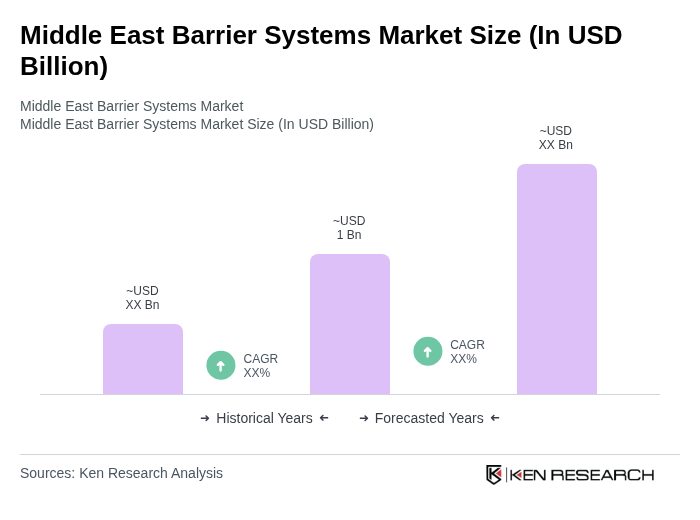
- The Middle East Barrier Systems Market is valued at USD 1 billion, based on a five-year historical analysis. This growth is primarily driven by increasing urbanization, infrastructure development, and heightened security concerns across the region, supported by strong transport and construction spending in the Middle East and Africa barrier systems market. The demand for barrier systems, including crash barriers and access control solutions, has surged due to ongoing construction projects and the need for enhanced safety measures in public and private spaces, particularly in highways, airports, logistics hubs, industrial sites, and critical infrastructure.
- Key players in this market include Saudi Arabia, the United Arab Emirates, and Qatar. These countries dominate the market due to their significant investments in infrastructure projects, such as highways, airports, and commercial facilities, aligned with large-scale national programs like Saudi Vision 2030, UAE federal transport plans, and Qatar’s ongoing logistics and tourism infrastructure expansion. The rapid urbanization and economic diversification initiatives in these nations further contribute to the growing demand for advanced barrier systems, including road safety barriers, perimeter security solutions, and high?impact bollards for critical infrastructure and urban security.
- In 2023, the UAE government strengthened mandatory requirements for safety barriers and edge protection within the UAE Fire and Life Safety Code of Practice 2018 (as amended), issued by the UAE Ministry of Interior, Civil Defense General Command. These provisions require guardrails, parapets, and protective barriers on elevated edges, ramps, and high?risk fall zones in new buildings and major refurbishments, with performance criteria on height, loading, and continuity to enhance public safety and reduce accidents in urban areas, thereby driving the demand for barrier systems across the region.
Middle East Barrier Systems Market Segmentation
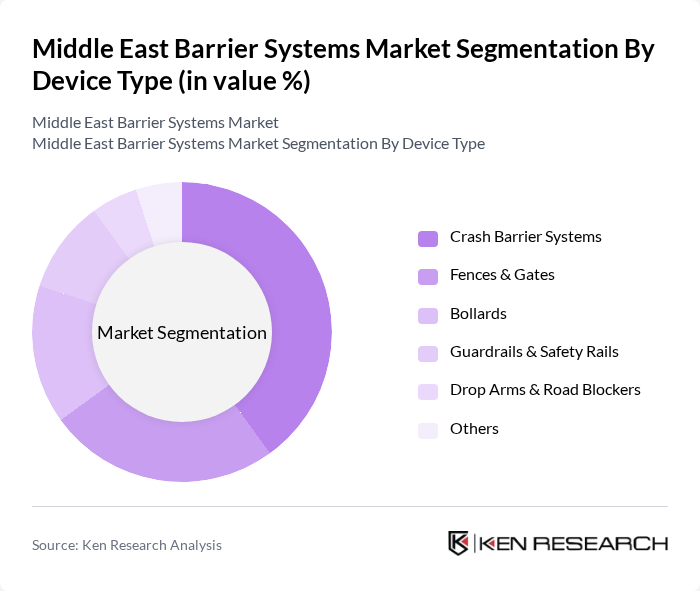
By Device Type:The device type segmentation includes various subsegments such as Crash Barrier Systems, Fences & Gates, Bollards, Guardrails & Safety Rails, Drop Arms & Road Blockers, and Others. Among these, Crash Barrier Systems are leading the market due to their critical role in ensuring road safety and preventing accidents, in line with the high share of crash-tested roadside barriers in global barrier system revenues. The increasing number of vehicles on the roads and the rise in traffic-related incidents have heightened the demand for effective crash barriers, particularly along highways, expressways, and urban arterials. Additionally, the growing focus on safety regulations and standards in the construction of roadways and highways, together with investments in smart transport corridors and upgraded guardrail standards, further supports the dominance of this subsegment.
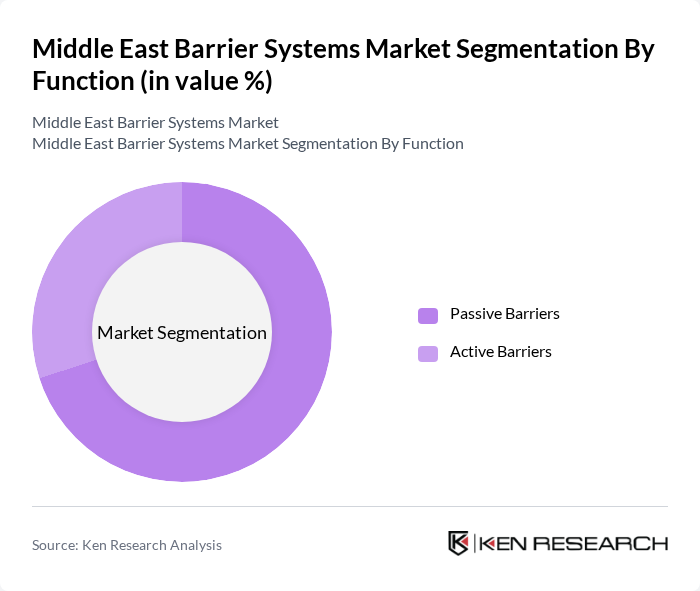
By Function:The function segmentation comprises Passive Barriers and Active Barriers. Passive Barriers dominate the market due to their widespread application in various settings, including roadways, airports, and commercial facilities, mirroring the dominance of metal guardrails and fixed roadside systems in global barrier deployments. These barriers are designed to provide safety without requiring active intervention, making them a preferred choice for many infrastructure projects where continuous protection and low operating costs are prioritized. The increasing focus on safety and security in public spaces, along with rising deployment of perimeter fences, guardrails, and fixed bollards around transport hubs and industrial sites, has led to a higher demand for passive solutions, further solidifying their market leadership.
Middle East Barrier Systems Market Competitive Landscape
The Middle East Barrier Systems Market is characterized by a dynamic mix of regional and international players. Leading participants such as Tata Steel Limited, Bekaert, Valtir LLC, Lindsay Corporation, Valmont Industries Inc., Hill & Smith PLC, Saferoad Group, A-SAFE, Hebei Jinheng, ArcelorMittal, NV Bekaert Fencing, Gulf Steel Industries, Saudi Steel Pipe Company, Al-Ayuni Investment & Contracting Company, and Local System Integrators & EPC Players contribute to innovation, geographic expansion, and service delivery in this space, with several of these companies also identified as key suppliers in the global barrier systems market.
Middle East Barrier Systems Market Industry Analysis
Growth Drivers
- Increasing Infrastructure Development:The Middle East is witnessing a surge in infrastructure projects, with investments projected to reach $1.5 trillion in future. Major initiatives include the Saudi Vision 2030 and UAE's Expo 2020, which emphasize urban development and transportation networks. This growth necessitates advanced barrier systems for safety and security, driving demand. The construction sector's contribution to the region's GDP is expected to grow by 4.5% annually, further bolstering the market for barrier systems.
- Rising Security Concerns:Heightened security threats in the Middle East, including terrorism and civil unrest, have led to increased investments in security infrastructure. In future, government spending on security is anticipated to exceed $33 billion, reflecting a 10% increase from previous years. This trend is prompting organizations to adopt advanced barrier systems to protect critical assets and public spaces, thereby driving market growth. The demand for robust security solutions is expected to remain strong as geopolitical tensions persist.
- Government Initiatives for Urban Development:Governments across the Middle East are actively promoting urban development through various initiatives. For instance, the UAE's National Agenda aims to enhance urban infrastructure, with a budget allocation of $16 billion for smart city projects in future. These initiatives create a favorable environment for barrier systems, as they are essential for managing traffic, ensuring safety, and enhancing urban aesthetics. The focus on sustainable urbanization further supports the adoption of innovative barrier solutions.
Market Challenges
- High Initial Investment Costs:The barrier systems market faces significant challenges due to high initial investment costs, which can deter potential buyers. For instance, the average cost of installing advanced barrier systems can range from $55,000 to $210,000, depending on the technology and application. This financial barrier limits market penetration, particularly among small and medium-sized enterprises. As a result, many organizations may opt for less effective, traditional security measures, hindering overall market growth.
- Regulatory Compliance Issues:Navigating the complex regulatory landscape poses a challenge for barrier systems manufacturers and suppliers. Compliance with safety and environmental regulations can be cumbersome, with varying standards across different countries in the region. For example, the implementation of new safety standards in Saudi Arabia requires significant adjustments in product design and manufacturing processes. This complexity can lead to delays in product launches and increased operational costs, impacting market competitiveness.
Middle East Barrier Systems Market Future Outlook
The Middle East barrier systems market is poised for significant growth, driven by ongoing infrastructure projects and increasing security demands. As urbanization accelerates, the integration of smart technologies into barrier systems will become essential, enhancing efficiency and effectiveness. Additionally, partnerships with government agencies will facilitate the development of tailored solutions that meet specific security needs. The focus on sustainability will also shape product innovation, leading to the emergence of eco-friendly barrier solutions that align with regional environmental goals.
Market Opportunities
- Expansion in Emerging Markets:Emerging markets within the Middle East present significant opportunities for barrier systems. Countries like Iraq and Yemen are investing in rebuilding efforts, with projected infrastructure spending of $25 billion in future. This creates a demand for effective security solutions, including barrier systems, to protect new developments and enhance public safety.
- Integration of Smart Technologies:The integration of smart technologies into barrier systems offers a lucrative opportunity for innovation. With the global smart security market expected to reach $120 billion in future, manufacturers can capitalize on this trend by developing intelligent barrier solutions that incorporate IoT and AI. These advancements will enhance security capabilities and operational efficiency, appealing to a broader range of customers.
Scope of the Report
| Segment | Sub-Segments |
|---|---|
| By Device Type | Crash Barrier Systems Fences & Gates Bollards Guardrails & Safety Rails Drop Arms & Road Blockers Others |
| By Function | Passive Barriers Active Barriers |
| By Application | Roadways & Highways Airports Railways & Metro Commercial & Industrial Facilities Military, Defense & Critical Infrastructure Residential & Public Spaces Others |
| By Material | Metal Concrete Plastic & Composite Materials Others |
| By Technology | Rigid Systems Semi-rigid Systems Flexible Systems |
| By Access Control & Automation Level | Manual Barriers Automated Barriers Smart / Connected Barriers |
| By Country | Saudi Arabia United Arab Emirates Qatar Kuwait Oman Bahrain Rest of Middle East |
Key Target Audience
Investors and Venture Capitalist Firms
Government and Regulatory Bodies (e.g., Ministry of Interior, Ministry of Defense)
Manufacturers and Producers
Infrastructure Development Agencies
Security and Defense Contractors
Urban Planning Authorities
Construction and Engineering Firms
Financial Institutions
Players Mentioned in the Report:
Tata Steel Limited
Bekaert
Valtir LLC
Lindsay Corporation
Valmont Industries Inc.
Hill & Smith PLC
Saferoad Group
A-SAFE
Hebei Jinheng
ArcelorMittal
NV Bekaert Fencing
Gulf Steel Industries
Saudi Steel Pipe Company
Al-Ayuni Investment & Contracting Company
Local System Integrators & EPC Players (Overview)
Table of Contents
Market Assessment Phase
1. Executive Summary and Approach
2. Middle East Barrier Systems Market Overview
2.1 Key Insights and Strategic Recommendations
2.2 Middle East Barrier Systems Market Overview
2.3 Definition and Scope
2.4 Evolution of Market Ecosystem
2.5 Timeline of Key Regulatory Milestones
2.6 Value Chain & Stakeholder Mapping
2.7 Business Cycle Analysis
2.8 Policy & Incentive Landscape
3. Middle East Barrier Systems Market Analysis
3.1 Growth Drivers
3.1.1 Increasing Infrastructure Development
3.1.2 Rising Security Concerns
3.1.3 Government Initiatives for Urban Development
3.1.4 Technological Advancements in Barrier Systems
3.2 Market Challenges
3.2.1 High Initial Investment Costs
3.2.2 Regulatory Compliance Issues
3.2.3 Limited Awareness Among End-Users
3.2.4 Competition from Alternative Security Solutions
3.3 Market Opportunities
3.3.1 Expansion in Emerging Markets
3.3.2 Integration of Smart Technologies
3.3.3 Partnerships with Government Agencies
3.3.4 Customization of Barrier Solutions
3.4 Market Trends
3.4.1 Shift Towards Sustainable Barrier Solutions
3.4.2 Increasing Use of Automated Systems
3.4.3 Growth in E-commerce and Logistics Security
3.4.4 Adoption of Modular Barrier Systems
3.5 Government Regulation
3.5.1 Safety Standards for Barrier Systems
3.5.2 Environmental Regulations
3.5.3 Import Tariffs on Barrier Materials
3.5.4 Incentives for Local Manufacturing
4. SWOT Analysis
5. Stakeholder Analysis
6. Porter's Five Forces Analysis
7. Middle East Barrier Systems Market Market Size, 2019-2024
7.1 By Value
7.2 By Volume
7.3 By Average Selling Price
8. Middle East Barrier Systems Market Segmentation
8.1 By Device Type
8.1.1 Crash Barrier Systems
8.1.2 Fences & Gates
8.1.3 Bollards
8.1.4 Guardrails & Safety Rails
8.1.5 Drop Arms & Road Blockers
8.1.6 Others
8.2 By Function
8.2.1 Passive Barriers
8.2.2 Active Barriers
8.3 By Application
8.3.1 Roadways & Highways
8.3.2 Airports
8.3.3 Railways & Metro
8.3.4 Commercial & Industrial Facilities
8.3.5 Military, Defense & Critical Infrastructure
8.3.6 Residential & Public Spaces
8.3.7 Others
8.4 By Material
8.4.1 Metal
8.4.2 Concrete
8.4.3 Plastic & Composite Materials
8.4.4 Others
8.5 By Technology
8.5.1 Rigid Systems
8.5.2 Semi-rigid Systems
8.5.3 Flexible Systems
8.6 By Access Control & Automation Level
8.6.1 Manual Barriers
8.6.2 Automated Barriers
8.6.3 Smart / Connected Barriers
8.7 By Country
8.7.1 Saudi Arabia
8.7.2 United Arab Emirates
8.7.3 Qatar
8.7.4 Kuwait
8.7.5 Oman
8.7.6 Bahrain
8.7.7 Rest of Middle East
9. Middle East Barrier Systems Market Competitive Analysis
9.1 Market Share of Key Players
9.2 Cross Comparison of Key Players
9.2.1 Company Name
9.2.2 Group Size (Large, Medium, or Small as per industry convention)
9.2.3 Revenue (Latest Financial Year, USD Million)
9.2.4 Middle East Barrier Systems Revenue (USD Million)
9.2.5 3-year Revenue CAGR (%)
9.2.6 EBITDA Margin (%)
9.2.7 Market Share in Middle East Barrier Systems (%)
9.2.8 Installed Base / Projects Executed in ME (Number)
9.2.9 Average Deal Size (USD)
9.2.10 Order Backlog / Pipeline (USD Million)
9.2.11 R&D Intensity (% of Revenue)
9.2.12 Win Rate in Competitive Bids (%)
9.2.13 On-time Project Delivery Rate (%)
9.2.14 Key End-markets Exposure (Transportation, Oil & Gas, Defense, etc.)
9.3 SWOT Analysis of Top Players
9.4 Pricing Analysis
9.5 Detailed Profile of Major Companies
9.5.1 Tata Steel Limited
9.5.2 Bekaert
9.5.3 Valtir LLC
9.5.4 Lindsay Corporation
9.5.5 Valmont Industries Inc.
9.5.6 Hill & Smith PLC
9.5.7 Saferoad Group
9.5.8 A-SAFE
9.5.9 Hebei Jinheng
9.5.10 ArcelorMittal
9.5.11 NV Bekaert Fencing
9.5.12 Gulf Steel Industries
9.5.13 Saudi Steel Pipe Company
9.5.14 Al-Ayuni Investment & Contracting Company
9.5.15 Local System Integrators & EPC Players (Overview)
10. Middle East Barrier Systems Market End-User Analysis
10.1 Procurement Behavior of Key Ministries
10.1.1 Ministry of Interior
10.1.2 Ministry of Defense
10.1.3 Ministry of Transport
10.1.4 Ministry of Urban Development
10.2 Corporate Spend on Infrastructure & Energy
10.2.1 Investment Trends in Security Infrastructure
10.2.2 Budget Allocation for Barrier Systems
10.2.3 Corporate Partnerships for Security Solutions
10.2.4 Others
10.3 Pain Point Analysis by End-User Category
10.3.1 Security Concerns
10.3.2 Cost Management
10.3.3 Compliance with Regulations
10.3.4 Others
10.4 User Readiness for Adoption
10.4.1 Awareness of Barrier Systems
10.4.2 Training and Support Needs
10.4.3 Integration with Existing Systems
10.4.4 Others
10.5 Post-Deployment ROI and Use Case Expansion
10.5.1 Measurement of Security Effectiveness
10.5.2 Cost Savings Analysis
10.5.3 Expansion into New Use Cases
10.5.4 Others
11. Middle East Barrier Systems Market Future Size, 2025-2030
11.1 By Value
11.2 By Volume
11.3 By Average Selling Price
Go-To-Market Strategy Phase
1. Whitespace Analysis + Business Model Canvas
1.1 Market Gaps Identification
1.2 Business Model Development
2. Marketing and Positioning Recommendations
2.1 Branding Strategies
2.2 Product USPs
3. Distribution Plan
3.1 Urban Retail vs Rural NGO Tie-ups
4. Channel & Pricing Gaps
4.1 Underserved Routes
4.2 Pricing Bands
5. Unmet Demand & Latent Needs
5.1 Category Gaps
5.2 Consumer Segments
6. Customer Relationship
6.1 Loyalty Programs
6.2 After-sales Service
7. Value Proposition
7.1 Sustainability
7.2 Integrated Supply Chains
8. Key Activities
8.1 Regulatory Compliance
8.2 Branding
8.3 Distribution Setup
9. Entry Strategy Evaluation
9.1 Domestic Market Entry Strategy
9.1.1 Product Mix
9.1.2 Pricing Band
9.1.3 Packaging
9.2 Export Entry Strategy
9.2.1 Target Countries
9.2.2 Compliance Roadmap
10. Entry Mode Assessment
10.1 JV
10.2 Greenfield
10.3 M&A
10.4 Distributor Model
11. Capital and Timeline Estimation
11.1 Capital Requirements
11.2 Timelines
12. Control vs Risk Trade-Off
12.1 Ownership vs Partnerships
13. Profitability Outlook
13.1 Breakeven Analysis
13.2 Long-term Sustainability
14. Potential Partner List
14.1 Distributors
14.2 JVs
14.3 Acquisition Targets
15. Execution Roadmap
15.1 Phased Plan for Market Entry
15.1.1 Market Setup
15.1.2 Market Entry
15.1.3 Growth Acceleration
15.1.4 Scale & Stabilize
15.2 Key Activities and Milestones
15.2.1 Milestone Planning
15.2.2 Activity Tracking
Research Methodology
Phase 1: Approach1
Desk Research
- Analysis of market reports from regional trade associations and government publications
- Review of academic journals and white papers on barrier systems technology and applications
- Compilation of industry statistics from international organizations and market research firms
Primary Research
- Interviews with industry experts, including engineers and project managers in barrier system installations
- Surveys with procurement managers from construction and infrastructure firms
- Field visits to barrier system manufacturing facilities for firsthand insights
Validation & Triangulation
- Cross-validation of data through multiple sources, including trade publications and expert interviews
- Triangulation of findings from primary and secondary research to ensure consistency
- Sanity checks through expert panel discussions to validate assumptions and projections
Phase 2: Market Size Estimation1
Top-down Assessment
- Estimation of market size based on national infrastructure spending and regional development plans
- Segmentation of the market by application areas such as military, civil, and commercial uses
- Incorporation of government initiatives and funding for barrier system projects
Bottom-up Modeling
- Collection of sales data from leading manufacturers of barrier systems
- Estimation of unit prices and volume sold across different market segments
- Analysis of installation and maintenance costs to derive total market value
Forecasting & Scenario Analysis
- Development of forecasting models based on historical growth rates and market trends
- Scenario analysis considering factors such as geopolitical stability and economic growth
- Projections for market growth through 2030 under various regulatory and economic conditions
Phase 3: CATI Sample Composition1
| Scope Item/Segment | Sample Size | Target Respondent Profiles |
|---|---|---|
| Military Barrier Systems | 100 | Defense Procurement Officers, Military Engineers |
| Civil Infrastructure Barriers | 80 | Urban Planners, Civil Engineers |
| Commercial Security Barriers | 70 | Facility Managers, Security Consultants |
| Environmental Protection Barriers | 60 | Environmental Engineers, Project Managers |
| Barrier System Maintenance Services | 90 | Maintenance Supervisors, Operations Managers |
Frequently Asked Questions
What is the current value of the Middle East Barrier Systems Market?
The Middle East Barrier Systems Market is valued at approximately USD 1 billion, driven by urbanization, infrastructure development, and security concerns. This valuation is based on a five-year historical analysis of market trends and growth factors in the region.
Which countries are the key players in the Middle East Barrier Systems Market?
What are the main drivers of growth in the Middle East Barrier Systems Market?
What types of barrier systems are most in demand in the Middle East?
Other Regional/Country Reports
Other Adjacent Reports
Indonesia Road Safety Equipment Market
Mexico Perimeter Security Systems Market
Germany Access Control Devices Market
South Africa Traffic Management Systems Market
GCC Construction Safety Equipment Market Size, Share, Trends & Forecast 2025–2030Bahrain Infrastructure Protection Market
South Africa Smart City Technologies Market
KSA Airport Infrastructure Market
South Africa Industrial Security Solutions Market
Mexico Urban Development Market
Why Buy From Us?

What makes us stand out is that our consultants follow Robust, Refine and Result (RRR) methodology. Robust for clear definitions, approaches and sanity checking, Refine for differentiating respondents' facts and opinions, and Result for presenting data with story.

We have set a benchmark in the industry by offering our clients with syndicated and customized market research reports featuring coverage of entire market as well as meticulous research and analyst insights.

While we don't replace traditional research, we flip the method upside down. Our dual approach of Top Bottom & Bottom Top ensures quality deliverable by not just verifying company fundamentals but also looking at the sector and macroeconomic factors.

With one step in the future, our research team constantly tries to show you the bigger picture. We help with some of the tough questions you may encounter along the way: How is the industry positioned? Best marketing channel? KPI's of competitors? By aligning every element, we help maximize success.

Our report gives you instant access to the answers and sources that other companies might choose to hide. We elaborate each steps of research methodology we have used and showcase you the sample size to earn your trust.

If you need any support, we are here! We pride ourselves on universe strength, data quality, and quick, friendly, and professional service.