About the Report
Base Year 2024Middle East Biohacking Market Overview
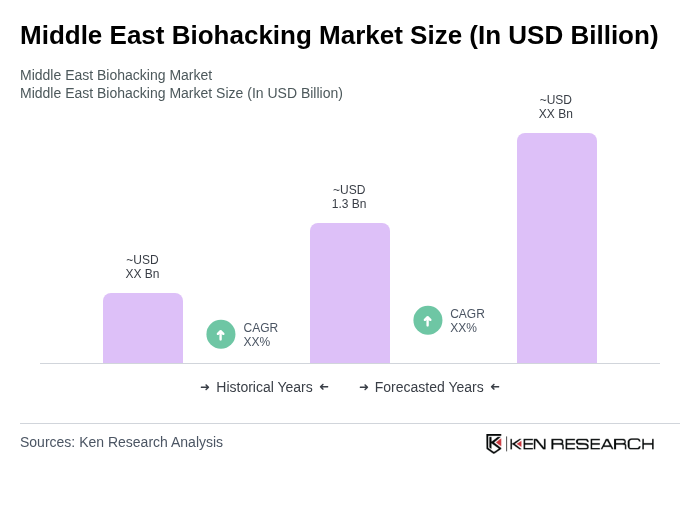
- The Middle East Biohacking Market is valued at USD 1.3 billion, based on a five-year historical analysis, taking into account the UAE biohacking market size and its share within the global biohacking industry. This growth is primarily driven by increasing consumer interest in health optimization, advancements in wearable technology, and a rising awareness of personalized healthcare solutions. The market has seen a surge in demand for products that enhance physical and cognitive performance, supported by growing adoption of supplements, smart drugs, and performance wearables, reflecting a broader trend towards self-improvement and wellness.
- Key players in this market include the United Arab Emirates and Saudi Arabia, which dominate due to their robust healthcare infrastructure, high disposable incomes, and a growing population of health-conscious consumers. The UAE, in particular, has positioned itself as a hub for innovation and technology, with strong investments in digital health, preventive care, and wellness technologies, attracting biohacking and health-tech ventures. Saudi Arabia is also accelerating investment in digital health and wearable-based monitoring under broader healthcare transformation and Vision 2030 initiatives, further supporting biohacking-related adoption.
- In 2023, the UAE government implemented regulations to promote biohacking practices, focusing on the safety and efficacy of biohacking products. This initiative includes guidelines for the approval of wearable devices and supplements, ensuring that they meet health standards and are safe for consumer use, thereby fostering trust and encouraging market growth. In the context of biohacking-related products, relevant requirements are primarily governed through medical device and health product frameworks such as the Medical Devices Regulation issued by the Ministry of Health and Prevention (Cabinet Decision No. 40 of 2016), which sets classification, registration, conformity assessment, and post-market surveillance obligations for medical devices and certain wearable technologies placed on the UAE market, as well as through the UAE Federal Law on Pharmaceutical Products and related regulations overseeing the registration, quality, and marketing of dietary supplements and similar health products.
Middle East Biohacking Market Segmentation
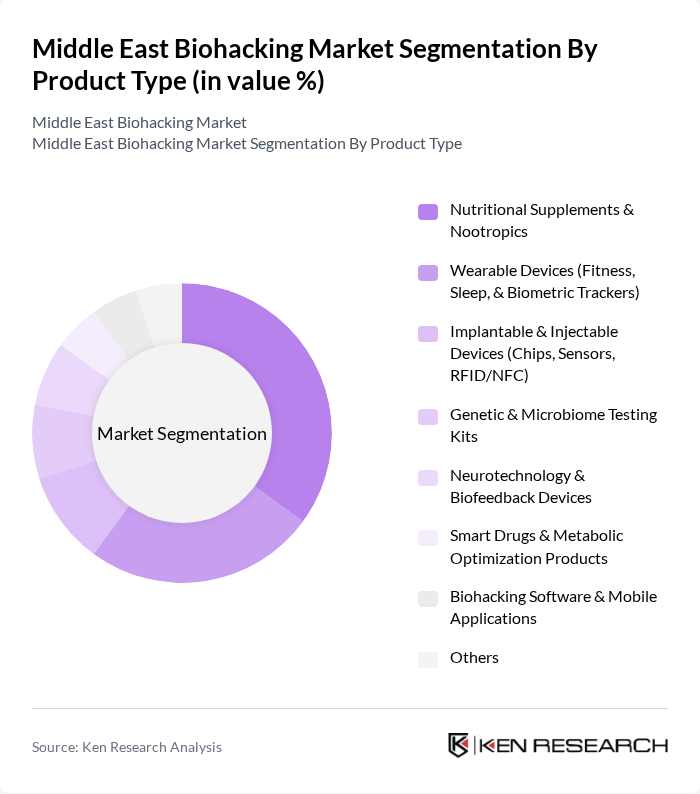
By Product Type:The product type segmentation includes various categories that cater to the diverse needs of consumers in the biohacking space. The subsegments are Nutritional Supplements & Nootropics, Wearable Devices (Fitness, Sleep, & Biometric Trackers), Implantable & Injectable Devices (Chips, Sensors, RFID/NFC), Genetic & Microbiome Testing Kits, Neurotechnology & Biofeedback Devices, Smart Drugs & Metabolic Optimization Products, Biohacking Software & Mobile Applications, and Others. Among these, Nutritional Supplements & Nootropics are leading the market due to their widespread acceptance and demand for cognitive enhancement and overall health improvement, although in the UAE specifically, wearables represent the largest single product segment by revenue within biohacking offerings.
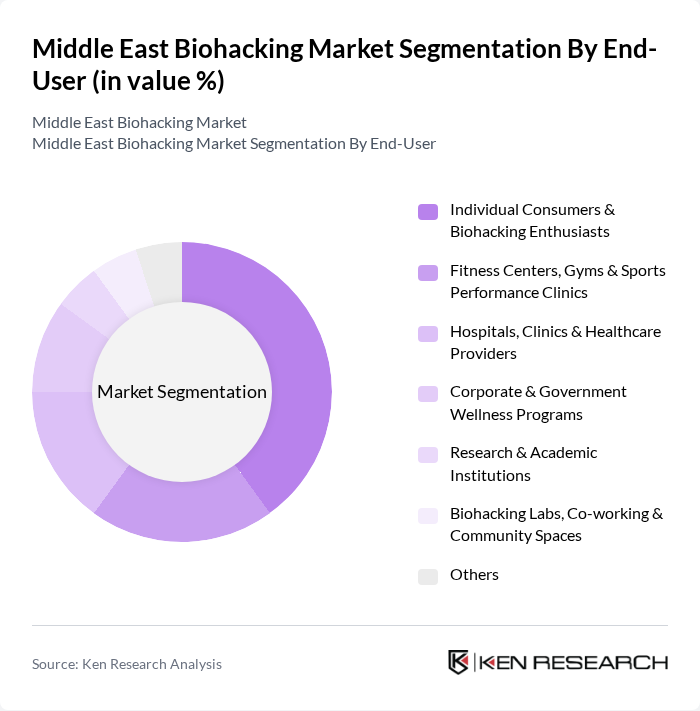
By End-User:The end-user segmentation encompasses various groups that utilize biohacking products and services. This includes Individual Consumers & Biohacking Enthusiasts, Fitness Centers, Gyms & Sports Performance Clinics, Hospitals, Clinics & Healthcare Providers, Corporate & Government Wellness Programs, Research & Academic Institutions, Biohacking Labs, Co-working & Community Spaces, and Others. Individual Consumers & Biohacking Enthusiasts dominate this segment, driven by a growing trend of self-optimization, preventive health tracking via wearables and apps, and rising awareness of longevity and performance enhancement among the general population.
Middle East Biohacking Market Competitive Landscape
The Middle East Biohacking Market is characterized by a dynamic mix of regional and international players. Leading participants such as Oura Health Oy, WHOOP, Inc., Levels Health, Inc., Thorne HealthTech, Inc., InsideTracker (Segterra, Inc.), DNAfit Life Sciences Ltd (CircleDNA), ZOE Limited, Biostrap USA, LLC, Apple Inc. (Health & Wearables Division), Fitbit LLC (Google), The ODIN (Open Discovery Institute), OsteoStrong, Thriveport, LLC (SleepCycle, Productivity & Biohacking Apps), Biohacking ORB (UAE), UpGrade Fitness & Wellness Clinics (Saudi Arabia & UAE) contribute to innovation, geographic expansion, and service delivery in this space.
Middle East Biohacking Market Industry Analysis
Growth Drivers
- Increasing Health Consciousness:The Middle East has seen a significant rise in health consciousness, with the World Health Organization reporting that 60% of adults in the region are now prioritizing health and wellness. This shift is driven by rising obesity rates, which reached 28% recently, prompting individuals to seek biohacking solutions. The demand for health optimization tools, including supplements and wearable devices, is expected to grow as consumers become more proactive about their health.
- Technological Advancements in Wearable Devices:The wearable technology market in the Middle East is projected to reach $1.5 billion in the near future, driven by innovations in health monitoring devices. Companies like Fitbit and Apple are expanding their presence, offering advanced features such as heart rate monitoring and sleep tracking. This technological evolution is encouraging consumers to adopt biohacking practices, as they can easily track their health metrics and make informed decisions about their wellness.
- Rising Demand for Personalized Health Solutions:The demand for personalized health solutions is surging, with the market for personalized nutrition expected to exceed $500 million in the Middle East in the near future. Consumers are increasingly seeking tailored health products that cater to their unique needs, such as DNA-based diets and customized supplements. This trend is supported by a growing awareness of the benefits of individualized health strategies, driving innovation in the biohacking sector.
Market Challenges
- Regulatory Hurdles:The biohacking market in the Middle East faces significant regulatory challenges, with varying standards across countries. For instance, the UAE has stringent regulations for health products, requiring extensive testing and approval processes. This can delay product launches and increase costs, with compliance expenses estimated at around $200,000 per product. Such hurdles can deter new entrants and slow market growth.
- Limited Consumer Awareness:Despite the growth potential, consumer awareness of biohacking remains limited. A survey conducted recently indicated that only 30% of consumers in the region are familiar with biohacking concepts. This lack of understanding can hinder market penetration, as potential customers may be skeptical about the efficacy of biohacking products. Educational initiatives are crucial to bridge this knowledge gap and stimulate demand.
Middle East Biohacking Market Future Outlook
The future of the Middle East biohacking market appears promising, driven by technological advancements and a growing focus on health optimization. As consumers increasingly embrace personalized health solutions, the market is likely to witness a surge in innovative products and services. Additionally, collaborations between tech companies and healthcare providers will enhance the accessibility of biohacking tools, fostering a more health-conscious society. The integration of AI in health monitoring will further revolutionize the sector, making biohacking more mainstream.
Market Opportunities
- Expansion of E-commerce Platforms:The rise of e-commerce in the Middle East, projected to reach $28 billion in the near future, presents a significant opportunity for biohacking products. Online platforms enable consumers to access a wider range of biohacking solutions, enhancing market reach and convenience. This trend is expected to drive sales and increase consumer engagement in the biohacking sector.
- Collaborations with Healthcare Providers:Partnerships between biohacking companies and healthcare providers can enhance credibility and consumer trust. With healthcare spending in the region expected to exceed $100 billion in the near future, these collaborations can facilitate the integration of biohacking solutions into traditional healthcare systems, promoting holistic health approaches and expanding market opportunities.
Scope of the Report
| Segment | Sub-Segments |
|---|---|
| By Product Type | Nutritional Supplements & Nootropics Wearable Devices (Fitness, Sleep, & Biometric Trackers) Implantable & Injectable Devices (Chips, Sensors, RFID/NFC) Genetic & Microbiome Testing Kits Neurotechnology & Biofeedback Devices Smart Drugs & Metabolic Optimization Products Biohacking Software & Mobile Applications Others |
| By End-User | Individual Consumers & Biohacking Enthusiasts Fitness Centers, Gyms & Sports Performance Clinics Hospitals, Clinics & Healthcare Providers Corporate & Government Wellness Programs Research & Academic Institutions Biohacking Labs, Co-working & Community Spaces Others |
| By Application | Health & Vital Sign Monitoring Sports, Fitness & Performance Enhancement Preventive & Personalized Healthcare Cognitive Enhancement & Mental Wellness Longevity & Anti-aging Sleep, Stress & Recovery Management Others |
| By Distribution Channel | Direct-to-Consumer Online Platforms E-commerce Marketplaces Pharmacies & Health Stores Specialty Clinics, Wellness Centers & Biohacking Studios Corporate & Institutional Channels Others |
| By Country | Saudi Arabia United Arab Emirates Qatar Kuwait Oman & Bahrain Rest of Middle East & North Africa |
| By Consumer Demographics | Age Group (18–24, 25–34, 35–44, 45–54, 55+) Gender Income Level (Mass, Affluent, High Net Worth) Lifestyle & Wellness Orientation Tech Adoption & Digital Engagement Level Others |
| By Technology Integration | Mobile & Web Applications Cloud-Based Analytics & Dashboards AI & Machine Learning-Based Personalization IoT-Enabled Connected Devices & Platforms Blockchain & Data Security Solutions Others |
Key Target Audience
Investors and Venture Capitalist Firms
Government and Regulatory Bodies (e.g., Ministry of Health, Food and Drug Authority)
Manufacturers and Producers of Biohacking Products
Distributors and Retailers of Health and Wellness Products
Healthcare Providers and Clinics
Technology Providers and Developers
Industry Associations and Trade Organizations
Pharmaceutical Companies and Biotechnology Firms
Players Mentioned in the Report:
Oura Health Oy
WHOOP, Inc.
Levels Health, Inc.
Thorne HealthTech, Inc.
InsideTracker (Segterra, Inc.)
DNAfit Life Sciences Ltd (CircleDNA)
ZOE Limited
Biostrap USA, LLC
Apple Inc. (Health & Wearables Division)
Fitbit LLC (Google)
The ODIN (Open Discovery Institute)
OsteoStrong
Thriveport, LLC (SleepCycle, Productivity & Biohacking Apps)
Biohacking ORB (UAE)
UpGrade Fitness & Wellness Clinics (Saudi Arabia & UAE)
Table of Contents
Market Assessment Phase
1. Executive Summary and Approach
2. Middle East Biohacking Market Overview
2.1 Key Insights and Strategic Recommendations
2.2 Middle East Biohacking Market Overview
2.3 Definition and Scope
2.4 Evolution of Market Ecosystem
2.5 Timeline of Key Regulatory Milestones
2.6 Value Chain & Stakeholder Mapping
2.7 Business Cycle Analysis
2.8 Policy & Incentive Landscape
3. Middle East Biohacking Market Analysis
3.1 Growth Drivers
3.1.1 Increasing Health Consciousness
3.1.2 Technological Advancements in Wearable Devices
3.1.3 Rising Demand for Personalized Health Solutions
3.1.4 Growth of the Wellness Industry
3.2 Market Challenges
3.2.1 Regulatory Hurdles
3.2.2 High Initial Investment Costs
3.2.3 Limited Consumer Awareness
3.2.4 Data Privacy Concerns
3.3 Market Opportunities
3.3.1 Expansion of E-commerce Platforms
3.3.2 Collaborations with Healthcare Providers
3.3.3 Development of Innovative Biohacking Products
3.3.4 Increasing Investment in Health Tech Startups
3.4 Market Trends
3.4.1 Growth of DIY Biohacking Communities
3.4.2 Integration of AI in Health Monitoring
3.4.3 Focus on Mental Health and Cognitive Enhancement
3.4.4 Rise of Subscription-Based Health Services
3.5 Government Regulation
3.5.1 Health and Safety Standards for Biohacking Products
3.5.2 Data Protection Regulations
3.5.3 Licensing Requirements for Health Devices
3.5.4 Guidelines for Clinical Trials and Research
4. SWOT Analysis
5. Stakeholder Analysis
6. Porter's Five Forces Analysis
7. Middle East Biohacking Market Market Size, 2019-2024
7.1 By Value
7.2 By Volume
7.3 By Average Selling Price
8. Middle East Biohacking Market Segmentation
8.1 By Product Type
8.1.1 Nutritional Supplements & Nootropics
8.1.2 Wearable Devices (Fitness, Sleep, & Biometric Trackers)
8.1.3 Implantable & Injectable Devices (Chips, Sensors, RFID/NFC)
8.1.4 Genetic & Microbiome Testing Kits
8.1.5 Neurotechnology & Biofeedback Devices
8.1.6 Smart Drugs & Metabolic Optimization Products
8.1.7 Biohacking Software & Mobile Applications
8.1.8 Others
8.2 By End-User
8.2.1 Individual Consumers & Biohacking Enthusiasts
8.2.2 Fitness Centers, Gyms & Sports Performance Clinics
8.2.3 Hospitals, Clinics & Healthcare Providers
8.2.4 Corporate & Government Wellness Programs
8.2.5 Research & Academic Institutions
8.2.6 Biohacking Labs, Co-working & Community Spaces
8.2.7 Others
8.3 By Application
8.3.1 Health & Vital Sign Monitoring
8.3.2 Sports, Fitness & Performance Enhancement
8.3.3 Preventive & Personalized Healthcare
8.3.4 Cognitive Enhancement & Mental Wellness
8.3.5 Longevity & Anti-aging
8.3.6 Sleep, Stress & Recovery Management
8.3.7 Others
8.4 By Distribution Channel
8.4.1 Direct-to-Consumer Online Platforms
8.4.2 E-commerce Marketplaces
8.4.3 Pharmacies & Health Stores
8.4.4 Specialty Clinics, Wellness Centers & Biohacking Studios
8.4.5 Corporate & Institutional Channels
8.4.6 Others
8.5 By Country
8.5.1 Saudi Arabia
8.5.2 United Arab Emirates
8.5.3 Qatar
8.5.4 Kuwait
8.5.5 Oman & Bahrain
8.5.6 Rest of Middle East & North Africa
8.6 By Consumer Demographics
8.6.1 Age Group (18–24, 25–34, 35–44, 45–54, 55+)
8.6.2 Gender
8.6.3 Income Level (Mass, Affluent, High Net Worth)
8.6.4 Lifestyle & Wellness Orientation
8.6.5 Tech Adoption & Digital Engagement Level
8.6.6 Others
8.7 By Technology Integration
8.7.1 Mobile & Web Applications
8.7.2 Cloud-Based Analytics & Dashboards
8.7.3 AI & Machine Learning-Based Personalization
8.7.4 IoT-Enabled Connected Devices & Platforms
8.7.5 Blockchain & Data Security Solutions
8.7.6 Others
9. Middle East Biohacking Market Competitive Analysis
9.1 Market Share of Key Players
9.2 Cross Comparison of Key Players
9.2.1 Company Name
9.2.2 Regional Footprint in the Middle East (Number of Countries Operated)
9.2.3 Estimated Middle East Biohacking Revenue
9.2.4 3-year Revenue CAGR in the Region
9.2.5 Active User / Subscriber Base in the Middle East
9.2.6 Average Revenue per User (ARPU)
9.2.7 Customer Acquisition Cost (Digital & Offline)
9.2.8 Market Penetration in Key GCC Markets (Saudi Arabia, UAE)
9.2.9 Product & Service Portfolio Breadth (Number of Biohacking Categories Covered)
9.2.10 R&D and Innovation Intensity (% of Revenue Spent on R&D)
9.2.11 Partnership & Distribution Network Strength (Number of Local Partners/Clinics)
9.2.12 Regulatory & Compliance Readiness Score (Regional Certifications & Approvals)
9.3 SWOT Analysis of Top Players
9.4 Pricing Analysis
9.5 Detailed Profile of Major Companies
9.5.1 Oura Health Oy
9.5.2 WHOOP, Inc.
9.5.3 Levels Health, Inc.
9.5.4 Thorne HealthTech, Inc.
9.5.5 InsideTracker (Segterra, Inc.)
9.5.6 DNAfit Life Sciences Ltd (CircleDNA)
9.5.7 ZOE Limited
9.5.8 Biostrap USA, LLC
9.5.9 Apple Inc. (Health & Wearables Division)
9.5.10 Fitbit LLC (Google)
9.5.11 The ODIN (Open Discovery Institute)
9.5.12 OsteoStrong
9.5.13 Thriveport, LLC (SleepCycle, Productivity & Biohacking Apps)
9.5.14 Biohacking ORB (UAE)
9.5.15 UpGrade Fitness & Wellness Clinics (Saudi Arabia & UAE)
10. Middle East Biohacking Market End-User Analysis
10.1 Procurement Behavior of Key Ministries
10.1.1 Health Ministry Initiatives
10.1.2 Budget Allocation for Health Innovations
10.1.3 Collaboration with Private Sector
10.1.4 Regulatory Compliance Requirements
10.2 Corporate Spend on Infrastructure & Energy
10.2.1 Investment in Health Technologies
10.2.2 Budget for Employee Wellness Programs
10.2.3 Funding for Research and Development
10.2.4 Partnerships with Biohacking Firms
10.3 Pain Point Analysis by End-User Category
10.3.1 Individual Consumers' Health Concerns
10.3.2 Corporate Wellness Challenges
10.3.3 Healthcare Providers' Resource Limitations
10.3.4 Research Institutions' Funding Gaps
10.4 User Readiness for Adoption
10.4.1 Awareness of Biohacking Benefits
10.4.2 Accessibility of Biohacking Products
10.4.3 Training and Support Availability
10.4.4 Cultural Acceptance of Biohacking
10.5 Post-Deployment ROI and Use Case Expansion
10.5.1 Measurement of Health Outcomes
10.5.2 User Feedback and Satisfaction
10.5.3 Scalability of Biohacking Solutions
10.5.4 Long-term Engagement Strategies
11. Middle East Biohacking Market Future Size, 2025-2030
11.1 By Value
11.2 By Volume
11.3 By Average Selling Price
Go-To-Market Strategy Phase
1. Whitespace Analysis + Business Model Canvas
1.1 Market Gaps Identification
1.2 Value Proposition Development
1.3 Revenue Streams Analysis
1.4 Cost Structure Evaluation
1.5 Key Partnerships Exploration
1.6 Customer Segmentation
1.7 Channels of Distribution
2. Marketing and Positioning Recommendations
2.1 Branding Strategies
2.2 Product USPs
2.3 Target Audience Engagement
2.4 Digital Marketing Tactics
2.5 Offline Marketing Strategies
2.6 Public Relations Initiatives
2.7 Community Building Efforts
3. Distribution Plan
3.1 Urban Retail Strategies
3.2 Rural NGO Tie-ups
3.3 E-commerce Integration
3.4 Direct-to-Consumer Approaches
3.5 Partnerships with Health Institutions
3.6 Logistics and Supply Chain Management
3.7 Distribution Channel Optimization
4. Channel & Pricing Gaps
4.1 Underserved Routes
4.2 Pricing Bands Analysis
4.3 Competitor Pricing Strategies
4.4 Consumer Price Sensitivity
4.5 Value-Based Pricing Models
4.6 Discount and Promotion Strategies
4.7 Pricing Transparency Initiatives
5. Unmet Demand & Latent Needs
5.1 Category Gaps Identification
5.2 Consumer Segments Analysis
5.3 Emerging Trends Exploration
5.4 Product Development Opportunities
5.5 Market Entry Barriers
5.6 Customer Feedback Mechanisms
5.7 Innovation in Service Delivery
6. Customer Relationship
6.1 Loyalty Programs Design
6.2 After-sales Service Strategies
6.3 Customer Engagement Initiatives
6.4 Feedback and Improvement Loops
6.5 Community Building Efforts
6.6 Customer Education Programs
6.7 Relationship Management Tools
7. Value Proposition
7.1 Sustainability Initiatives
7.2 Integrated Supply Chains
7.3 Unique Selling Points Development
7.4 Customer-Centric Innovations
7.5 Competitive Advantage Strategies
7.6 Brand Loyalty Building
7.7 Value Communication Strategies
8. Key Activities
8.1 Regulatory Compliance
8.2 Branding Initiatives
8.3 Distribution Setup
8.4 Market Research Activities
8.5 Training and Development Programs
8.6 Partnership Development
8.7 Performance Monitoring
9. Entry Strategy Evaluation
9.1 Domestic Market Entry Strategy
9.1.1 Product Mix Considerations
9.1.2 Pricing Band Analysis
9.1.3 Packaging Strategies
9.2 Export Entry Strategy
9.2.1 Target Countries Identification
9.2.2 Compliance Roadmap Development
10. Entry Mode Assessment
10.1 Joint Ventures
10.2 Greenfield Investments
10.3 Mergers & Acquisitions
10.4 Distributor Model Evaluation
10.5 Risk Assessment
10.6 Control Considerations
10.7 Partnership Opportunities
11. Capital and Timeline Estimation
11.1 Capital Requirements Analysis
11.2 Timelines for Market Entry
11.3 Financial Projections
11.4 Funding Sources Exploration
11.5 Budget Allocation Strategies
11.6 Cost Management Plans
11.7 Investment Return Expectations
12. Control vs Risk Trade-Off
12.1 Ownership Considerations
1
Research Methodology
Phase 1: Approach1
Desk Research
- Analysis of market reports from regional health and wellness organizations
- Review of academic journals focusing on biohacking trends and technologies
- Examination of government publications on health regulations and biohacking policies
Primary Research
- Interviews with biohacking practitioners and influencers in the Middle East
- Surveys targeting health and wellness professionals, including nutritionists and fitness trainers
- Focus groups with consumers interested in biohacking products and services
Validation & Triangulation
- Cross-validation of findings through multiple expert interviews
- Triangulation of data from consumer surveys and industry reports
- Sanity checks through feedback from a panel of biohacking experts
Phase 2: Market Size Estimation1
Top-down Assessment
- Estimation of market size based on overall health and wellness expenditure in the region
- Segmentation of the market by biohacking categories such as supplements, wearables, and workshops
- Incorporation of demographic trends and lifestyle changes influencing biohacking adoption
Bottom-up Modeling
- Collection of sales data from leading biohacking product retailers
- Estimation of average spending per consumer on biohacking-related products
- Volume estimates based on user adoption rates and market penetration
Forecasting & Scenario Analysis
- Multi-factor regression analysis considering factors like health trends and technological advancements
- Scenario modeling based on potential regulatory changes and consumer behavior shifts
- Development of baseline, optimistic, and pessimistic market forecasts through 2030
Phase 3: CATI Sample Composition1
| Scope Item/Segment | Sample Size | Target Respondent Profiles |
|---|---|---|
| Biohacking Product Users | 120 | Health Enthusiasts, Fitness Coaches |
| Wearable Technology Adoption | 100 | Tech-Savvy Consumers, Users of Health Wearables |
| Nutrition and Supplement Trends | 80 | Nutritionists, Dietitians |
| Workshops and Community Engagement | 70 | Event Organizers, Community Leaders |
| Online Biohacking Forums | 90 | Forum Moderators, Active Participants |
Frequently Asked Questions
What is the current value of the Middle East Biohacking Market?
The Middle East Biohacking Market is valued at approximately USD 1.3 billion, driven by increasing consumer interest in health optimization, advancements in wearable technology, and a growing awareness of personalized healthcare solutions.
Which countries are leading in the Middle East Biohacking Market?
What are the main drivers of growth in the Middle East Biohacking Market?
What challenges does the Middle East Biohacking Market face?
Other Regional/Country Reports
Indonesia Biohacking Market
Malaysia Biohacking Market
Other Adjacent Reports
Indonesia Fitness and Wellness Market
Germany Neurotechnology Market
South Korea Biofeedback Devices Market
Why Buy From Us?

What makes us stand out is that our consultants follow Robust, Refine and Result (RRR) methodology. Robust for clear definitions, approaches and sanity checking, Refine for differentiating respondents' facts and opinions, and Result for presenting data with story.

We have set a benchmark in the industry by offering our clients with syndicated and customized market research reports featuring coverage of entire market as well as meticulous research and analyst insights.

While we don't replace traditional research, we flip the method upside down. Our dual approach of Top Bottom & Bottom Top ensures quality deliverable by not just verifying company fundamentals but also looking at the sector and macroeconomic factors.

With one step in the future, our research team constantly tries to show you the bigger picture. We help with some of the tough questions you may encounter along the way: How is the industry positioned? Best marketing channel? KPI's of competitors? By aligning every element, we help maximize success.

Our report gives you instant access to the answers and sources that other companies might choose to hide. We elaborate each steps of research methodology we have used and showcase you the sample size to earn your trust.

If you need any support, we are here! We pride ourselves on universe strength, data quality, and quick, friendly, and professional service.