About the Report
Base Year 2024United Arab Emirates Cereal Ingredients Market Overview
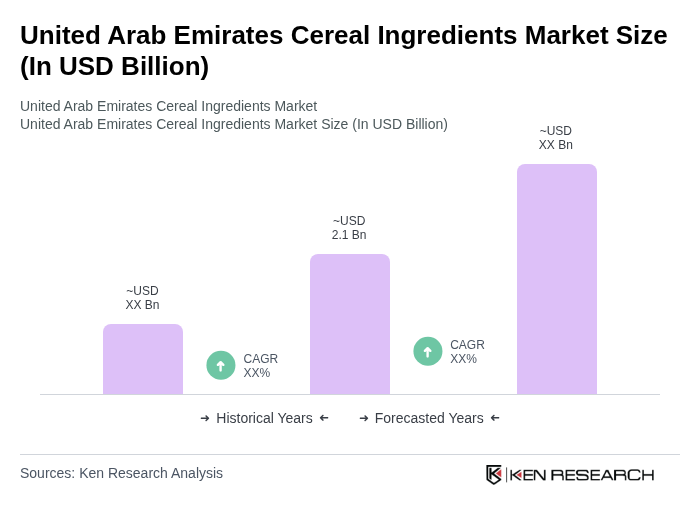
- The United Arab Emirates Cereal Ingredients Market is valued at USD 2.1 billion, based on a five-year historical analysis.This growth is primarily driven by increasing health consciousness among consumers and the rising demand for nutritious, convenient food options such as breakfast cereals, granola, and cereal-based snack bars.The growing popularity of ready-to-eat and ready-to-cook breakfast cereals, on-the-go cereal snacks, and high-fiber and fortified products has further fueled the market, as consumers seek quick, healthy meal and snacking solutions in line with busy urban lifestyles.
- Key cities such as Dubai and Abu Dhabi dominate the market due to their status as major commercial hubs, high urbanization, and diverse populations, including a large expatriate community that drives demand for a wide variety of cereal products and global brands.Modern retail formats such as hypermarkets, supermarkets, and convenience stores, along with rapidly expanding e‑commerce and online grocery platforms, enhance the visibility and accessibility of cereal and cereal-ingredient-based products in these emirates.Additionally, the presence of numerous regional food processors and multinational ingredient and branded cereal companies supports product innovation, import of diverse grain bases, and continuous portfolio expansion, strengthening overall market growth.
- In 2023, the UAE government continued to advance nutrition-related regulations under frameworks such as the UAE National Nutrition Strategy 2017–2021 and subsequent implementation measures, alongside the mandatory front-of-pack nutrition labelling and limits on trans fats and industrially produced partially hydrogenated oils issued through the Ministerial Decree of the Ministry of Health and Prevention and the Emirates Authority for Standardization and Metrology (ESMA).These instruments encourage food and cereal manufacturers to reduce sugar, saturated fat, and sodium content, comply with specified nutrient disclosure standards, and progressively reformulate products to align with national health objectives and Gulf Standardization Organization (GSO) food labelling and compositional requirements, thereby supporting healthier cereal ingredient use and product development.
United Arab Emirates Cereal Ingredients Market Segmentation
By Ingredient Type:
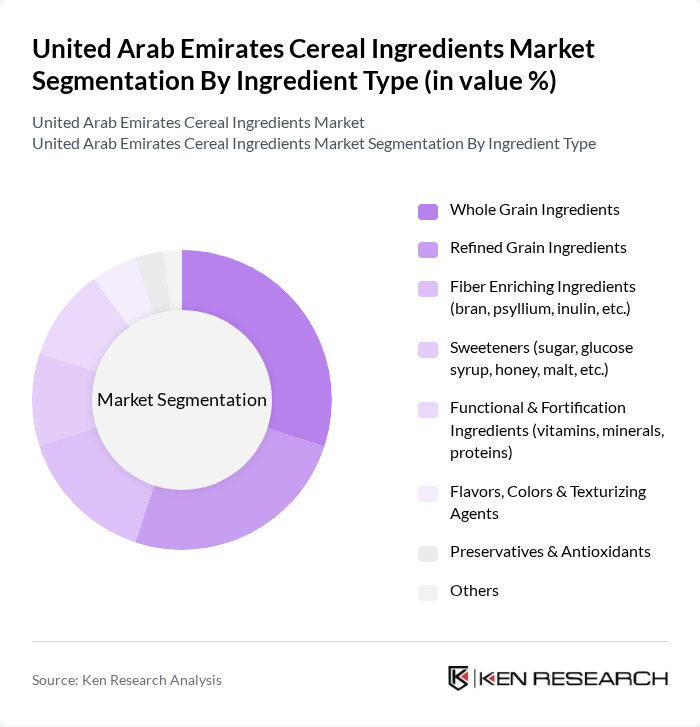
The ingredient type segmentation includes various subsegments such as Whole Grain Ingredients, Refined Grain Ingredients, Fiber Enriching Ingredients, Sweeteners, Functional & Fortification Ingredients, Flavors, Colors & Texturizing Agents, Preservatives & Antioxidants, and Others. Whole Grain Ingredients are increasingly important in the market due to growing consumer preference for healthier options that are rich in fiber and nutrients, supported by rising awareness of cardiovascular health, weight management, and digestive wellness.Demand for Fiber Enriching Ingredients and Functional & Fortification Ingredients is also expanding as manufacturers respond to interest in high-fiber, protein-enriched, vitamin- and mineral-fortified cereals and clean-label formulations, especially among health-conscious urban consumers.
By Cereal Base:
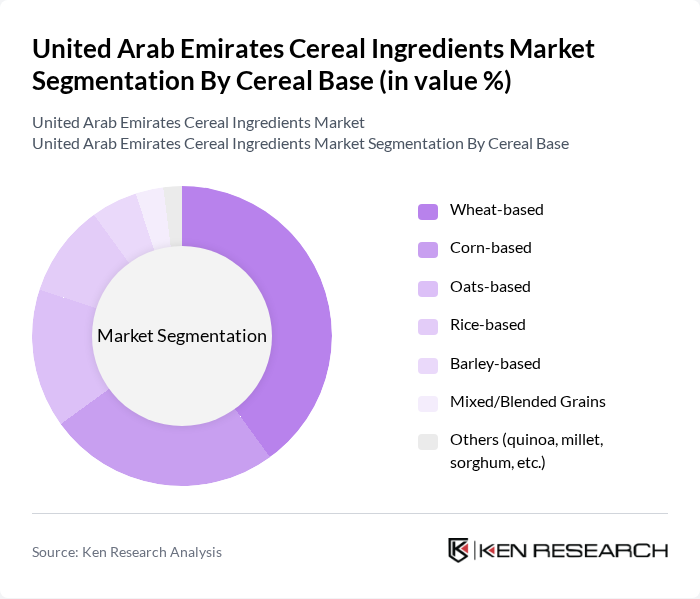
This segmentation includes Wheat-based, Corn-based, Oats-based, Rice-based, Barley-based, Mixed/Blended Grains, and Others. Wheat-based cereals continue to hold a significant share of the market due to their widespread consumption in bakery, pasta, and cereal applications and their versatility in both traditional and Western-style food products.Corn-based and oats-based cereals are also gaining prominence, supported by the popularity of ready-to-eat breakfast cereals, granola, muesli, and snack formats, while mixed and blended grains, including quinoa and millet, are increasingly used in premium, high-fiber, gluten-conscious, and better-for-you product lines.
United Arab Emirates Cereal Ingredients Market Competitive Landscape
The United Arab Emirates Cereal Ingredients Market is characterized by a dynamic mix of regional and international players. Leading participants such as Al Ghurair Foods, Al Dahra Holding, IFFCO Group, United Foods Company, Agthia Group PJSC, Al Islami Foods, Almarai Company, Nestlé Middle East FZE, General Mills Inc., Kellogg Company, PepsiCo (Quaker Oats), Cereal Partners Worldwide (Nestlé & General Mills), Barilla Group, Mondelez International, and other regional cereal and ingredient suppliers contribute to innovation, geographic expansion, and service delivery in this space.
United Arab Emirates Cereal Ingredients Market Industry Analysis
Growth Drivers
- Increasing Health Consciousness:The United Arab Emirates has seen a significant rise in health awareness, with 67% of consumers actively seeking healthier food options. This trend is supported by the UAE's obesity rate, which stands at 32%, prompting a shift towards nutritious cereal ingredients. The government’s health initiatives, including the National Nutrition Strategy, aim to reduce lifestyle-related diseases, further driving demand for cereals that offer health benefits, such as whole grains and fiber-rich options.
- Rising Demand for Convenience Foods:The convenience food sector in the UAE is projected to reach AED 12 billion in future, reflecting a growing consumer preference for ready-to-eat meals. This trend is fueled by the fast-paced lifestyle of urban residents, leading to increased consumption of cereal-based products that offer quick preparation. The demand for instant cereals and snack bars is particularly high, as they align with the busy schedules of working professionals and families.
- Expansion of the Food Processing Industry:The UAE's food processing industry is expected to grow at a rate of 5.5% annually, reaching AED 50 billion in future. This expansion is driven by investments in technology and infrastructure, enhancing the production of cereal ingredients. The establishment of food parks and processing zones, such as the Dubai Food Park, supports local manufacturers in meeting the increasing demand for diverse cereal products, thereby boosting the overall market.
Market Challenges
- Fluctuating Raw Material Prices:The cereal ingredients market in the UAE faces challenges due to volatile raw material prices, particularly for grains like wheat and oats. In future, wheat prices surged by 20% due to global supply chain disruptions and adverse weather conditions. This unpredictability affects production costs and profit margins for local manufacturers, making it difficult to maintain competitive pricing in the market.
- Stringent Regulatory Compliance:The UAE has implemented strict food safety regulations, which require compliance with the UAE Food Law and international standards. In future, the cost of compliance is expected to rise by 15% due to increased testing and certification requirements. This poses a significant challenge for small and medium-sized enterprises (SMEs) in the cereal ingredients sector, as they may struggle to meet these regulations while managing operational costs.
United Arab Emirates Cereal Ingredients Market Future Outlook
The future of the UAE cereal ingredients market appears promising, driven by evolving consumer preferences and technological advancements. The increasing focus on health and wellness will likely propel the demand for innovative, nutritious cereal products. Additionally, the rise of e-commerce platforms is expected to enhance product accessibility, allowing consumers to explore a wider range of options. As local manufacturers adapt to these trends, they will be better positioned to capture market share and meet the growing needs of health-conscious consumers.
Market Opportunities
- Growth in E-commerce for Food Products:The e-commerce food sector in the UAE is projected to grow by 25% in future, providing a significant opportunity for cereal ingredient manufacturers. Online platforms enable brands to reach a broader audience, catering to the increasing demand for convenience and home delivery services. This shift allows for innovative marketing strategies and direct consumer engagement, enhancing brand loyalty.
- Innovations in Product Development:There is a growing opportunity for product innovation in the cereal ingredients market, particularly in developing gluten-free and high-protein options. With the health food market expected to reach AED 8 billion in future, manufacturers can capitalize on this trend by introducing new formulations that cater to specific dietary needs, thus attracting a diverse consumer base.
Scope of the Report
| Segment | Sub-Segments |
|---|---|
| By Ingredient Type | Whole Grain Ingredients Refined Grain Ingredients Fiber Enriching Ingredients (bran, psyllium, inulin, etc.) Sweeteners (sugar, glucose syrup, honey, malt, etc.) Functional & Fortification Ingredients (vitamins, minerals, proteins) Flavors, Colors & Texturizing Agents Preservatives & Antioxidants Others |
| By Cereal Base | Wheat-based Corn-based Oats-based Rice-based Barley-based Mixed/Blended Grains Others (quinoa, millet, sorghum, etc.) |
| By Function | Taste & Flavor Enhancers Texture & Mouthfeel Modifiers Shelf-life Extension & Preservation Nutritional Fortification Clean-label / Natural Positioning Others |
| By Application | Ready-to-Eat Breakfast Cereals Hot Cereals (oatmeal, porridge, etc.) Bakery & Snack Products Nutritional & Dietary Supplements Baby Food & Infant Cereals Others |
| By End-User Industry | Industrial Food & Beverage Manufacturers HoReCa / Foodservice Private Label / Retail Brands Others |
| By Nature | Conventional Ingredients Organic & Clean-label Ingredients Others |
| By Region | Abu Dhabi Dubai Sharjah Ajman Ras Al Khaimah Fujairah Umm Al Quwain |
Key Target Audience
Investors and Venture Capitalist Firms
Government and Regulatory Bodies (e.g., Ministry of Climate Change and Environment, Abu Dhabi Food Control Authority)
Manufacturers and Producers
Distributors and Retailers
Food and Beverage Companies
Importers and Exporters
Industry Associations (e.g., UAE Food and Beverage Manufacturers Group)
Financial Institutions
Players Mentioned in the Report:
Al Ghurair Foods
Al Dahra Holding
IFFCO Group
United Foods Company
Agthia Group PJSC
Al Islami Foods
Almarai Company
Nestle Middle East FZE
General Mills Inc.
Kellogg Company
PepsiCo (Quaker Oats)
Cereal Partners Worldwide (Nestle & General Mills)
Barilla Group
Mondelez International
Other Regional Cereal & Ingredient Suppliers
Table of Contents
Market Assessment Phase
1. Executive Summary and Approach
2. United Arab Emirates Cereal Ingredients Market Overview
2.1 Key Insights and Strategic Recommendations
2.2 United Arab Emirates Cereal Ingredients Market Overview
2.3 Definition and Scope
2.4 Evolution of Market Ecosystem
2.5 Timeline of Key Regulatory Milestones
2.6 Value Chain & Stakeholder Mapping
2.7 Business Cycle Analysis
2.8 Policy & Incentive Landscape
3. United Arab Emirates Cereal Ingredients Market Analysis
3.1 Growth Drivers
3.1.1 Increasing Health Consciousness
3.1.2 Rising Demand for Convenience Foods
3.1.3 Expansion of the Food Processing Industry
3.1.4 Government Initiatives to Promote Local Production
3.2 Market Challenges
3.2.1 Fluctuating Raw Material Prices
3.2.2 Stringent Regulatory Compliance
3.2.3 Competition from Imported Products
3.2.4 Limited Consumer Awareness of Cereal Ingredients
3.3 Market Opportunities
3.3.1 Growth in E-commerce for Food Products
3.3.2 Innovations in Product Development
3.3.3 Increasing Export Potential
3.3.4 Collaborations with Health and Wellness Brands
3.4 Market Trends
3.4.1 Shift Towards Organic and Natural Ingredients
3.4.2 Rise of Plant-Based Diets
3.4.3 Customization of Cereal Products
3.4.4 Focus on Sustainable Sourcing
3.5 Government Regulation
3.5.1 Food Safety Standards and Regulations
3.5.2 Labeling Requirements for Cereal Products
3.5.3 Import Tariffs on Cereal Ingredients
3.5.4 Support for Local Agricultural Initiatives
4. SWOT Analysis
5. Stakeholder Analysis
6. Porter's Five Forces Analysis
7. United Arab Emirates Cereal Ingredients Market Market Size, 2019-2024
7.1 By Value
7.2 By Volume
7.3 By Average Selling Price
8. United Arab Emirates Cereal Ingredients Market Segmentation
8.1 By Ingredient Type
8.1.1 Whole Grain Ingredients
8.1.2 Refined Grain Ingredients
8.1.3 Fiber Enriching Ingredients (bran, psyllium, inulin, etc.)
8.1.4 Sweeteners (sugar, glucose syrup, honey, malt, etc.)
8.1.5 Functional & Fortification Ingredients (vitamins, minerals, proteins)
8.1.6 Flavors, Colors & Texturizing Agents
8.1.7 Preservatives & Antioxidants
8.1.8 Others
8.2 By Cereal Base
8.2.1 Wheat-based
8.2.2 Corn-based
8.2.3 Oats-based
8.2.4 Rice-based
8.2.5 Barley-based
8.2.6 Mixed/Blended Grains
8.2.7 Others (quinoa, millet, sorghum, etc.)
8.3 By Function
8.3.1 Taste & Flavor Enhancers
8.3.2 Texture & Mouthfeel Modifiers
8.3.3 Shelf-life Extension & Preservation
8.3.4 Nutritional Fortification
8.3.5 Clean-label / Natural Positioning
8.3.6 Others
8.4 By Application
8.4.1 Ready-to-Eat Breakfast Cereals
8.4.2 Hot Cereals (oatmeal, porridge, etc.)
8.4.3 Bakery & Snack Products
8.4.4 Nutritional & Dietary Supplements
8.4.5 Baby Food & Infant Cereals
8.4.6 Others
8.5 By End-User Industry
8.5.1 Industrial Food & Beverage Manufacturers
8.5.2 HoReCa / Foodservice
8.5.3 Private Label / Retail Brands
8.5.4 Others
8.6 By Nature
8.6.1 Conventional Ingredients
8.6.2 Organic & Clean-label Ingredients
8.6.3 Others
8.7 By Region
8.7.1 Abu Dhabi
8.7.2 Dubai
8.7.3 Sharjah
8.7.4 Ajman
8.7.5 Ras Al Khaimah
8.7.6 Fujairah
8.7.7 Umm Al Quwain
9. United Arab Emirates Cereal Ingredients Market Competitive Analysis
9.1 Market Share of Key Players
9.2 Cross Comparison of Key Players
9.2.1 Company Name
9.2.2 Company Size (Revenue Tier: Large, Medium, Small)
9.2.3 UAE Cereal Ingredients Revenue (USD Million)
9.2.4 3-year Revenue CAGR in UAE Cereal Ingredients Business
9.2.5 EBITDA Margin (%) – UAE Operations
9.2.6 Market Share (%) in UAE Cereal Ingredients
9.2.7 Average Selling Price Index vs Market
9.2.8 Volume Sold (Tonnes) – Latest Year
9.2.9 Distribution Coverage (no. of key accounts / channels served)
9.2.10 New Product Launches in Last 3 Years (count)
9.2.11 R&D Spend as % of Revenue
9.2.12 Certification & Compliance Score (e.g., HACCP, ISO, organic, halal)
9.2.13 Brand Awareness / Preference Index (survey-based)
9.3 SWOT Analysis of Top Players
9.4 Pricing Analysis
9.5 Detailed Profile of Major Companies
9.5.1 Al Ghurair Foods
9.5.2 Al Dahra Holding
9.5.3 IFFCO Group
9.5.4 United Foods Company
9.5.5 Agthia Group PJSC
9.5.6 Al Islami Foods
9.5.7 Almarai Company
9.5.8 Nestlé Middle East FZE
9.5.9 General Mills Inc.
9.5.10 Kellogg Company
9.5.11 PepsiCo (Quaker Oats)
9.5.12 Cereal Partners Worldwide (Nestlé & General Mills)
9.5.13 Barilla Group
9.5.14 Mondelez International
9.5.15 Other Regional Cereal & Ingredient Suppliers
10. United Arab Emirates Cereal Ingredients Market End-User Analysis
10.1 Procurement Behavior of Key Ministries
10.1.1 Ministry of Health and Prevention
10.1.2 Ministry of Economy
10.1.3 Ministry of Climate Change and Environment
10.1.4 Others
10.2 Corporate Spend on Infrastructure & Energy
10.2.1 Investment in Food Processing Facilities
10.2.2 Budget Allocation for R&D
10.2.3 Expenditure on Sustainable Practices
10.2.4 Others
10.3 Pain Point Analysis by End-User Category
10.3.1 Food Manufacturers
10.3.2 Retailers
10.3.3 Distributors
10.3.4 Others
10.4 User Readiness for Adoption
10.4.1 Awareness of Cereal Ingredients
10.4.2 Willingness to Pay for Quality
10.4.3 Adoption of New Products
10.4.4 Others
10.5 Post-Deployment ROI and Use Case Expansion
10.5.1 Measurement of ROI
10.5.2 Expansion into New Markets
10.5.3 Customer Feedback Integration
10.5.4 Others
11. United Arab Emirates Cereal Ingredients Market Future Size, 2025-2030
11.1 By Value
11.2 By Volume
11.3 By Average Selling Price
Go-To-Market Strategy Phase
1. Whitespace Analysis + Business Model Canvas
1.1 Market Gaps Identification
1.2 Business Model Development
2. Marketing and Positioning Recommendations
2.1 Branding Strategies
2.2 Product USPs
3. Distribution Plan
3.1 Urban Retail vs Rural NGO Tie-ups
4. Channel & Pricing Gaps
4.1 Underserved Routes
4.2 Pricing Bands
5. Unmet Demand & Latent Needs
5.1 Category Gaps
5.2 Consumer Segments
6. Customer Relationship
6.1 Loyalty Programs
6.2 After-sales Service
7. Value Proposition
7.1 Sustainability
7.2 Integrated Supply Chains
8. Key Activities
8.1 Regulatory Compliance
8.2 Branding
8.3 Distribution Setup
9. Entry Strategy Evaluation
9.1 Domestic Market Entry Strategy
9.1.1 Product Mix
9.1.2 Pricing Band
9.1.3 Packaging
9.2 Export Entry Strategy
9.2.1 Target Countries
9.2.2 Compliance Roadmap
10. Entry Mode Assessment
10.1 JV
10.2 Greenfield
10.3 M&A
10.4 Distributor Model
11. Capital and Timeline Estimation
11.1 Capital Requirements
11.2 Timelines
12. Control vs Risk Trade-Off
12.1 Ownership vs Partnerships
13. Profitability Outlook
13.1 Breakeven Analysis
13.2 Long-term Sustainability
14. Potential Partner List
14.1 Distributors
14.2 JVs
14.3 Acquisition Targets
15. Execution Roadmap
15.1 Phased Plan for Market Entry
15.1.1 Market Setup
15.1.2 Market Entry
15.1.3 Growth Acceleration
15.1.4 Scale & Stabilize
15.2 Key Activities and Milestones
15.2.1 Milestone Planning
15.2.2 Activity Tracking
Research Methodology
Phase 1: Approach1
Desk Research
- Analysis of industry reports from local and international market research firms
- Review of government publications and trade statistics from the UAE Ministry of Economy
- Examination of academic journals and articles focusing on cereal ingredient trends in the Middle East
Primary Research
- Interviews with key stakeholders in the cereal ingredients supply chain, including manufacturers and distributors
- Surveys conducted with food product developers and R&D teams in the UAE
- Focus group discussions with consumers to understand preferences and trends in cereal consumption
Validation & Triangulation
- Cross-validation of findings through multiple data sources, including trade associations and market reports
- Triangulation of qualitative insights from interviews with quantitative data from surveys
- Sanity checks performed by industry experts to ensure data reliability and relevance
Phase 2: Market Size Estimation1
Top-down Assessment
- Estimation of market size based on national consumption data and import/export statistics of cereal ingredients
- Segmentation of the market by product type, including flour, grains, and additives
- Incorporation of growth rates from related sectors such as bakery and snack foods
Bottom-up Modeling
- Collection of sales data from leading cereal ingredient manufacturers operating in the UAE
- Estimation of market share based on production capacity and distribution reach
- Volume and pricing analysis to derive revenue estimates for each product segment
Forecasting & Scenario Analysis
- Utilization of time series analysis to project future market trends based on historical data
- Scenario modeling to assess the impact of economic factors, such as inflation and consumer spending
- Development of best-case, worst-case, and most-likely scenarios through 2030
Phase 3: CATI Sample Composition1
| Scope Item/Segment | Sample Size | Target Respondent Profiles |
|---|---|---|
| Cereal Ingredient Manufacturers | 60 | Production Managers, Quality Control Officers |
| Food Product Developers | 60 | R&D Managers, Product Innovation Specialists |
| Retail Buyers and Merchandisers | 50 | Category Managers, Purchasing Agents |
| Health and Nutrition Experts | 40 | Dietitians, Nutritionists |
| Consumers of Cereal Products | 120 | General Consumers, Health-Conscious Shoppers |
Frequently Asked Questions
What is the current value of the United Arab Emirates Cereal Ingredients Market?
The United Arab Emirates Cereal Ingredients Market is valued at approximately USD 2.1 billion, reflecting a significant growth trend driven by increasing health consciousness and demand for nutritious, convenient food options among consumers.
What factors are driving growth in the UAE Cereal Ingredients Market?
Which cities in the UAE are leading in cereal ingredient consumption?
What types of cereal ingredients are most popular in the UAE?
Other Regional/Country Reports
Other Adjacent Reports
Singapore Snack Foods Market
Germany Bakery Ingredients Market
Malaysia Functional Foods MarketThailand Health Supplements Market
Kuwait Grain Processing Market
UAE Food Additives MarketJapan Convenience Foods Market
Brazil Nutritional Ingredients Market
KSA food packaging market size, share, growth drivers, trends, opportunities & forecast 2025–2030Why Buy From Us?

What makes us stand out is that our consultants follow Robust, Refine and Result (RRR) methodology. Robust for clear definitions, approaches and sanity checking, Refine for differentiating respondents' facts and opinions, and Result for presenting data with story.

We have set a benchmark in the industry by offering our clients with syndicated and customized market research reports featuring coverage of entire market as well as meticulous research and analyst insights.

While we don't replace traditional research, we flip the method upside down. Our dual approach of Top Bottom & Bottom Top ensures quality deliverable by not just verifying company fundamentals but also looking at the sector and macroeconomic factors.

With one step in the future, our research team constantly tries to show you the bigger picture. We help with some of the tough questions you may encounter along the way: How is the industry positioned? Best marketing channel? KPI's of competitors? By aligning every element, we help maximize success.

Our report gives you instant access to the answers and sources that other companies might choose to hide. We elaborate each steps of research methodology we have used and showcase you the sample size to earn your trust.

If you need any support, we are here! We pride ourselves on universe strength, data quality, and quick, friendly, and professional service.