Region:Middle East
Author(s):Rebecca
Product Code:KRAC2627
Pages:88
Published On:October 2025
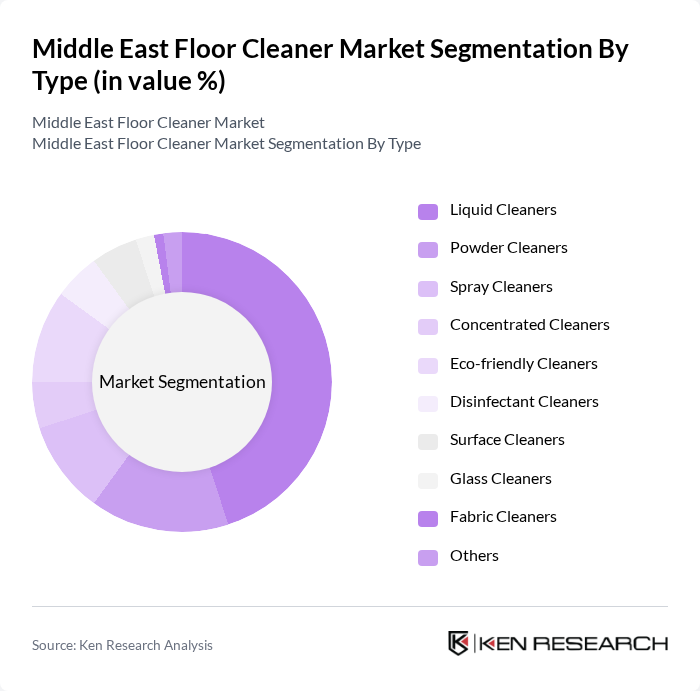
By Type:The market is segmented into various types of floor cleaners, including liquid cleaners, powder cleaners, spray cleaners, concentrated cleaners, eco-friendly cleaners, disinfectant cleaners, surface cleaners, glass cleaners, fabric cleaners, and others. Among these, liquid cleaners dominate the market due to their ease of use and effectiveness in various cleaning applications. The trend towards convenience and efficiency in cleaning products has led to a significant preference for liquid formulations, particularly in residential and commercial settings. Eco-friendly and disinfectant cleaners are also experiencing increased demand as consumers and institutions prioritize sustainability and health safety .
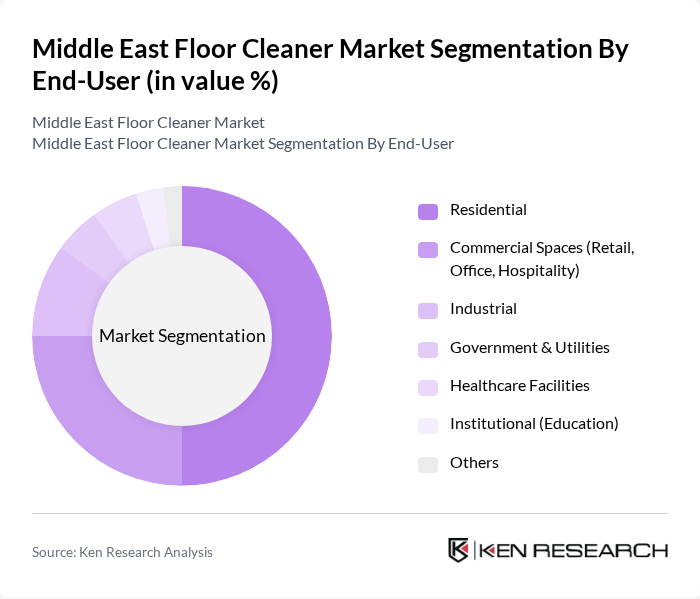
By End-User:The end-user segmentation includes residential, commercial spaces (retail, office, hospitality), industrial, government & utilities, healthcare facilities, institutional (education), and others. The residential segment is the largest due to the increasing focus on home cleanliness and hygiene, especially post-pandemic. Consumers are investing more in cleaning products to maintain a healthy living environment, which drives the demand in this segment. Commercial and healthcare sectors are also witnessing robust growth due to stricter hygiene protocols and increased facility management investments .
The Middle East Floor Cleaner Market is characterized by a dynamic mix of regional and international players. Leading participants such as Procter & Gamble, Unilever, Reckitt Benckiser, Henkel AG & Co. KGaA, SC Johnson, Ecolab Inc., Diversey Holdings, Ltd., The Clorox Company, Colgate-Palmolive, 3M Company, Kimberly-Clark Corporation, BASF SE, Kärcher Middle East, Nilfisk Group, Al Sanea Chemical Products, National Detergent Company (NDC), Saudi Industrial Detergents Co. (SIDCO), Hayat Kimya, Zep Inc., Spartan Chemical Company contribute to innovation, geographic expansion, and service delivery in this space.
The Middle East floor cleaner market is poised for significant transformation driven by evolving consumer preferences and technological advancements. The shift towards sustainable cleaning solutions is expected to gain momentum, with eco-friendly products projected to capture 25% of the market in future. Additionally, the integration of smart cleaning devices is anticipated to enhance user experience, making cleaning more efficient. As e-commerce continues to expand, brands that leverage online platforms will likely see increased market penetration and customer engagement.
| Segment | Sub-Segments |
|---|---|
| By Type | Liquid Cleaners Powder Cleaners Spray Cleaners Concentrated Cleaners Eco-friendly Cleaners Disinfectant Cleaners Surface Cleaners Glass Cleaners Fabric Cleaners Others |
| By End-User | Residential Commercial Spaces (Retail, Office, Hospitality) Industrial Government & Utilities Healthcare Facilities Institutional (Education) Others |
| By Distribution Channel | Supermarkets/Hypermarkets Online Retail Convenience Stores Wholesale Distributors Direct Sales Others |
| By Packaging Type | Bottles Pouches Cans Bulk Packaging |
| By Price Range | Economy Mid-range Premium |
| By Brand Type | National Brands Private Labels Generic Brands |
| By Product Formulation | Chemical-based Natural-based Biodegradable Others |
| Scope Item/Segment | Sample Size | Target Respondent Profiles |
|---|---|---|
| Retail Floor Cleaner Sales | 100 | Store Managers, Category Buyers |
| Commercial Cleaning Services | 80 | Operations Managers, Service Supervisors |
| Household Consumer Preferences | 120 | Homeowners, Apartment Residents |
| Eco-friendly Product Adoption | 60 | Sustainability Advocates, Green Product Retailers |
| Market Trends and Innovations | 90 | Product Development Managers, Marketing Executives |
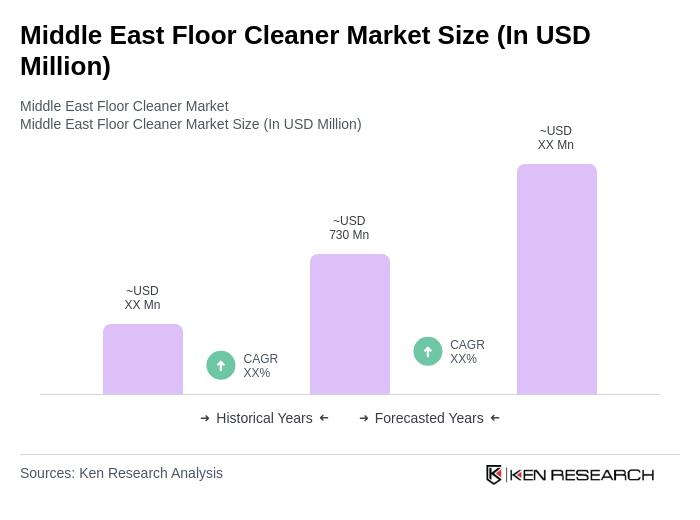
The Middle East Floor Cleaner Market is valued at approximately USD 730 million, driven by urbanization, rising disposable incomes, and increased hygiene awareness among consumers in both residential and commercial sectors.

What makes us stand out is that our consultants follow Robust, Refine and Result (RRR) methodology. Robust for clear definitions, approaches and sanity checking, Refine for differentiating respondents' facts and opinions, and Result for presenting data with story.

We have set a benchmark in the industry by offering our clients with syndicated and customized market research reports featuring coverage of entire market as well as meticulous research and analyst insights.

While we don't replace traditional research, we flip the method upside down. Our dual approach of Top Bottom & Bottom Top ensures quality deliverable by not just verifying company fundamentals but also looking at the sector and macroeconomic factors.

With one step in the future, our research team constantly tries to show you the bigger picture. We help with some of the tough questions you may encounter along the way: How is the industry positioned? Best marketing channel? KPI's of competitors? By aligning every element, we help maximize success.

Our report gives you instant access to the answers and sources that other companies might choose to hide. We elaborate each steps of research methodology we have used and showcase you the sample size to earn your trust.

If you need any support, we are here! We pride ourselves on universe strength, data quality, and quick, friendly, and professional service.













