Middle East Fountain Dispenser Equipment Market Report Size Share Growth Drivers Trends Opportunities & Forecast 2025–2030

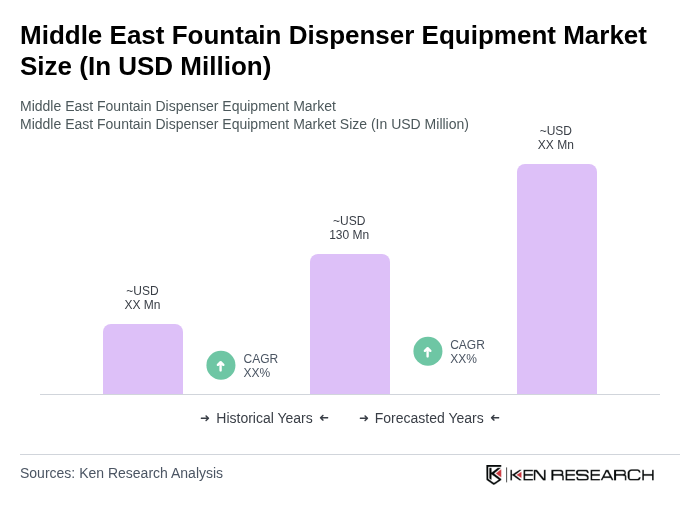
The Middle East Fountain Dispenser Equipment Market, valued at USD 130 million, is growing due to rising demand in quick-service restaurants, cafes, and self-service stations in GCC regions.

Region:Middle East

Author(s):Geetanshi

Product Code:KRAE5586

Pages:90

Published On:December 2025
About the Report

Base Year 2024

Middle East Fountain Dispenser Equipment Market Overview

  • The Middle East Fountain Dispenser Equipment Market is valued at USD 130 million, based on a five-year historical analysis. This growth is primarily driven by the increasing demand for beverage dispensing solutions in the foodservice sector, particularly in quick-service restaurants and cafes, as well as the rising trend of self-service beverage stations in various venues.
  • Key players in this market include the GCC countries, particularly Saudi Arabia and the UAE, which dominate due to their robust hospitality and tourism sectors. The rapid urbanization and increasing disposable income in these regions further fuel the demand for advanced fountain dispenser systems.
  • The Dubai Municipality Energy Efficiency Regulations, 2018 issued by the Dubai Supreme Council of Energy require foodservice appliances to meet minimum energy performance standards, including efficiency thresholds for refrigeration and dispensing systems. Compliance mandates energy labeling, third-party testing, and minimum efficiency ratings for commercial equipment used in hospitality venues.
Middle East Fountain Dispenser Equipment Market Report Size Share Growth Drivers Trends Opportunities & Forecast 2025–2030 Size

Middle East Fountain Dispenser Equipment Market Segmentation

By Product Type:The product type segmentation includes various categories of fountain dispensers that cater to different consumer needs and preferences. The dominant sub-segment in this category is the Countertop Fountain Dispensers, which are favored for their compact design and ease of use in limited spaces. These dispensers are widely used in quick-service restaurants and cafes, where space optimization is crucial. Other notable sub-segments include Floor-standing and Wall-mounted Fountain Dispensers, which are popular in larger venues due to their capacity and visibility.
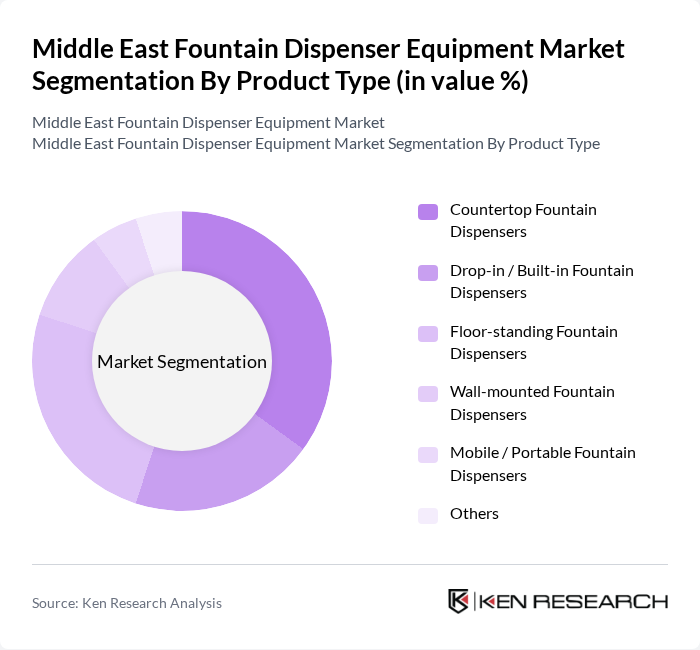
Middle East Fountain Dispenser Equipment Market segmentation by Product Type.

By Beverage Type:The beverage type segmentation encompasses a variety of dispensing solutions tailored to different beverage categories. Carbonated Soft Drink Dispensers lead this segment, driven by the high demand for soft drinks in fast-food outlets and entertainment venues. Non-Carbonated Beverage Dispensers, including juice and iced tea options, are also gaining traction as consumer preferences shift towards healthier choices. The Frozen Beverage & Slush Dispensers are popular in warmer climates, while Beer & Alcoholic Beverage Fountain Systems cater to the growing nightlife and hospitality sectors.
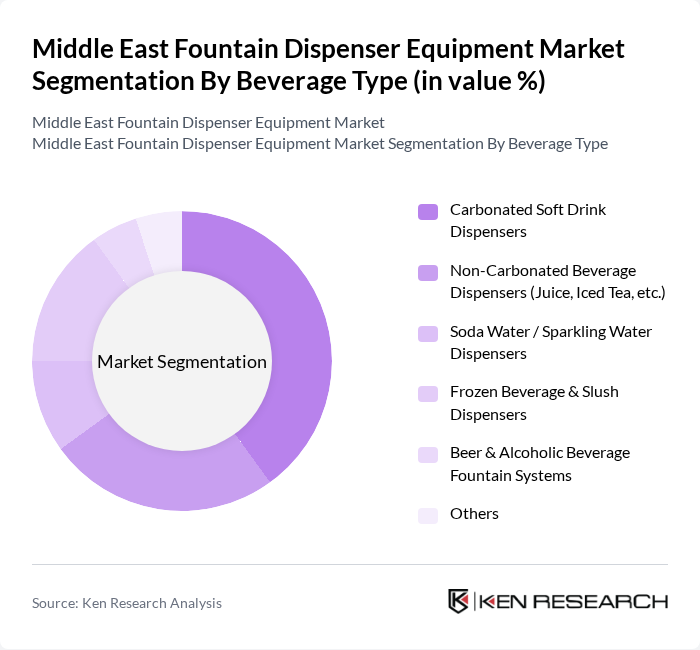
Middle East Fountain Dispenser Equipment Market segmentation by Beverage Type.

Middle East Fountain Dispenser Equipment Market Competitive Landscape

The Middle East Fountain Dispenser Equipment Market is characterized by a dynamic mix of regional and international players. Leading participants such as Lancer Corporation, Cornelius, Inc., Manitowoc Beverage Systems, PepsiCo, Inc. (foodservice fountain operations), The Coca-Cola Company (fountain equipment & dispensing solutions), Middleby Corporation, Hoshizaki Corporation, ITW Food Equipment Group, Ali Group S.r.l., FETCO, Wilbur Curtis Company, Franke Group, Tetra Pak (Beverage Dispensing Solutions), regional stainless steel fabrication & dispensing OEMs, selected local Middle East fountain equipment integrators & service providers contribute to innovation, geographic expansion, and service delivery in this space.

Lancer Corporation

1916

San Antonio, Texas, USA

Cornelius, Inc.

1931

Glendale, Arizona, USA

Manitowoc Beverage Systems

1902

Manitowoc, Wisconsin, USA

PepsiCo, Inc.

1965

Purchase, New York, USA

The Coca-Cola Company

1892

Atlanta, Georgia, USA

Company

Establishment Year

Headquarters

Regional Fountain Dispenser Revenue (USD Million)

Fountain Dispenser Revenue CAGR (Historical & Forecast)

Installed Base of Fountain Dispenser Units in Middle East (Number of Units)

Market Share in Key End-User Segments (QSR, Hospitality, etc.)

Average Selling Price (ASP) per Fountain Dispenser Unit

R&D Intensity (% of Revenue Spent on Product Development)

Middle East Fountain Dispenser Equipment Market Industry Analysis

Growth Drivers

  • Increasing Demand for Convenience:The Middle East has seen a significant rise in consumer demand for convenience in beverage dispensing, with the food service sector projected to grow by 6.5% annually through future. This trend is driven by urbanization, with over 90% of the population living in cities, leading to a preference for quick-service options. Additionally, the region's hospitality industry, which contributes approximately $35 billion to the economy, is increasingly adopting fountain dispensers to enhance customer experience and operational efficiency.
  • Rising Popularity of Self-Service Kiosks:Self-service kiosks are becoming increasingly popular in the Middle East, with an estimated 20% growth in installations expected by future. This trend is fueled by the region's tech-savvy population and the growing demand for contactless service options, especially post-pandemic. The hospitality sector, which includes over 1,200 hotels and restaurants in major cities, is rapidly integrating these kiosks to streamline operations and reduce labor costs, thus driving the fountain dispenser market.
  • Technological Advancements:The fountain dispenser equipment market is benefiting from rapid technological advancements, with innovations such as IoT-enabled dispensers projected to increase by 25% in adoption by future. These advancements enhance user experience through features like real-time inventory tracking and remote monitoring. The Middle East's focus on smart city initiatives, with investments exceeding $25 billion, further supports the integration of advanced dispenser technologies in various sectors, including retail and hospitality.

Market Challenges

  • High Initial Investment Costs:One of the significant challenges facing the fountain dispenser market in the Middle East is the high initial investment required for advanced equipment. The average cost of a high-quality dispenser can range from $6,000 to $16,000, which poses a barrier for small and medium-sized enterprises. This financial hurdle is compounded by the need for ongoing maintenance and operational costs, which can deter potential buyers from making the switch from traditional beverage serving methods.
  • Regulatory Compliance Issues:Navigating regulatory compliance is a critical challenge for the fountain dispenser market in the Middle East. Health and safety standards for food equipment are stringent, with compliance costs averaging around $2,500 per installation. Additionally, environmental regulations regarding waste disposal and energy efficiency are becoming increasingly stringent, requiring manufacturers and operators to invest in compliance measures, which can hinder market growth and innovation.

Middle East Fountain Dispenser Equipment Market Future Outlook

The future of the Middle East fountain dispenser equipment market appears promising, driven by ongoing technological innovations and a shift towards automated solutions. As consumer preferences evolve, businesses are likely to invest in smart dispensers that offer customization and personalization. Furthermore, the increasing focus on sustainability will push manufacturers to develop eco-friendly solutions, aligning with regional environmental goals. The hospitality sector's growth will also create new opportunities for market expansion, particularly in untapped areas.

Market Opportunities

  • Growth in the Hospitality Sector:The hospitality sector in the Middle East is projected to grow by 8% annually, creating significant opportunities for fountain dispenser equipment. With over 1,500 new hotels expected to open by future, there is a rising demand for efficient beverage dispensing solutions that enhance guest experiences and operational efficiency, making this a lucrative market segment for suppliers.
  • Potential for Eco-Friendly Solutions:As consumers become more health-conscious and environmentally aware, there is a growing demand for eco-friendly dispenser solutions. The market for sustainable products is expected to grow by 12% annually, driven by initiatives aimed at reducing plastic waste. Companies that innovate in this space can capture a significant share of the market by offering biodegradable or reusable dispensing options that align with consumer values.

Scope of the Report

SegmentSub-Segments
By Product Type

Countertop Fountain Dispensers

Drop-in / Built-in Fountain Dispensers

Floor-standing Fountain Dispensers

Wall-mounted Fountain Dispensers

Mobile / Portable Fountain Dispensers

Others

By Beverage Type

Carbonated Soft Drink Dispensers

Non-Carbonated Beverage Dispensers (Juice, Iced Tea, etc.)

Soda Water / Sparkling Water Dispensers

Frozen Beverage & Slush Dispensers

Beer & Alcoholic Beverage Fountain Systems

Others

By End-User

Quick Service Restaurants (QSRs) & Fast Food Chains

Full-Service Restaurants & Cafes

Cinemas, Entertainment & Leisure Venues

Hotels, Resorts & Catering Services

Corporate & Institutional (Offices, Education, Healthcare)

Others

By Technology

Manual / Mechanical Fountain Dispensers

Semi-Automatic Fountain Dispensers

Fully Automatic Fountain Dispensers

Smart / IoT-Enabled Fountain Dispensers

Energy-Efficient & Eco-Design Systems

Others

By Distribution Channel

Direct Sales (OEM to End-User)

Distributors & Dealers

Online (E-commerce & OEM Portals)

Specialized Equipment Retailers

Others

By Installation Environment

Indoor Installations

Outdoor Installations

Drive-Thru & On-the-Go Formats

Others

By Region

GCC Countries (Saudi Arabia, UAE, Qatar, Kuwait, Oman, Bahrain)

Levant Region (Jordan, Lebanon, Syria, Iraq, Palestine)

North Africa (Egypt, Morocco, Algeria, Tunisia)

Rest of Middle East & North Africa

Key Target Audience

Investors and Venture Capitalist Firms

Government and Regulatory Bodies (e.g., Ministry of Health, Ministry of Environment)

Manufacturers and Producers

Distributors and Retailers

Hospitality Industry Stakeholders (e.g., Hotel Chains, Restaurant Groups)

Facility Management Companies

Water Quality and Treatment Companies

Trade Associations and Industry Groups

Players Mentioned in the Report:

Lancer Corporation

Cornelius, Inc.

Manitowoc Beverage Systems

PepsiCo, Inc. (foodservice fountain operations)

The Coca-Cola Company (fountain equipment & dispensing solutions)

Middleby Corporation

Hoshizaki Corporation

ITW Food Equipment Group

Ali Group S.r.l.

FETCO

Wilbur Curtis Company

Franke Group

Tetra Pak (Beverage Dispensing Solutions)

regional stainless steel fabrication & dispensing OEMs

selected local Middle East fountain equipment integrators & service providers

Table of Contents

Market Assessment Phase

1. Executive Summary and Approach


2. Middle East Fountain Dispenser Equipment Market Overview

2.1 Key Insights and Strategic Recommendations

2.2 Middle East Fountain Dispenser Equipment Market Overview

2.3 Definition and Scope

2.4 Evolution of Market Ecosystem

2.5 Timeline of Key Regulatory Milestones

2.6 Value Chain & Stakeholder Mapping

2.7 Business Cycle Analysis

2.8 Policy & Incentive Landscape


3. Middle East Fountain Dispenser Equipment Market Analysis

3.1 Growth Drivers

3.1.1 Increasing demand for convenience in beverage dispensing
3.1.2 Rising popularity of self-service kiosks
3.1.3 Expansion of the food and beverage industry
3.1.4 Technological advancements in dispenser equipment

3.2 Market Challenges

3.2.1 High initial investment costs
3.2.2 Regulatory compliance issues
3.2.3 Competition from traditional beverage serving methods
3.2.4 Limited awareness among end-users

3.3 Market Opportunities

3.3.1 Growth in the hospitality sector
3.3.2 Increasing health consciousness among consumers
3.3.3 Potential for eco-friendly dispenser solutions
3.3.4 Expansion into untapped markets

3.4 Market Trends

3.4.1 Shift towards automated dispensing solutions
3.4.2 Integration of smart technology in dispensers
3.4.3 Customization and personalization of beverage options
3.4.4 Focus on sustainability and waste reduction

3.5 Government Regulation

3.5.1 Health and safety standards for food equipment
3.5.2 Environmental regulations on waste disposal
3.5.3 Import/export regulations for equipment
3.5.4 Incentives for energy-efficient technologies

4. SWOT Analysis


5. Stakeholder Analysis


6. Porter's Five Forces Analysis


7. Middle East Fountain Dispenser Equipment Market Size, 2019-2024

7.1 By Value

7.2 By Volume

7.3 By Average Selling Price


8. Middle East Fountain Dispenser Equipment Market Segmentation

8.1 By Product Type

8.1.1 Countertop Fountain Dispensers
8.1.2 Drop-in / Built-in Fountain Dispensers
8.1.3 Floor-standing Fountain Dispensers
8.1.4 Wall-mounted Fountain Dispensers
8.1.5 Mobile / Portable Fountain Dispensers
8.1.6 Others

8.2 By Beverage Type

8.2.1 Carbonated Soft Drink Dispensers
8.2.2 Non-Carbonated Beverage Dispensers (Juice, Iced Tea, etc.)
8.2.3 Soda Water / Sparkling Water Dispensers
8.2.4 Frozen Beverage & Slush Dispensers
8.2.5 Beer & Alcoholic Beverage Fountain Systems
8.2.6 Others

8.3 By End-User

8.3.1 Quick Service Restaurants (QSRs) & Fast Food Chains
8.3.2 Full-Service Restaurants & Cafes
8.3.3 Cinemas, Entertainment & Leisure Venues
8.3.4 Hotels, Resorts & Catering Services
8.3.5 Corporate & Institutional (Offices, Education, Healthcare)
8.3.6 Others

8.4 By Technology

8.4.1 Manual / Mechanical Fountain Dispensers
8.4.2 Semi-Automatic Fountain Dispensers
8.4.3 Fully Automatic Fountain Dispensers
8.4.4 Smart / IoT-Enabled Fountain Dispensers
8.4.5 Energy-Efficient & Eco-Design Systems
8.4.6 Others

8.5 By Distribution Channel

8.5.1 Direct Sales (OEM to End-User)
8.5.2 Distributors & Dealers
8.5.3 Online (E-commerce & OEM Portals)
8.5.4 Specialized Equipment Retailers
8.5.5 Others

8.6 By Installation Environment

8.6.1 Indoor Installations
8.6.2 Outdoor Installations
8.6.3 Drive-Thru & On-the-Go Formats
8.6.4 Others

8.7 By Region

8.7.1 GCC Countries (Saudi Arabia, UAE, Qatar, Kuwait, Oman, Bahrain)
8.7.2 Levant Region (Jordan, Lebanon, Syria, Iraq, Palestine)
8.7.3 North Africa (Egypt, Morocco, Algeria, Tunisia)
8.7.4 Rest of Middle East & North Africa

9. Middle East Fountain Dispenser Equipment Market Competitive Analysis

9.1 Market Share of Key Players

9.2 Cross Comparison of Key Players

9.2.1 Company Name
9.2.2 Regional Fountain Dispenser Revenue (USD Million)
9.2.3 Fountain Dispenser Revenue CAGR (Historical & Forecast)
9.2.4 Installed Base of Fountain Dispenser Units in Middle East (Number of Units)
9.2.5 Market Share in Key End-User Segments (QSR, Hospitality, etc.)
9.2.6 Average Selling Price (ASP) per Fountain Dispenser Unit
9.2.7 R&D Intensity (% of Revenue Spent on Product Development)
9.2.8 EBITDA Margin from Fountain Dispenser Business (%)
9.2.9 Return on Invested Capital (ROIC) – Fountain Dispenser Segment (%)
9.2.10 Service & Maintenance Revenue Share (%)
9.2.11 New Contract Wins / Key Accounts Added per Year (Number)
9.2.12 Average Contract Duration for Fountain Dispenser Installations (Years)

9.3 SWOT Analysis of Top Players

9.4 Pricing Analysis

9.5 Detailed Profile of Major Companies

9.5.1 Lancer Corporation
9.5.2 Cornelius, Inc.
9.5.3 Manitowoc Beverage Systems
9.5.4 PepsiCo, Inc. (foodservice fountain operations)
9.5.5 The Coca-Cola Company (fountain equipment & dispensing solutions)
9.5.6 Middleby Corporation
9.5.7 Hoshizaki Corporation
9.5.8 ITW Food Equipment Group
9.5.9 Ali Group S.r.l.
9.5.10 FETCO
9.5.11 Wilbur Curtis Company
9.5.12 Franke Group
9.5.13 Tetra Pak (Beverage Dispensing Solutions)
9.5.14 regional stainless steel fabrication & dispensing OEMs
9.5.15 selected local Middle East fountain equipment integrators & service providers

10. Middle East Fountain Dispenser Equipment Market End-User Analysis

10.1 Procurement Behavior of Key Ministries

10.1.1 Budget Allocation Trends
10.1.2 Procurement Processes
10.1.3 Supplier Selection Criteria
10.1.4 Contract Management Practices

10.2 Corporate Spend on Infrastructure & Energy

10.2.1 Investment Trends in Beverage Dispensing
10.2.2 Budgeting for Equipment Upgrades
10.2.3 Long-term Financial Commitments
10.2.4 Cost-Benefit Analysis Practices

10.3 Pain Point Analysis by End-User Category

10.3.1 Equipment Reliability Issues
10.3.2 Maintenance and Support Challenges
10.3.3 Cost Management Concerns
10.3.4 User Experience Feedback

10.4 User Readiness for Adoption

10.4.1 Training and Support Needs
10.4.2 Technology Acceptance Levels
10.4.3 Infrastructure Readiness
10.4.4 Feedback Mechanisms

10.5 Post-Deployment ROI and Use Case Expansion

10.5.1 Performance Metrics Tracking
10.5.2 Case Studies of Successful Implementations
10.5.3 User Satisfaction Surveys
10.5.4 Future Expansion Plans

11. Middle East Fountain Dispenser Equipment Market Future Size, 2025-2030

11.1 By Value

11.2 By Volume

11.3 By Average Selling Price


Go-To-Market Strategy Phase

1. Whitespace Analysis + Business Model Canvas

1.1 Market Gaps Identification

1.2 Value Proposition Development

1.3 Revenue Streams Analysis

1.4 Cost Structure Evaluation

1.5 Key Partnerships Exploration

1.6 Customer Segmentation

1.7 Channels of Distribution


2. Marketing and Positioning Recommendations

2.1 Branding Strategies

2.2 Product USPs

2.3 Target Market Identification

2.4 Communication Strategies

2.5 Digital Marketing Approaches

2.6 Customer Engagement Tactics

2.7 Performance Metrics


3. Distribution Plan

3.1 Urban Retail Strategies

3.2 Rural NGO Tie-ups

3.3 E-commerce Integration

3.4 Logistics and Supply Chain Management

3.5 Distribution Partnerships

3.6 Inventory Management

3.7 Performance Tracking


4. Channel & Pricing Gaps

4.1 Underserved Routes

4.2 Pricing Bands Analysis

4.3 Competitor Pricing Strategies

4.4 Customer Willingness to Pay

4.5 Value-Based Pricing Models

4.6 Discounting Strategies

4.7 Pricing Optimization Techniques


5. Unmet Demand & Latent Needs

5.1 Category Gaps Identification

5.2 Consumer Segments Analysis

5.3 Emerging Trends Exploration

5.4 Product Development Opportunities

5.5 Market Entry Strategies

5.6 Customer Feedback Mechanisms

5.7 Future Demand Projections


6. Customer Relationship

6.1 Loyalty Programs Design

6.2 After-sales Service Strategies

6.3 Customer Feedback Loops

6.4 Relationship Management Tools

6.5 Engagement Metrics

6.6 Retention Strategies

6.7 Customer Experience Enhancements


7. Value Proposition

7.1 Sustainability Initiatives

7.2 Integrated Supply Chains

7.3 Unique Selling Points

7.4 Customer-Centric Innovations

7.5 Competitive Advantages

7.6 Market Differentiation Strategies

7.7 Value Communication Techniques


8. Key Activities

8.1 Regulatory Compliance

8.2 Branding Initiatives

8.3 Distribution Setup

8.4 Marketing Campaigns

8.5 Training and Development

8.6 Performance Monitoring

8.7 Stakeholder Engagement


9. Entry Strategy Evaluation

9.1 Domestic Market Entry Strategy

9.1.1 Product Mix Considerations
9.1.2 Pricing Band Analysis
9.1.3 Packaging Strategies

9.2 Export Entry Strategy

9.2.1 Target Countries Identification
9.2.2 Compliance Roadmap Development

10. Entry Mode Assessment

10.1 Joint Ventures

10.2 Greenfield Investments

10.3 Mergers & Acquisitions

10.4 Distributor Model Evaluation


11. Capital and Timeline Estimation

11.1 Capital Requirements Analysis

11.2 Timelines for Implementation


12. Control vs Risk Trade-Off

12.1 Ownership vs Partnerships


13. Profitability Outlook

13.1 Breakeven Analysis

13.2 Long-term Sustainability Strategies


14. Potential Partner List

14.1 Distributors Identification

14.2 Joint Ventures Opportunities

14.3 Acquisition Targets


15. Execution Roadmap

15.1 Phased Plan for Market Entry

15.1.1 Market Setup
15.1.2 Market Entry
15.1.3 Growth Acceleration
15.1.4 Scale & Stabilize

15.2 Key Activities and Milestones

15.2.1 Milestone Tracking
15.2.2 Activity Scheduling

Research Methodology

ApproachModellingSample

Phase 1: Approach1

Desk Research

  • Industry reports from regional trade associations and market research firms
  • Government publications on water management and environmental regulations
  • Market analysis articles from specialized journals focusing on water dispensing technologies

Primary Research

  • Interviews with key stakeholders in the fountain dispenser manufacturing sector
  • Surveys targeting facility managers in hospitality and public sectors
  • Field visits to installations of fountain dispensers for observational insights

Validation & Triangulation

  • Cross-validation of data from multiple sources including trade publications and expert interviews
  • Triangulation of market trends with historical sales data and growth forecasts
  • Sanity checks through feedback from industry experts and consultants

Phase 2: Market Size Estimation1

Top-down Assessment

  • Analysis of total water dispenser market size in the Middle East
  • Segmentation by end-user categories such as commercial, residential, and institutional
  • Incorporation of regional growth drivers such as urbanization and tourism

Bottom-up Modeling

  • Estimation of unit sales based on historical data from major distributors
  • Cost analysis of fountain dispenser installations and maintenance services
  • Volume projections based on anticipated demand from new construction projects

Forecasting & Scenario Analysis

  • Multi-variable forecasting using economic indicators and water scarcity trends
  • Scenario planning based on potential regulatory changes and technological advancements
  • Development of baseline, optimistic, and pessimistic market growth scenarios through 2030

Phase 3: CATI Sample Composition1

Scope Item/SegmentSample SizeTarget Respondent Profiles
Commercial Fountain Dispenser Usage110Facility Managers, Procurement Officers
Residential Fountain Dispenser Adoption85Homeowners, Property Managers
Institutional Fountain Dispenser Insights75School Administrators, Hospital Facility Managers
Market Trends in Hospitality Sector95Hotel Managers, Catering Service Providers
Regulatory Impact on Fountain Dispenser Market65Environmental Compliance Officers, Policy Makers

Frequently Asked Questions

What is the current value of the Middle East Fountain Dispenser Equipment Market?

The Middle East Fountain Dispenser Equipment Market is valued at approximately USD 130 million, reflecting a five-year historical analysis. This growth is driven by increasing demand for beverage dispensing solutions in the foodservice sector, particularly in quick-service restaurants and cafes.

Which countries dominate the Middle East Fountain Dispenser Equipment Market?

What are the key regulations affecting fountain dispenser equipment in the Middle East?

What types of fountain dispensers are most popular in the Middle East?

Other Regional/Country Reports

Indonesia Fountain Dispenser Equipment Market

Malaysia Fountain Dispenser Equipment Market

KSA Fountain Dispenser Equipment Market

APAC Fountain Dispenser Equipment Market

SEA Fountain Dispenser Equipment Market

Vietnam Fountain Dispenser Equipment Market

Other Adjacent Reports

Singapore Beverage Dispensing Systems Market

Brazil Commercial Refrigeration Equipment Market

Indonesia Foodservice Equipment Market

Germany Soft Drink Manufacturing Market

Singapore Hospitality Supplies Market

Oman Vending Machine Market

Qatar Ice Making Equipment Market

Bahrain Carbonated Beverage Production Market

Germany Self-Service Kiosk Market

Brazil Beverage Packaging Market

Why Buy From Us?

Refine Robust Result (RRR) Framework

What makes us stand out is that our consultants follow Robust, Refine and Result (RRR) methodology. Robust for clear definitions, approaches and sanity checking, Refine for differentiating respondents' facts and opinions, and Result for presenting data with story.

Our Reach Is Unmatched

We have set a benchmark in the industry by offering our clients with syndicated and customized market research reports featuring coverage of entire market as well as meticulous research and analyst insights.

Shifting the Research Paradigm

While we don't replace traditional research, we flip the method upside down. Our dual approach of Top Bottom & Bottom Top ensures quality deliverable by not just verifying company fundamentals but also looking at the sector and macroeconomic factors.

More Insights-Better Decisions

With one step in the future, our research team constantly tries to show you the bigger picture. We help with some of the tough questions you may encounter along the way: How is the industry positioned? Best marketing channel? KPI's of competitors? By aligning every element, we help maximize success.

Transparency and Trust

Our report gives you instant access to the answers and sources that other companies might choose to hide. We elaborate each steps of research methodology we have used and showcase you the sample size to earn your trust.

Round the Clock Support

If you need any support, we are here! We pride ourselves on universe strength, data quality, and quick, friendly, and professional service.

Why Clients Choose Us?

400000+
Reports in repository
150+
Consulting projects a year
100+
Analysts
8000+
Client Queries in 2022








