About the Report
Base Year 2024Listen to the audio summary
Middle East Gene Synthesis Research Use Market Overview
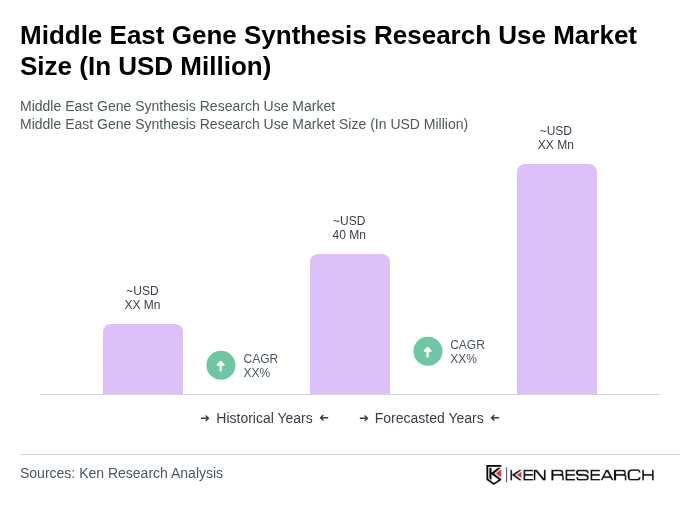
- The Middle East Gene Synthesis Research Use Market is valued at USD 40 million, based on a five-year historical analysis and triangulation with regional DNA and gene synthesis revenue estimates for the Middle East and Africa. This growth is primarily driven by advancements in biotechnology, increasing investments in genomics research, and the rising demand for synthetic biology applications across sectors such as healthcare, industrial biotechnology, and agriculture.
- Key players in this market include Saudi Arabia, the United Arab Emirates, and Qatar, which are among the leading Middle Eastern countries investing in genomics, precision medicine, and biotechnology infrastructure. These countries contribute significantly to regional demand due to their expanding research infrastructure, targeted government funding for biotechnology initiatives, and a growing number of academic, clinical, and research institutions focused on genetic and synthetic biology research.
- In the United Arab Emirates, national life sciences and genomics programs have prioritized synthetic DNA and gene technologies as part of broader biotechnology and precision medicine strategies, with multi-hundred?million?dollar commitments across genomics, biomanufacturing, and innovation ecosystems to support research and development in areas such as synthetic biology, vaccine R&D, and advanced therapeutics. These initiatives aim to foster innovation and collaboration among local universities, research centers, and private companies, strengthening the UAE’s positioning as a regional hub for DNA and gene synthesis?enabled research.
Middle East Gene Synthesis Research Use Market Segmentation
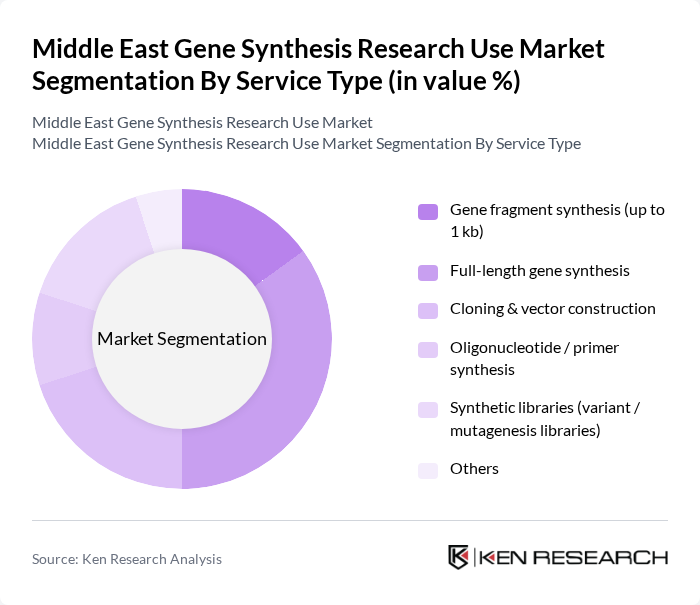
By Service Type:The service type segmentation includes various offerings that cater to the diverse needs of researchers and organizations in the gene synthesis domain. The subsegments are as follows: Gene fragment synthesis (up to 1 kb), Full-length gene synthesis, Cloning & vector construction, Oligonucleotide / primer synthesis, Synthetic libraries (variant / mutagenesis libraries), and Others. Among these, full-length gene synthesis is currently the leading subsegment due to its critical role in advanced genetic research and therapeutic applications.
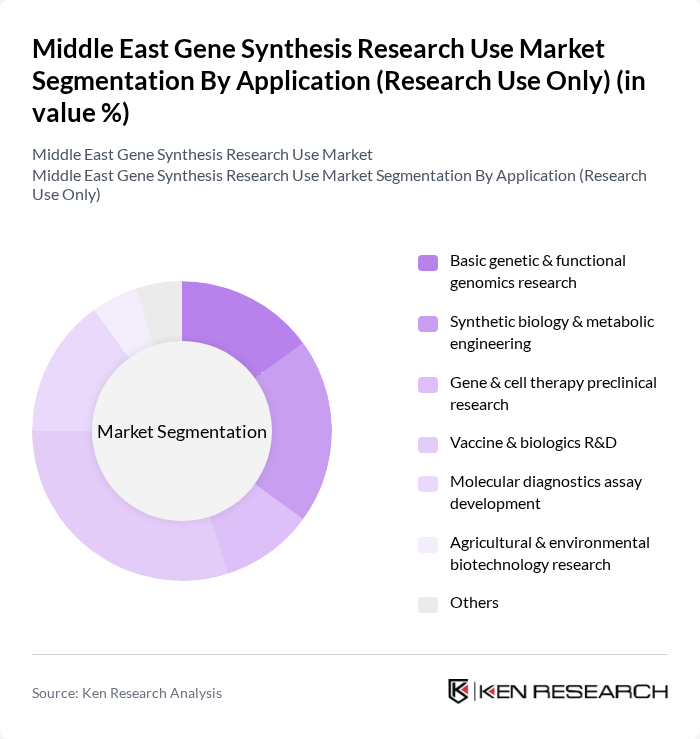
By Application (Research Use Only):The application segmentation focuses on the various research areas utilizing gene synthesis technologies. The subsegments include Basic genetic & functional genomics research, Synthetic biology & metabolic engineering, Gene & cell therapy preclinical research, Vaccine & biologics R&D, Molecular diagnostics assay development, Agricultural & environmental biotechnology research, and Others. The vaccine & biologics R&D subsegment is currently the most significant due to the increasing global focus on vaccine development and the need for rapid responses to emerging health threats.
Middle East Gene Synthesis Research Use Market Competitive Landscape
The Middle East Gene Synthesis Research Use Market is characterized by a dynamic mix of regional and international players. Leading participants such as Thermo Fisher Scientific Inc., Integrated DNA Technologies Inc. (IDT), GenScript Biotech Corporation, Eurofins Genomics, Twist Bioscience Corporation, Codex DNA Inc. (Telesis Bio), Bio-Synthesis Inc., Bioneer Corporation, ATUM, LGC Biosearch Technologies (LGC Group), Agilent Technologies Inc., ProteoGenix, Quintara Biosciences, DNA Script, Regional players and local gene synthesis service providers contribute to innovation, geographic expansion, and service delivery in this space.
Middle East Gene Synthesis Research Use Market Industry Analysis
Growth Drivers
- Increasing Demand for Synthetic Biology Applications:The Middle East is witnessing a surge in synthetic biology applications, driven by a growing need for innovative solutions in healthcare and agriculture. In future, the biotechnology sector in the region is projected to reach $10 billion, with synthetic biology contributing significantly. This demand is fueled by advancements in genomics and the need for sustainable agricultural practices, as the region faces food security challenges due to climate change and population growth.
- Advancements in Gene Editing Technologies:The rapid evolution of gene editing technologies, particularly CRISPR, is a key growth driver in the Middle East. In future, investments in gene editing research are expected to exceed $1.5 billion, reflecting a robust interest from both public and private sectors. These advancements enable precise modifications in genetic material, enhancing research capabilities and fostering innovation in therapeutic development, which is crucial for addressing regional health issues.
- Rising Investment in Biotechnology Research:The Middle East is experiencing a notable increase in biotechnology research funding, with government and private investments projected to reach $2 billion in future. This influx of capital is aimed at fostering innovation and supporting research initiatives in gene synthesis and related fields. Countries like the UAE and Saudi Arabia are leading this trend, establishing research hubs that attract global talent and partnerships, thereby enhancing the region's scientific capabilities.
Market Challenges
- High Costs Associated with Gene Synthesis:One of the significant challenges facing the Middle East gene synthesis market is the high cost of gene synthesis technologies, which can exceed $500,000 for advanced projects. This financial barrier limits access for smaller research institutions and startups, hindering innovation. As a result, many potential projects remain underfunded, stalling advancements in synthetic biology applications that could benefit the region's healthcare and agricultural sectors.
- Regulatory Hurdles in Genetic Research:The regulatory landscape for genetic research in the Middle East presents substantial challenges, with compliance costs estimated at $200,000 per project. Stringent regulations can delay research timelines and increase operational costs, discouraging investment in gene synthesis initiatives. Furthermore, the lack of harmonized regulations across countries complicates cross-border collaborations, limiting the potential for regional scientific advancements and innovation in biotechnology.
Middle East Gene Synthesis Research Use Market Future Outlook
The future of the Middle East gene synthesis market appears promising, driven by ongoing advancements in biotechnology and increasing collaboration among research institutions. As countries in the region prioritize healthcare innovation and sustainable agriculture, the demand for gene synthesis technologies is expected to rise. Additionally, the integration of artificial intelligence in genetic research is likely to enhance efficiency and accuracy, paving the way for breakthroughs in personalized medicine and therapeutic development, ultimately transforming the regional landscape.
Market Opportunities
- Expansion of Research Institutions in the Region:The establishment of new research institutions in the Middle East presents significant opportunities for gene synthesis advancements. With over 50 new biotech research centers projected to open in future, collaboration and innovation will flourish, enhancing the region's capacity for groundbreaking research and development in synthetic biology.
- Collaborations with International Biotech Firms:Partnerships with global biotech firms are becoming increasingly common in the Middle East, providing access to advanced technologies and expertise. In future, collaborations are expected to increase by 30%, facilitating knowledge transfer and accelerating the development of gene synthesis applications, which can significantly impact local healthcare and agricultural sectors.
Scope of the Report
| Segment | Sub-Segments |
|---|---|
| By Service Type | Gene fragment synthesis (up to 1 kb) Full-length gene synthesis Cloning & vector construction Oligonucleotide / primer synthesis Synthetic libraries (variant / mutagenesis libraries) Others |
| By Application (Research Use Only) | Basic genetic & functional genomics research Synthetic biology & metabolic engineering Gene & cell therapy preclinical research Vaccine & biologics R&D Molecular diagnostics assay development Agricultural & environmental biotechnology research Others |
| By Technology | Solid?phase DNA synthesis PCR?based enzyme synthesis Chip?based / array synthesis Enzymatic DNA synthesis platforms Others |
| By End-User | Academic & research institutes Government & non-profit research centers Pharmaceutical & biopharmaceutical companies Biotechnology companies & startups Contract research organizations (CROs) Clinical & reference laboratories (research units) Others |
| By Country | Saudi Arabia United Arab Emirates Qatar Kuwait Oman Rest of GCC Egypt Rest of Middle East |
| By Funding Source | Government grants & national genomics programs University & institutional research budgets Pharmaceutical & biotech R&D budgets Venture capital & private equity Philanthropic & non-profit funding Others |
Key Target Audience
Investors and Venture Capitalist Firms
Government and Regulatory Bodies (e.g., Ministry of Health, Ministry of Environment, National Biotechnology Authority)
Biotechnology and Pharmaceutical Companies
Contract Research Organizations (CROs)
Biomanufacturers
Healthcare Providers and Laboratories
Biotechnology Industry Associations
Funding Agencies and Grant Providers
Players Mentioned in the Report:
Thermo Fisher Scientific Inc.
Integrated DNA Technologies Inc. (IDT)
GenScript Biotech Corporation
Eurofins Genomics
Twist Bioscience Corporation
Codex DNA Inc. (Telesis Bio)
Bio-Synthesis Inc.
Bioneer Corporation
ATUM
LGC Biosearch Technologies (LGC Group)
Agilent Technologies Inc.
ProteoGenix
Quintara Biosciences
DNA Script
Regional players and local gene synthesis service providers
Table of Contents
Market Assessment Phase
1. Executive Summary and Approach
2. Middle East Gene Synthesis Research Use Market Overview
2.1 Key Insights and Strategic Recommendations
2.2 Middle East Gene Synthesis Research Use Market Overview
2.3 Definition and Scope
2.4 Evolution of Market Ecosystem
2.5 Timeline of Key Regulatory Milestones
2.6 Value Chain & Stakeholder Mapping
2.7 Business Cycle Analysis
2.8 Policy & Incentive Landscape
3. Middle East Gene Synthesis Research Use Market Analysis
3.1 Growth Drivers
3.1.1 Increasing demand for synthetic biology applications
3.1.2 Advancements in gene editing technologies
3.1.3 Rising investment in biotechnology research
3.1.4 Growing focus on personalized medicine
3.2 Market Challenges
3.2.1 High costs associated with gene synthesis
3.2.2 Regulatory hurdles in genetic research
3.2.3 Limited access to advanced technologies
3.2.4 Ethical concerns surrounding genetic modifications
3.3 Market Opportunities
3.3.1 Expansion of research institutions in the region
3.3.2 Collaborations with international biotech firms
3.3.3 Development of cost-effective synthesis methods
3.3.4 Increasing public and private funding for genomics
3.4 Market Trends
3.4.1 Rise of CRISPR technology in gene synthesis
3.4.2 Growth of synthetic biology startups
3.4.3 Integration of AI in genetic research
3.4.4 Focus on sustainable and ethical gene synthesis
3.5 Government Regulation
3.5.1 Guidelines for genetic research and applications
3.5.2 Compliance requirements for synthetic biology
3.5.3 Intellectual property laws related to gene synthesis
3.5.4 Funding incentives for biotech research
4. SWOT Analysis
5. Stakeholder Analysis
6. Porter's Five Forces Analysis
7. Middle East Gene Synthesis Research Use Market Market Size, 2019-2024
7.1 By Value
7.2 By Volume
7.3 By Average Selling Price
8. Middle East Gene Synthesis Research Use Market Segmentation
8.1 By Service Type
8.1.1 Gene fragment synthesis (up to 1 kb)
8.1.2 Full-length gene synthesis
8.1.3 Cloning & vector construction
8.1.4 Oligonucleotide / primer synthesis
8.1.5 Synthetic libraries (variant / mutagenesis libraries)
8.1.6 Others
8.2 By Application (Research Use Only)
8.2.1 Basic genetic & functional genomics research
8.2.2 Synthetic biology & metabolic engineering
8.2.3 Gene & cell therapy preclinical research
8.2.4 Vaccine & biologics R&D
8.2.5 Molecular diagnostics assay development
8.2.6 Agricultural & environmental biotechnology research
8.2.7 Others
8.3 By Technology
8.3.1 Solid?phase DNA synthesis
8.3.2 PCR?based enzyme synthesis
8.3.3 Chip?based / array synthesis
8.3.4 Enzymatic DNA synthesis platforms
8.3.5 Others
8.4 By End-User
8.4.1 Academic & research institutes
8.4.2 Government & non-profit research centers
8.4.3 Pharmaceutical & biopharmaceutical companies
8.4.4 Biotechnology companies & startups
8.4.5 Contract research organizations (CROs)
8.4.6 Clinical & reference laboratories (research units)
8.4.7 Others
8.5 By Country
8.5.1 Saudi Arabia
8.5.2 United Arab Emirates
8.5.3 Qatar
8.5.4 Kuwait
8.5.5 Oman
8.5.6 Rest of GCC
8.5.7 Egypt
8.5.8 Rest of Middle East
8.6 By Funding Source
8.6.1 Government grants & national genomics programs
8.6.2 University & institutional research budgets
8.6.3 Pharmaceutical & biotech R&D budgets
8.6.4 Venture capital & private equity
8.6.5 Philanthropic & non-profit funding
8.6.6 Others
9. Middle East Gene Synthesis Research Use Market Competitive Analysis
9.1 Market Share of Key Players
9.2 Cross Comparison of Key Players
9.2.1 Company name
9.2.2 Regional revenue (Middle East, USD million)
9.2.3 3-year revenue CAGR in gene synthesis (Middle East)
9.2.4 Share of revenue from research-use-only (RUO) customers
9.2.5 Number of active institutional accounts in the Middle East
9.2.6 Average order value per research customer
9.2.7 Average turnaround time for standard gene synthesis (days)
9.2.8 On-time delivery rate (%)
9.2.9 Gross margin (%) on gene synthesis services
9.2.10 Customer retention rate (%) – top 50 accounts
9.2.11 R&D spend as % of gene synthesis revenue
9.2.12 Local presence indicators (no. of local offices / labs)
9.3 SWOT Analysis of Top Players
9.4 Pricing Analysis
9.5 Detailed Profile of Major Companies
9.5.1 Thermo Fisher Scientific Inc.
9.5.2 Integrated DNA Technologies Inc. (IDT)
9.5.3 GenScript Biotech Corporation
9.5.4 Eurofins Genomics
9.5.5 Twist Bioscience Corporation
9.5.6 Codex DNA Inc. (Telesis Bio)
9.5.7 Bio-Synthesis Inc.
9.5.8 Bioneer Corporation
9.5.9 ATUM
9.5.10 LGC Biosearch Technologies (LGC Group)
9.5.11 Agilent Technologies Inc.
9.5.12 ProteoGenix
9.5.13 Quintara Biosciences
9.5.14 DNA Script
9.5.15 Regional players and local gene synthesis service providers
10. Middle East Gene Synthesis Research Use Market End-User Analysis
10.1 Procurement Behavior of Key Ministries
10.1.1 Budget Allocation Trends
10.1.2 Decision-Making Processes
10.1.3 Preferred Suppliers
10.1.4 Compliance Requirements
10.2 Corporate Spend on Infrastructure & Energy
10.2.1 Investment Priorities
10.2.2 Spending Patterns
10.2.3 Infrastructure Development Plans
10.2.4 Energy Efficiency Initiatives
10.3 Pain Point Analysis by End-User Category
10.3.1 Research Limitations
10.3.2 Budget Constraints
10.3.3 Technology Gaps
10.3.4 Regulatory Compliance Issues
10.4 User Readiness for Adoption
10.4.1 Training and Support Needs
10.4.2 Technology Acceptance Levels
10.4.3 Infrastructure Readiness
10.4.4 Investment Willingness
10.5 Post-Deployment ROI and Use Case Expansion
10.5.1 Performance Metrics
10.5.2 User Feedback Mechanisms
10.5.3 Scalability Potential
10.5.4 Future Investment Plans
11. Middle East Gene Synthesis Research Use Market Future Size, 2025-2030
11.1 By Value
11.2 By Volume
11.3 By Average Selling Price
Go-To-Market Strategy Phase
1. Whitespace Analysis + Business Model Canvas
1.1 Market Gaps Identification
1.2 Value Proposition Development
1.3 Revenue Streams Analysis
1.4 Cost Structure Evaluation
1.5 Key Partnerships Exploration
1.6 Customer Segmentation
1.7 Channels of Distribution
2. Marketing and Positioning Recommendations
2.1 Branding Strategies
2.2 Product USPs
2.3 Target Market Identification
2.4 Communication Strategies
2.5 Digital Marketing Approaches
2.6 Customer Engagement Tactics
2.7 Performance Metrics
3. Distribution Plan
3.1 Urban Retail Strategies
3.2 Rural NGO Tie-ups
3.3 E-commerce Opportunities
3.4 Direct Sales Approaches
3.5 Distribution Partnerships
3.6 Logistics and Supply Chain Management
3.7 Performance Tracking
4. Channel & Pricing Gaps
4.1 Underserved Routes
4.2 Pricing Bands Analysis
4.3 Competitor Pricing Strategies
4.4 Customer Price Sensitivity
4.5 Value-Based Pricing Models
4.6 Discounting Strategies
4.7 Pricing Optimization Techniques
5. Unmet Demand & Latent Needs
5.1 Category Gaps
5.2 Consumer Segments Analysis
5.3 Emerging Trends Identification
5.4 Product Development Opportunities
5.5 Market Entry Barriers
5.6 Customer Feedback Integration
5.7 Future Demand Projections
6. Customer Relationship
6.1 Loyalty Programs
6.2 After-sales Service
6.3 Customer Support Strategies
6.4 Feedback Mechanisms
6.5 Relationship Management Tools
6.6 Engagement Strategies
6.7 Performance Metrics
7. Value Proposition
7.1 Sustainability Initiatives
7.2 Integrated Supply Chains
7.3 Unique Selling Points
7.4 Customer-Centric Approaches
7.5 Competitive Advantages
7.6 Market Differentiation Strategies
7.7 Performance Metrics
8. Key Activities
8.1 Regulatory Compliance
8.2 Branding Initiatives
8.3 Distribution Setup
8.4 Marketing Campaigns
8.5 Training and Development
8.6 Performance Monitoring
8.7 Continuous Improvement Processes
9. Entry Strategy Evaluation
9.1 Domestic Market Entry Strategy
9.1.1 Product Mix
9.1.2 Pricing Band
9.1.3 Packaging
9.2 Export Entry Strategy
9.2.1 Target Countries
9.2.2 Compliance Roadmap
10. Entry Mode Assessment
10.1 Joint Ventures
10.2 Greenfield Investments
10.3 Mergers & Acquisitions
10.4 Distributor Model
11. Capital and Timeline Estimation
11.1 Capital Requirements
11.2 Timelines
12. Control vs Risk Trade-Off
12.1 Ownership vs Partnerships
13. Profitability Outlook
13.1 Breakeven Analysis
13.2 Long-term Sustainability
14. Potential Partner List
14.1 Distributors
14.2 Joint Ventures
14.3 Acquisition Targets
15. Execution Roadmap
15.1 Phased Plan for Market Entry
15.1.1 Market Setup
15.1.2 Market Entry
15.1.3 Growth Acceleration
15.1.4 Scale & Stabilize
15.2 Key Activities and Milestones
15.2.1 Activity Planning
15.2.2 Milestone Tracking
Research Methodology
Phase 1: Approach1
Desk Research
- Analysis of market reports from regional biotechnology associations and research institutions
- Review of published articles in scientific journals focusing on gene synthesis technologies
- Examination of government publications and white papers on biotechnology regulations in the Middle East
Primary Research
- Interviews with key opinion leaders in the gene synthesis field, including researchers and industry experts
- Surveys conducted with biotechnology firms and academic institutions involved in gene synthesis
- Field interviews with laboratory managers and procurement officers in relevant sectors
Validation & Triangulation
- Cross-validation of findings through multiple data sources, including academic and industry reports
- Triangulation of market insights from primary interviews with secondary data trends
- Sanity checks through expert panel discussions to ensure data reliability
Phase 2: Market Size Estimation1
Top-down Assessment
- Estimation of the overall biotechnology market size in the Middle East as a baseline
- Segmentation of the gene synthesis market by application areas such as pharmaceuticals, agriculture, and research
- Incorporation of growth rates from related sectors to project gene synthesis market potential
Bottom-up Modeling
- Collection of data on gene synthesis service pricing from leading providers in the region
- Estimation of market volume based on the number of projects and demand from research institutions
- Calculation of revenue projections based on service uptake and pricing strategies
Forecasting & Scenario Analysis
- Development of forecasting models using historical growth data and market trends
- Scenario analysis based on potential regulatory changes and technological advancements
- Creation of multiple market outlooks (baseline, optimistic, and pessimistic) through 2030
Phase 3: CATI Sample Composition1
| Scope Item/Segment | Sample Size | Target Respondent Profiles |
|---|---|---|
| Pharmaceutical Applications | 110 | R&D Managers, Regulatory Affairs Specialists |
| Agricultural Biotechnology | 80 | Biotech Researchers, Crop Scientists |
| Academic Research Institutions | 70 | University Professors, Lab Directors |
| Clinical Research Organizations | 60 | Clinical Project Managers, Biostatisticians |
| Industrial Biotechnology | 90 | Production Managers, Quality Control Analysts |
Frequently Asked Questions
What is the current value of the Middle East Gene Synthesis Research Use Market?
The Middle East Gene Synthesis Research Use Market is valued at approximately USD 40 million, based on a five-year historical analysis and regional revenue estimates for DNA and gene synthesis in the Middle East and Africa.
What factors are driving growth in the Middle East Gene Synthesis Market?
Which countries are leading in gene synthesis research in the Middle East?
What are the key applications of gene synthesis in the Middle East?
Other Regional/Country Reports
Other Adjacent Reports
Kuwait Vaccine Development Market
Qatar Cell Therapy Market Report Size Share Growth Drivers Trends Opportunities & Forecast 2025–2030Kuwait Agricultural Biotechnology Market Size, Share, Growth Drivers, Trends, Opportunities & Forecast 2025–2030Why Buy From Us?

What makes us stand out is that our consultants follow Robust, Refine and Result (RRR) methodology. Robust for clear definitions, approaches and sanity checking, Refine for differentiating respondents' facts and opinions, and Result for presenting data with story.

We have set a benchmark in the industry by offering our clients with syndicated and customized market research reports featuring coverage of entire market as well as meticulous research and analyst insights.

While we don't replace traditional research, we flip the method upside down. Our dual approach of Top Bottom & Bottom Top ensures quality deliverable by not just verifying company fundamentals but also looking at the sector and macroeconomic factors.

With one step in the future, our research team constantly tries to show you the bigger picture. We help with some of the tough questions you may encounter along the way: How is the industry positioned? Best marketing channel? KPI's of competitors? By aligning every element, we help maximize success.

Our report gives you instant access to the answers and sources that other companies might choose to hide. We elaborate each steps of research methodology we have used and showcase you the sample size to earn your trust.

If you need any support, we are here! We pride ourselves on universe strength, data quality, and quick, friendly, and professional service.