About the Report
Base Year 2024Middle East Hangover Cure Products Market Overview
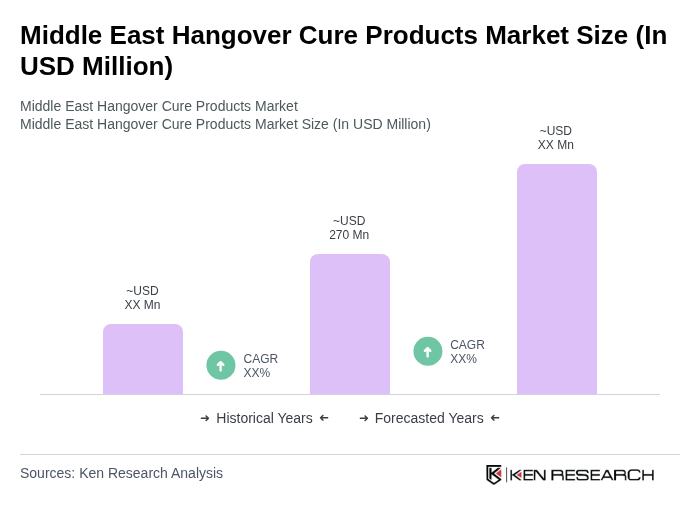
- The Middle East Hangover Cure Products Market is valued at USD 270 million, based on a five-year historical analysis of the regional hangover cure products industry within the broader Middle East and Africa market. This growth is primarily driven by the increasing consumption of alcoholic beverages among certain resident and expatriate populations, particularly in licensed social venues and tourism-led settings, alongside a rising awareness of health, wellness, and productivity among consumers seeking effective post-alcohol recovery solutions.
- Key contributing markets in this region include the UAE, Saudi Arabia, and Qatar, supported by growing tourism, premium hospitality, and licensed on-trade outlets such as hotels, bars, and private clubs, which underpin demand for recovery and rehydration products associated with alcohol consumption. The combination of high disposable income among segments of the population, expanding tourism flows, and a gradual shift toward Western-style socializing patterns in designated venues further contributes to market expansion for hangover cure and rehydration solutions.
- In the UAE, hangover cure products are governed under the wider frameworks for dietary supplements, traditional medicines, and functional foods, which include requirements for product registration, safety assessment, and labeling overseen by the Ministry of Health and Prevention and relevant emirate-level authorities. The “Registration of a Health Product as a Supplement” service issued by the Ministry of Health and Prevention sets conditions on ingredients, quality, and mandatory labeling for such products, including health claims and usage instructions, thereby ensuring consumer protection and alignment with national health standards.
Middle East Hangover Cure Products Market Segmentation
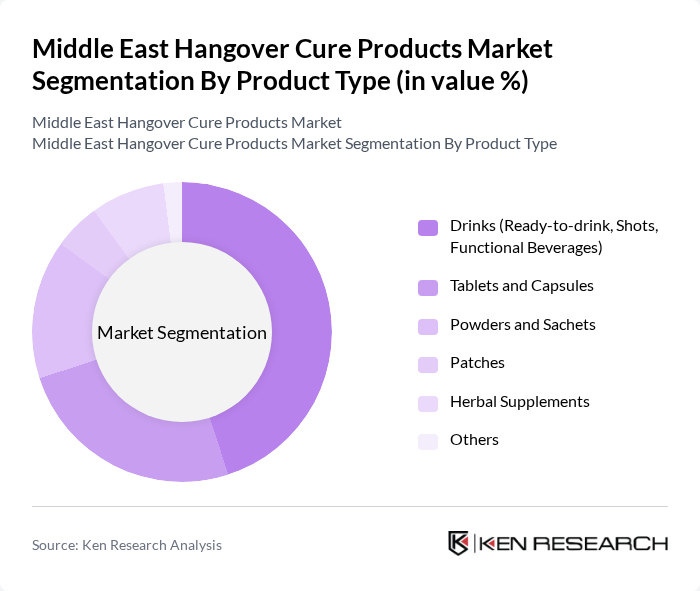
By Product Type:The product type segmentation includes various forms of hangover cure products such as drinks, tablets, powders, patches, herbal supplements, and others. These products broadly overlap with hangover remedies and rehydration or recovery formulations identified in global and regional market studies. Among these, drinks, particularly ready-to-drink and functional beverages that combine electrolytes, vitamins, amino acids, and herbal extracts, are increasingly adopted due to their convenience, palatability, and perceived rapid onset of relief after alcohol consumption. The trend towards health-conscious choices has also led to a rise in demand for herbal and plant-based supplements that incorporate ingredients such as milk thistle, kudzu root, green tea, and vitamins, which are perceived as more natural alternatives for liver support and detoxification. Tablets and capsules remain popular for their portability, precise dosing, and ease of inclusion in travel and nightlife routines, while powders and sachets cater to consumers looking for customizable solutions that can be mixed with water or other beverages. Patches are emerging as a novel option in some markets, appealing to those seeking non-ingestible, transdermal methods of recovery, although their presence in the Middle East is still in early stages compared with oral formats.
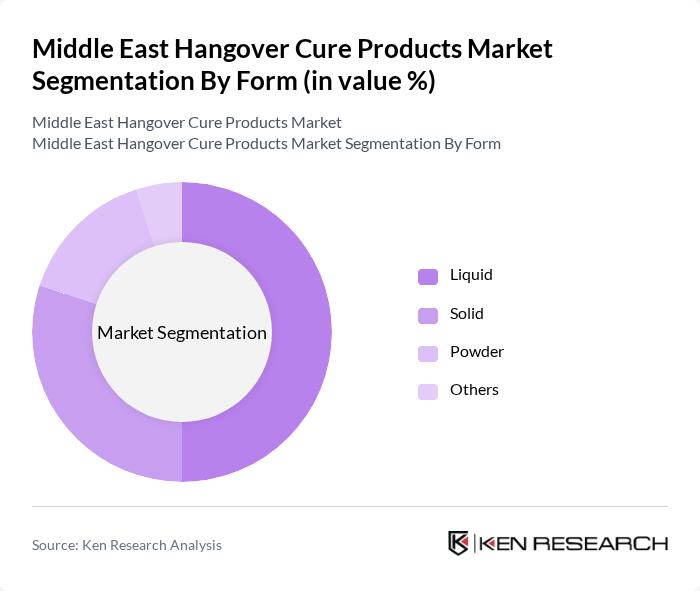
By Form:The market is segmented by form into liquid, solid, powder, and others. Liquid forms, particularly drinks and oral solutions, dominate many global and regional hangover cure and rehydration markets due to their ease of consumption, faster absorption, and ability to combine hydration with functional ingredients such as electrolytes, B-vitamins, and herbal extracts. Solid forms, including tablets and capsules, are also popular for their convenience, portability, and longer shelf life, making them suitable for travel retail, pharmacy channels, and online purchase. Powdered forms are gaining traction as they allow for customizable dosages, easy storage, and mixing with water or sports drinks, aligning with broader trends in sports nutrition and electrolyte powders. Other forms, such as patches and innovative delivery systems, are emerging but currently hold a smaller share, with adoption still concentrated in niche consumer segments experimenting with alternative formats.
Middle East Hangover Cure Products Market Competitive Landscape
The Middle East Hangover Cure Products Market is characterized by a dynamic mix of regional and international players. Leading participants such as ZBiotics Company, DrinkAde, Cheers Health, Inc., Flyby, AfterDrink Ltd., Himalaya Wellness (PartySmart), Hangover Heaven LLC, The Hangover Club, Hydralyte LLC, NoMo Nausea, Reviv Global, DOTSHOT (Herbal Beverages Pvt. Ltd.), Al Haramain Pharmacy, Dr. M. M. Al-Mansour Pharmacy, and other regional players contribute to innovation, geographic expansion, and service delivery in this space.
Middle East Hangover Cure Products Market Industry Analysis
Growth Drivers
- Increasing Awareness of Health and Wellness:The Middle East has seen a significant rise in health consciousness, with the World Health Organization reporting a 5–8% increase in health-related spending as a percentage of GDP. This trend is driving consumers to seek products that promote recovery and well-being, including hangover cures. The region's health and wellness market is projected to reach $30 billion in future, indicating a robust demand for effective hangover solutions that align with this growing awareness.
- Rise in Social Drinking Culture:The social drinking culture in the Middle East is evolving, particularly among younger demographics. According to a recent report by the International Wine and Spirit Research, alcohol consumption in the region increased by 10% in future. This shift is leading to a higher demand for hangover remedies, as consumers seek effective solutions to mitigate the effects of increased alcohol consumption during social gatherings and events.
- Growth of the Tourism Industry:The Middle East's tourism sector is booming, with the World Travel & Tourism Council estimating a 25% increase in international tourist arrivals in future compared to previous years. This influx of tourists, particularly in countries like the UAE and Saudi Arabia, is driving demand for hangover cure products. Tourists often seek convenient solutions to enjoy nightlife without the aftereffects, creating a lucrative market for innovative hangover remedies tailored to this demographic.
Market Challenges
- Regulatory Hurdles:The hangover cure products market in the Middle East faces significant regulatory challenges. Many countries in the region have strict regulations regarding the sale and marketing of health-related products. For instance, the UAE's Ministry of Health and Prevention has stringent guidelines that require extensive testing and approval processes, which can delay product launches and increase costs for manufacturers, limiting market entry for new players.
- Competition from Traditional Remedies:Traditional remedies for hangovers, such as herbal teas and homeopathic solutions, remain popular in the Middle East. A survey conducted recently indicated that 60% of consumers still prefer these time-honored methods over modern hangover cures. This entrenched preference poses a challenge for new entrants, as they must not only educate consumers about their products but also compete against established cultural practices that prioritize traditional solutions.
Middle East Hangover Cure Products Market Future Outlook
The future of the Middle East hangover cure products market appears promising, driven by evolving consumer preferences and increasing health awareness. As the tourism sector continues to thrive, the demand for convenient and effective hangover solutions is expected to rise. Additionally, the integration of technology in product development, such as personalized formulations, will likely enhance consumer engagement and satisfaction, paving the way for innovative offerings that cater to diverse needs and preferences in the region.
Market Opportunities
- Expansion of E-commerce Platforms:The growth of e-commerce in the Middle East presents a significant opportunity for hangover cure products. With online retail sales projected to reach $30 billion in future, brands can leverage digital platforms to reach a broader audience, particularly younger consumers who prefer online shopping for convenience and accessibility.
- Development of Innovative Product Formulations:There is a growing demand for innovative hangover remedies that incorporate natural ingredients. A report from the Middle East Natural Products Association indicates that the market for natural health products is expected to grow by 20% in future. Companies that focus on developing unique formulations that emphasize organic and natural components can capture this expanding consumer base seeking healthier alternatives.
Scope of the Report
| Segment | Sub-Segments |
|---|---|
| By Product Type | Drinks (Ready-to-drink, Shots, Functional Beverages) Tablets and Capsules Powders and Sachets Patches Herbal Supplements Others |
| By Form | Liquid Solid Powder Others |
| By End-User | Individual Consumers Hospitality Sector (Hotels, Resorts, Bars, Nightclubs) Event Organizers Corporate Clients Others |
| By Distribution Channel | Online Retail Pharmacies Supermarkets and Hypermarkets Convenience Stores Others |
| By Ingredient Type | Herbal/Natural Ingredients Synthetic Ingredients Vitamins and Minerals Others |
| By Price Range | Premium Mid-Range Budget Others |
| By Consumer Demographics | Age Group (18-25, 26-35, 36-50, 51+) Gender Lifestyle Preferences Others |
| By Region | GCC Countries Levant Region North Africa Others |
Key Target Audience
Investors and Venture Capitalist Firms
Government and Regulatory Bodies (e.g., Ministry of Health, Food and Drug Administration)
Manufacturers and Producers
Distributors and Retailers
Hospitality Industry Stakeholders (e.g., Hotels, Bars, Restaurants)
Health and Wellness Organizations
Pharmaceutical Companies
Market Entry Consultants
Players Mentioned in the Report:
ZBiotics Company
DrinkAde
Cheers Health, Inc.
Flyby
AfterDrink Ltd.
Himalaya Wellness (PartySmart)
Hangover Heaven LLC
The Hangover Club
Hydralyte LLC
NoMo Nausea
Reviv Global
DOTSHOT (Herbal Beverages Pvt. Ltd.)
Al Haramain Pharmacy
Dr. M. M. Al-Mansour Pharmacy
Other Regional Players
Table of Contents
Market Assessment Phase
1. Executive Summary and Approach
2. Middle East Hangover Cure Products Market Overview
2.1 Key Insights and Strategic Recommendations
2.2 Middle East Hangover Cure Products Market Overview
2.3 Definition and Scope
2.4 Evolution of Market Ecosystem
2.5 Timeline of Key Regulatory Milestones
2.6 Value Chain & Stakeholder Mapping
2.7 Business Cycle Analysis
2.8 Policy & Incentive Landscape
3. Middle East Hangover Cure Products Market Analysis
3.1 Growth Drivers
3.1.1 Increasing awareness of health and wellness
3.1.2 Rise in social drinking culture
3.1.3 Growth of the tourism industry
3.1.4 Availability of diverse product offerings
3.2 Market Challenges
3.2.1 Regulatory hurdles
3.2.2 Competition from traditional remedies
3.2.3 Limited consumer awareness
3.2.4 Price sensitivity among consumers
3.3 Market Opportunities
3.3.1 Expansion of e-commerce platforms
3.3.2 Development of innovative product formulations
3.3.3 Collaborations with health and wellness influencers
3.3.4 Increasing demand for natural and organic products
3.4 Market Trends
3.4.1 Growth in ready-to-drink hangover solutions
3.4.2 Emergence of subscription-based services
3.4.3 Focus on sustainability in packaging
3.4.4 Rise of personalized health solutions
3.5 Government Regulation
3.5.1 Labeling and advertising regulations
3.5.2 Health and safety standards
3.5.3 Import/export regulations
3.5.4 Licensing requirements for manufacturers
4. SWOT Analysis
5. Stakeholder Analysis
6. Porter's Five Forces Analysis
7. Middle East Hangover Cure Products Market Size, 2019-2024
7.1 By Value
7.2 By Volume
7.3 By Average Selling Price
8. Middle East Hangover Cure Products Market Segmentation
8.1 By Product Type
8.1.1 Drinks (Ready-to-drink, Shots, Functional Beverages)
8.1.2 Tablets and Capsules
8.1.3 Powders and Sachets
8.1.4 Patches
8.1.5 Herbal Supplements
8.1.6 Others
8.2 By Form
8.2.1 Liquid
8.2.2 Solid
8.2.3 Powder
8.2.4 Others
8.3 By End-User
8.3.1 Individual Consumers
8.3.2 Hospitality Sector (Hotels, Resorts, Bars, Nightclubs)
8.3.3 Event Organizers
8.3.4 Corporate Clients
8.3.5 Others
8.4 By Distribution Channel
8.4.1 Online Retail
8.4.2 Pharmacies
8.4.3 Supermarkets and Hypermarkets
8.4.4 Convenience Stores
8.4.5 Others
8.5 By Ingredient Type
8.5.1 Herbal/Natural Ingredients
8.5.2 Synthetic Ingredients
8.5.3 Vitamins and Minerals
8.5.4 Others
8.6 By Price Range
8.6.1 Premium
8.6.2 Mid-Range
8.6.3 Budget
8.6.4 Others
8.7 By Consumer Demographics
8.7.1 Age Group (18-25, 26-35, 36-50, 51+)
8.7.2 Gender
8.7.3 Lifestyle Preferences
8.7.4 Others
8.8 By Region
8.8.1 GCC Countries
8.8.2 Levant Region
8.8.3 North Africa
8.8.4 Others
9. Middle East Hangover Cure Products Market Competitive Analysis
9.1 Market Share of Key Players
9.2 Cross Comparison of Key Players
9.2.1 Company Name
9.2.2 Group Size (Large, Medium, or Small as per industry convention)
9.2.3 Revenue (USD / Local Currency)
9.2.4 Revenue CAGR (3–5 Years)
9.2.5 EBITDA Margin
9.2.6 Market Share (%)
9.2.7 Market Penetration Rate (Middle East / GCC)
9.2.8 Average Selling Price Index
9.2.9 Product Portfolio Breadth (No. of SKUs / Formats)
9.2.10 R&D Intensity (% of Revenue)
9.2.11 Digital / E-commerce Sales Mix (% of Revenue)
9.2.12 Distribution Network Coverage (No. of Countries / Outlets)
9.2.13 Brand Awareness Score
9.2.14 Customer Satisfaction / NPS
9.3 SWOT Analysis of Top Players
9.4 Pricing Analysis
9.5 Detailed Profile of Major Companies
9.5.1 ZBiotics Company
9.5.2 DrinkAde
9.5.3 Cheers Health, Inc.
9.5.4 Flyby
9.5.5 AfterDrink Ltd.
9.5.6 Himalaya Wellness (PartySmart)
9.5.7 Hangover Heaven LLC
9.5.8 The Hangover Club
9.5.9 Hydralyte LLC
9.5.10 NoMo Nausea
9.5.11 Reviv Global
9.5.12 DOTSHOT (Herbal Beverages Pvt. Ltd.)
9.5.13 Al Haramain Pharmacy
9.5.14 Dr. M. M. Al-Mansour Pharmacy
9.5.15 Other Regional Players
10. Middle East Hangover Cure Products Market End-User Analysis
10.1 Procurement Behavior of Key Ministries
10.1.1 Budget Allocation for Health Products
10.1.2 Preference for Local vs. Imported Products
10.1.3 Evaluation Criteria for Product Selection
10.1.4 Frequency of Procurement
10.2 Corporate Spend on Infrastructure & Energy
10.2.1 Investment in Health and Wellness Programs
10.2.2 Budget for Employee Wellness Initiatives
10.2.3 Spending on Hangover Prevention Products
10.2.4 Partnerships with Health Product Suppliers
10.3 Pain Point Analysis by End-User Category
10.3.1 Lack of Awareness about Hangover Solutions
10.3.2 Accessibility of Products
10.3.3 Effectiveness of Available Products
10.3.4 Price Sensitivity
10.4 User Readiness for Adoption
10.4.1 Awareness of Hangover Products
10.4.2 Willingness to Try New Products
10.4.3 Feedback on Existing Products
10.4.4 Influence of Social Media on Adoption
10.5 Post-Deployment ROI and Use Case Expansion
10.5.1 Measurement of Effectiveness
10.5.2 Customer Feedback and Improvement
10.5.3 Expansion into New Markets
10.5.4 Long-term Customer Engagement Strategies
11. Middle East Hangover Cure Products Market Future Size, 2025-2030
11.1 By Value
11.2 By Volume
11.3 By Average Selling Price
Go-To-Market Strategy Phase
1. Whitespace Analysis + Business Model Canvas
1.1 Market Gaps Identification
1.2 Value Proposition Development
1.3 Revenue Streams Analysis
1.4 Customer Segmentation
1.5 Key Partnerships
1.6 Cost Structure Analysis
1.7 Channels of Distribution
2. Marketing and Positioning Recommendations
2.1 Branding Strategies
2.2 Product USPs
2.3 Target Audience Identification
2.4 Marketing Channels
2.5 Promotional Strategies
3. Distribution Plan
3.1 Urban Retail vs Rural NGO Tie-ups
3.2 Distribution Partnerships
3.3 Logistics and Supply Chain Management
3.4 Inventory Management Strategies
3.5 Distribution Channel Optimization
4. Channel & Pricing Gaps
4.1 Underserved Routes
4.2 Pricing Bands
4.3 Competitive Pricing Analysis
4.4 Price Sensitivity Assessment
4.5 Value-Based Pricing Strategies
5. Unmet Demand & Latent Needs
5.1 Category Gaps
5.2 Consumer Segments
5.3 Product Development Opportunities
5.4 Market Entry Strategies
5.5 Customer Feedback Mechanisms
6. Customer Relationship
6.1 Loyalty Programs
6.2 After-sales Service
6.3 Customer Engagement Strategies
6.4 Feedback and Improvement Processes
6.5 Community Building Initiatives
7. Value Proposition
7.1 Sustainability
7.2 Integrated Supply Chains
7.3 Customer-Centric Innovations
7.4 Competitive Differentiation
7.5 Long-term Value Creation
8. Key Activities
8.1 Regulatory Compliance
8.2 Branding
8.3 Distribution Setup
8.4 Marketing Execution
8.5 Performance Monitoring
9. Entry Strategy Evaluation
9.1 Domestic Market Entry Strategy
9.1.1 Product Mix
9.1.2 Pricing Band
9.1.3 Packaging
9.2 Export Entry Strategy
9.2.1 Target Countries
9.2.2 Compliance Roadmap
10. Entry Mode Assessment
10.1 JV
10.2 Greenfield
10.3 M&A
10.4 Distributor Model
11. Capital and Timeline Estimation
11.1 Capital Requirements
11.2 Timelines
12. Control vs Risk Trade-Off
12.1 Ownership vs Partnerships
13. Profitability Outlook
13.1 Breakeven Analysis
13.2 Long-term Sustainability
14. Potential Partner List
14.1 Distributors
14.2 JVs
14.3 Acquisition Targets
15. Execution Roadmap
15.1 Phased Plan for Market Entry
15.1.1 Market Setup
15.1.2 Market Entry
15.1.3 Growth Acceleration
15.1.4 Scale & Stabilize
15.2 Key Activities and Milestones
15.2.1 Activity Planning
15.2.2 Milestone Tracking
Research Methodology
Phase 1: Approach1
Desk Research
- Analysis of market reports from industry associations and trade publications focused on hangover cure products
- Review of consumer behavior studies and health trends related to alcohol consumption in the Middle East
- Examination of regulatory frameworks and health guidelines impacting the sale of hangover remedies
Primary Research
- Interviews with product developers and marketers from leading hangover cure brands
- Surveys targeting consumers who have purchased hangover remedies in the last year
- Focus groups with health professionals discussing the efficacy and safety of various hangover cure ingredients
Validation & Triangulation
- Cross-validation of findings through multiple consumer surveys and expert interviews
- Triangulation of data from sales figures, market trends, and consumer feedback
- Sanity checks conducted through expert panel reviews to ensure data reliability
Phase 2: Market Size Estimation1
Top-down Assessment
- Estimation of market size based on overall beverage consumption trends in the Middle East
- Segmentation of the market by product type, including pills, drinks, and natural remedies
- Incorporation of demographic data to assess potential market growth among different age groups
Bottom-up Modeling
- Collection of sales data from key retailers and online platforms selling hangover cure products
- Estimation of average price points and sales volumes for each product category
- Analysis of consumer purchasing patterns to project future demand based on historical data
Forecasting & Scenario Analysis
- Multi-factor regression analysis incorporating economic indicators and health trends
- Scenario modeling based on potential changes in alcohol consumption laws and health awareness campaigns
- Development of baseline, optimistic, and pessimistic market forecasts through 2030
Phase 3: CATI Sample Composition1
| Scope Item/Segment | Sample Size | Target Respondent Profiles |
|---|---|---|
| Consumer Preferences for Hangover Remedies | 150 | Regular consumers of alcoholic beverages, aged 21-45 |
| Retail Insights on Hangover Cure Sales | 100 | Store Managers, Category Buyers in health and wellness sectors |
| Health Professional Perspectives on Efficacy | 80 | Doctors, Nutritionists, and Pharmacists |
| Market Trends in Natural Remedies | 70 | Product Developers, Herbalists, and Alternative Medicine Practitioners |
| Impact of Marketing Strategies on Consumer Choices | 90 | Marketing Executives, Brand Managers in the beverage industry |
Frequently Asked Questions
What is the current value of the Middle East Hangover Cure Products Market?
The Middle East Hangover Cure Products Market is valued at approximately USD 270 million, reflecting a five-year historical analysis of the industry within the broader Middle East and Africa market.
What factors are driving the growth of the hangover cure products market in the Middle East?
Which countries are the primary markets for hangover cure products in the Middle East?
How are hangover cure products regulated in the UAE?
Other Regional/Country Reports
Indonesia Hangover Cure Products Market
Malaysia Hangover Cure Products Market
Other Adjacent Reports
Philippines Rehydration Solutions Market
Kuwait Nutraceuticals Market Size, Share & Forecast, By Product Type, Application & Distribution Channel, 2026–2032Germany Wellness Products Market
Mexico Over-the-Counter Remedies Market
Malaysia Electrolyte Supplements Market
Why Buy From Us?

What makes us stand out is that our consultants follow Robust, Refine and Result (RRR) methodology. Robust for clear definitions, approaches and sanity checking, Refine for differentiating respondents' facts and opinions, and Result for presenting data with story.

We have set a benchmark in the industry by offering our clients with syndicated and customized market research reports featuring coverage of entire market as well as meticulous research and analyst insights.

While we don't replace traditional research, we flip the method upside down. Our dual approach of Top Bottom & Bottom Top ensures quality deliverable by not just verifying company fundamentals but also looking at the sector and macroeconomic factors.

With one step in the future, our research team constantly tries to show you the bigger picture. We help with some of the tough questions you may encounter along the way: How is the industry positioned? Best marketing channel? KPI's of competitors? By aligning every element, we help maximize success.

Our report gives you instant access to the answers and sources that other companies might choose to hide. We elaborate each steps of research methodology we have used and showcase you the sample size to earn your trust.

If you need any support, we are here! We pride ourselves on universe strength, data quality, and quick, friendly, and professional service.