Ken Research Logo

Middle East lidar light detection and ranging market size, share, growth drivers, trends, opportunities & forecast 2025–2030

The Middle East LiDAR market, valued at USD 350 million, is growing due to urbanization, smart city initiatives, and tech integrations like AI for mapping and surveying.

Region:Middle East

Author(s):Dev

Product Code:KRAC8713

Pages:97

Published On:November 2025

About the Report

Base Year 2024

Middle East LiDAR (Light Detection and Ranging) Market Overview

  • The Middle East LiDAR market is valued at USD 350 million, based on a five-year historical analysis. This growth is primarily driven by the increasing demand for high-precision mapping and surveying technologies across sectors such as construction, transportation, and environmental monitoring. The rise in urbanization, infrastructure development, and the adoption of LiDAR for autonomous vehicles and smart city initiatives have further fueled market expansion. Integration of LiDAR with AI and machine learning, as well as the development of portable systems for challenging environments, are among the latest trends enhancing market potential.
  • Countries such as Saudi Arabia and the United Arab Emirates dominate the Middle East LiDAR market due to their significant investments in infrastructure projects and smart city initiatives. These nations are leveraging advanced technologies to improve urban planning and resource management, making them key players in the LiDAR landscape. The presence of major construction firms and robust government support for digital transformation and technological advancements further contribute to their market leadership.
  • In 2023, the UAE government issued the “Surveying and Mapping Regulations, 2023” under the Federal Authority for Land and Maritime Transport, mandating the use of advanced surveying technologies, including LiDAR, for all major construction and infrastructure projects. This regulation aims to enhance accuracy in land surveying and promote sustainable development practices. Compliance with these standards is required for project approval, ensuring improved efficiency and reduced environmental impacts for construction activities.
Middle East LiDAR (Light Detection and Ranging) Market Size

Middle East LiDAR (Light Detection and Ranging) Market Segmentation

By Type:The market is segmented into various types of LiDAR technologies, including Airborne LiDAR, Terrestrial LiDAR, Mobile LiDAR, UAV/Drone-based LiDAR, Bathymetric LiDAR, and Others. Among these, Airborne LiDAR is the most widely used due to its ability to cover large areas quickly and efficiently, making it ideal for topographic mapping and environmental studies. Terrestrial LiDAR is also significant, favored for its precision in capturing detailed ground-level data, especially in urban and construction settings.
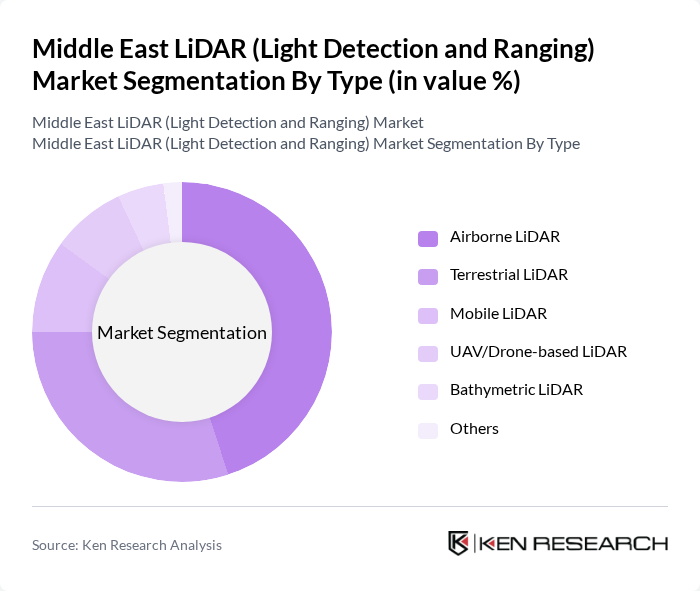
Middle East LiDAR (Light Detection and Ranging) Market segmentation by Type.

By End-User Industry:The LiDAR market is segmented by end-user industries, including Government & Municipalities, Construction & Engineering, Transportation & Infrastructure, Oil & Gas, Mining & Quarrying, Agriculture & Forestry, Defense & Security, and Others. The Construction & Engineering sector is the leading segment, driven by the increasing need for accurate site surveys and project planning. Government initiatives to enhance urban infrastructure and the adoption of digital mapping technologies also contribute significantly to demand from this sector.
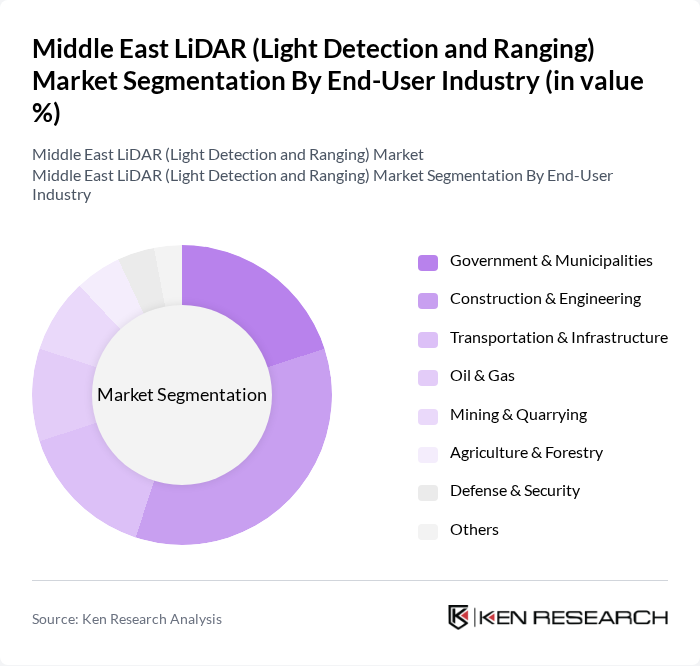
Middle East LiDAR (Light Detection and Ranging) Market segmentation by End-User Industry.

Middle East LiDAR (Light Detection and Ranging) Market Competitive Landscape

The Middle East LiDAR (Light Detection and Ranging) Market is characterized by a dynamic mix of regional and international players. Leading participants such as Leica Geosystems, RIEGL Laser Measurement Systems, Velodyne Lidar, Teledyne Optech, Quantum Spatial, GeoCue Group, Fugro, Woolpert, Aerial Services, Inc., 3D Laser Mapping, Topcon Positioning Systems, Hexagon AB, Esri, Hesai Technology, MENA 3D, GlobalScan Technologies, YellowScan, LightWare LiDAR, Trimble Inc. contribute to innovation, geographic expansion, and service delivery in this space.

Leica Geosystems

1921

Switzerland

RIEGL Laser Measurement Systems

1978

Austria

Velodyne Lidar

1983

USA

Teledyne Optech

1974

Canada

Quantum Spatial

2006

USA

Company

Establishment Year

Headquarters

Company Size (Large, Medium, Small)

Regional Market Share (%)

Revenue Growth Rate (CAGR, %)

Number of Major Regional Projects

Market Penetration Rate (Installations/Deployments in ME)

Product Portfolio Breadth (Hardware, Software, Services)

Middle East LiDAR (Light Detection and Ranging) Market Industry Analysis

Growth Drivers

  • Increasing Demand for Accurate Topographical Data:The Middle East is experiencing a surge in demand for precise topographical data, driven by urbanization and infrastructure development. In future, the region's construction sector is projected to reach $200 billion, necessitating accurate mapping for effective planning. This demand is further supported by the World Bank's report indicating that 60% of urban areas in the Middle East require updated geographical data to manage growth sustainably, enhancing the LiDAR market's potential.
  • Expansion of Infrastructure Projects:The Middle East is witnessing significant investments in infrastructure, with over $500 billion allocated for projects in future alone. This includes transportation networks, smart cities, and energy facilities, all of which require advanced surveying technologies. The UAE and Saudi Arabia are leading this trend, with initiatives like NEOM and the Dubai 2040 Urban Master Plan, which emphasize the need for LiDAR technology to ensure efficient project execution and management.
  • Advancements in LiDAR Technology:Technological innovations in LiDAR systems, such as increased accuracy and reduced costs, are propelling market growth. In future, the introduction of new LiDAR sensors with 10x higher resolution is expected to enhance data collection capabilities. According to industry reports, the cost of LiDAR systems has decreased by 30% over the past five years, making them more accessible for various applications, including environmental monitoring and urban planning in the Middle East.

Market Challenges

  • High Initial Investment Costs:The adoption of LiDAR technology is hindered by substantial initial investment costs, which can exceed $100,000 for advanced systems. This financial barrier limits access for smaller firms and public sector projects, particularly in developing regions of the Middle East. The International Monetary Fund (IMF) highlights that many countries in the region face budget constraints, making it challenging to allocate funds for such high-tech solutions, thereby slowing market penetration.
  • Limited Awareness and Expertise:A significant challenge in the Middle East LiDAR market is the lack of awareness and expertise among potential users. Many stakeholders, including government agencies and private firms, are not fully informed about the benefits of LiDAR technology. According to a recent industry survey, over 40% of companies reported insufficient knowledge about LiDAR applications, which hampers its adoption and limits the market's growth potential in the region.

Middle East LiDAR (Light Detection and Ranging) Market Future Outlook

The future of the Middle East LiDAR market appears promising, driven by technological advancements and increasing applications across various sectors. As urbanization accelerates, the demand for precise mapping and data collection will intensify, particularly in smart city initiatives. Furthermore, the integration of LiDAR with emerging technologies, such as artificial intelligence and machine learning, is expected to enhance data analysis capabilities, making LiDAR an indispensable tool for urban planners and environmentalists in the region.

Market Opportunities

  • Integration with UAV Technology:The integration of LiDAR with unmanned aerial vehicles (UAVs) presents a significant opportunity for the market. In future, the UAV market in the Middle East is projected to grow to $1.5 billion, facilitating cost-effective and efficient data collection for various applications, including agriculture and environmental monitoring, thereby expanding the reach of LiDAR technology.
  • Increased Government Funding for Smart City Projects:Governments in the Middle East are increasingly investing in smart city projects, with funding expected to exceed $50 billion by future. This investment will drive demand for advanced technologies like LiDAR, which are essential for urban planning, infrastructure development, and environmental management, creating a robust market opportunity for LiDAR providers.

Scope of the Report

SegmentSub-Segments
By Type

Airborne LiDAR

Terrestrial LiDAR

Mobile LiDAR

UAV/Drone-based LiDAR

Bathymetric LiDAR

Others

By End-User Industry

Government & Municipalities

Construction & Engineering

Transportation & Infrastructure

Oil & Gas

Mining & Quarrying

Agriculture & Forestry

Defense & Security

Others

By Application

Urban Planning & Smart Cities

Corridor Mapping (Roads, Rail, Powerlines)

Environmental Monitoring & Forestry

Disaster Management

Oil & Gas Exploration

Mining

Autonomous Vehicles & ADAS

Others

By Technology

Mechanical Scanning LiDAR

Solid-state LiDAR

Single Photon LiDAR

Geiger-mode LiDAR

Others

By Data Processing Method

Point Cloud Processing

D Modeling & Visualization

Data Fusion (LiDAR + Photogrammetry/Satellite)

Real-time Data Processing

Others

By Region

GCC Countries (Saudi Arabia, UAE, Qatar, Kuwait, Bahrain, Oman)

Levant Region (Jordan, Lebanon, etc.)

North Africa (Egypt, Morocco, Algeria, etc.)

Others

By Investment Source

Private Investments

Government Funding

International Aid

Others

Key Target Audience

Investors and Venture Capitalist Firms

Government and Regulatory Bodies (e.g., Ministry of Municipal and Rural Affairs, Ministry of Transport)

Manufacturers and Producers of LiDAR Equipment

Geospatial Data Service Providers

Infrastructure Development Agencies

Environmental and Conservation Organizations

Urban Planning Authorities

Telecommunications Companies

Players Mentioned in the Report:

Leica Geosystems

RIEGL Laser Measurement Systems

Velodyne Lidar

Teledyne Optech

Quantum Spatial

GeoCue Group

Fugro

Woolpert

Aerial Services, Inc.

3D Laser Mapping

Topcon Positioning Systems

Hexagon AB

Esri

Hesai Technology

MENA 3D

GlobalScan Technologies

YellowScan

LightWare LiDAR

Trimble Inc.

Table of Contents

Market Assessment Phase

1. Executive Summary and Approach


2. Middle East LiDAR (Light Detection and Ranging) Market Overview

2.1 Key Insights and Strategic Recommendations

2.2 Middle East LiDAR (Light Detection and Ranging) Market Overview

2.3 Definition and Scope

2.4 Evolution of Market Ecosystem

2.5 Timeline of Key Regulatory Milestones

2.6 Value Chain & Stakeholder Mapping

2.7 Business Cycle Analysis

2.8 Policy & Incentive Landscape


3. Middle East LiDAR (Light Detection and Ranging) Market Analysis

3.1 Growth Drivers

3.1.1 Increasing demand for accurate topographical data
3.1.2 Expansion of infrastructure projects
3.1.3 Advancements in LiDAR technology
3.1.4 Growing applications in environmental monitoring

3.2 Market Challenges

3.2.1 High initial investment costs
3.2.2 Limited awareness and expertise
3.2.3 Regulatory hurdles
3.2.4 Data privacy concerns

3.3 Market Opportunities

3.3.1 Integration with UAV technology
3.3.2 Expansion into emerging markets
3.3.3 Increased government funding for smart city projects
3.3.4 Development of new applications in agriculture

3.4 Market Trends

3.4.1 Adoption of real-time data processing
3.4.2 Growth in demand for 3D mapping
3.4.3 Rising interest in autonomous vehicles
3.4.4 Enhanced collaboration between industries

3.5 Government Regulation

3.5.1 Licensing requirements for aerial surveys
3.5.2 Environmental impact assessments
3.5.3 Data sharing regulations
3.5.4 Standards for LiDAR data accuracy

4. SWOT Analysis


5. Stakeholder Analysis


6. Porter's Five Forces Analysis


7. Middle East LiDAR (Light Detection and Ranging) Market Market Size, 2019-2024

7.1 By Value

7.2 By Volume

7.3 By Average Selling Price


8. Middle East LiDAR (Light Detection and Ranging) Market Segmentation

8.1 By Type

8.1.1 Airborne LiDAR
8.1.2 Terrestrial LiDAR
8.1.3 Mobile LiDAR
8.1.4 UAV/Drone-based LiDAR
8.1.5 Bathymetric LiDAR
8.1.6 Others

8.2 By End-User Industry

8.2.1 Government & Municipalities
8.2.2 Construction & Engineering
8.2.3 Transportation & Infrastructure
8.2.4 Oil & Gas
8.2.5 Mining & Quarrying
8.2.6 Agriculture & Forestry
8.2.7 Defense & Security
8.2.8 Others

8.3 By Application

8.3.1 Urban Planning & Smart Cities
8.3.2 Corridor Mapping (Roads, Rail, Powerlines)
8.3.3 Environmental Monitoring & Forestry
8.3.4 Disaster Management
8.3.5 Oil & Gas Exploration
8.3.6 Mining
8.3.7 Autonomous Vehicles & ADAS
8.3.8 Others

8.4 By Technology

8.4.1 Mechanical Scanning LiDAR
8.4.2 Solid-state LiDAR
8.4.3 Single Photon LiDAR
8.4.4 Geiger-mode LiDAR
8.4.5 Others

8.5 By Data Processing Method

8.5.1 Point Cloud Processing
8.5.2 3D Modeling & Visualization
8.5.3 Data Fusion (LiDAR + Photogrammetry/Satellite)
8.5.4 Real-time Data Processing
8.5.5 Others

8.6 By Region

8.6.1 GCC Countries (Saudi Arabia, UAE, Qatar, Kuwait, Bahrain, Oman)
8.6.2 Levant Region (Jordan, Lebanon, etc.)
8.6.3 North Africa (Egypt, Morocco, Algeria, etc.)
8.6.4 Others

8.7 By Investment Source

8.7.1 Private Investments
8.7.2 Government Funding
8.7.3 International Aid
8.7.4 Others

9. Middle East LiDAR (Light Detection and Ranging) Market Competitive Analysis

9.1 Market Share of Key Players

9.2 Cross Comparison of Key Players

9.2.1 Company Name
9.2.2 Company Size (Large, Medium, Small)
9.2.3 Regional Market Share (%)
9.2.4 Revenue Growth Rate (CAGR, %)
9.2.5 Number of Major Regional Projects
9.2.6 Market Penetration Rate (Installations/Deployments in ME)
9.2.7 Product Portfolio Breadth (Hardware, Software, Services)
9.2.8 R&D Investment as % of Revenue
9.2.9 Strategic Partnerships/Local Alliances
9.2.10 Customer Segments Served (Govt, Oil & Gas, Construction, etc.)
9.2.11 Average Deal Size (USD)
9.2.12 Customer Acquisition Cost (USD)
9.2.13 Return on Investment (ROI, %)
9.2.14 After-Sales Support Infrastructure (Regional Presence)
9.2.15 Technology Differentiation (e.g., AI/ML, Real-time Processing)

9.3 SWOT Analysis of Top Players

9.4 Pricing Analysis

9.5 Detailed Profile of Major Companies

9.5.1 Leica Geosystems
9.5.2 RIEGL Laser Measurement Systems
9.5.3 Velodyne Lidar
9.5.4 Teledyne Optech
9.5.5 Quantum Spatial
9.5.6 GeoCue Group
9.5.7 Fugro
9.5.8 Woolpert
9.5.9 Aerial Services, Inc.
9.5.10 3D Laser Mapping
9.5.11 Topcon Positioning Systems
9.5.12 Hexagon AB
9.5.13 Esri
9.5.14 Hesai Technology
9.5.15 MENA 3D
9.5.16 GlobalScan Technologies
9.5.17 YellowScan
9.5.18 LightWare LiDAR
9.5.19 Trimble Inc.

10. Middle East LiDAR (Light Detection and Ranging) Market End-User Analysis

10.1 Procurement Behavior of Key Ministries

10.1.1 Budget Allocation Trends
10.1.2 Decision-Making Processes
10.1.3 Preferred Suppliers
10.1.4 Contracting Practices

10.2 Corporate Spend on Infrastructure & Energy

10.2.1 Investment Priorities
10.2.2 Spending Patterns
10.2.3 Project Financing Sources
10.2.4 Future Spending Projections

10.3 Pain Point Analysis by End-User Category

10.3.1 Challenges in Data Acquisition
10.3.2 Integration Issues with Existing Systems
10.3.3 Cost Management Concerns
10.3.4 Regulatory Compliance Challenges

10.4 User Readiness for Adoption

10.4.1 Training and Skill Development Needs
10.4.2 Technology Acceptance Levels
10.4.3 Infrastructure Readiness
10.4.4 Support and Maintenance Requirements

10.5 Post-Deployment ROI and Use Case Expansion

10.5.1 Measurement of Success Metrics
10.5.2 Case Studies of Successful Implementations
10.5.3 Future Use Case Opportunities
10.5.4 Feedback Mechanisms for Improvement

11. Middle East LiDAR (Light Detection and Ranging) Market Future Size, 2025-2030

11.1 By Value

11.2 By Volume

11.3 By Average Selling Price


Go-To-Market Strategy Phase

1. Whitespace Analysis + Business Model Canvas

1.1 Market Gaps Identification

1.2 Value Proposition Development

1.3 Revenue Streams Analysis

1.4 Cost Structure Evaluation

1.5 Key Partnerships Exploration

1.6 Customer Segmentation

1.7 Channels of Distribution


2. Marketing and Positioning Recommendations

2.1 Branding Strategies

2.2 Product USPs

2.3 Target Market Identification

2.4 Communication Strategies

2.5 Digital Marketing Approaches

2.6 Event Marketing Plans

2.7 Customer Engagement Tactics


3. Distribution Plan

3.1 Urban Retail Strategies

3.2 Rural NGO Tie-ups

3.3 Online Distribution Channels

3.4 Direct Sales Approaches

3.5 Partnership with Local Distributors

3.6 Logistics and Supply Chain Management

3.7 Inventory Management Solutions


4. Channel & Pricing Gaps

4.1 Underserved Routes

4.2 Pricing Bands Analysis

4.3 Competitor Pricing Strategies

4.4 Customer Price Sensitivity

4.5 Discounting Strategies

4.6 Bundling Opportunities

4.7 Value-Based Pricing Models


5. Unmet Demand & Latent Needs

5.1 Category Gaps Identification

5.2 Consumer Segments Analysis

5.3 Emerging Trends Exploration

5.4 Customer Feedback Integration

5.5 Innovation Opportunities

5.6 Market Entry Barriers

5.7 Future Demand Projections


6. Customer Relationship

6.1 Loyalty Programs Development

6.2 After-sales Service Enhancements

6.3 Customer Feedback Mechanisms

6.4 Relationship Management Tools

6.5 Community Engagement Initiatives

6.6 Customer Education Programs

6.7 Personalization Strategies


7. Value Proposition

7.1 Sustainability Initiatives

7.2 Integrated Supply Chains

7.3 Competitive Advantage Analysis

7.4 Customer-Centric Innovations

7.5 Value-Added Services

7.6 Brand Positioning Strategies

7.7 Long-term Value Creation


8. Key Activities

8.1 Regulatory Compliance

8.2 Branding Initiatives

8.3 Distribution Setup

8.4 Market Research Activities

8.5 Training and Development Programs

8.6 Performance Monitoring Systems

8.7 Stakeholder Engagement Activities


9. Entry Strategy Evaluation

9.1 Domestic Market Entry Strategy

9.1.1 Product Mix Considerations
9.1.2 Pricing Band Analysis
9.1.3 Packaging Strategies

9.2 Export Entry Strategy

9.2.1 Target Countries Identification
9.2.2 Compliance Roadmap Development

10. Entry Mode Assessment

10.1 Joint Ventures

10.2 Greenfield Investments

10.3 Mergers & Acquisitions

10.4 Distributor Model Evaluation

10.5 Risk Assessment

10.6 Strategic Alliances

10.7 Market Adaptation Strategies


11. Capital and Timeline Estimation

11.1 Capital Requirements Analysis

11.2 Timelines for Market Entry

11.3 Financial Projections

11.4 Funding Sources Exploration

11.5 Cost-Benefit Analysis

11.6 Resource Allocation Plans

11.7 Milestone Tracking


12. Control vs Risk Trade-Off

12.1 Ownership vs Partnerships

12.2 Risk Mitigation Strategies

12.3 Control Mechanisms

12.4 Partnership Evaluation Criteria

12.5 Long-term Strategic Planning

12.6 Exit Strategies

12.7 Performance Metrics


13. Profitability Outlook

13.1 Break


Research Methodology

ApproachModellingSample

Phase 1: Approach1

Desk Research

  • Analysis of industry reports from regional and global market research firms
  • Review of government publications and policy documents related to LiDAR technology
  • Examination of academic journals and conference papers on LiDAR applications in the Middle East

Primary Research

  • Interviews with key stakeholders in the LiDAR market, including manufacturers and service providers
  • Surveys targeting end-users such as urban planners, environmental agencies, and construction firms
  • Field visits to projects utilizing LiDAR technology to gather firsthand insights

Validation & Triangulation

  • Cross-verification of data from multiple sources to ensure consistency and reliability
  • Engagement with industry experts for qualitative insights and validation of findings
  • Sanity checks through comparison with historical market trends and growth patterns

Phase 2: Market Size Estimation1

Top-down Assessment

  • Estimation of the overall market size based on regional economic indicators and technology adoption rates
  • Segmentation of the market by application areas such as surveying, mapping, and environmental monitoring
  • Incorporation of government initiatives promoting smart city projects and infrastructure development

Bottom-up Modeling

  • Collection of data on sales volumes from leading LiDAR equipment manufacturers in the region
  • Estimation of service revenues from LiDAR data processing and analysis firms
  • Calculation of market size based on unit sales and average selling prices of LiDAR systems

Forecasting & Scenario Analysis

  • Development of growth projections based on technological advancements and market trends
  • Scenario modeling considering factors such as regulatory changes and economic fluctuations
  • Creation of baseline, optimistic, and pessimistic forecasts through 2030

Phase 3: CATI Sample Composition1

Scope Item/SegmentSample SizeTarget Respondent Profiles
Urban Planning Applications60City Planners, Urban Development Officials
Environmental Monitoring50Environmental Scientists, Policy Makers
Construction and Infrastructure55Project Managers, Civil Engineers
Agricultural Applications40Agronomists, Farm Managers
Transportation and Logistics45Logistics Coordinators, Transportation Planners

Frequently Asked Questions

What is the current value of the Middle East LiDAR market?

The Middle East LiDAR market is valued at approximately USD 350 million, driven by the increasing demand for high-precision mapping and surveying technologies across various sectors, including construction, transportation, and environmental monitoring.

Which countries dominate the Middle East LiDAR market?

What are the key applications of LiDAR technology in the Middle East?

What are the main types of LiDAR technologies used in the Middle East?

Other Regional/Country Reports

Indonesia Lidar Light Detection and Ranging Market

Malaysia Lidar Light Detection and Ranging Market

KSA Lidar Light Detection and Ranging Market

APAC Lidar Light Detection and Ranging Market

SEA Lidar Light Detection and Ranging Market

Vietnam Lidar Light Detection and Ranging Market

Other Adjacent Reports

Egypt Geospatial Technology Market

Brazil Remote Sensing Market

KSA Autonomous Vehicle Technology Market

Saudi Arabia Smart City Infrastructure Market

KSA Construction Surveying Market

Brazil Oil and Gas Mapping Market

Bahrain Mining Surveying Market

South Africa Agriculture Monitoring Market

Bahrain Defense Surveillance Market

Vietnam Environmental Mapping Market

Why Buy From Us?

Refine Robust Result (RRR) Framework

What makes us stand out is that our consultants follow Robust, Refine and Result (RRR) methodology. Robust for clear definitions, approaches and sanity checking, Refine for differentiating respondents' facts and opinions, and Result for presenting data with story.

Our Reach Is Unmatched

We have set a benchmark in the industry by offering our clients with syndicated and customized market research reports featuring coverage of entire market as well as meticulous research and analyst insights.

Shifting the Research Paradigm

While we don't replace traditional research, we flip the method upside down. Our dual approach of Top Bottom & Bottom Top ensures quality deliverable by not just verifying company fundamentals but also looking at the sector and macroeconomic factors.

More Insights-Better Decisions

With one step in the future, our research team constantly tries to show you the bigger picture. We help with some of the tough questions you may encounter along the way: How is the industry positioned? Best marketing channel? KPI's of competitors? By aligning every element, we help maximize success.

Transparency and Trust

Our report gives you instant access to the answers and sources that other companies might choose to hide. We elaborate each steps of research methodology we have used and showcase you the sample size to earn your trust.

Round the Clock Support

If you need any support, we are here! We pride ourselves on universe strength, data quality, and quick, friendly, and professional service.

Why Clients Choose Us?

400000+
Reports in repository
150+
Consulting projects a year
100+
Analysts
8000+
Client Queries in 2022








