About the Report
Base Year 2024Middle East Offshore Lubricants Market Overview
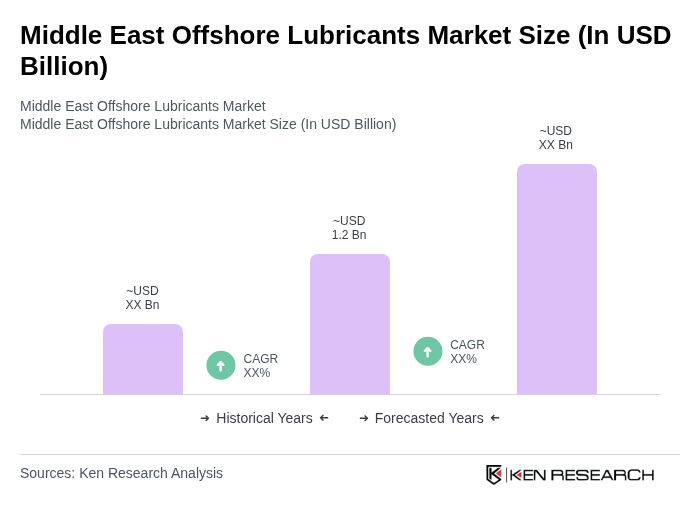
- The Middle East Offshore Lubricants Market is valued at USD 1.2 billion, based on a five-year historical analysis. This value is directionally consistent with the overall Middle East and Africa lubricants and marine lubricants market sizes, where regional lubricants are assessed in the low double?digit billion?USD range and offshore and marine applications account for a mid?single?digit share of total demand. This growth is primarily driven by increasing offshore oil and gas exploration and production activities in Saudi Arabia, the United Arab Emirates, and Qatar, as well as sustained offshore project pipelines across the Arabian Gulf. Rising demand for high-performance synthetic and specialty lubricants that can withstand high loads, salinity, and temperature variation, together with advancements in additive chemistry and Group II/III base oils, is improving equipment efficiency, drain intervals, and asset reliability in offshore environments.
- Key players in this market include Saudi Arabia, the United Arab Emirates, and Qatar. These countries dominate the regional lubricants demand due to their substantial offshore and onshore oil and gas reserves, large refining and petrochemical bases, and advanced infrastructure for drilling, production, and marine logistics. Saudi Arabia is identified as the largest lubricants-consuming market in the Middle East, while the UAE and Qatar leverage deepwater ports and specialized offshore service fleets to support exploration, production, and marine transport, benefitting from proximity to critical global shipping routes such as the Strait of Hormuz and the Red Sea corridors.
- In the UAE, environmental requirements for lubricants in offshore and marine applications are increasingly guided by international conventions and national implementation measures. A key instrument is the International Convention for the Prevention of Pollution from Ships (MARPOL) 73/78 and its Annex I, implemented in the UAE through Federal Law No. 24 of 1999 for the Protection and Development of the Environment and subsequent executive regulations, which require ship and offshore operators in UAE waters to prevent oil and chemical pollution and to use products that minimize discharges and ecological harm. While these rules do not explicitly prescribe a single lubricant formulation, they drive the adoption of environmentally acceptable lubricants (EALs) that meet vessel general permit and international eco-label criteria, encouraging offshore operators in the UAE to deploy low?toxicity, biodegradable products while maintaining operational efficiency.
Middle East Offshore Lubricants Market Segmentation
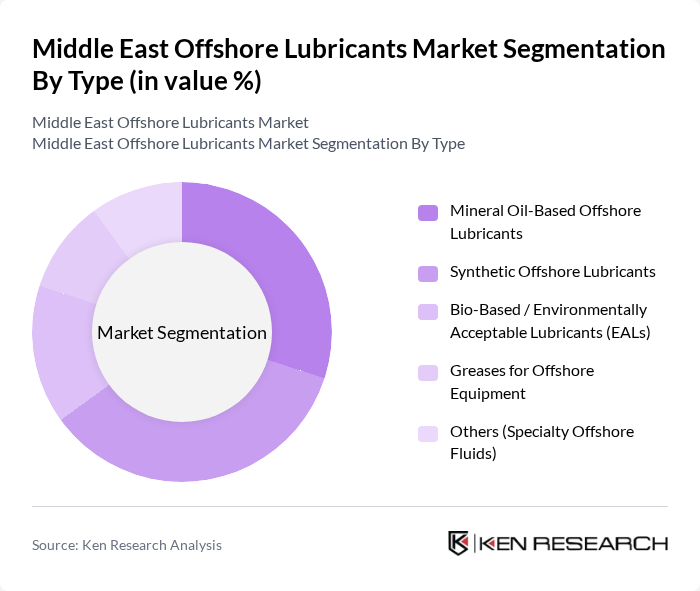
By Type:The market is segmented into various types of offshore lubricants, including mineral oil-based, synthetic, bio-based/environmentally acceptable lubricants (EALs), greases for offshore equipment, and specialty offshore fluids. This structure aligns with industry practice, where mineral and synthetic oils form the bulk of demand, while EALs and specialty fluids are gaining share in sensitive marine areas due to performance and environmental requirements. Each type serves specific applications and customer needs, with varying performance characteristics (oxidation stability, load-carrying capacity, water resistance) and environmental considerations such as biodegradability and toxicity.
By End-User Asset:The segmentation by end-user asset includes offshore drilling rigs (jack-ups and semi-submersibles), offshore production platforms (fixed and floating), FPSOs (floating production storage and offloading units), OSVs (offshore support vessels and supply vessels), and offshore wind and marine renewable assets. This breakdown reflects how offshore lubricants are specified in practice across drilling equipment, production topsides, subsea systems, propulsion and deck machinery on vessels, and rotating equipment used in offshore wind and other marine renewables. Each asset type has unique lubrication requirements based on operational conditions, load profiles, water ingress risk, and OEM specifications, driving demand for tailored formulations such as EP gear oils, hydraulic fluids, compressor oils, stern-tube lubricants, and corrosion-protective greases.

Middle East Offshore Lubricants Market Competitive Landscape
The Middle East Offshore Lubricants Market is characterized by a dynamic mix of regional and international players. Leading participants such as ExxonMobil Corporation, Shell plc, TotalEnergies SE, BP plc, Chevron Corporation, FUCHS SE, Castrol Limited, Gulf Oil International Ltd., Klüber Lubrication München SE & Co. KG, LUKOIL Marine Lubricants DMCC, ADNOC Distribution, Saudi Aramco (Luberef), PETROMIN Corporation, PETROLCOM Oil & Gas Services, ENOC Lubricants (Emirates National Oil Company) contribute to innovation, geographic expansion, and service delivery in this space.
Middle East Offshore Lubricants Market Industry Analysis
Growth Drivers
- Increasing Offshore Oil and Gas Exploration Activities:The Middle East is witnessing a surge in offshore oil and gas exploration, with investments reaching approximately $55 billion in future. Countries like Saudi Arabia and the UAE are expanding their offshore drilling capabilities, driven by the need to meet rising global energy demands. This increase in exploration activities directly correlates with the demand for specialized lubricants, which are essential for maintaining equipment efficiency and longevity in harsh marine environments.
- Rising Demand for High-Performance Lubricants:The demand for high-performance lubricants in the Middle East is projected to grow significantly, with an estimated market value of $1.3 billion by future. This growth is fueled by the need for lubricants that can withstand extreme temperatures and pressures encountered in offshore operations. As companies prioritize operational efficiency and equipment reliability, the shift towards advanced lubricant formulations becomes critical, driving innovation and investment in this sector.
- Technological Advancements in Lubricant Formulations:The Middle East offshore lubricants market is benefiting from technological advancements, with R&D spending expected to exceed $220 million in future. Innovations in synthetic and bio-based lubricants are enhancing performance and reducing environmental impact. These advancements not only improve equipment performance but also align with the region's commitment to sustainability, making high-tech lubricants increasingly attractive to operators in the offshore oil and gas sector.
Market Challenges
- Fluctuating Crude Oil Prices Affecting Demand:The volatility of crude oil prices poses a significant challenge for the offshore lubricants market in the Middle East. In future, crude oil prices are projected to fluctuate between $75 and $95 per barrel, impacting exploration budgets and, consequently, lubricant demand. Companies may delay or scale back projects in response to price instability, leading to reduced lubricant consumption and affecting overall market growth.
- High Competition from Local and International Players:The Middle East offshore lubricants market is characterized by intense competition, with over 55 key players vying for market share. This competitive landscape pressures pricing and innovation, making it challenging for new entrants to establish themselves. In future, the market is expected to see increased consolidation as companies seek to enhance their competitive edge through mergers and partnerships, further complicating the market dynamics.
Middle East Offshore Lubricants Market Future Outlook
The future of the Middle East offshore lubricants market appears promising, driven by ongoing investments in exploration and production activities. As companies increasingly adopt advanced lubricant technologies, the focus on sustainability will shape product development. Additionally, the integration of digital solutions for lubricant management is expected to enhance operational efficiency. These trends indicate a robust market environment, with opportunities for growth in both traditional and innovative lubricant solutions, catering to evolving industry needs.
Market Opportunities
- Expansion of Offshore Drilling Activities in New Regions:The exploration of untapped offshore reserves in regions like the Eastern Mediterranean is creating new opportunities for lubricant suppliers. With projected investments of $20 billion in future, this expansion will drive demand for specialized lubricants tailored to diverse environmental conditions, presenting a lucrative market for innovative products.
- Growing Adoption of Bio-Based Lubricants:The shift towards eco-friendly products is gaining momentum, with bio-based lubricants expected to capture 25% of the market by future. This trend is driven by stringent environmental regulations and increasing consumer awareness. Companies that invest in developing and marketing bio-based lubricants will likely benefit from enhanced brand loyalty and market differentiation.
Scope of the Report
| Segment | Sub-Segments |
|---|---|
| By Type | Mineral Oil-Based Offshore Lubricants Synthetic Offshore Lubricants Bio-Based / Environmentally Acceptable Lubricants (EALs) Greases for Offshore Equipment Others (Specialty Offshore Fluids) |
| By End-User Asset | Offshore Drilling Rigs (Jack-ups, Semi-submersibles) Offshore Production Platforms (Fixed & Floating) FPSOs (Floating Production Storage and Offloading Units) OSVs (Offshore Support Vessels & Supply Vessels) Offshore Wind & Marine Renewable Assets |
| By Offshore Application | Engine Oils for Main and Auxiliary Engines Hydraulic Fluids for Deck & Subsea Equipment Gear Oils for Winches, Gears & Thrusters Compressor & Turbine Oils Greases & Specialty Fluids (Thrusters, Wire Ropes, Subsea) |
| By Packaging Type | Bulk & IBC Container Supply (Barge / Truck) Drums Pails Cartridges & Small Packs Others |
| By Supply / Distribution Channel | Direct Supply to NOCs, IOCs & Drilling Contractors Marine & Offshore Distributors / Bunker Suppliers OEM / Service Company Alliances Online & E-Procurement Portals Retail & Other Channels |
| By Country / Sub-Region | Saudi Arabia United Arab Emirates Qatar Kuwait Oman & Bahrain Rest of Middle East & East Mediterranean (incl. Egypt, Israel, Cyprus) |
| By Customer Type | National Oil Companies (NOCs) International Oil Companies (IOCs) Drilling & Marine Contractors Offshore Service Companies & EPCs |
Key Target Audience
Investors and Venture Capitalist Firms
Government and Regulatory Bodies (e.g., Ministry of Energy, Environmental Protection Agency)
Manufacturers and Producers
Distributors and Retailers
Oil and Gas Exploration Companies
Marine and Shipping Companies
Industry Associations (e.g., Middle East Oil and Gas Association)
Financial Institutions
Players Mentioned in the Report:
ExxonMobil Corporation
Shell plc
TotalEnergies SE
BP plc
Chevron Corporation
FUCHS SE
Castrol Limited
Gulf Oil International Ltd.
Kluber Lubrication Munchen SE & Co. KG
LUKOIL Marine Lubricants DMCC
ADNOC Distribution
Saudi Aramco (Luberef)
PETROMIN Corporation
PETROLCOM Oil & Gas Services
ENOC Lubricants (Emirates National Oil Company)
Table of Contents
Market Assessment Phase
1. Executive Summary and Approach
2. Middle East Offshore Lubricants Market Overview
2.1 Key Insights and Strategic Recommendations
2.2 Middle East Offshore Lubricants Market Overview
2.3 Definition and Scope
2.4 Evolution of Market Ecosystem
2.5 Timeline of Key Regulatory Milestones
2.6 Value Chain & Stakeholder Mapping
2.7 Business Cycle Analysis
2.8 Policy & Incentive Landscape
3. Middle East Offshore Lubricants Market Analysis
3.1 Growth Drivers
3.1.1 Increasing offshore oil and gas exploration activities
3.1.2 Rising demand for high-performance lubricants
3.1.3 Technological advancements in lubricant formulations
3.1.4 Stringent environmental regulations promoting eco-friendly products
3.2 Market Challenges
3.2.1 Fluctuating crude oil prices affecting demand
3.2.2 High competition from local and international players
3.2.3 Supply chain disruptions due to geopolitical tensions
3.2.4 Limited awareness of advanced lubricant technologies
3.3 Market Opportunities
3.3.1 Expansion of offshore drilling activities in new regions
3.3.2 Growing adoption of bio-based lubricants
3.3.3 Increasing investments in renewable energy sectors
3.3.4 Development of customized lubricant solutions for specific applications
3.4 Market Trends
3.4.1 Shift towards synthetic lubricants
3.4.2 Rising focus on sustainability and eco-friendly products
3.4.3 Integration of IoT in lubricant monitoring and management
3.4.4 Increasing collaborations between lubricant manufacturers and oil companies
3.5 Government Regulation
3.5.1 Implementation of stricter environmental standards
3.5.2 Incentives for using biodegradable lubricants
3.5.3 Regulations on lubricant disposal and recycling
3.5.4 Compliance requirements for offshore operations
4. SWOT Analysis
5. Stakeholder Analysis
6. Porter's Five Forces Analysis
7. Middle East Offshore Lubricants Market Market Size, 2019-2024
7.1 By Value
7.2 By Volume
7.3 By Average Selling Price
8. Middle East Offshore Lubricants Market Segmentation
8.1 By Type
8.1.1 Mineral Oil-Based Offshore Lubricants
8.1.2 Synthetic Offshore Lubricants
8.1.3 Bio-Based / Environmentally Acceptable Lubricants (EALs)
8.1.4 Greases for Offshore Equipment
8.1.5 Others (Specialty Offshore Fluids)
8.2 By End-User Asset
8.2.1 Offshore Drilling Rigs (Jack-ups, Semi-submersibles)
8.2.2 Offshore Production Platforms (Fixed & Floating)
8.2.3 FPSOs (Floating Production Storage and Offloading Units)
8.2.4 OSVs (Offshore Support Vessels & Supply Vessels)
8.2.5 Offshore Wind & Marine Renewable Assets
8.3 By Offshore Application
8.3.1 Engine Oils for Main and Auxiliary Engines
8.3.2 Hydraulic Fluids for Deck & Subsea Equipment
8.3.3 Gear Oils for Winches, Gears & Thrusters
8.3.4 Compressor & Turbine Oils
8.3.5 Greases & Specialty Fluids (Thrusters, Wire Ropes, Subsea)
8.4 By Packaging Type
8.4.1 Bulk & IBC Container Supply (Barge / Truck)
8.4.2 Drums
8.4.3 Pails
8.4.4 Cartridges & Small Packs
8.4.5 Others
8.5 By Supply / Distribution Channel
8.5.1 Direct Supply to NOCs, IOCs & Drilling Contractors
8.5.2 Marine & Offshore Distributors / Bunker Suppliers
8.5.3 OEM / Service Company Alliances
8.5.4 Online & E-Procurement Portals
8.5.5 Retail & Other Channels
8.6 By Country / Sub-Region
8.6.1 Saudi Arabia
8.6.2 United Arab Emirates
8.6.3 Qatar
8.6.4 Kuwait
8.6.5 Oman & Bahrain
8.6.6 Rest of Middle East & East Mediterranean (incl. Egypt, Israel, Cyprus)
8.7 By Customer Type
8.7.1 National Oil Companies (NOCs)
8.7.2 International Oil Companies (IOCs)
8.7.3 Drilling & Marine Contractors
8.7.4 Offshore Service Companies & EPCs
9. Middle East Offshore Lubricants Market Competitive Analysis
9.1 Market Share of Key Players
9.2 Cross Comparison of Key Players
9.2.1 Company Name
9.2.2 Group Size (Global Major, Regional Player, Local/National)
9.2.3 Offshore Lubricants Revenue in the Middle East (USD Million)
9.2.4 Offshore Lubricants Revenue CAGR in the Region (%)
9.2.5 Share of Offshore Lubricants in Total Lubricants Portfolio (%)
9.2.6 Offshore Market Penetration (Number of Offshore Assets / Contracts Served)
9.2.7 Product Portfolio Breadth (Number of Offshore-Specific SKUs / EALs)
9.2.8 Average Delivered Price Level vs Market (Discount / Premium %)
9.2.9 Regional Blending & Supply Footprint (Number of Blending Plants / Marine Hubs)
9.2.10 Key NOC/IOC Relationships (Number of Long-Term Supply Agreements)
9.2.11 Service & Technical Support Depth (Number of Field Engineers / Labs in Region)
9.2.12 On-time Delivery Performance to Offshore Locations (%)
9.3 SWOT Analysis of Top Players
9.4 Pricing Analysis
9.5 Detailed Profile of Major Companies
9.5.1 ExxonMobil Corporation
9.5.2 Shell plc
9.5.3 TotalEnergies SE
9.5.4 BP plc
9.5.5 Chevron Corporation
9.5.6 FUCHS SE
9.5.7 Castrol Limited
9.5.8 Gulf Oil International Ltd.
9.5.9 Klüber Lubrication München SE & Co. KG
9.5.10 LUKOIL Marine Lubricants DMCC
9.5.11 ADNOC Distribution
9.5.12 Saudi Aramco (Luberef)
9.5.13 PETROMIN Corporation
9.5.14 PETROLCOM Oil & Gas Services
9.5.15 ENOC Lubricants (Emirates National Oil Company)
10. Middle East Offshore Lubricants Market End-User Analysis
10.1 Procurement Behavior of Key Ministries
10.1.1 Key Procurement Policies
10.1.2 Budget Allocation Trends
10.1.3 Supplier Selection Criteria
10.1.4 Contract Management Practices
10.2 Corporate Spend on Infrastructure & Energy
10.2.1 Investment Trends in Offshore Projects
10.2.2 Budgeting for Lubricants in Operations
10.2.3 Cost Management Strategies
10.2.4 Future Spending Projections
10.3 Pain Point Analysis by End-User Category
10.3.1 Operational Efficiency Challenges
10.3.2 Quality Assurance Issues
10.3.3 Supply Chain Disruptions
10.3.4 Regulatory Compliance Difficulties
10.4 User Readiness for Adoption
10.4.1 Awareness of Advanced Lubricants
10.4.2 Training and Support Needs
10.4.3 Adoption Barriers
10.4.4 Feedback Mechanisms
10.5 Post-Deployment ROI and Use Case Expansion
10.5.1 Measurement of ROI
10.5.2 Case Studies of Successful Implementations
10.5.3 Future Use Case Opportunities
10.5.4 Customer Feedback and Iteration
11. Middle East Offshore Lubricants Market Future Size, 2025-2030
11.1 By Value
11.2 By Volume
11.3 By Average Selling Price
Go-To-Market Strategy Phase
1. Whitespace Analysis + Business Model Canvas
1.1 Market Gaps Identification
1.2 Business Model Development
2. Marketing and Positioning Recommendations
2.1 Branding Strategies
2.2 Product USPs
3. Distribution Plan
3.1 Urban Retail Strategies
3.2 Rural NGO Tie-Ups
4. Channel & Pricing Gaps
4.1 Underserved Routes
4.2 Pricing Bands
5. Unmet Demand & Latent Needs
5.1 Category Gaps
5.2 Consumer Segments
6. Customer Relationship
6.1 Loyalty Programs
6.2 After-Sales Service
7. Value Proposition
7.1 Sustainability Initiatives
7.2 Integrated Supply Chains
8. Key Activities
8.1 Regulatory Compliance
8.2 Branding Efforts
8.3 Distribution Setup
9. Entry Strategy Evaluation
9.1 Domestic Market Entry Strategy
9.1.1 Product Mix Considerations
9.1.2 Pricing Band Strategy
9.1.3 Packaging Solutions
9.2 Export Entry Strategy
9.2.1 Target Countries
9.2.2 Compliance Roadmap
10. Entry Mode Assessment
10.1 Joint Ventures
10.2 Greenfield Investments
10.3 Mergers & Acquisitions
10.4 Distributor Model
11. Capital and Timeline Estimation
11.1 Capital Requirements
11.2 Timelines for Implementation
12. Control vs Risk Trade-Off
12.1 Ownership Considerations
12.2 Partnerships Evaluation
13. Profitability Outlook
13.1 Breakeven Analysis
13.2 Long-Term Sustainability Strategies
14. Potential Partner List
14.1 Distributors
14.2 Joint Ventures
14.3 Acquisition Targets
15. Execution Roadmap
15.1 Phased Plan for Market Entry
15.1.1 Market Setup
15.1.2 Market Entry
15.1.3 Growth Acceleration
15.1.4 Scale & Stabilize
15.2 Key Activities and Milestones
15.2.1 Milestone Planning
15.2.2 Activity Tracking
Research Methodology
Phase 1: Approach1
Desk Research
- Industry reports from the Middle East Lubricants Association and relevant trade bodies
- Market analysis from government publications and energy sector reports
- Academic journals and white papers focusing on offshore lubricants and marine applications
Primary Research
- Interviews with technical managers at offshore drilling companies
- Surveys with procurement specialists in marine lubricant supply chains
- Field interviews with engineers and product developers in lubricant manufacturing
Validation & Triangulation
- Cross-validation of data through multiple industry sources and expert opinions
- Triangulation of market size estimates using sales data and consumption patterns
- Sanity checks through feedback from industry panels and focus groups
Phase 2: Market Size Estimation1
Top-down Assessment
- Analysis of total oil and gas sector spending in the Middle East
- Segmentation of lubricant demand by offshore drilling and marine transportation
- Incorporation of regional economic growth forecasts and energy policies
Bottom-up Modeling
- Volume estimates based on production capacities of leading lubricant manufacturers
- Cost analysis derived from pricing structures of various lubricant grades
- Calculation of market size based on consumption rates in offshore operations
Forecasting & Scenario Analysis
- Multi-variable regression analysis incorporating oil price fluctuations and regulatory changes
- Scenario modeling based on technological advancements in lubricant formulations
- Development of baseline, optimistic, and pessimistic market forecasts through 2030
Phase 3: CATI Sample Composition1
| Scope Item/Segment | Sample Size | Target Respondent Profiles |
|---|---|---|
| Offshore Drilling Operations | 120 | Operations Managers, Technical Directors |
| Marine Transportation Sector | 90 | Fleet Managers, Procurement Officers |
| Lubricant Manufacturing Companies | 80 | Product Development Managers, Quality Control Engineers |
| Regulatory Bodies and Associations | 50 | Policy Makers, Industry Analysts |
| Research and Development Institutions | 60 | Research Scientists, Technical Consultants |
Frequently Asked Questions
What is the current value of the Middle East Offshore Lubricants Market?
The Middle East Offshore Lubricants Market is valued at approximately USD 1.2 billion, reflecting a consistent growth trend aligned with the broader lubricants market in the region, driven by increased offshore oil and gas exploration activities.
Which countries are the key players in the Middle East Offshore Lubricants Market?
What factors are driving the growth of the Middle East Offshore Lubricants Market?
What are the main types of offshore lubricants available in the market?
Other Regional/Country Reports
Indonesia Offshore Lubricants Market
Malaysia Offshore Lubricants Market
KSA Offshore Lubricants Market
APAC Offshore Lubricants Market
SEA Offshore Lubricants Market
Vietnam Offshore Lubricants Market
Other Adjacent Reports
Singapore Offshore Oil Exploration Market
Japan Marine Fuels Market
Germany Lubricant Additives Market
Oman Base Oils Market
Germany Synthetic Lubricants Market
Thailand Bio-based Lubricants Market
Kuwait Offshore Drilling Services Market
Kuwait Offshore Support Vessels Market
Philippines Subsea Equipment Market
Brazil Offshore Wind Energy Market
Why Buy From Us?

What makes us stand out is that our consultants follow Robust, Refine and Result (RRR) methodology. Robust for clear definitions, approaches and sanity checking, Refine for differentiating respondents' facts and opinions, and Result for presenting data with story.

We have set a benchmark in the industry by offering our clients with syndicated and customized market research reports featuring coverage of entire market as well as meticulous research and analyst insights.

While we don't replace traditional research, we flip the method upside down. Our dual approach of Top Bottom & Bottom Top ensures quality deliverable by not just verifying company fundamentals but also looking at the sector and macroeconomic factors.

With one step in the future, our research team constantly tries to show you the bigger picture. We help with some of the tough questions you may encounter along the way: How is the industry positioned? Best marketing channel? KPI's of competitors? By aligning every element, we help maximize success.

Our report gives you instant access to the answers and sources that other companies might choose to hide. We elaborate each steps of research methodology we have used and showcase you the sample size to earn your trust.

If you need any support, we are here! We pride ourselves on universe strength, data quality, and quick, friendly, and professional service.