About the Report
Base Year 2024Middle East Point Entry Water Treatment Systems Market Overview
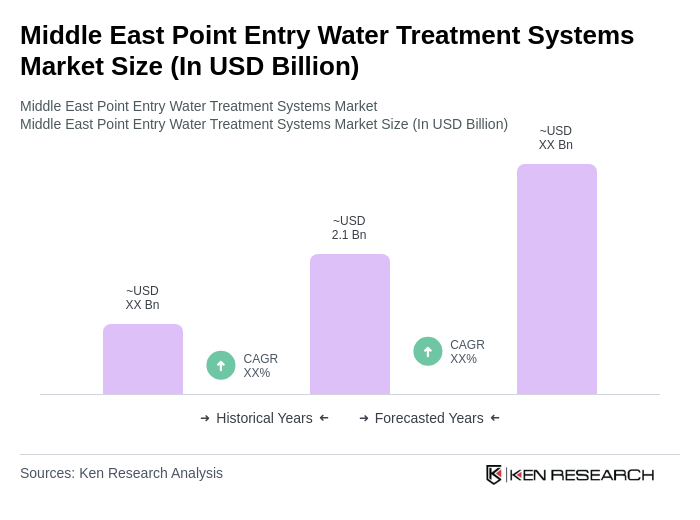
- The Middle East Point Entry Water Treatment Systems Market is valued at USD 2.1 billion, based on a five-year historical analysis. Growth is primarily driven by intensifying water scarcity due to arid climatic conditions, rapid urbanization, and the need for sustainable water management solutions. The rising demand for clean drinking water, increasing adoption of advanced treatment technologies, and government investments in water infrastructure are further propelling market expansion.
- Key players in this market includeSaudi Arabia, the United Arab Emirates, and Qatar, which dominate due to significant investments in infrastructure and water treatment facilities. These countries are facing acute water shortages, prompting governments to prioritize water treatment initiatives, desalination, and advanced purification technologies to ensure sustainable water supply.
- In 2023, the UAE government issued theUAE Cabinet Resolution No. 39 of 2023 on Water Efficiency in Buildings, mandating that all new residential and commercial developments incorporate advanced water treatment and reuse systems. This regulation aims to enhance water conservation, ensure treated water meets stringent quality standards, and promote reuse in irrigation and non-potable applications. The regulation is enforced by the Ministry of Energy and Infrastructure and sets minimum efficiency thresholds, compliance certification, and periodic monitoring for all new construction projects.
Middle East Point Entry Water Treatment Systems Market Segmentation
By Type:
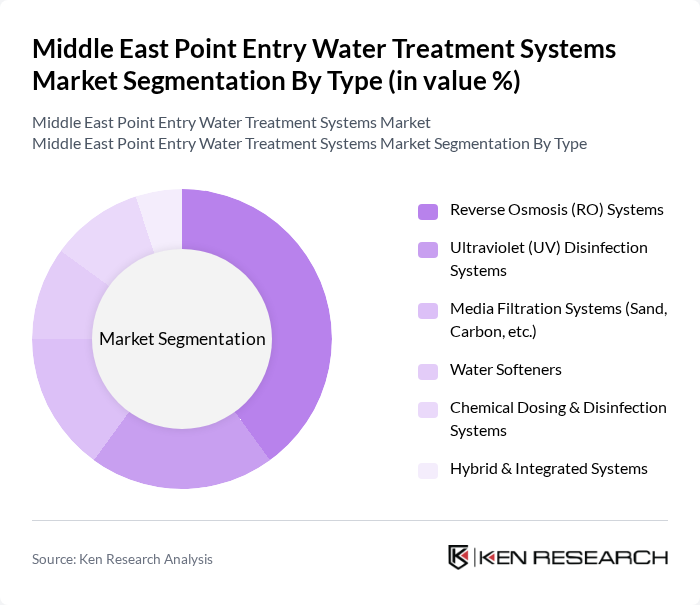
The market is segmented into various types, includingReverse Osmosis (RO) Systems, Ultraviolet (UV) Disinfection Systems, Media Filtration Systems, Water Softeners, Chemical Dosing & Disinfection Systems, and Hybrid & Integrated Systems. Among these,Reverse Osmosis (RO) Systemshold a leading share due to their high effectiveness in removing a broad spectrum of contaminants and delivering high-quality potable water. Growing consumer awareness of water quality, increasing concerns about chemical and microbial contamination, and the prevalence of brackish water sources in the region are driving robust demand for RO systems, particularly in residential and commercial sectors.
By End-User:
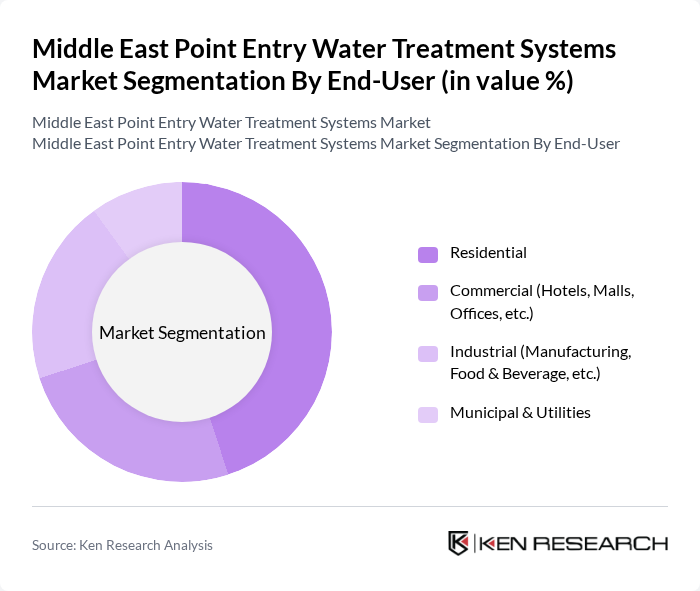
The end-user segmentation includesResidential, Commercial, Industrial, and Municipal & Utilities. TheResidentialsegment is the largest, driven by rising consumer awareness of waterborne health risks, the proliferation of home water purification systems, and increased government focus on safe drinking water at the household level. The trend toward decentralized water treatment, combined with growing urban populations and higher disposable incomes, is further fueling demand for advanced water treatment solutions in residential settings.
Middle East Point Entry Water Treatment Systems Market Competitive Landscape
The Middle East Point Entry Water Treatment Systems Market is characterized by a dynamic mix of regional and international players. Leading participants such as Veolia Water Technologies, SUEZ Water Technologies & Solutions, Xylem Inc., Pentair PLC, Ecolab Inc., Danaher Corporation (Pall Water, Trojan Technologies), IDE Technologies, Aquatech International LLC, A. O. Smith Corporation, Toray Industries, Inc., Alfa Laval AB, Siemens AG, Metito Holdings Ltd., H2O Innovation Inc., Kurita Water Industries Ltd. contribute to innovation, geographic expansion, and service delivery in this space.
Middle East Point Entry Water Treatment Systems Market Industry Analysis
Growth Drivers
- Increasing Water Scarcity:The Middle East faces severe water scarcity, with the World Bank reporting that over 60% of the region's population lives in water-stressed areas. By the future, the demand for water is projected to exceed supply by 40 billion cubic meters annually. This dire situation drives the need for efficient water treatment systems, as countries like Saudi Arabia and the UAE invest heavily in technologies to address this critical issue, ensuring sustainable water access for their populations.
- Rising Demand for Clean Water:The demand for clean water in the Middle East is escalating, with the population expected to reach over 500 million in future. According to the WHO, approximately 77 million people in the region lack access to safe drinking water. This growing population, coupled with increasing urbanization, necessitates advanced water treatment solutions to meet health standards and improve quality of life, prompting investments in point entry water treatment systems.
- Government Initiatives for Water Treatment:Governments across the Middle East are implementing robust initiatives to enhance water treatment infrastructure. For instance, the UAE's Water Security Strategy aims to increase water reuse to 95% in future. Additionally, Saudi Arabia's National Water Strategy allocates $133 billion for water projects in future. These initiatives create a favorable environment for the adoption of point entry water treatment systems, driving market growth significantly.
Market Challenges
- High Initial Investment Costs:The high initial investment required for point entry water treatment systems poses a significant challenge. For instance, the cost of advanced filtration systems can range from $50,000 to $200,000, depending on capacity and technology. Many municipalities and private entities struggle to secure funding, which can hinder the deployment of necessary water treatment solutions, especially in economically constrained regions of the Middle East.
- Regulatory Compliance Issues:Navigating the complex regulatory landscape in the Middle East can be challenging for water treatment providers. Each country has its own set of regulations, often requiring extensive documentation and compliance checks. For example, the UAE mandates that all water treatment facilities adhere to stringent environmental standards, which can delay project timelines and increase costs, ultimately impacting market growth and innovation.
Middle East Point Entry Water Treatment Systems Market Future Outlook
The future of the Middle East point entry water treatment systems market appears promising, driven by technological advancements and increasing government support. As urban populations grow, the demand for efficient and sustainable water solutions will intensify. Innovations such as smart water management systems and decentralized treatment solutions are expected to gain traction, enhancing operational efficiency. Furthermore, partnerships between private companies and governments will likely foster investment in infrastructure, ensuring that water treatment systems evolve to meet future challenges effectively.
Market Opportunities
- Expansion of Urban Infrastructure:Rapid urbanization in the Middle East presents significant opportunities for point entry water treatment systems. With cities like Riyadh and Dubai expanding, the demand for integrated water solutions is increasing. Investments in urban infrastructure are projected to exceed $100 billion in future, creating a favorable environment for innovative water treatment technologies to thrive.
- Development of Smart Water Solutions:The integration of IoT and AI in water management systems offers substantial market opportunities. In future, the smart water market in the Middle East is expected to grow to $1.5 billion, driven by the need for real-time monitoring and efficient resource management. This trend will encourage the adoption of advanced point entry water treatment systems, enhancing overall water quality and sustainability.
Scope of the Report
| Segment | Sub-Segments |
|---|---|
| By Type | Reverse Osmosis (RO) Systems Ultraviolet (UV) Disinfection Systems Media Filtration Systems (Sand, Carbon, etc.) Water Softeners Chemical Dosing & Disinfection Systems Hybrid & Integrated Systems |
| By End-User | Residential Commercial (Hotels, Malls, Offices, etc.) Industrial (Manufacturing, Food & Beverage, etc.) Municipal & Utilities |
| By Application | Drinking Water Treatment Wastewater Reuse & Recycling Process Water Treatment Irrigation & Agriculture |
| By Distribution Channel | Direct Sales (B2B, Projects) Online Sales Retail/Dealer Sales System Integrators & EPC Contractors |
| By Region | GCC Countries (Saudi Arabia, UAE, Qatar, etc.) Levant (Jordan, Lebanon, etc.) North Africa (Egypt, Morocco, etc.) Rest of Middle East |
| By Price Range | Entry-Level Systems Mid-Range Systems Premium/Advanced Systems |
| By Technology | Conventional Treatment Technologies Advanced Membrane Technologies Hybrid & Smart Systems Others (Emerging Technologies) |
Key Target Audience
Investors and Venture Capitalist Firms
Government and Regulatory Bodies (e.g., Ministry of Water Resources, Environmental Protection Agency)
Manufacturers and Producers
Distributors and Retailers
Water Utility Companies
Technology Providers
Industry Associations (e.g., Middle East Water Association)
Financial Institutions
Players Mentioned in the Report:
Veolia Water Technologies
SUEZ Water Technologies & Solutions
Xylem Inc.
Pentair PLC
Ecolab Inc.
Danaher Corporation (Pall Water, Trojan Technologies)
IDE Technologies
Aquatech International LLC
A. O. Smith Corporation
Toray Industries, Inc.
Alfa Laval AB
Siemens AG
Metito Holdings Ltd.
H2O Innovation Inc.
Kurita Water Industries Ltd.
Table of Contents
Market Assessment Phase
1. Executive Summary and Approach
2. Middle East Point Entry Water Treatment Systems Market Overview
2.1 Key Insights and Strategic Recommendations
2.2 Middle East Point Entry Water Treatment Systems Market Overview
2.3 Definition and Scope
2.4 Evolution of Market Ecosystem
2.5 Timeline of Key Regulatory Milestones
2.6 Value Chain & Stakeholder Mapping
2.7 Business Cycle Analysis
2.8 Policy & Incentive Landscape
3. Middle East Point Entry Water Treatment Systems Market Analysis
3.1 Growth Drivers
3.1.1 Increasing Water Scarcity
3.1.2 Rising Demand for Clean Water
3.1.3 Government Initiatives for Water Treatment
3.1.4 Technological Advancements in Water Treatment
3.2 Market Challenges
3.2.1 High Initial Investment Costs
3.2.2 Regulatory Compliance Issues
3.2.3 Limited Awareness Among Consumers
3.2.4 Competition from Alternative Solutions
3.3 Market Opportunities
3.3.1 Expansion of Urban Infrastructure
3.3.2 Increasing Investment in Renewable Energy
3.3.3 Partnerships with Local Governments
3.3.4 Development of Smart Water Solutions
3.4 Market Trends
3.4.1 Adoption of IoT in Water Treatment
3.4.2 Shift Towards Sustainable Practices
3.4.3 Growth of Decentralized Water Treatment Systems
3.4.4 Integration of AI in Water Management
3.5 Government Regulation
3.5.1 Water Quality Standards
3.5.2 Environmental Protection Regulations
3.5.3 Subsidies for Water Treatment Technologies
3.5.4 Licensing Requirements for Water Treatment Facilities
4. SWOT Analysis
5. Stakeholder Analysis
6. Porter's Five Forces Analysis
7. Middle East Point Entry Water Treatment Systems Market Market Size, 2019-2024
7.1 By Value
7.2 By Volume
7.3 By Average Selling Price
8. Middle East Point Entry Water Treatment Systems Market Segmentation
8.1 By Type
8.1.1 Reverse Osmosis (RO) Systems
8.1.2 Ultraviolet (UV) Disinfection Systems
8.1.3 Media Filtration Systems (Sand, Carbon, etc.)
8.1.4 Water Softeners
8.1.5 Chemical Dosing & Disinfection Systems
8.1.6 Hybrid & Integrated Systems
8.2 By End-User
8.2.1 Residential
8.2.2 Commercial (Hotels, Malls, Offices, etc.)
8.2.3 Industrial (Manufacturing, Food & Beverage, etc.)
8.2.4 Municipal & Utilities
8.3 By Application
8.3.1 Drinking Water Treatment
8.3.2 Wastewater Reuse & Recycling
8.3.3 Process Water Treatment
8.3.4 Irrigation & Agriculture
8.4 By Distribution Channel
8.4.1 Direct Sales (B2B, Projects)
8.4.2 Online Sales
8.4.3 Retail/Dealer Sales
8.4.4 System Integrators & EPC Contractors
8.5 By Region
8.5.1 GCC Countries (Saudi Arabia, UAE, Qatar, etc.)
8.5.2 Levant (Jordan, Lebanon, etc.)
8.5.3 North Africa (Egypt, Morocco, etc.)
8.5.4 Rest of Middle East
8.6 By Price Range
8.6.1 Entry-Level Systems
8.6.2 Mid-Range Systems
8.6.3 Premium/Advanced Systems
8.7 By Technology
8.7.1 Conventional Treatment Technologies
8.7.2 Advanced Membrane Technologies
8.7.3 Hybrid & Smart Systems
8.7.4 Others (Emerging Technologies)
9. Middle East Point Entry Water Treatment Systems Market Competitive Analysis
9.1 Market Share of Key Players
9.2 Cross Comparison of Key Players
9.2.1 Company Name
9.2.2 Market Share in Middle East POE Segment
9.2.3 Revenue from Middle East Water Treatment Operations
9.2.4 Installed Base (Number of POE Systems Deployed)
9.2.5 CAGR of Regional Revenue (Last 3-5 Years)
9.2.6 Customer Segmentation (Residential, Commercial, Industrial)
9.2.7 Product Portfolio Breadth (Number of POE Solutions)
9.2.8 Local Manufacturing/Assembly Presence
9.2.9 Distribution & Service Network Coverage
9.2.10 R&D/Innovation Investment (as % of Revenue)
9.3 SWOT Analysis of Top Players
9.4 Pricing Analysis
9.5 Detailed Profile of Major Companies
9.5.1 Veolia Water Technologies
9.5.2 SUEZ Water Technologies & Solutions
9.5.3 Xylem Inc.
9.5.4 Pentair PLC
9.5.5 Ecolab Inc.
9.5.6 Danaher Corporation (Pall Water, Trojan Technologies)
9.5.7 IDE Technologies
9.5.8 Aquatech International LLC
9.5.9 A. O. Smith Corporation
9.5.10 Toray Industries, Inc.
9.5.11 Alfa Laval AB
9.5.12 Siemens AG
9.5.13 Metito Holdings Ltd.
9.5.14 H2O Innovation Inc.
9.5.15 Kurita Water Industries Ltd.
10. Middle East Point Entry Water Treatment Systems Market End-User Analysis
10.1 Procurement Behavior of Key Ministries
10.1.1 Government Procurement Policies
10.1.2 Budget Allocations for Water Treatment
10.1.3 Decision-Making Processes
10.2 Corporate Spend on Infrastructure & Energy
10.2.1 Investment Trends in Water Infrastructure
10.2.2 Corporate Social Responsibility Initiatives
10.2.3 Energy Efficiency Investments
10.3 Pain Point Analysis by End-User Category
10.3.1 Residential User Concerns
10.3.2 Commercial User Challenges
10.3.3 Industrial User Requirements
10.4 User Readiness for Adoption
10.4.1 Awareness Levels
10.4.2 Training and Support Needs
10.4.3 Financial Readiness
10.5 Post-Deployment ROI and Use Case Expansion
10.5.1 Measurement of ROI
10.5.2 Case Studies of Successful Implementations
10.5.3 Future Expansion Opportunities
11. Middle East Point Entry Water Treatment Systems Market Future Size, 2025-2030
11.1 By Value
11.2 By Volume
11.3 By Average Selling Price
Go-To-Market Strategy Phase
1. Whitespace Analysis + Business Model Canvas
1.1 Market Gaps Identification
1.2 Business Model Development
2. Marketing and Positioning Recommendations
2.1 Branding Strategies
2.2 Product USPs
3. Distribution Plan
3.1 Urban Retail vs Rural NGO Tie-Ups
4. Channel & Pricing Gaps
4.1 Underserved Routes
4.2 Pricing Bands
5. Unmet Demand & Latent Needs
5.1 Category Gaps
5.2 Consumer Segments
6. Customer Relationship
6.1 Loyalty Programs
6.2 After-Sales Service
7. Value Proposition
7.1 Sustainability
7.2 Integrated Supply Chains
8. Key Activities
8.1 Regulatory Compliance
8.2 Branding
8.3 Distribution Setup
9. Entry Strategy Evaluation
9.1 Domestic Market Entry Strategy
9.1.1 Product Mix
9.1.2 Pricing Band
9.1.3 Packaging
9.2 Export Entry Strategy
9.2.1 Target Countries
9.2.2 Compliance Roadmap
10. Entry Mode Assessment
10.1 JV
10.2 Greenfield
10.3 M&A
10.4 Distributor Model
11. Capital and Timeline Estimation
11.1 Capital Requirements
11.2 Timelines
12. Control vs Risk Trade-Off
12.1 Ownership vs Partnerships
13. Profitability Outlook
13.1 Breakeven Analysis
13.2 Long-Term Sustainability
14. Potential Partner List
14.1 Distributors
14.2 JVs
14.3 Acquisition Targets
15. Execution Roadmap
15.1 Phased Plan for Market Entry
15.1.1 Market Setup
15.1.2 Market Entry
15.1.3 Growth Acceleration
15.1.4 Scale & Stabilize
15.2 Key Activities and Milestones
15.2.1 Milestone Planning
15.2.2 Activity Tracking
Research Methodology
Phase 1: Approach1
Desk Research
- Analysis of market reports from regional water treatment associations and industry publications
- Review of government regulations and policies related to water treatment in the Middle East
- Examination of trade statistics and import/export data from customs authorities
Primary Research
- Interviews with key stakeholders in water treatment companies, including CEOs and technical directors
- Surveys with municipal water authorities and environmental agencies
- Field visits to operational water treatment facilities for firsthand insights
Validation & Triangulation
- Cross-validation of findings through multiple data sources, including industry reports and expert opinions
- Triangulation of market trends with historical data and future projections
- Sanity checks conducted through expert panel discussions and feedback sessions
Phase 2: Market Size Estimation1
Top-down Assessment
- Estimation of total addressable market based on national water consumption statistics
- Segmentation of the market by technology type (e.g., reverse osmosis, UV treatment)
- Incorporation of regional growth factors such as population growth and urbanization rates
Bottom-up Modeling
- Collection of data on installed capacities and operational efficiencies from leading water treatment plants
- Cost analysis based on equipment procurement and maintenance expenses
- Volume estimates derived from water treatment contracts and service agreements
Forecasting & Scenario Analysis
- Multi-variable forecasting using factors such as climate change impacts and regulatory changes
- Scenario modeling based on varying levels of investment in water infrastructure
- Development of baseline, optimistic, and pessimistic market growth scenarios through 2030
Phase 3: CATI Sample Composition1
| Scope Item/Segment | Sample Size | Target Respondent Profiles |
|---|---|---|
| Municipal Water Treatment Facilities | 100 | Water Treatment Managers, Environmental Engineers |
| Industrial Water Treatment Solutions | 80 | Operations Directors, Process Engineers |
| Residential Water Purification Systems | 60 | Product Managers, Sales Executives |
| Desalination Projects | 50 | Project Managers, Technical Consultants |
| Water Quality Monitoring Services | 70 | Quality Assurance Managers, Regulatory Compliance Officers |
Frequently Asked Questions
What is the current value of the Middle East Point Entry Water Treatment Systems Market?
The Middle East Point Entry Water Treatment Systems Market is valued at approximately USD 2.1 billion, driven by factors such as water scarcity, urbanization, and the need for sustainable water management solutions.
What are the main drivers of growth in the Middle East water treatment market?
Which countries dominate the Middle East Point Entry Water Treatment Systems Market?
What regulations have been introduced in the UAE regarding water treatment systems?
Other Regional/Country Reports
Indonesia Point Entry Water Treatment Systems Market
Malaysia Point Entry Water Treatment Systems Market
APAC Point Entry Water Treatment Systems Market
SEA Point Entry Water Treatment Systems Market
Other Adjacent Reports
South Africa Desalination Systems Market
Belgium Wastewater Treatment Market
Qatar Water Filtration Systems Market
Philippines Reverse Osmosis Technology Market
Belgium UV Disinfection Systems Market
Qatar Water Softening Equipment Market
South Korea Smart Water Management Market
Kuwait Industrial Water Purification Market
South Korea Municipal Water Infrastructure Market
KSA Water Recycling Solutions Market
Why Buy From Us?

What makes us stand out is that our consultants follow Robust, Refine and Result (RRR) methodology. Robust for clear definitions, approaches and sanity checking, Refine for differentiating respondents' facts and opinions, and Result for presenting data with story.

We have set a benchmark in the industry by offering our clients with syndicated and customized market research reports featuring coverage of entire market as well as meticulous research and analyst insights.

While we don't replace traditional research, we flip the method upside down. Our dual approach of Top Bottom & Bottom Top ensures quality deliverable by not just verifying company fundamentals but also looking at the sector and macroeconomic factors.

With one step in the future, our research team constantly tries to show you the bigger picture. We help with some of the tough questions you may encounter along the way: How is the industry positioned? Best marketing channel? KPI's of competitors? By aligning every element, we help maximize success.

Our report gives you instant access to the answers and sources that other companies might choose to hide. We elaborate each steps of research methodology we have used and showcase you the sample size to earn your trust.

If you need any support, we are here! We pride ourselves on universe strength, data quality, and quick, friendly, and professional service.